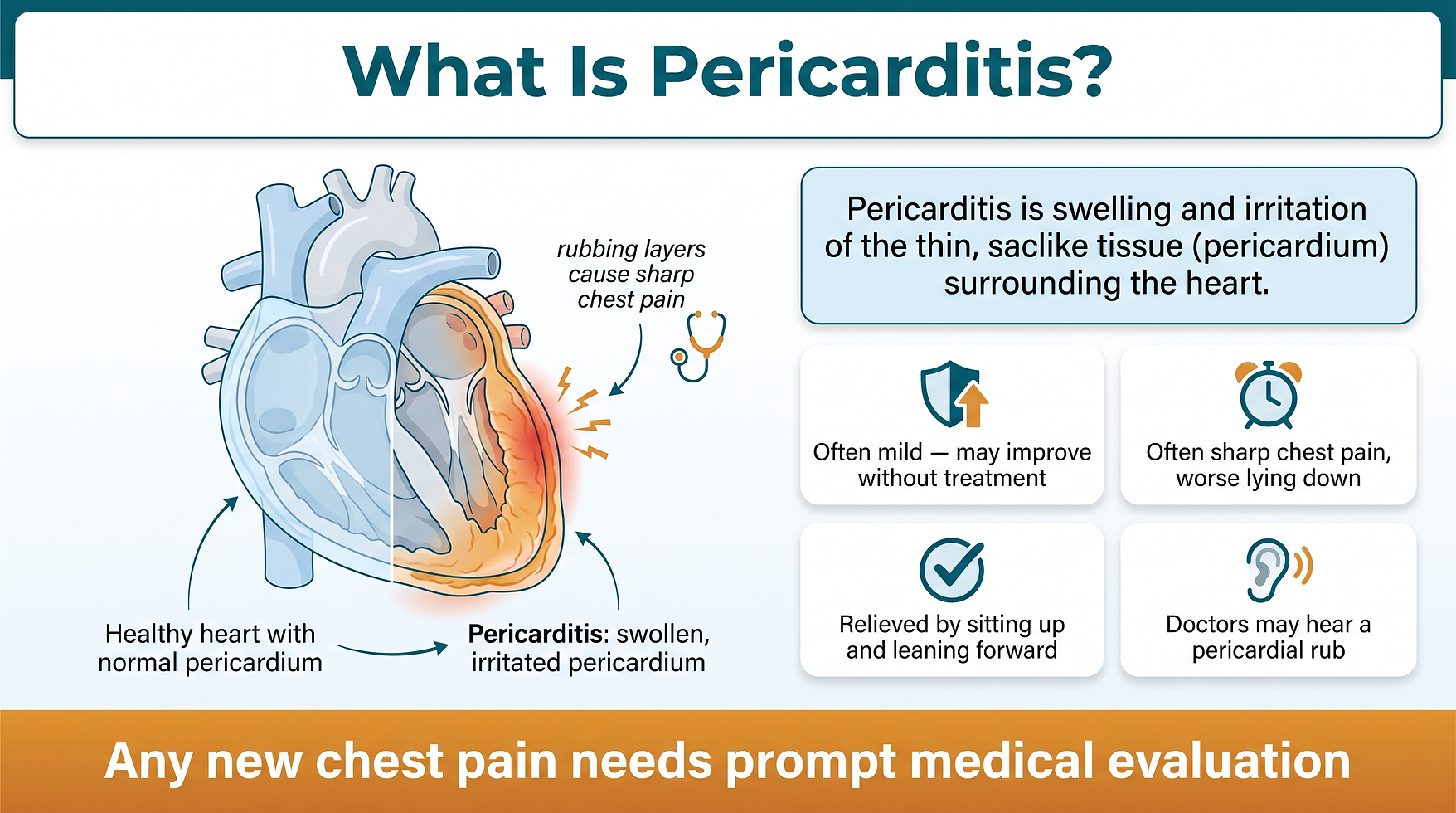
Pericarditis: Symptoms, Causes & Treatment — Why Sharp Chest Pain Needs a Prompt Check

Updated: 2 days ago
Medically reviewed by Dr. Baraa Alnahhal, MD · Last reviewed: September 2026
TL;DR
Pericarditis is swelling and irritation of the pericardium — the thin, saclike tissue that surrounds the heart. When the irritated layers of the pericardium rub against each other, they typically produce sharp, stabbing chest pain that most often sits behind the breastbone or on the left side, worsens with coughing, lying down, or deep breathing, and eases when sitting up or leaning forward. In most cases pericarditis is mild, may go away without treatment, and needs only pain relievers or an anti-inflammatory medicine such as colchicine; very serious cases involve fluid around the heart or a stiffened pericardium and can require a drainage procedure or, rarely, surgery. Because any new chest pain can resemble a heart attack, it should always be checked by a healthcare professional right away.
Quick Answer: What Is Pericarditis?
Pericarditis is swelling and irritation of the pericardium, the thin, saclike tissue surrounding the heart.
The most common symptom is sharp, stabbing chest pain, most often felt behind the breastbone or on the left side of the chest.
The pain typically worsens when coughing, lying down, or taking a deep breath, and improves when sitting up or leaning forward.
Pericarditis is often mild and may go away without treatment; more-serious cases are treated with medicines and, very rarely, surgery.
The cause is often unknown (idiopathic pericarditis), but viral infections, immune responses after a heart attack or heart surgery, injuries, autoimmune disease, and some medicines can trigger it.
Rare complications include fluid around the heart (pericardial effusion), a stiffened scarred lining (constrictive pericarditis), and cardiac tamponade — a life-threatening emergency requiring immediate treatment.
Any new chest pain should be evaluated right away, because pericarditis pain can be hard to distinguish from a heart attack.
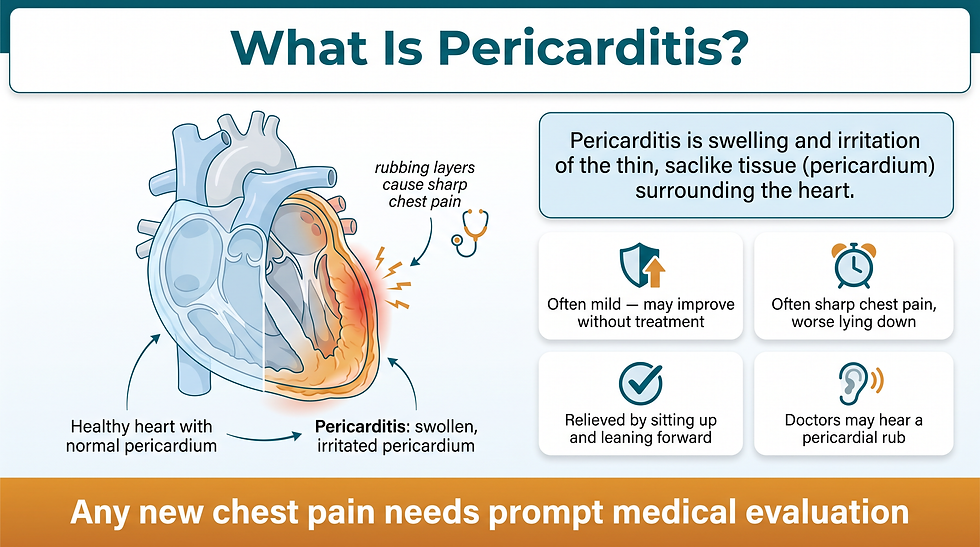
Figure 1: Pericarditis in one view — how the inflamed sac around the heart creates position-based chest pain, and how care typically proceeds.
What Is Pericarditis?
Pericarditis (per-ih-KAR-die-tis) is swelling and irritation of the thin, saclike tissue that surrounds the heart. That tissue is called the pericardium. In most cases of pericarditis, there is extra fluid in the pericardium too.
The pericardium has two layers that wrap around the heart like a snug, lubricated sac. When the pericardium becomes irritated, these two layers swell and rub against each other — and that rubbing is what causes the characteristic sharp chest pain.
Pericardium: the thin, saclike membrane that surrounds and protects the heart, made of two lubricated layers that normally glide smoothly over each other as the heart beats.
Most of the time, pericarditis is mild. It may go away without treatment. When treatment is needed for more-serious symptoms, it can include medicines and, very rarely, surgery.
One point deserves emphasis up front: the chest pain of acute pericarditis can be hard to tell apart from the pain of a heart attack. Because of that overlap, any new chest pain should always be checked by a healthcare professional. Finding and treating pericarditis early may also help lower the risk of long-term complications.
What Are the Symptoms of Pericarditis?
Chest pain is the most common symptom of pericarditis. It usually feels sharp or stabbing, although some people experience dull, achy, or pressure-like pain instead. The pain most often sits behind the breastbone or on the left side of the chest, and its behavior is a strong clue to the diagnosis.
Pain behavior | What it typically does |
|---|---|
Location | Behind the breastbone or on the left side of the chest |
Radiation | May spread to the left shoulder and neck, or to both shoulders |
Worse with | Coughing, lying down, or taking a deep breath |
Better with | Sitting up or leaning forward |
Besides chest pain, pericarditis can also cause a range of other symptoms:
Symptom | Description |
|---|---|
Cough | A dry, persistent cough |
Fatigue | Weakness, tiredness, or a general sick feeling |
Fever | Usually low-grade |
Palpitations | A pounding or racing heartbeat |
Leg and foot swelling | Fluid retention in the lower extremities |
Belly swelling | Swelling of the abdomen |
Shortness of breath | Particularly when lying down |
When to See a Doctor
The guidance is simple and non-negotiable: get medical care right away if you have new chest pain.
Many pericarditis symptoms resemble those of other heart and lung conditions — including a heart attack. Any chest pain should be thoroughly checked by a healthcare professional. Never assume chest pain is "just" pericarditis, and never assume it will pass on its own.
How Pericarditis Is Categorized by Duration
Pericarditis episodes are grouped by how they behave over time. The categories matter because treatment choices and recurrence risk differ.
Type | Duration | Behavior |
|---|---|---|
Acute pericarditis | Up to 4 weeks | Begins suddenly; can occur in future episodes; pain is hard to tell apart from a heart attack |
Recurrent pericarditis | About 4–6 weeks after an acute episode | No symptoms in between episodes |
Incessant pericarditis | About 4–6 weeks, but less than 3 months | Symptoms continue the whole time |
Chronic constrictive pericarditis | More than 3 months | Develops slowly |
What Causes Pericarditis?
In many cases, the cause of pericarditis is hard to determine — and sometimes no cause is found at all. When no cause is identified, the condition is called idiopathic pericarditis.
When a cause can be found, it usually falls into one of these categories:
Cause category | Details |
|---|---|
Immune response after heart damage | After a heart attack or heart surgery, the immune system can react by inflaming the pericardium — known as Dressler syndrome, post-myocardial infarction syndrome, or post-cardiac injury syndrome |
Infections | Most commonly viruses |
Injury | Injury to the heart or chest |
Autoimmune disease | Conditions such as lupus or rheumatoid arthritis |
Other long-term conditions | Including kidney failure and cancer |
Some medicines | Including phenytoin (a seizure treatment, sold as Dilantin) and procainamide (a medicine for irregular heartbeat) |

Figure 2: How viruses, immune responses, injuries, and other conditions trigger pericardial inflammation.
Who Is Most at Risk?
Pericarditis can affect anyone, including otherwise healthy adults. Risk is tied mostly to exposure to the triggers above rather than to age or lifestyle. People with a recent viral illness, a recent heart attack or heart surgery, an autoimmune condition, kidney failure, or cancer have elevated risk — and people taking phenytoin or procainamide should know that these medicines can occasionally trigger pericarditis.
What Complications Can Pericarditis Cause?
Most pericarditis resolves without lasting problems, but untreated or severe inflammation can damage the pericardium in three serious ways:
Complication | What happens | Seriousness |
|---|---|---|
Pericardial effusion | Excess fluid builds up around the heart; can lead to further heart complications | Needs medical attention |
Cardiac tamponade | Fluid pressure presses on the heart so it cannot fill properly; less blood leaves the heart and blood pressure drops sharply | Life-threatening — requires emergency treatment |
Constrictive pericarditis | The pericardium thickens and scars, becoming rigid and permanent; the heart cannot fill and empty properly, causing severe swelling of the legs and abdomen and shortness of breath | Long-term complication requiring specialist care |
The honest picture: complications are rare, but cardiac tamponade in particular moves fast. That is another reason new chest pain should never be self-managed at home.
Can Pericarditis Be Prevented?
There is no specific way to prevent pericarditis itself. However, many cases follow viral infections, so reducing the chance of those infections may lower risk:
Prevention step | Why it helps |
|---|---|
Stay away from people with viral or flu-like illness until they recover | Limits exposure to viruses that can trigger heart inflammation |
Cover your mouth when sneezing or coughing if you are sick | Reduces spreading viruses to others |
Wash hands regularly with soap and water for at least 20 seconds | Good hygiene lowers infection risk |
Get recommended vaccines (examples: COVID-19, rubella, influenza) | Viral diseases such as these can cause heart inflammation |
One nuance worth knowing: rarely, the COVID-19 vaccine can cause pericarditis and myocarditis (inflammation of the heart muscle) — especially in males ages 12 to 17. The benefits and risks of vaccination are worth discussing with a healthcare professional.
How Is Pericarditis Diagnosed?
Diagnosis begins with an exam and a medical history review. A key clue is heard with a stethoscope: pericarditis produces a specific sound called a pericardial rub — the sound of the two pericardial layers rubbing against each other.
Test | What it involves | What it shows |
|---|---|---|
Pericardial rub (stethoscope exam) | Listening to the heart | The characteristic rubbing sound of irritated pericardial layers |
Blood tests | A blood sample tested in a lab | Signs of a heart attack, inflammation, or infection |
Electrocardiogram (ECG) | A quick, painless test that records the heart's electrical signals | How the heart is beating; characteristic electrical changes of pericarditis |
Chest X-ray | An imaging scan of the chest | Whether the heart is enlarged or changed in size or shape |
Echocardiogram | Sound waves create images of the moving heart | How well the heart pumps; whether fluid has built up around the heart; whether the sac is affecting how the heart fills and pumps |
Cardiac CT scan | X-rays create detailed images of the heart and chest | Heart thickening, a sign of constrictive pericarditis |
Cardiac MRI | Magnetic fields and radio waves create detailed images | Thickening, inflammation, or other changes in the pericardium |
How Is Pericarditis Treated?
Treatment depends on the cause and the severity of the pericarditis. Mild pericarditis may get better without treatment.
Medications
Medicine type | When it is used | Notes |
|---|---|---|
Pain relievers | First-line for most cases | Often over-the-counter aspirin or ibuprofen (Advil, Motrin IB, and others); always talk with a healthcare professional before taking OTC medicine and take as directed; sometimes prescription-strength pain relievers are used |
Colchicine (Colcrys, Mitigare) | Sudden pericarditis, or symptoms that keep coming back | Lowers inflammation; do not take if you have liver or kidney disease; can interact with other medicines, so health history is checked first |
Corticosteroids (e.g., prednisone) | When symptoms do not improve with other medicines, or keep returning | A strong anti-inflammatory medicine |
Immunosuppressants | When rheumatoid arthritis causes the pericarditis | Turn down the immune system to lower inflammation |
Immunomodulators | When inflammation keeps recurring | Change immune system activity to control inflammation; example: an interleukin-1 blocker |
Antibiotics | When a bacterial infection caused the pericarditis | Target the underlying infection |
Drainage and Surgery
If fluid around the heart is causing problems, procedures can remove it:
Procedure | What it involves | When it is used |
|---|---|---|
Pericardiocentesis | A sterile needle or a small tube (catheter) removes and drains excess fluid from the pericardium | Pericardial effusion putting pressure on the heart |
Pericardiectomy | Surgical removal of part or all of the pericardium | When the sac stays rigid because of constrictive pericarditis |

Figure 3: The pericarditis pathway — from new chest pain through rub, ECG, and echo testing to medicines, drainage, and recovery.
What Can People Do at Home?
For mild pericarditis, rest and over-the-counter pain medicines (if recommended by a healthcare professional and taken as directed) are the foundation of home care.
Self-care step | Why it helps |
|---|---|
Rest while recovering | Gives the inflamed pericardium time to heal |
Take recommended pain medicines as directed | Controls pain and inflammation |
Avoid strenuous physical activity and competitive sports while recovering | Strenuous effort can trigger symptoms |
The activity restriction deserves emphasis: talk with a healthcare professional about how long rest is needed before returning to exercise or sports.
Clinical Trials
Clinical trials are research studies that test new treatments, interventions, and tests. People with recurrent or difficult pericarditis can ask their healthcare professional whether a clinical trial might be an option.
Preparing for a Pericarditis Appointment
Care typically starts with a primary care professional or an emergency room doctor, who may refer the patient to a cardiologist — a doctor trained in heart diseases. Coming prepared makes the visit more productive.
Before the appointment: ask whether any preparation is needed, such as food or drink restrictions before tests; write down symptoms and how long they have lasted; list key personal medical information and other recent health concerns; bring a list of every medicine, vitamin, and supplement with dosages; consider bringing a family member or friend; and write down questions.
Questions worth asking:
Question | Why ask it |
|---|---|
What is the most likely cause of these symptoms? | Viral, idiopathic, post-surgery, and drug-triggered pericarditis are managed differently |
What tests will be done? | ECG, echo, X-ray, blood work — knowing the plan reduces anxiety |
Will I need to stay in the hospital? | Fluid-related complications can require admission |
What treatment approach do you recommend? | Sets expectations for medicines or procedures |
How soon should my symptoms improve? | Guides when to call back if they do not |
What are the possible side effects of these medicines? | Colchicine, steroids, and immunosuppressants each carry specific risks |
Is there a risk of long-term complications? | Pericardial effusion, constrictive pericarditis, and tamponade |
How often will I need follow-up visits? | Recurrence is a real possibility |
Are there any restrictions on my activity or diet? | Strenuous activity must wait until recovery is confirmed |
How do I manage my other health conditions together with this? | Kidney disease, autoimmune disease, and drug interactions matter |
The healthcare professional is likely to ask: describe the symptoms, where they are, and how severe they are; when they started; whether they came on gradually or suddenly; whether similar symptoms occurred in the past; whether breathing is difficult; whether body position changes the pain; any recent cold or flu symptoms or fever; any unexplained weight loss; family history of heart disease; and whether you smoke.
Conclusion
Pericarditis is usually a mild condition — and sometimes it clears without treatment at all. But its defining symptom, sharp chest pain, overlaps with heart attacks and other serious heart and lung conditions, which is why new chest pain should always be checked right away rather than watched and waited.
If you develop chest pain that worsens when lying down and eases when leaning forward, schedule prompt medical care. Expect a stethoscope exam, an ECG, blood tests, and imaging to check for fluid around the heart. If treatment is needed, it is often as simple as rest and pain relievers — sometimes with colchicine to keep the inflammation from returning. Avoid strenuous activity while recovering, follow up on any recurrence, and ask about the rare but serious complications if symptoms ever worsen. With early care, most people recover fully from pericarditis.
Frequently Asked Questions
What is pericarditis?
Pericarditis is swelling and irritation of the pericardium — the thin, saclike tissue surrounding the heart. When the irritated layers rub against each other, it typically causes sharp chest pain. It is often mild and may go away without treatment.
What does pericarditis chest pain feel like?
Pericarditis pain is usually sharp or stabbing and most often felt behind the breastbone or on the left side of the chest. It may spread to the left shoulder and neck or both shoulders. It typically worsens when coughing, lying down, or taking a deep breath, and improves when sitting up or leaning forward.
How is pericarditis different from a heart attack?
The chest pain of acute pericarditis can be hard to tell apart from heart attack pain — which is exactly why any new chest pain should be thoroughly checked by a healthcare professional. Pericarditis pain characteristically changes with body position and breathing, but only a medical evaluation can tell them apart reliably.
What causes pericarditis?
In many cases no cause is found (idiopathic pericarditis). Known triggers include viral infections, the immune response after a heart attack or heart surgery (Dressler syndrome), chest or heart injury, autoimmune diseases such as lupus or rheumatoid arthritis, long-term conditions like kidney failure and cancer, and some medicines such as phenytoin and procainamide.
Can pericarditis go away on its own?
Yes. Pericarditis is often mild and may go away without treatment. Mild cases are managed with rest and over-the-counter pain relievers if recommended. When treatment is needed for more-serious symptoms, it can include medicines and, very rarely, surgery.
What is colchicine and why is it used for pericarditis?
Colchicine (Colcrys, Mitigare) lowers inflammation and is used for sudden pericarditis or symptoms that keep coming back. It should not be taken by people with liver or kidney disease, and it can interact with other medicines, so a healthcare professional checks health history before prescribing it.
Is pericarditis dangerous?
Usually not — but untreated pericarditis can cause fluid buildup around the heart, which in rare cases leads to cardiac tamponade, a life-threatening condition in which pressure on the heart causes blood pressure to drop sharply and requires emergency treatment. Another long-term complication, constrictive pericarditis, permanently stiffens the pericardium and impairs how the heart fills and empties.
Can pericarditis come back?
Yes. Future episodes can occur. When symptoms return about 4 to 6 weeks after an acute episode, it is called recurrent pericarditis; when symptoms continue for 4 to 6 weeks up to 3 months, it is called incessant pericarditis. Colchicine and, in stubborn cases, corticosteroids or immune-modulating medicines help control recurrences.
Can I exercise with pericarditis?
During recovery, strenuous physical activity and competitive sports should be avoided because they can trigger symptoms. Ask a healthcare professional how long rest is needed before resuming exercise.
How is pericarditis prevented?
There is no specific way to prevent pericarditis. Because viral infections are a common trigger, good hygiene — hand-washing for at least 20 seconds, covering coughs and sneezes, staying away from sick people — and recommended vaccines may help lower risk.
External References
Pericarditis — Symptoms & Causes. Clinical reference page, last reviewed April 9, 2024. https://www.mayoclinic.org/diseases-conditions/pericarditis/symptoms-causes/syc-20352510
Pericarditis — Diagnosis & Treatment. Clinical reference page, last reviewed April 9, 2024. https://www.mayoclinic.org/diseases-conditions/pericarditis/diagnosis-treatment/drc-20352514
This article is for general informational purposes and is not a substitute for professional medical advice, diagnosis, or treatment. Always consult a qualified healthcare professional about any medical condition.
Comments