Penile Implant: Types, Surgery, Recovery and Results

Updated: 2 days ago
Written and medically reviewed by Dr. Baraa Alnahhal, MD · Last reviewed: November 2026 · How we review
Quick Answer
A penile implant (penile prosthesis) is a device placed by surgery that lets you get an erection. It's usually used for erectile dysfunction that hasn't improved with other treatments. The two types are inflatable implants and non-inflatable rods. Over 90% of people are happy with the results, and implants last about 20 years on average.
What the research says
Most men were satisfied: a meta-analysis of 83 studies with 12,132 men followed for about 4 years found 83% were satisfied with their penile implant, with higher satisfaction for three-piece inflatable devices and long-term complications of 3% to 4.6% (Corona G et al., Andrology, 2025) [2]
Coated implants cut infections: pooling 14 studies with 9,910 first-time implants, infections occurred in 0.89% with antibiotic- or water-coated inflatable implants versus 2.32% with uncoated devices (Mandava SH et al., Journal of Urology, 2012) [3]
Key takeaways
A penile implant lets you get an erection on demand.
It's used for ED that hasn't improved with other treatments.
Types are inflatable and non-inflatable.
Most people go home the same day after surgery.
Over 90% of people are happy with the results.
What is a penile implant?
A penile implant is placed inside the penis to make it firm enough for sex. Over 63,000 implants were performed worldwide from 2005 to 2012, about 86% in the United States. Sensation, orgasm and ejaculation don't change. Sources: [1]
Who it's for

An implant is usually considered after other treatments.
Erectile dysfunction that hasn't improved with medicines or a vacuum constriction device.
Peyronie's disease that meets the same criteria.
After penile construction, such as phalloplasty or metoidioplasty. Sources: [1]
Types of penile implants
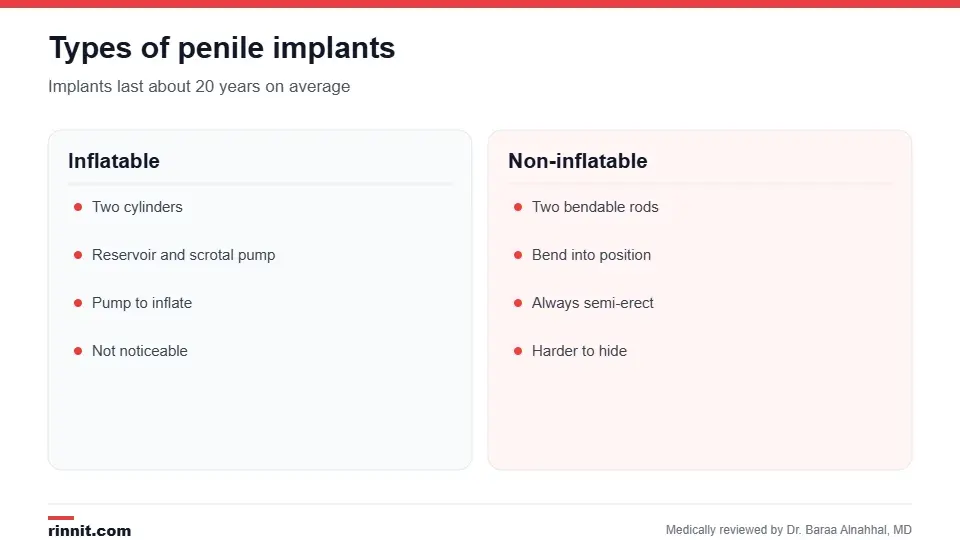
Inflatable implants aren't noticeable when deflated.
;; Inflatable | Non-inflatable | |
Parts | Two cylinders, a fluid reservoir and a pump in the scrotum | Two bendable silicone rods |
How it works | Press the pump to inflate; release a valve to deflate | Bend the penis into position |
Appearance | Not noticeable | Always semi-erect, harder to hide |
Sources: [1, 2]
How to prepare
Tell your provider about all medicines and supplements; some raise bleeding risk, but don't stop them without asking.
Share any allergies, including to latex, iodine or antibiotics.
Don't eat or drink after midnight; take needed medicines with a small sip of water.
Wash your belly and groin the day before and the morning of surgery, but don't shave.
Report any skin or urinary infection. Sources: [1]
What happens during surgery
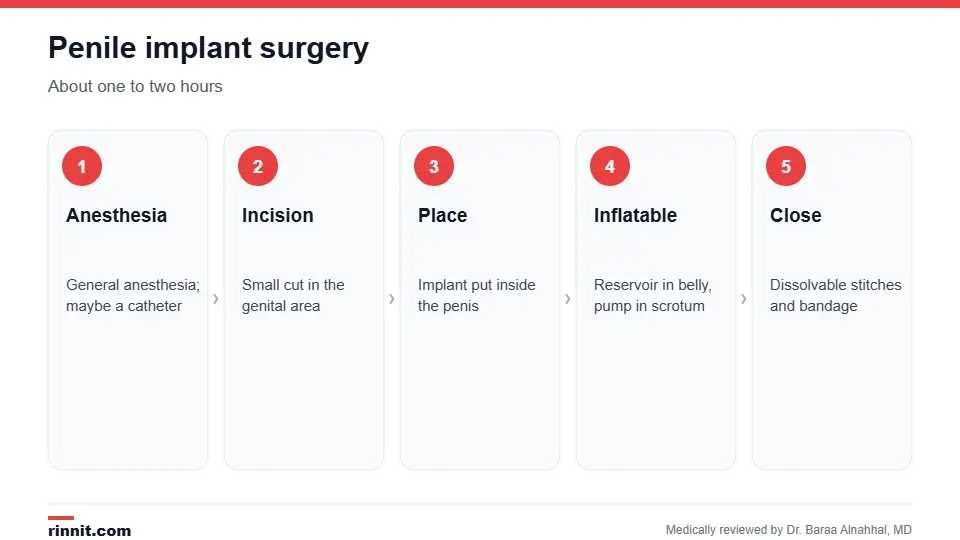
Surgery usually takes one to two hours.
You get general anesthesia, and a catheter may be placed.
The urologist makes a cut in the genital area.
The implant is placed inside the penis; for inflatable types, the reservoir goes in the belly and the pump in the scrotum.
The cut is closed with dissolvable stitches, and drains may be placed. Sources: [1]
Risks
Risk | Notes |
Infection | May require removing the implant |
Bleeding | May need more surgery |
Urethral damage | Repaired; may delay the implant |
Erosion or part movement | Possible |
Mechanical failure | Possible |
Shorter-feeling penis | Erections may seem shorter |
Complications are uncommon. Sources: [1, 2, 3]
Recovery
Most people go home the same day; you'll need a driver and help for a day or two.
Pain and swelling ease after a week; tenderness can last up to six weeks.
Use an ice pack up to 10 minutes at a time and keep the area clean and dry.
Avoid heavy lifting and hard exercise.
No sex or masturbation for at least four weeks; most resume sex at six weeks.
Take at least a week off for a desk job and two to four weeks for a physical job. Sources: [1]
Results
An implant gives firm erections on demand. Over 90% of people are happy with the results, and most say sex feels the same or better. Natural erections with medication aren't possible afterward, and an implant can't make your penis bigger than before. Implants last 20 years on average. Sources: [1, 2]
When to call your provider
Heavy bleeding from the incision.
A fever of 100.4°F (38°C) or higher.
Signs of incision infection.
Increasing pain. Sources: [1]
Conclusion
A penile implant is a reliable, long-lasting option for ED when other treatments haven't worked, with very high satisfaction. Following recovery instructions closely helps lower the risk of infection.
Keep learning: read about erectile dysfunction and Peyronie's disease.
Frequently asked questions
What is a penile implant?
A surgically placed device that lets you get an erection.
Who needs a penile implant?
People with ED that hasn't improved with other treatments.
What types of penile implants are there?
Inflatable and non-inflatable (bendable).
How long does surgery take?
About one to two hours.
When can I have sex after surgery?
After at least four weeks; most resume at six weeks.
Will sensation change?
No. Sensation, orgasm and ejaculation stay the same.
Can others tell I have an implant?
Inflatable implants usually aren't noticeable.
How long does a penile implant last?
About 20 years on average.
Are people happy with penile implants?
Yes. Over 90% are happy with the results.
Is it covered by insurance?
It's often covered for diagnosed ED.
Related Reading
Penectomy: Types, Surgery and Recovery explains penectomy for penile cancer.
Erectile Dysfunction: Symptoms, Causes, and Treatment the main reason for a penile implant.
Peyronie's Disease: Symptoms, Causes & Treatment a curved penis condition.
Phalloplasty: Reconstructive Surgery for Penile Construction penile construction surgery.
Alprostadil for Erectile Dysfunction an injection treatment for ED.
Prostatectomy: Types, Surgery, Risks and Recovery prostate surgery that can cause ED.
References
Cleveland Clinic. Penile Implant: Purpose, Procedure, Risks & Recovery. Cleveland Clinic. Last updated November 11, 2022. https://my.clevelandclinic.org/health/treatments/10054-surgical-penile-implants
Corona G, Santi D, Cocci A, et al. Long-term penile prosthesis couple's satisfaction: a systematic review and meta-analysis. Andrology. 2025;13(3):610-623. PMID 39010798. https://doi.org/10.1111/andr.13696
Mandava SH, Serefoglu EC, Freier MT, et al. Infection retardant coated inflatable penile prostheses decrease the incidence of infection: a systematic review and meta-analysis. J Urol. 2012;188(5):1855-1860. PMID 22999690. https://doi.org/10.1016/j.juro.2012.07.022
Medical disclaimer
This article is for general education only and does not replace advice from a qualified healthcare professional. Talk to your doctor about your own diagnosis and treatment, and seek emergency care right away for severe or sudden symptoms.



Comments