Pedophobia (Fear of Children): Understanding the Symptoms and Management

Updated: 2 days ago
Medically reviewed by Dr. Baraa Alnahhal, MD · Last reviewed: October 2026
Pedophobia is an irrational and persistent fear of infants and small children. It is often rooted in a past negative experience or linked with other conditions such as obsessive-compulsive disorder (OCD), and it can cause significant emotional and physical distress [1]. Fortunately, professional treatments such as exposure therapy and cognitive behavioral therapy (CBT) can help people manage and overcome this specific phobia [1].
Quick Answer
Pedophobia is a specific phobic disorder involving an unreasonable and uncontrollable fear of babies and small children. Being near children, thinking about them or seeing images can trigger intense anxiety, panic and physical reactions, leading to avoidance. Diagnosis requires the fear to persist for at least six months. Treatment is psychotherapy, mainly exposure therapy and CBT, sometimes with medication. [1]
What the research says
Little research looks at pedophobia on its own, so these findings come from studies of specific phobias, the category it belongs to.
Exposure-based treatment outperformed other approaches for specific phobia. A meta-analysis of 33 randomized treatment studies found that exposure-based treatment produced large effect sizes compared with no treatment and outperformed placebo conditions and alternative psychotherapies. Treatment involving real-life (in vivo) contact with the feared target did better than other forms of exposure right after treatment but not at follow-up, more sessions predicted better outcomes, and results did not depend on the type of phobia (Wolitzky-Taylor et al., Clin Psychol Rev, 2008).
Virtual reality exposure worked about as well as in-person exposure. A meta-analysis of 30 randomized trials with 1,057 participants, 14 of which tested virtual reality exposure therapy for specific phobias, found a large effect compared with a waitlist (g = 0.90). Virtual reality and in vivo exposure did not differ significantly (g = −0.07) (Carl et al., J Anxiety Disord, 2019).
Specific phobias are common and can persist, so early treatment matters. A review reported that lifetime prevalence of specific phobias worldwide ranges from 3% to 15%. Phobias persist for several years or even decades in 10 to 30% of cases and strongly predict later anxiety, mood, and substance-use disorders. Exposure therapy remains the treatment of choice, although it might be less effective in the long term than previously believed (Eaton et al., Lancet Psychiatry, 2018).
Research summaries are based on article abstracts retrieved from PubMed.
What is pedophobia (fear of children)?
People with pedophobia develop an irrational fear of babies and small children. A phobia is an anxiety disorder that makes a person unreasonably fearful of something that will not harm them, and pedophobia is a specific phobic disorder, meaning the fear is tied to something particular [1]. Someone with this condition may take extreme measures to avoid being around small children, and even the thought of being near children can cause anxiety and fear [1].
It is important to distinguish pedophobia from pediophobia, which is the fear of dolls or inanimate objects that look real. Some people experience both [1].
It is hard to know exactly how many people have a specific phobia like pedophobia, because many keep the fear to themselves or do not recognize it. About 1 in 10 American adults and 1 in 5 teenagers will deal with a specific phobia disorder at some point in their lives [1].
What are the risk factors and associated conditions for pedophobia?
Some people are more likely to develop pedophobia. People with obsessive-compulsive disorder (OCD) who need things to be neat and orderly may view children as messy and disruptive and fear the chaos that comes with small children [1]. Someone with mysophobia (fear of germs) may see children as tiny germ carriers, which reinforces avoidance [1].
Risk Category | Contributing Factors |
Sex | Women are more likely to have a phobia than men. |
Family history | Growing up with a parent or loved one who has a phobia or anxiety disorder may predispose a person to the same or a different phobia. |
Genetics | Some studies suggest that a genetic change may make people more likely to have an anxiety or phobic disorder. |
Associated phobias | Often linked with fear of germs (mysophobia) or fear of teenagers (ephebiphobia). Having more than one phobia is common. |

What causes and triggers pedophobia?
Pedophobia, the fear of children, may be caused by a harmful or negative experience with an infant or child. That experience can happen in childhood or adulthood, and a person may experience it directly or witness it [1]. Common triggers include:
Past trauma: child abuse, or bullying, humiliation, or violence involving a child.
Loss: the death of an infant or child, or pregnancy loss such as a miscarriage or stillbirth.
Behavioral stressors: witnessing extreme temper tantrums by a child.
What are the symptoms of pedophobia?
Symptoms range from mild unease to severe panic. A person may recognize that the fear of children is irrational and still be unable to control the body’s physical responses [1]. Pedophobia affects everyone differently. A person may be able to be around children they know, such as relatives, but not other children, or may be unable to be around any children without panicky symptoms. Some people feel anxious just thinking about children or seeing images of them [1].
Physical Symptoms
When near children, or even just thinking about them, a person may experience:
Heart and breathing: rapid heart rate, rapid breathing, and shortness of breath.
Stomach and digestion: nausea, vomiting, or diarrhea.
General: profuse sweating, shaking or trembling, dizziness, and dry mouth.
Emotional and Behavioral Symptoms
The emotional impact often shows up as an extreme feeling of dread or terror. This leads to persistent anxiety and avoidance of places where children may be, such as parks, stores, or family gatherings, which can interfere with social, professional, and personal life [1].

How is pedophobia diagnosed?
A mental health professional, such as a psychologist, diagnoses phobias using the American Psychiatric Association’s Diagnostic and Statistical Manual of Mental Disorders (DSM), based on symptoms and how they affect quality of life [1]. Providers look for:
Intense fear of infants and small children that persists for at least six months.
Symptoms that start as soon as the person is near children or simply thinks about being around them.
Extreme fear or anxiety that leads the person to avoid situations where children might be present.
Symptoms that affect quality of life.
Fear, anxiety, or dread that does not match the real danger.
How is pedophobia managed and treated?
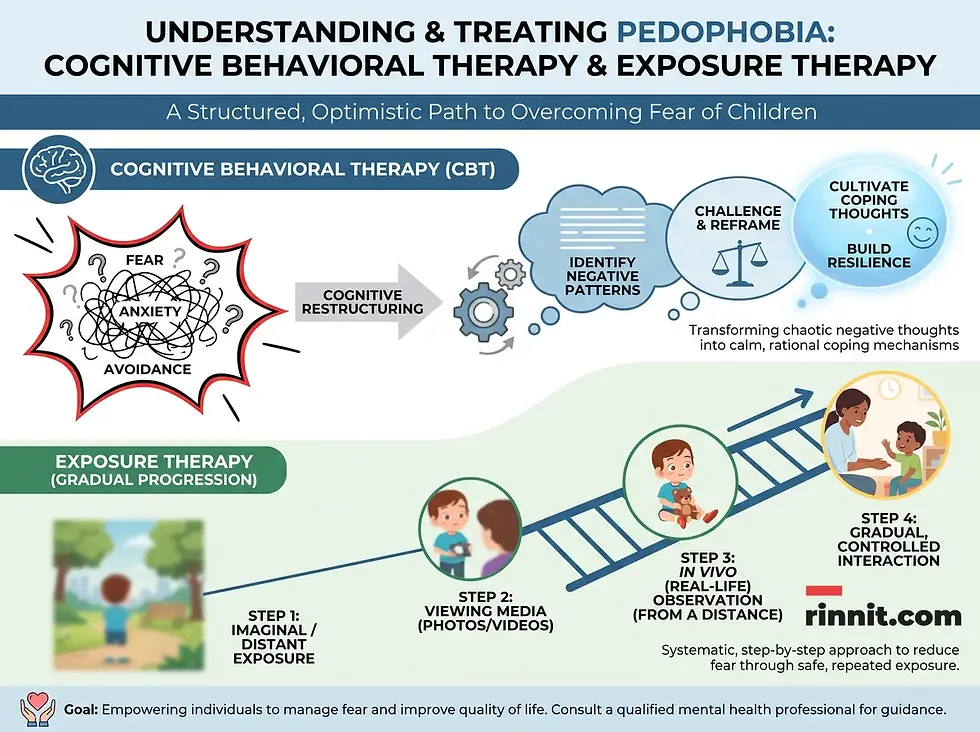
A mental health professional can help a person overcome the fear of being around small children. Psychotherapy, also called talk therapy, often works for people with pedophobia [1]. The goal is to help the person regain control over their responses and reduce the impact of the fear on daily life. In research on specific phobias, exposure-based treatment has been shown to outperform alternative approaches [2].
Therapeutic Approaches
Exposure therapy (desensitization): You slowly face your fear through gradually increasing exposure to images or situations that involve children. The goal is to desensitize you through repeated exposure, and most people with specific phobias see symptom improvement over time [1].
Cognitive behavioral therapy (CBT): CBT helps you analyze why you fear children and address any traumatic events behind the fear. After you discover the cause, you learn how to change your perceptions and responses to situations involving children [1].
Medications: Anti-anxiety drugs or antidepressants may help while you are getting psychotherapy. They ease symptoms, which makes it easier to be around children [1].
What are the complications of pedophobia?
An extreme fear of children can make it difficult to function in society. A person may miss social events, struggle at work, and develop depression. Some people have panic attacks, which can feel a lot like a heart attack, with a racing heart and noncardiac chest pain [1].
Conclusion
Pedophobia is a challenging condition that can make a world full of children feel overwhelming, but it is a treatable anxiety disorder. By addressing the underlying causes, whether they are rooted in past trauma, family history, or associated conditions such as OCD, people can find relief. Avoiding children altogether is not realistic or healthy, and psychotherapy with exposure therapy and CBT is the most effective path toward reclaiming quality of life [1].
When should you take action about pedophobia?
Call your healthcare provider if you or a loved one has panic attacks, persistent anxiety that interferes with daily life or sleep, signs of depression, or substance use problems [1]. Early help can prevent complications such as depression and social isolation. A mental health specialist can discuss a personalized treatment plan with you.
Frequently Asked Questions
Is pedophobia just a dislike of children?
No. While some people simply prefer not to be around children, pedophobia is a clinical anxiety disorder. It involves an irrational, intense fear that triggers physical symptoms and significant emotional distress [1].
Can past trauma cause a fear of children?
Yes. Negative or harmful experiences involving children, such as abuse, witnessing violence, or pregnancy loss, are common triggers for developing pedophobia [1].
How is pedophobia different from pediophobia?
Pedophobia is the fear of actual, living children. Pediophobia is the fear of dolls or inanimate objects that look real. The two are distinct, but some people have both [1].
Are women more likely to have pedophobia?
Women are more likely than men to have a phobia, including specific phobic disorders like pedophobia [1].
What are the physical signs of a pedophobic reaction?
Physical signs include a rapid heart rate and breathing, sweating, shaking, dizziness, nausea, and shortness of breath when exposed to children or the thought of them [1].
Can OCD lead to pedophobia?
Yes. People with OCD who need things to be neat and orderly may view children as messy and disruptive, which can lead to the development of this phobia [1].
What is exposure therapy for pedophobia?
Exposure therapy involves gradually and repeatedly facing the fear of children, starting with images and moving toward real-life situations, to desensitize the fear response [1].
Is medication used to treat the fear of children?
Anti-anxiety medicines or antidepressants may be used to ease symptoms while a person is in psychotherapy, rather than as a stand-alone cure [1].
Can pedophobia cause panic attacks?
Yes. Some people with pedophobia have panic attacks, which can feel like a heart attack, with a racing heart and noncardiac chest pain [1].
How long must symptoms last for a diagnosis?
The intense fear of children must persist for at least six months to be diagnosed as a specific phobic disorder [1].
Related Resources
External resource for deeper reading:
Cleveland Clinic. Pedophobia (Fear of Children). Cleveland Clinic Health Library. Last updated March 15, 2022. https://my.clevelandclinic.org/health/diseases/22538-pedophobia-fear-of-children
Related Reading
Specific Phobias: Symptoms, Causes, and How Exposure Therapy Helps You Overcome Them explains how specific phobias develop and how exposure therapy treats them.
Exposure Therapy: What It Is, How It Works, Types, and What to Expect describes how gradual, guided exposure helps people face and reduce fears.
Anthropophobia (Fear of People): Causes, Symptoms, and Treatment covers the intense fear of people and how it is treated.
Social Anxiety Disorder: Symptoms, Causes, Treatment & Complete Guide explains social anxiety disorder symptoms, causes and effective treatments.
References
Cleveland Clinic. Pedophobia (Fear of Children). Cleveland Clinic Health Library. Last updated March 15, 2022. https://my.clevelandclinic.org/health/diseases/22538-pedophobia-fear-of-children
Wolitzky-Taylor KB, Horowitz JD, Powers MB, et al. Psychological approaches in the treatment of specific phobias: a meta-analysis. Clin Psychol Rev. 2008;28(6):1021-1037. PMID: 18410984. DOI: 10.1016/j.cpr.2008.02.007
Carl E, Stein AT, Levihn-Coon A, et al. Virtual reality exposure therapy for anxiety and related disorders: a meta-analysis of randomized controlled trials. J Anxiety Disord. 2019;61:27-36. PMID: 30287083. DOI: 10.1016/j.janxdis.2018.08.003
Eaton WW, Bienvenu OJ, Miloyan B. Specific phobias. Lancet Psychiatry. 2018;5(8):678-686. PMID: 30060873. DOI: 10.1016/S2215-0366(18)30169-X
Medical disclaimer
This article is for informational purposes only and is not a substitute for professional medical advice, diagnosis, or treatment. Always seek the advice of your physician or other qualified health provider with any questions you may have about a medical condition.



Comments