Anthropophobia (Fear of People): Causes, Symptoms, and Treatment

Updated: 2 days ago
Medically reviewed by Dr. Baraa Alnahhal, MD · Last reviewed: September 2026
TL;DR
Anthropophobia is the fear of people — and it's distinct from social anxiety disorder. People with anthropophobia fear people themselves, regardless of the setting, rather than fearing social situations. It is not a formal diagnosis in the DSM-5, but many experts consider it a specific phobia. Symptoms include anticipatory anxiety, sweating, rapid heartbeat, and trouble breathing. While there is no cure, up to 90% of people who consistently practice exposure therapy see their symptoms decrease.
Quick Answer
What it is: Anthropophobia is the fear of people — a fear of people themselves, not of social situations — and it is not a formal clinical diagnosis in the DSM-5, though many experts view it as a specific phobia.
How common: It is most common in teenagers and females; about 1 in 5 adolescents experience a specific phobia at some point, and around 1 in 10 adults experience one in their lifetime.
Symptoms: Anticipatory anxiety (excessive worry before being around others), fear of being judged or watched, plus physical signs like sweating, rapid heartbeat, nausea, and tremors.
Outlook: There is no cure, but symptoms improve for many with treatment — up to 90% of people who consistently practice exposure therapy experience a decrease in symptoms.
What Is Anthropophobia?
Anthropophobia is the fear of people. People with anthropophobia may avoid crowds, fear eye contact, or worry that they are being judged.
Anthropophobia is not a clinical disorder in the Diagnostic and Statistical Manual of Mental Disorders (DSM-5), but many experts consider it a specific phobia.
Like other specific phobias, anthropophobia involves intense anxiety that isn't proportional to the actual threat. Many people with specific phobias know the fear is irrational — but they still have difficulty controlling their symptoms or intrusive, fearful thoughts.
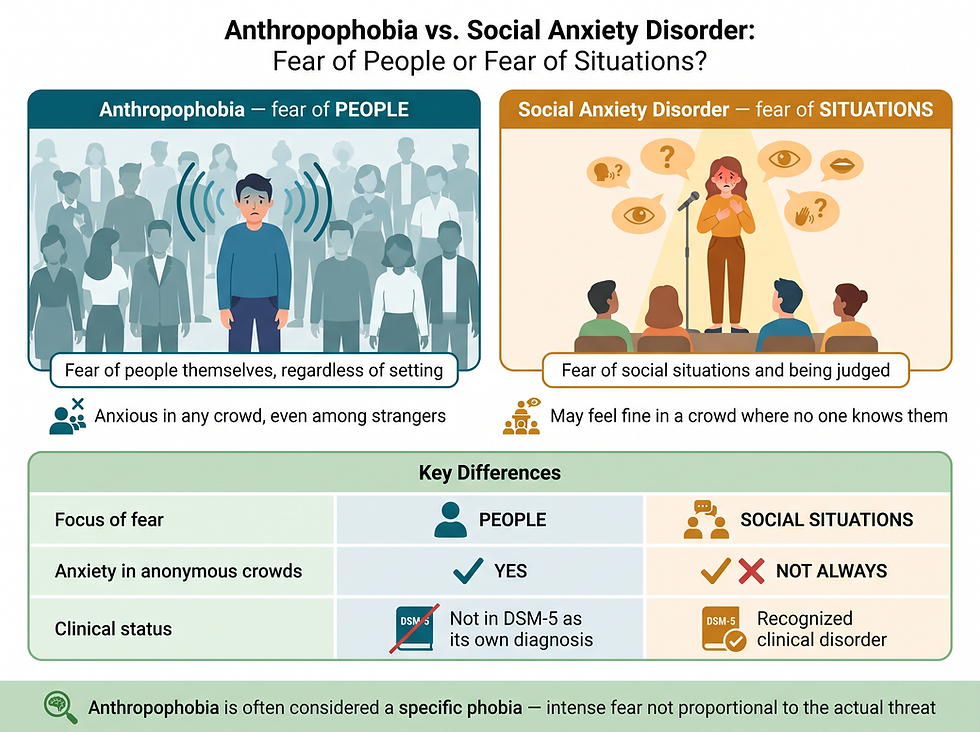
What's the Difference Between Anthropophobia and Social Anxiety Disorder?
Anthropophobia can be part of a social anxiety disorder, but the two terms are not exactly the same. The distinction comes down to what you fear — people or situations.
People with social anxiety disorder feel intense distress in social situations, such as going on a date or talking to a waiter. Notably, someone with social anxiety disorder might not feel anxious in a crowd where no one knows them.
People with anthropophobia feel afraid of people, regardless of setting. They feel anxious in any crowd. Their fear is specific to people, not to social settings.
For context, social phobia — also called sociophobia — is simply the former name for social anxiety disorder.
Feature | Anthropophobia | Social Anxiety Disorder |
What triggers the fear | People themselves | Social situations (dates, conversations, performances) |
Anxiety in anonymous crowds | Yes — anxious in any crowd | Not always — may feel fine where no one knows them |
Focus of fear | Specific to people, not settings | Specific to social settings and judgment |
Clinical status | Not in the DSM-5 as its own diagnosis | Recognized clinical disorder |
How Common Is Anthropophobia?
Anthropophobia and other specific phobias are most common in teenagers and females.
According to data from the National Institute of Mental Health, about 1 in 5 adolescents experience a specific phobia at some point. Around 1 in 10 adults experience a specific phobia in their lifetime.
Population | Specific phobia prevalence |
Adolescents (at some point) | About 1 in 5 |
Adults (lifetime) | Around 1 in 10 |
Most affected groups | Teenagers and females |
What Causes Anthropophobia?
Anthropophobia doesn't always have a clear cause. However, you may be more likely to develop it if you have or have experienced certain factors.
Risk factor | Why it matters |
Betrayal from close loved ones | A traumatic breach of trust can fuel fear of people |
Family history of anxiety disorders | Anxiety can run in families |
Hormonal imbalances | Hormone levels can influence anxiety |
Problems with adrenal glands | The adrenal glands produce stress hormones; dysfunction raises anxiety risk |

What Are the Symptoms of Anthropophobia?
Many people with anthropophobia experience anticipatory anxiety — dread, worry, or fear about an upcoming event. With anthropophobia, people may worry excessively before being around other people.
The core anxieties tend to center on three fears: being judged by others, being watched, and making eye contact.
This anxiety often produces physical symptoms as well. The body responds to the perceived threat with a fight-or-flight response, which can include:
Physical symptom | Description |
Difficulty breathing or shortness of breath (dyspnea) | Trouble catching your breath |
Flushed skin | Redness or heat in the face and skin |
Nausea or vomiting | Stomach distress triggered by anxiety |
Rapid heartbeat or heart palpitations | Pounding or racing heart |
Sweating | Excess perspiration during or before exposure to people |
Tremors or shaking | Visible shakiness from intense anxiety |
How Is Anthropophobia Diagnosed?
Anthropophobia does not have specific clinical diagnostic guidelines. Still, a healthcare provider may identify symptoms of anthropophobia by asking three key questions:
Diagnostic question | What it reveals |
Do the same social situations always cause fear or anxiety? | Whether the fear pattern is consistent |
Does avoiding people interfere with your day-to-day routine? | Whether the fear causes functional impairment |
Has the anxiety lasted six months or longer? | Whether the fear meets the chronicity threshold used for phobias |
Sometimes, the fear of people is actually a symptom of another diagnosis, such as social anxiety disorder.
Anthropophobia may also be closely related to taijin kyofusho — a culture-specific diagnosis found in Korea and Japan. Taijin kyofusho is distress or fear of interpersonal relationships, specifically the fear of offending others.
Additionally, people may experience anthropophobia along with other conditions:
Related condition | Nature of the overlap |
Avoidant personality disorder | Pervasive fear of rejection drives social avoidance |
Delusional disorder | Fixed false beliefs may involve fear of people |
Paranoid personality disorder | Suspicion of others' motives overlaps with fear of people |
Post-traumatic stress disorder (PTSD) | Trauma-related fear responses can target people |

Is There a Cure for Anthropophobia?
There is no cure for anthropophobia. But for many people, symptoms improve with treatment. For some, the fear of people decreases enough that it no longer interferes with day-to-day life.
How Is Anthropophobia Treated?
There is no one specific treatment for anthropophobia. However, several treatments used for specific phobias may help.
Exposure therapy is often the first treatment for specific phobias. It involves gradually introducing the specific fear into your life — you may start by imagining interacting with others, then practice being around small groups of people. Up to 90% of people who consistently practice exposure therapy have a decrease in symptoms.
Cognitive behavioral therapy (CBT) involves talking with a therapist about your symptoms. You learn to identify irrational thoughts and replace them with rational ones. CBT may not be as helpful as exposure therapy for people with severe phobia symptoms.
Hypnotherapy involves guided relaxation and focused concentration. A provider guides you to a state of such intense concentration that you are temporarily unaware of your surroundings. Hypnotherapy often increases the success of phobia treatment.
Medications may be useful for anxiety disorders or some specific phobias. For example, you might take diazepam (Valium) or alprazolam (Xanax) before certain events to avoid panic attacks — intense, sudden anxiety that causes physical symptoms. Medication is not right for everyone, so speak with your healthcare provider before starting a new medicine.
Treatment | How it works | Effectiveness note |
Exposure therapy | Gradually introduces the fear into your life, from imagining interactions to small groups | Up to 90% of consistent practitioners see symptom decrease; often the first treatment |
Cognitive behavioral therapy (CBT) | Identify irrational thoughts and replace them with rational ones | May be less helpful than exposure therapy for severe phobias |
Hypnotherapy | Guided relaxation and intense concentration, temporarily unaware of surroundings | Often increases treatment success |
Medications (e.g., diazepam, alprazolam) | Taken before triggering events to prevent panic attacks | Useful for some; not right for everyone — consult a provider |
What Can I Practice at Home?
People with anthropophobia can also learn relaxation techniques. Practicing these can help lower anxiety, especially when exposed to what you fear.
Technique | How to do it |
Aerobic exercise | For example, 20 jumping jacks when you feel anxious |
Meditation and guided imagery | Techniques to manage stress |
Breathing techniques | Calm the body's physical anxiety response |
What Happens Without Treatment?
With proper treatment, most people find that symptoms of anthropophobia improve.
Without treatment, anthropophobia can increase your risk of:
Complication | What it involves |
Mood disorders | Anxiety or depression |
Social withdrawal or isolation | Pulling away from relationships entirely |
Substance misuse | Alcohol or drug use as a coping mechanism |
Can Anthropophobia Be Prevented?
There is no guaranteed way to prevent anthropophobia. However, if you struggle with anxious thoughts or behaviors, healthy habits may help reduce how severe your symptoms are.
Preventive habit | Details |
Stay hydrated | Drink plenty of water; limit alcohol and caffeine to avoid dehydration |
Eat a nutritious diet | Whole grains, lean protein, healthy fat, fruits and vegetables |
Exercise consistently | Regular physical activity supports mental health |
Sleep 7–8 hours nightly | Adequate sleep reduces anxiety severity |
Stay connected | Talk to trusted loved ones regularly to decrease the risk of social isolation |
Conclusion
Anthropophobia is the fear of people themselves — a distinct experience from social anxiety disorder, which targets situations rather than people. While it isn't formally listed in the DSM-5, it shares the hallmarks of a specific phobia: intense, irrational fear that persists even when you know it doesn't make sense. It most commonly affects teenagers and females, and it often arrives with a heavy physical burden — racing heart, sweating, nausea, tremors, and dread that builds long before you're even around anyone.
The encouraging news is that anthropophobia is highly treatable. Exposure therapy, the first-line approach for specific phobias, helps up to 90% of consistent practitioners see their symptoms decrease. Combined with CBT, hypnotherapy, medications when appropriate, and daily relaxation habits, most people find their fear stops running their lives.
If a fear of people interferes with your daily life, speak with a healthcare provider. Treatment may include therapy, medication, or practicing relaxation techniques at home. Untreated anthropophobia raises your risk of depression, isolation, and substance misuse — so don't wait for it to get worse. Ask your provider about exposure therapy and build simple habits like breathing exercises, exercise, and staying connected with trusted loved ones.
FAQ
What is anthropophobia?
Anthropophobia is the fear of people. People with anthropophobia may avoid crowds, fear eye contact, or worry that they are being judged. It is not a clinical disorder in the DSM-5, but many experts consider it a specific phobia.
How is anthropophobia different from social anxiety disorder?
People with social anxiety disorder feel intense distress in social situations, such as going on a date or talking to a waiter, and might feel fine in a crowd where no one knows them. People with anthropophobia feel afraid of people themselves, regardless of setting — they feel anxious in any crowd.
Is anthropophobia rare?
Specific phobias like anthropophobia are most common in teenagers and females. About 1 in 5 adolescents experience a specific phobia at some point, and around 1 in 10 adults experience one in their lifetime.
What are the physical symptoms of anthropophobia?
People may experience difficulty breathing or shortness of breath, flushed skin, nausea or vomiting, rapid heartbeat or palpitations, sweating, and tremors or shaking — often preceded by anticipatory anxiety, which is excessive dread before being around other people.
What causes anthropophobia?
It doesn't always have a clear cause, but you may be more likely to develop it if you've experienced betrayal from close loved ones, have a family history of anxiety disorders, have hormonal imbalances, or have problems with your adrenal glands, which produce stress hormones.
Is there a cure for anthropophobia?
There is no cure, but for many people symptoms improve with treatment, and the fear may decrease enough that it no longer interferes with day-to-day life.
What is the most effective treatment for anthropophobia?
Exposure therapy is often the first treatment for specific phobias, and up to 90% of people who consistently practice it have a decrease in symptoms. It involves gradually introducing the fear into your life, from imagining interactions to practicing being around small groups. CBT, hypnotherapy, and medications can also help.
What happens if anthropophobia goes untreated?
Without treatment, anthropophobia can increase your risk of mood disorders such as anxiety or depression, social withdrawal or isolation, and substance misuse, including alcohol or drugs.
References
Cleveland Clinic. Anthropophobia (Fear of People). Medically reviewed; last updated 07/30/2021. my.clevelandclinic.org/health/diseases/21948-anthropophobia-fear-of-people
National Institute of Mental Health. Social Anxiety Disorder (statistics). Accessed 8/26/2021. nimh.nih.gov/health/statistics/social-anxiety-disorder
National Institute of Mental Health. Specific Phobia (statistics). Accessed 8/26/2021. nimh.nih.gov/health/statistics/specific-phobia
Merck Manuals (Consumer Version). Specific Phobic Disorders. Accessed 8/26/2021. merckmanuals.com/home/mental-health-disorders/anxiety-and-stress-related-disorders/specific-phobic-disorders
Medical Disclaimer: This article is for general informational purposes only and is not a substitute for professional medical advice, diagnosis, or treatment. Always seek the advice of a qualified healthcare provider with any questions you may have about a mental health condition. If a fear of people interferes with your daily life, speak with a healthcare provider about treatment options such as therapy, medication, or relaxation techniques. In case of emergency or crisis, contact your local emergency services or a mental health crisis line.
Comments