OCPD Comprehensive Guide: Recognizing Symptoms, Diagnosis, and Path to Recovery

Updated: 3 days ago
Medically reviewed by Dr. Baraa Alnahhal, MD · Last reviewed: October 2026
Quick Answer: OCPD at a Glance
Obsessive-compulsive personality disorder (OCPD) is a personality disorder centered on perfectionism, order and control, [1] causing rigidity, overdevotion to work and difficulty delegating. [1] It may be the most common personality disorder in the U.S., affecting 3% to 8% of adults. [1] [2] Unlike OCD, it is a personality pattern, often without self-awareness. [1] Treatment is psychotherapy, including CBT. [1] [2]
Feature | Details |
Definition | A personality disorder centered on perfectionism, order, and control of oneself, others, and situations. [1] |
Group | Cluster C personality disorders, which involve anxiety and fear. [1] |
Key symptoms | Rigidity, perfectionism that interferes with finishing tasks, excessive devotion to work, difficulty delegating, and unwillingness to throw out worthless objects. [1] |
How common | |
OCD vs OCPD | OCD involves unwanted intrusive thoughts (obsessions) and repetitive behaviors (compulsions). OCPD is a personality pattern, and people with it usually lack self-awareness. [1] |
Main treatment | Psychotherapy, including cognitive behavioral therapy (CBT) and psychodynamic therapy. [1] |
What the research says
OCPD is common, and CBT is its best-studied treatment. A clinical review reports that OCPD affects about 3% to 8% of people in the general population and is more common in older and less educated people. Findings on differences between men and women are inconsistent, and most evidence supports disturbed attachment and heritability as causes. The authors conclude that cognitive (behavioral) therapy is so far the best-validated treatment. (Diedrich & Voderholzer, Curr Psychiatry Rep, 2015) [2]
A newer therapy aimed at rigidity looks promising, but the evidence is early. In a secondary analysis of a randomized trial of 250 people with treatment-resistant depression (117 of whom also had OCPD), radically open dialectical behavior therapy (RO DBT) plus usual care improved emotional coping and psychological flexibility at 12 months compared with usual care alone in people with OCPD. There were no significant differences in depression or interpersonal functioning, and having OCPD did not reduce the benefit of treatment. (Steinhoff et al., Personal Disord, 2025) [3]
What Is Obsessive-Compulsive Personality Disorder (OCPD)?
OCPD is a mental health condition that causes an extensive preoccupation with perfectionism, organization, and control. [1] These thought patterns and behaviors interfere with completing tasks and keeping relationships healthy. [1] People with OCPD have rigid beliefs and specific ways of doing tasks, and they don’t allow for flexibility or compromise. [1]
OCPD is one of the “Cluster C” personality disorders, which involve anxiety and fear. [1] Studies suggest it is the most common personality disorder in the general population in the United States, affecting 3% to 8% of adults. [1] [2] At a glance, people with OCPD often seem confident, organized, and high-achieving, and their exacting standards can even help in certain jobs. [1] But their inability to compromise or change usually harms their relationships. [1]
How is obsessive-compulsive personality disorder (OCPD) different from OCD?
The names sound alike, but OCPD and obsessive-compulsive disorder (OCD) are different conditions.
Feature | OCD | OCPD |
Type | A mental health condition in its own DSM-5 group (obsessive-compulsive and related disorders). [1] | A personality disorder (Cluster C). [1] |
Main features | Frequent unwanted, intrusive thoughts (obsessions) that lead to repetitive behaviors (compulsions), such as repeated hand washing. [1] | A pervasive preoccupation with order, perfectionism, control, and specific ways of doing things. [1] |
Self-awareness | People usually know the condition is causing their behavior and accept that they need professional help. [1] | People usually have little, if any, self-awareness of their behaviors. [1] |
Reason for seeking help | Usually seek help for the condition itself. | Often seek help for another problem, such as anxiety or depression after losing a job or a relationship. [1] |

What are the symptoms of obsessive-compulsive personality disorder (OCPD)?
Symptoms of OCPD usually begin by early adulthood, often in the late teens or early 20s. [1] The main sign is a pervasive preoccupation with order, perfectionism, control, and specific ways of doing things, which makes it hard to complete tasks and causes problems in relationships. [1]
Behavioral Signs
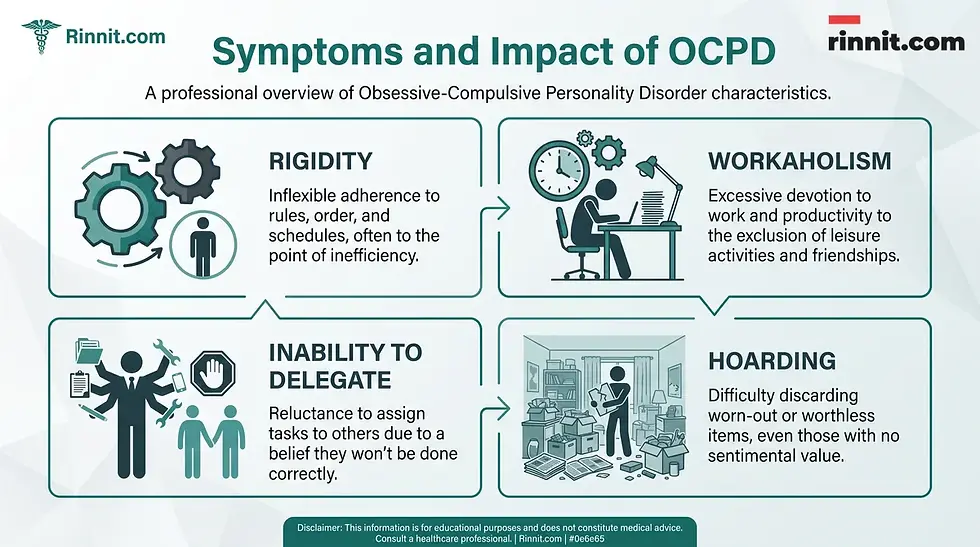
Perfectionism: standards so exacting that they get in the way of finishing tasks. [1]
Rigidity and stubbornness: being unwilling to compromise or accept other ways of doing things. [1]
Excessive devotion to work: putting productivity first and neglecting hobbies and time with loved ones. [1]
Trouble delegating: difficulty working with others or handing off tasks unless they agree to do things exactly as the person wants. [1]
Thinking and Emotional Signs
Black-or-white thinking: seeing everything as all good or all bad (dichotomous thinking). [1]
Doubt and indecisiveness: extreme caution to avoid anything they see as failure. [1]
Fixation: focusing on details, rules, lists, and order, or on a single idea or task. [1]
Difficulty with criticism: trouble coping with criticism and an over-focus on other people’s flaws. [1]
Difficulty discarding: unwillingness to throw out broken or worthless objects, even when they have no sentimental value. [1]
What causes obsessive-compulsive personality disorder and who is at risk?
Personality disorders are among the least understood mental health conditions, and researchers are still working to find the exact causes. [1] They think several factors play a role.
Genetics: scientists have identified a malfunctioning gene that may be a factor in OCPD. [1] People are also more likely to have OCPD if they have biological family members with personality disorders, anxiety, or depression. [1]
Childhood trauma: one study revealed a link between childhood traumas, such as child abuse, and the development of personality disorders. [1]
Other factors: OCPD is more common in adults whose highest level of education is high school or less. [1] [2] It is also more likely in people with anxiety disorders (24%), mood disorders (24%), or mild to moderate substance use disorders (12% to 25%). [1]
How is obsessive-compulsive personality disorder (OCPD) diagnosed?
OCPD can be hard to diagnose because most people with a personality disorder don’t think their behavior or way of thinking is a problem. [1] When they do seek help, it is often because of anxiety or depression caused by problems the disorder created, such as losing a job or a relationship. [1]
A psychologist or psychiatrist who suspects OCPD often starts with broad, general questions that won’t create a hostile or defensive atmosphere. They ask about relationships, work history, reality testing, and impulse control. [1] Because a person may lack insight into their behavior, professionals often work with family and friends to gather more information. [1]
The diagnosis is based on the criteria in the American Psychiatric Association’s Diagnostic and Statistical Manual of Mental Disorders (DSM-5). The person must have a persistent pattern of preoccupation with order, perfectionism, and control, shown by four or more of the behaviors listed above. [1]
How is obsessive-compulsive personality disorder (OCPD) treated?
Most people with OCPD don’t believe their behavior is a problem, but they may seek help when another issue causes distress. [1] Psychotherapy (talk therapy) is usually the treatment of choice. [1] The goal is to help the person uncover the motivations and fears behind their thoughts and behaviors and learn to relate to others more positively. [1]

Therapy
Cognitive behavioral therapy (CBT): a structured, goal-oriented therapy in which a therapist helps the person look closely at their thoughts and emotions and see how thoughts affect actions. People can unlearn negative thoughts and behaviors and adopt healthier thinking patterns and habits. [1]
Psychodynamic therapy: focuses on the psychological roots of emotional suffering. Through self-reflection, the person looks at problematic relationships and behavior patterns to better understand themselves and change how they relate to others and their environment. [1]
Medication
No medication currently treats personality disorders. [1] There are medicines for depression and anxiety, which people with OCPD may also have, and treating those conditions can make it easier to treat OCPD. [1]
What are the complications and outlook of obsessive-compulsive personality disorder?
The outlook depends on whether OCPD is treated. Left untreated, it may result in poor relationships, difficulties at work, and impaired social functioning. [1] OCPD can’t be prevented, but many of the related problems can be lessened with treatment, and getting help as soon as symptoms appear can reduce the disruption to a person’s life, family, and friendships. [1]
It also affects the people around them. Loved ones of people with OCPD often experience stress, depression, and isolation, [1] so looking after their own mental health matters too.
What is the bottom line on obsessive-compulsive personality disorder?
OCPD is a complex condition that often goes unrecognized by the people who have it. With professional support and therapy, people can learn to balance their drive for excellence with the flexibility needed for healthy relationships and a fulfilling life. If perfectionism and the need for control are straining your work or relationships, a mental health professional can help.
Want to learn more? For more about personality disorders and mental health wellness, visit Rinnit.com.
Frequently Asked Questions
Is OCPD the same as being a perfectionist?
No. Perfectionism is one feature of OCPD, but OCPD is a mental health condition in which perfectionism, the need for order, and the need for control are so extensive that they interfere with completing tasks and keeping relationships healthy. [1]
Can you have both OCD and OCPD?
They are separate conditions with different features, and a person can have more than one mental health condition at the same time. A mental health professional can sort out which diagnoses apply.
Why do people with OCPD work so much?
Excessive devotion to work and productivity is one of the symptoms of OCPD. [1] It often leads people to neglect hobbies and spend less time with loved ones. [1]
Does OCPD cause hoarding?
Not exactly. A symptom of OCPD is being unwilling to throw out broken or worthless objects even when they have no sentimental value. [1]
How do I know if I have OCPD or I just like being organized?
Liking order is not a disorder. In OCPD, the preoccupation with order, perfectionism, and control is persistent, makes it hard to finish tasks, and causes problems in relationships. [1] A diagnosis requires four or more of the listed behaviors [1] and is made by a mental health professional.
Can OCPD be treated?
Yes. Psychotherapy is usually the treatment of choice and can help a person uncover the fears behind their behavior and relate to others more positively. [1] Getting help as soon as symptoms appear can reduce disruption to life, family, and friendships. [1]
What is “black or white” thinking?
It is seeing situations as all good or all bad, with no middle ground. Doctors call it dichotomous thinking, and it is one of the signs of OCPD. [1]
Why is it hard to delegate tasks with OCPD?
People with OCPD often struggle to work with others or hand off tasks unless the other person agrees to do things exactly as they want. [1]
Does childhood trauma cause OCPD?
The exact cause is not known. One study found a link between childhood traumas, such as child abuse, and the development of personality disorders. [1]
Can medication help with OCPD?
No medication treats personality disorders themselves. [1] Medicines for depression and anxiety can help when those conditions are also present, which can make therapy easier. [1]
At what age does OCPD start?
It usually begins in the late teens or early 20s, and symptoms usually begin by early adulthood. [1]
Do people with OCPD realize they have a problem?
Often they don’t. People with OCPD usually have little, if any, self-awareness of their behaviors, [1] and many don’t think their way of thinking is a problem. [1]
What is psychodynamic therapy?
It is a type of talk therapy that focuses on the psychological roots of emotional suffering. Through self-reflection, a person looks at problematic relationships and behavior patterns to better understand themselves and how they relate to others. [1]
Can OCPD lead to job loss?
It can contribute. Left untreated, OCPD may result in difficulties at work, and some people seek help after losing a job or a relationship. [1]
How can loved ones cope?
Loved ones of people with OCPD often feel stress, depression, and isolation. [1] It is important for them to look after their own mental health and to seek help if they notice these feelings. [1]
Related Reading
Obsessive-Compulsive Disorder (OCD): Symptoms, Causes & Treatment Guide explains obsessive-compulsive disorder and how it differs from OCPD.
What Are Cluster C Personality Disorders? Symptoms, Causes, Diagnosis and Treatment describes the anxious and fearful personality disorder group that includes OCPD.
Personality Disorders: Types, Symptoms & Treatment Guide gives an overview of all personality disorder types and their treatment.
Cognitive Behavioral Therapy (CBT): What It Is, What It Treats and What to Expect explains how CBT works and which conditions it helps treat.
References
Cleveland Clinic. Obsessive-compulsive personality disorder (OCPD). Cleveland Clinic. Last updated December 13, 2022. https://my.clevelandclinic.org/health/diseases/24526-obsessive-compulsive-personality-disorder-ocpd
Diedrich A, Voderholzer U. Obsessive-compulsive personality disorder: a current review. Curr Psychiatry Rep. 2015;17(2):2. PMID 25617042. https://doi.org/10.1007/s11920-014-0547-8
Steinhoff MF, Baudinet J, Hempel RJ, et al. Obsessive-compulsive personality disorder in radically open dialectical behavior therapy for treatment-refractory depression. Personal Disord. 2025;17(2):178-188. PMID 41284832. https://doi.org/10.1037/per0000754
Medical disclaimer
This article is for informational purposes only and does not constitute medical advice. Always seek the advice of your physician or other qualified health provider with any questions you may have regarding a medical condition or mental health disorder.



Comments