Oblique Fracture: Understanding Angled Bone Breaks

Updated: 3 days ago
Medically reviewed by Dr. Baraa Alnahhal, MD · Last reviewed: October 19, 2026
Quick Answer: What is an Oblique Fracture?
An oblique fracture is a complete break that angles across a bone. It is characterized by a straight fracture line that is neither horizontal nor vertical but slanted relative to the bone's long axis. It most frequently occurs in long bones like the femur, tibia, or humerus when an impact hits the body at an angle.
What the research says
Smoking more than doubles the odds that a fracture fails to heal. A systematic review of 19 cohort studies found the adjusted odds of nonunion were 2.32 times higher in smokers (95% CI 1.76–3.06), with raised odds in tibial fractures (OR 2.16) and open fractures (OR 1.95) (Scolaro et al., J Bone Joint Surg Am, 2014). DOI [1]
Several fracture features raise the risk of nonunion. A systematic review ranked 10 risk factors for long bone nonunion, including open fracture, smoking, infection, comminuted or wedge fractures, a high degree of initial displacement, inadequate implant stability, and tibial location (Santolini et al., Injury, 2015). DOI [2]
How is an oblique fracture different from other fracture types?
Fracture Type | Direction of Break | Common Cause |
Oblique | Angled straight line across the bone. | Impact or fall at an angle. |
Transverse | Horizontal line perpendicular to the bone. | Direct, blunt force impact. |
Spiral | Winding, corkscrew-like break around the bone. | Severe twisting force (sports). |
Comminuted | Bone shattered into multiple pieces. | High-energy trauma. |
How do you identify an oblique fracture?
Oblique fractures are classified based on their severity and how the bone pieces are positioned after the break. Understanding these classifications helps determine the appropriate treatment plan.
Displacement and Alignment
Displaced Fracture: The bone pieces have moved out of their original position, creating a gap or overlap at the break site. These almost always require medical intervention to realign.
Non-Displaced Fracture: The bone is broken all the way through, but the pieces remain in their correct anatomical alignment. These are typically treated with simple immobilization.
Open vs. Closed Fractures
A closed fracture occurs when the bone breaks but the skin remains intact. An open fracture (formerly called a compound fracture) involves the bone breaking through the skin. Open fractures are medical emergencies due to the high risk of infection and the complexity of the soft tissue damage.
What are the common symptoms of an oblique fracture?
The symptoms of an oblique fracture are usually immediate and severe following a trauma.
Intense Pain: Sharp pain at the site of the injury, often worsening with movement.
Visible Deformity: A noticeable bump, bend, or shortening of the limb.
Swelling and Bruising: Rapid discoloration and inflammation around the break.
Loss of Function: The inability to bear weight or move the affected limb.
Tenderness: Extreme sensitivity to touch at the fracture site.

How is an oblique fracture diagnosed with imaging?
Prompt diagnosis is essential to ensure the bone heals in the correct position. Orthopedic specialists use several imaging tools to assess the damage.
X-rays: The primary tool used to confirm the presence of an angled break and determine its exact location.
CT Scan: Provides a 3D view of the bone, which is crucial for surgeons planning a complex repair.
MRI: Used if the doctor suspects damage to surrounding muscles, ligaments, or organs, providing a clear view of soft tissue.
What are the treatment and surgical options for an oblique fracture?
The goal of treatment is to stabilize the bone so the body's natural healing process can rejoin the fractured ends.
Non-Surgical Methods
For mild or non-displaced fractures, immobilization is the standard care.
Splinting: Used for 3 to 5 weeks to allow initial swelling to subside.
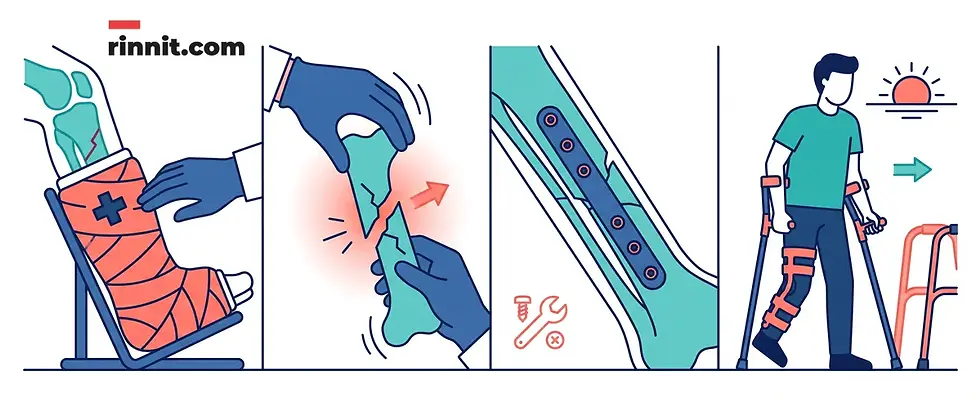
Casting: A fiberglass or plaster cast is typically worn for 6 to 8 weeks to provide rigid support.
Closed Reduction: A procedure where a doctor manually realigns the bones from the outside without surgery, usually under sedation or local anesthesia.
Surgical Procedures
Severe or displaced oblique fractures often require surgery to ensure proper long-term function.
Internal Fixation: The most common surgery, where metal rods, plates, or screws are attached directly to the bone to hold it in place.
External Fixation: Metal pins are placed through the skin into the bone and connected to a frame outside the body. This is often a temporary measure for unstable fractures.
Bone Grafting: If the bone is shattered or slow to heal, surgeons may insert donor bone tissue to stimulate regrowth.
For more orthopedic guides and injury infographics, explore our infographic templates.
Frequently Asked Questions
What is an oblique fracture?
An oblique fracture is a broken bone where the fracture line is at an angle across the bone.
Is an oblique fracture a complete break?
Yes, it typically goes all the way through the bone.
How is it different from a transverse fracture?
Oblique is angled, while transverse is horizontal across the bone.
How is it different from a spiral fracture?
Oblique is a straight angled line; spiral winds around the bone like a staircase.
What bones are most commonly affected?
Long bones like the femur (thigh), tibia (shin), and humerus (arm).
What causes an oblique fracture?
Usually a fall or impact that hits the bone at an angle.
What is a displaced oblique fracture?
A break where the bone pieces have moved out of alignment.
What is a non-displaced fracture?
A break where the bone pieces are still lined up correctly.
What is an open fracture?
A break where the bone pierces through the skin.
Why are open fractures dangerous?
Open fractures have a very high risk of infection and complications.
What are the first signs of a fracture?
Pain, swelling, and an inability to move the limb.
Can I walk on an oblique fracture?
No, you should not put weight on a suspected fracture until it is treated.
How do doctors diagnose these breaks?
Mainly through X-rays, and sometimes CT scans or MRIs.
When is an MRI needed for a fracture?
When doctors need to check for soft tissue or organ damage.
What is a closed reduction?
Manually setting the bone without surgery, often under anesthesia.
How long does a cast stay on?
Typically 6 to 8 weeks, depending on the bone.
What is internal fixation?
Using metal plates, screws, or rods inside the body to hold the bone.
Will I need the metal hardware removed?
Sometimes, but many people keep it in permanently unless it causes issues.
What is external fixation?
Using a metal frame outside the body to stabilize the bone.
When is bone grafting used?
When a fracture is severe or the bone isn't healing well on its own.
Where does graft bone come from?
From your hip, a donor, or artificial materials.
How long is the total recovery time?
Most people need a few months to fully recover.
Can osteoporosis cause oblique fractures?
Yes, weakened bones are much more likely to break from minor falls.
Are sports a common cause?
Yes, especially high-impact sports like football or soccer.
What is the femur?
The thigh bone, one of the most common sites for this fracture.
What is the tibia?
The shin bone, frequently injured in falls.
What is the humerus?
The upper arm bone.
Can an oblique fracture happen in the collarbone?
Yes, the clavicle is a common site for angled breaks.
What is a comminuted fracture?
A break where the bone shatters into more than two pieces.
Is surgery always required?
No, only for displaced or severe fractures.
What anesthesia is used for setting bones?
Local anesthetic, sedatives, or general anesthesia.
Can a fracture cause bruising?
Yes, bruising and discoloration are very common.
What does a deformity look like?
A bump or an unnatural angle in the limb.
How do I prevent infection in an open fracture?
Immediate medical cleaning and often antibiotics are required.
What is immobilization?
Keeping the bone perfectly still using a splint, cast, or brace.
How long does splinting last?
Usually 3 to 5 weeks before moving to a cast or brace.
Can children get oblique fractures?
Yes, anyone can get them, though their bones often heal faster.
Are car accidents a common cause?
Yes, the high-energy impact often causes angled breaks.
What is a prosthesis?
An artificial joint used if the fracture happens at a joint.
What is arthroplasty?
Joint replacement surgery.
Can I shower with a cast?
Only if you have a waterproof cast or use a special cover.
Will I need physical therapy?
Most people need PT to regain strength and mobility after the cast comes off.
What happens if a bone doesn't heal?
A bone that doesn't heal is called a non-union and may require surgery or bone grafts.
Does smoking affect bone healing?
Yes, smoking significantly slows down the bone's ability to regrow.
What should I eat to help my bones heal?
Foods high in calcium and vitamin D.
Is an oblique fracture worse than a transverse one?
Not necessarily; severity depends more on displacement and location.
Can I drive with a broken leg?
No, it is unsafe and usually illegal until cleared by a doctor.
What is the fibula?
The smaller bone in the lower leg (calf).
Can a fracture cause nerve damage?
Yes, which is why doctors check for numbness or tingling.
When should I call a doctor?
Immediately after any trauma where you suspect a bone is broken.
Related Reading
Bone Fractures: What Happens When a Bone Breaks, and How It Heals explains the main types of broken bones and how they heal.
What Is a Comminuted Fracture? Symptoms, Causes, Diagnosis and Treatment covers fractures where the bone breaks into several pieces.
Open Reduction and Internal Fixation (ORIF): Procedure, Recovery, and Risks describes surgery that uses plates and screws to fix fractures.
Casts for Broken Bones: Types, Care and Removal explains how casts work and how to care for one.
References
Scolaro JA, Schenker ML, Yannascoli S, Baldwin K, Mehta S, Ahn J. Cigarette smoking increases complications following fracture: a systematic review. J Bone Joint Surg Am. 2014;96(8):674-681. PMID 24740664. https://doi.org/10.2106/JBJS.M.00081
Santolini E, West R, Giannoudis PV. Risk factors for long bone fracture non-union: a stratification approach based on the level of the existing scientific evidence. Injury. 2015;46(Suppl 8):S8-S19. PMID 26747924. https://doi.org/10.1016/S0020-1383(15)30049-8
Disclaimer
The information provided in this article is for educational purposes only and should not be considered medical advice. Always consult with a qualified healthcare professional for diagnosis and treatment of any medical condition.



Comments