Nocardiosis 101: Causes, Symptoms, and Recovery Steps

Updated: 2 days ago
Medically reviewed by Dr. Baraa Alnahhal, MD · Last reviewed: October 2026
Quick Answer: Key Facts About Nocardiosis
Nocardiosis is a rare bacterial infection caused by Nocardia bacteria, which live in soil and dust and enter through inhaled dust or broken skin. It most often affects the lungs and skin but can spread to the brain. A weakened immune system is the biggest risk factor. It is not contagious and is treated with long-term antibiotics. [1]
Feature | Details |
Condition type | Rare bacterial infection caused by Nocardia bacteria. [1] |
Where the bacteria live | Soil, dirt, and dust around the world. |
How you get it | Breathing in contaminated dust, or getting the bacteria into a cut or break in the skin. [1] |
Main targets | The lungs and skin most often. It can spread to the brain and other organs. |
Biggest risk factor | A weakened immune system: transplants, cancer, diabetes, HIV, immune-lowering medicines, or chronic lung disease such as COPD. [1] |
Treatment | Antibiotics, usually for 6 to 12 months and sometimes longer. [1] |
Contagious? | No. It does not spread from person to person. [1] |
What the research says
Nocardiosis often spreads beyond one site, and spreading raises the risk of death. A 10-year French multicenter study of 110 adults with confirmed Nocardia infection found that 38 (34.5%) had disseminated infection. Autoimmune disease, low lymphocyte counts, and infection with N. farcinica were linked to spread. Mortality at 12 months was 36.8% with disseminated infection versus 18% with localized infection. (Soueges et al., J Infect, 2022 [3])
Transplant recipients are not the only people affected. A Mayo Clinic chart review of 110 adults with invasive nocardiosis found 54 (49%) were transplant patients and 56 (51%) were not. The lung was the most common site in both groups, and deaths at 1, 6, and 12 months were similar. More than 90% of isolates were susceptible to trimethoprim-sulfamethoxazole, linezolid, and amikacin, and trimethoprim-sulfamethoxazole prophylaxis did not prevent infection. (Harris et al., Mayo Clin Proc Innov Qual Outcomes, 2021 [2])
Treatment is long, and the first-choice antibiotic is well established. A systematic review of 2010–2020 studies (each describing 10 or more people) found trimethoprim-sulfamethoxazole is the preferred first treatment, with linezolid as a possible alternative. Six months of treatment suits most situations, longer courses are preferred when the infection has spread, and a multidrug regimen is reserved for more severe infections. (Margalit et al., Clin Microbiol Infect, 2021 [4])
What Is Nocardiosis?
Nocardiosis is a rare bacterial infection that can affect the lungs, skin, and brain. [1] It is caused by Nocardia bacteria, which live naturally in soil and dust across the globe. Most healthy people can breathe these bacteria in without getting sick. [1] For people with a weakened immune system, though, the infection can be serious.
Experts estimate there are between 500 and 1,000 cases in the US each year. [1] About 1% to 4% of people who receive heart or lung transplants get nocardiosis. [1] Even though it is rare, it can be fatal if it is not treated promptly and correctly.
How Do You Get Nocardiosis?
You get nocardiosis when the bacteria enter the body by breathing in contaminated dirt or dust, the most common route, or through a cut or break in the skin. The bacteria only cause illness when they get into the body in certain ways:
Breathing it in: This is the most common route. You inhale dirt or dust that contains the bacteria.
Through a cut or break in the skin: For example, pricking a finger on a thorn while gardening, or getting dirt or contaminated water into an existing wound. [1]
Contaminated medical equipment: This is very rare, but it has been reported during surgery.
Nocardiosis is not contagious. It cannot be passed from one person to another. [1]

What are the symptoms of nocardiosis?
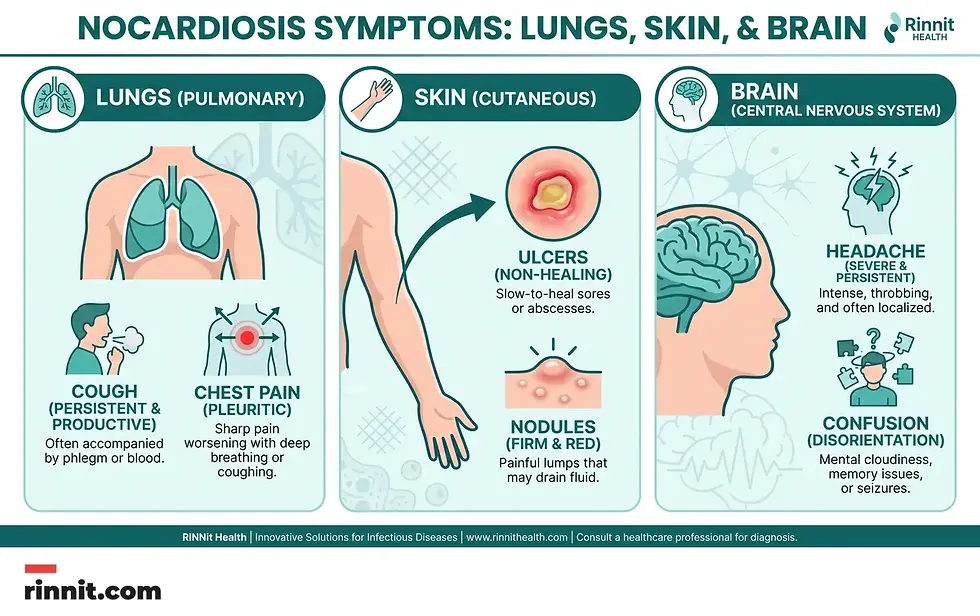
Symptoms depend on which part of the body is infected. The lungs and skin are the most common sites.
Lung and whole-body symptoms
A lung infection can look like other breathing illnesses. Common signs are a cough, chest pain, and shortness of breath. People may also have fever, night sweats, unexplained weight loss, and fatigue that gets worse over time. [1]
Skin symptoms
A skin infection may cause ulcers or sores that look like open wounds. They can be red or discolored, blistered, oozing, or crusted. [1] It can also cause bumps under the skin that are red, purple, or darker than the surrounding skin, and they can be painful. [1]
Brain symptoms
If the infection spreads to the brain, it can cause headache, nausea and vomiting, weakness, confusion, and seizures. [1] This is a serious complication that needs urgent care.
Who Is at the Highest Risk?
A weakened immune system is the main risk factor, because the body has a harder time fighting off bacteria from the environment.
High-risk group | Examples |
Transplant recipients | Solid organ transplants (especially lung or heart) and stem cell transplants (especially from a donor). [1] |
Chronic diseases | Cancer, diabetes, and HIV. [1] |
Lung conditions | Chronic lung disease such as COPD. [1] |
Medicines | Long-term immunosuppressant medicines for autoimmune diseases or other conditions. |
Complications can include spread to the brain, blood, skin, eyes, kidneys, bone, or muscles, as well as pneumonia, lung abscess, sepsis, respiratory failure, and organ failure. [1]
How is nocardiosis diagnosed and treated?
Doctors usually diagnose nocardiosis by growing the bacteria in a lab (culture) or by PCR testing of samples from the body. [1] They might test skin biopsies, sputum (mucus coughed up from the lungs), fluid collected from the lungs during a bronchoscopy, or a biopsy from a brain abscess. [1] A chest X-ray or CT scan can show how far an infection has spread in the lungs. [1]
Nocardiosis can be cured if it is treated right away. [1] The main treatment is antibiotics, often a combination, taken for 6 to 12 months. [1] Some people need them for more than a year to make sure the infection does not come back. Take every dose as prescribed, even if you feel better. People who have trouble breathing may also need extra oxygen or a ventilator, and very sick people may need to stay in the hospital. [1]
How can you prevent nocardiosis?
You can lower your nocardiosis risk by wearing gloves and a mask around dirt or dust, covering your skin, washing your hands often and treating wounds right away. [1]
Wear protective gear. Use gloves and a mask when working with dirt or dust.
Cover your skin. Wear clothing that covers your skin to help prevent cuts and scrapes.
Wash your hands. Wash often with soap and water, especially after being outdoors or working with dirt.
Treat wounds right away. Wash any cut with soap and water and cover it. If a wound is very deep, won't stop bleeding, or has dirt that won't wash out, get medical care right away. [1]
If you are an organ transplant recipient, your provider might also prescribe antibiotics to help prevent infections. [1]

When should you go to the emergency room for nocardiosis?
Go to the ER for nocardiosis if you have chest pain, difficulty breathing, confusion, seizures, a wound that won't heal or large dark blisters, since it can become life-threatening if it spreads. Go to the ER if you have any of these signs:
Chest pain or difficulty breathing
Confusion or an altered mental state
Seizures
A wound that won't heal or is getting bigger
Large blisters in the skin that are red, brown, dark green, or black
Foul-smelling fluid draining from blisters [1]
What is the bottom line on nocardiosis?
Nocardiosis is rare, but it can be serious, and it is treatable. Recovery takes months of steady antibiotic use, and most people can be cured when treatment starts early. If your immune system is weakened, protect your skin and lungs when you work with soil, treat cuts right away, and know the warning signs.
Have a weakened immune system? Ask your healthcare provider how to protect yourself, which symptoms to watch for, and when to go to the ER. A cough that won't go away, a skin sore that won't heal, or a new severe headache is worth a call to your care team.
Frequently Asked Questions
Is nocardiosis a type of fungus?
No. Nocardiosis is caused by Nocardia bacteria. It was sometimes mistaken for a fungal infection in the past because of how the bacteria grow.
Can I get nocardiosis from my pet?
Nocardiosis is not contagious. The usual sources are soil, dust, and cuts or wounds exposed to dirt. Pets are not listed as a source.
How long does it take to feel better?
Many people start to improve once treatment begins, but you must finish the full course, which is usually 6 to 12 months, even if you feel better. Stopping early can let the infection come back.
Can healthy people get nocardiosis?
Nocardiosis in healthy people is much less common, but it can happen in people with healthy immune systems. Most cases are in people whose immune systems are weakened.
What is the mortality rate?
Studies cited by Cleveland Clinic suggest a death rate between 15% and 40%. It depends on how severe or widespread the infection is and whether the immune system is weakened.
Does nocardiosis affect the eyes?
Yes. In some cases the infection spreads from the lungs to other parts of the body, including the eyes, brain, blood, skin, kidneys, bone, and muscles.
What kind of antibiotics are used?
Trimethoprim-sulfamethoxazole is usually the preferred first choice, and linezolid is an alternative. Severe cases may need a combination that includes drugs such as amikacin, imipenem, or a third-generation cephalosporin. The choice depends on the strain and lab testing.
Can I garden if I am immunocompromised?
Ask your doctor first. If they approve, wear gloves, a mask, and clothing that covers your skin, and wash your hands afterward.
Is there a vaccine for nocardiosis?
No. There is currently no vaccine to prevent Nocardia infections.
Can nocardiosis cause pneumonia?
Yes. Pneumonia is a known complication when the infection settles in the lungs.
What is a lung abscess?
A lung abscess is a pocket of pus that forms in the lung tissue as a result of infection.
How do doctors test for nocardiosis in the brain?
Doctors may take a biopsy of a brain abscess and use imaging such as a CT scan to look for infection.
Can diabetes increase my risk?
Yes. Diabetes is a known risk factor because it can weaken the body's ability to fight infection.
What should I do if I get dirt in a cut?
Wash the wound right away with soap and water and cover it. Watch it closely for signs of infection. If the wound is deep, won't stop bleeding, or has dirt that won't wash out, get medical care right away.
Why is the treatment so long?
Nocardia is hard to clear, and the infection can come back if treatment stops early. Most people need about 6 to 12 months, and some need longer, especially if the infection has spread or the immune system stays weakened.
Related Reading
Actinomycosis: What It Is, Why It Develops, and How It Is Treated explains a similar slow-growing bacterial infection and its treatment.
Sulfonamides (Sulfa Drugs): Uses, Full Drug List, Side Effects and Allergy Facts covers the sulfa antibiotics most often used to treat nocardiosis.
Immunocompromised: Understanding a Weakened Immune System explains why a weakened immune system raises the risk of infections.
Tuberculosis (TB): Symptoms, Causes, Testing, Treatment and Prevention covers a lung infection that can look like nocardiosis on scans.
References
Cleveland Clinic. Nocardiosis: Causes, Symptoms, Treatment & Prevention. Cleveland Clinic. Last updated March 4, 2025. https://my.clevelandclinic.org/health/diseases/nocardiosis
Harris DM, Dumitrascu AG, Chirila RM, et al. Invasive Nocardiosis in Transplant and Nontransplant Patients: 20-Year Experience in a Tertiary Care Center. Mayo Clin Proc Innov Qual Outcomes. 2021;5(2):298-307. PMID 33997629. https://doi.org/10.1016/j.mayocpiqo.2020.10.009
Soueges S, Bouiller K, Botelho-Nevers E, et al. Prognosis and factors associated with disseminated nocardiosis: a ten-year multicenter study. J Infect. 2022;85(2):130-136. PMID 35654278. https://doi.org/10.1016/j.jinf.2022.05.029
Margalit I, Lebeaux D, Tishler O, et al. How do I manage nocardiosis? Clin Microbiol Infect. 2021;27(4):550-558. PMID 33418019. https://doi.org/10.1016/j.cmi.2020.12.019
Medical disclaimer
This article is for general informational purposes only and does not constitute medical advice. Always consult a qualified healthcare professional for diagnosis and treatment decisions. If you are having a medical emergency, call your local emergency number right away.



Comments