Nissen Fundoplication: GERD Surgery, Risks and Recovery

Updated: 2 days ago
Written and medically reviewed by Dr. Baraa Alnahhal, MD · Last reviewed: November 2026 · How we review
Quick Answer
Nissen fundoplication is surgery for gastroesophageal reflux disease (GERD) in which the surgeon wraps the top of the stomach around the bottom of the esophagus to strengthen the valve that keeps acid out. It's used when other GERD treatments don't ease symptoms. Most surgeries are laparoscopic and take one to three hours. The main risk is symptoms returning.
What the research says
Surgery and medicine both controlled GERD long term: in the LOTUS trial of 554 people with chronic GERD, 85% were in remission at 5 years after laparoscopic antireflux surgery versus 92% on esomeprazole; surgery caused less regurgitation (2% vs. 13%) but more trouble swallowing (11% vs. 5%) and bloating (40% vs. 28%) (Galmiche JP et al., JAMA, 2011) [2]
Partial wraps caused fewer side effects: a meta-analysis of 7 trials with 792 patients found Nissen and Toupet wraps controlled reflux equally well, but Nissen caused more swallowing trouble (RR 1.61), more repeat surgery (RR 2.19) and more gas bloating (RR 1.58) (Broeders JA et al., British Journal of Surgery, 2010) [3]
Key takeaways
Nissen fundoplication wraps the stomach around the esophagus to stop reflux.
It's used when other GERD treatments haven't worked.
Most surgeries are laparoscopic and take one to three hours.
You'll eat soft foods for the first seven to 10 days.
Swallowing trouble and bloating can be long-term side effects.
What is Nissen fundoplication?
In GERD, the lower esophageal sphincter doesn't close well, so acid flows back up. Fundoplication reinforces this valve. It can ease GERD symptoms or make them go away. Sources: [1]
Why it's done
It's done for GERD in adults or children when other treatments don't ease symptoms. It also lowers the risk of Barrett's esophagus, which can lead to esophageal cancer. If you have a hiatal hernia, it's repaired during the same surgery. Sources: [1]
Types of fundoplication

Your surgeon chooses the best type for you.
Type | Wrap |
Nissen | 360 degrees, all the way around the esophagus |
Toupet | 270 degrees, around part of the back |
Dor | 180 degrees, halfway around the front, attached to the diaphragm |
Less invasive options for some people include TIF and the LINX procedure. Sources: [1, 3]
How to prepare
You may have tests such as esophageal manometry, GI X-rays, pH monitoring and upper endoscopy.
You may be told not to eat or drink after midnight before surgery. Sources: [1]
What happens during surgery
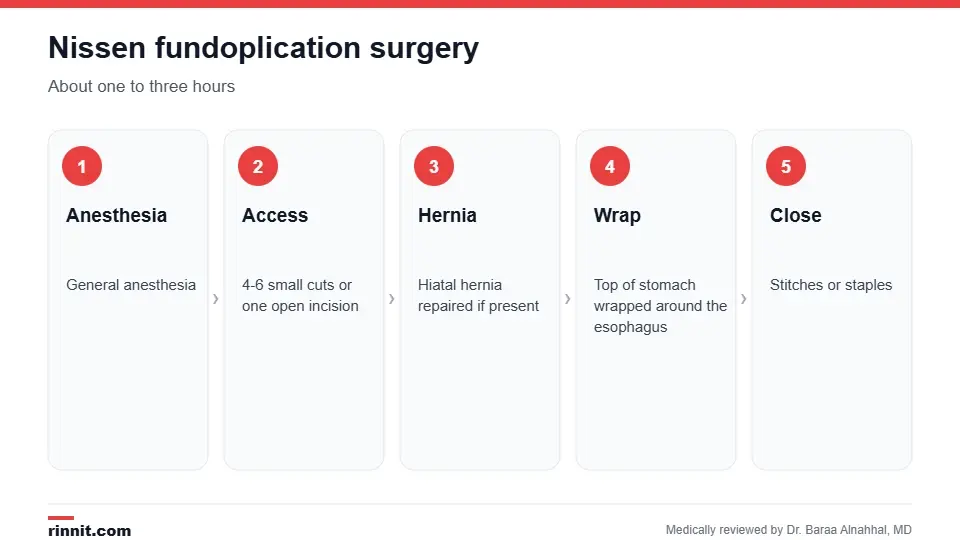
Surgery takes about one to three hours.
Approach | How it's done |
Laparoscopic | Four to six small cuts; a camera guides tiny tools; closed with stitches |
Open | One large cut in the belly; closed with staples |
You get general anesthesia, and surgery takes about one to three hours. Sources: [1]
Risks
Risk | Notes |
Symptoms returning | The main risk; one study found 10% needed a second surgery |
Infection | Possible |
Bloating | Possible long-term side effect |
Trouble vomiting | Possible long-term side effect |
Trouble swallowing (dysphagia) | Possible long-term side effect |
A sore throat is common after surgery. Sources: [1, 2, 3]
Recovery

Start with shakes and smoothies, then move to soft foods.
You'll stay in the hospital one or more days.
After open surgery, you may have a temporary nasogastric tube.
Take it easy for the first few days.
Eat soft foods for seven to 10 days, starting with protein shakes and smoothies, then yogurt, scrambled eggs and pasta.
Light exercise may be recommended for a few weeks.
Children may return to school in a few days but should avoid strenuous activity for at least three weeks. Sources: [1]
When to call your provider
Your incision bleeds more than expected.
Signs of infection, such as swelling, fever, redness or warm skin around the incision.
Your reflux symptoms return. Sources: [1]
Conclusion
Nissen fundoplication can bring long-term relief from GERD when medicines and lifestyle changes aren't enough. Following the soft-food plan and watching for side effects helps your recovery go smoothly.
Keep learning: read about GERD and hiatal hernia.
Frequently asked questions
What is Nissen fundoplication?
Surgery that wraps the top of the stomach around the esophagus to stop reflux.
Who needs Nissen fundoplication?
People with GERD whose symptoms don't improve with other treatments.
How long does surgery take?
About one to three hours.
Is it done laparoscopically?
Often, through four to six small cuts.
How long is the hospital stay?
One or more days.
What can I eat after surgery?
Soft foods for the first seven to 10 days.
Can reflux come back?
Yes. One study found 10% of people needed a second surgery.
What are the long-term side effects?
Bloating, trouble vomiting and trouble swallowing.
What's the difference between Nissen and Toupet?
Nissen is a full wrap; Toupet is a partial wrap with fewer side effects.
Is surgery better than medicine for GERD?
In one trial, both controlled GERD well over 5 years.
Related Reading
Acid Reflux & GERD: Symptoms, Causes, Diagnosis, and Treatment the condition the surgery treats.
Hiatal Hernia: Symptoms, Causes, and Treatment Options often repaired during fundoplication.
TIF Procedure (Transoral Incisionless Fundoplication): How It Works, Risks and Recovery an incision-free fundoplication.
LINX Procedure: A Modern Treatment for GERD a magnetic ring for GERD.
Heartburn: What It Is, Why Stomach Acid Causes the Burn, and How to Get Relief a common GERD symptom.
References
Cleveland Clinic. Nissen Fundoplication: Surgery, Complications & Recovery. Cleveland Clinic. Last updated June 20, 2025. https://my.clevelandclinic.org/health/treatments/4200-nissen-fundoplication
Galmiche JP, Hatlebakk J, Attwood S, et al. Laparoscopic antireflux surgery vs esomeprazole treatment for chronic GERD: the LOTUS randomized clinical trial. JAMA. 2011;305(19):1969-1977. PMID 21586712. https://doi.org/10.1001/jama.2011.626
Broeders JA, Mauritz FA, Ahmed Ali U, et al. Systematic review and meta-analysis of laparoscopic Nissen (posterior total) versus Toupet (posterior partial) fundoplication for gastro-oesophageal reflux disease. Br J Surg. 2010;97(9):1318-1330. PMID 20641062. https://doi.org/10.1002/bjs.7174
Medical disclaimer
This article is for general education only and does not replace advice from a qualified healthcare professional. Talk to your doctor about your own diagnosis and treatment, and seek emergency care right away for severe or sudden symptoms.



Comments