Nail-Patella Syndrome: Causes, Symptoms, and Management Strategies

Updated: 2 days ago
Medically reviewed by Dr. Baraa Alnahhal, MD · Last reviewed: October 2026
Quick Answer: Key Facts About Nail-Patella Syndrome
Nail-patella syndrome is a rare autosomal dominant genetic disorder caused by variants in the LMX1B gene, affecting roughly 1 in 50,000 people. [1] [3] Its main signs are missing or small kneecaps and abnormal fingernails. [1] It raises the risk of glaucoma, kidney disease and early-onset osteoarthritis, so care involves orthopaedic, kidney and eye specialists. [1]
What the research says
Kidney disease is common in NPS, but severe kidney failure is not. A review reported kidney disease in up to 40% of people with NPS and proteinuria in about one-third. Most had only an accelerated age-related loss of kidney filtration, while a small minority (5–10%) developed nephrotic-range proteinuria and progressed to end-stage kidney failure. (Lemley, Pediatr Nephrol, 2009) [4]
The same gene can cause kidney disease without nail or bone signs. A review found that some mutations in the homeodomain of LMX1B cause isolated nephropathy with no nail, patellar, or skeletal abnormality, so kidney checks matter even when the outward signs are mild. (Harita et al., Pediatr Nephrol, 2017) [5]
What Is Nail-Patella Syndrome?
Nail-Patella Syndrome (NPS), also known as Fong's disease or hereditary osteo-onychodysplasia (HOOD), is a rare hereditary condition that impacts the development of several body systems. It is primarily characterized by abnormalities in the skeletal system — specifically the kneecaps and elbows — and the fingernails. However, the condition can also involve internal organs, most notably the kidneys and the eyes. [1] [3]
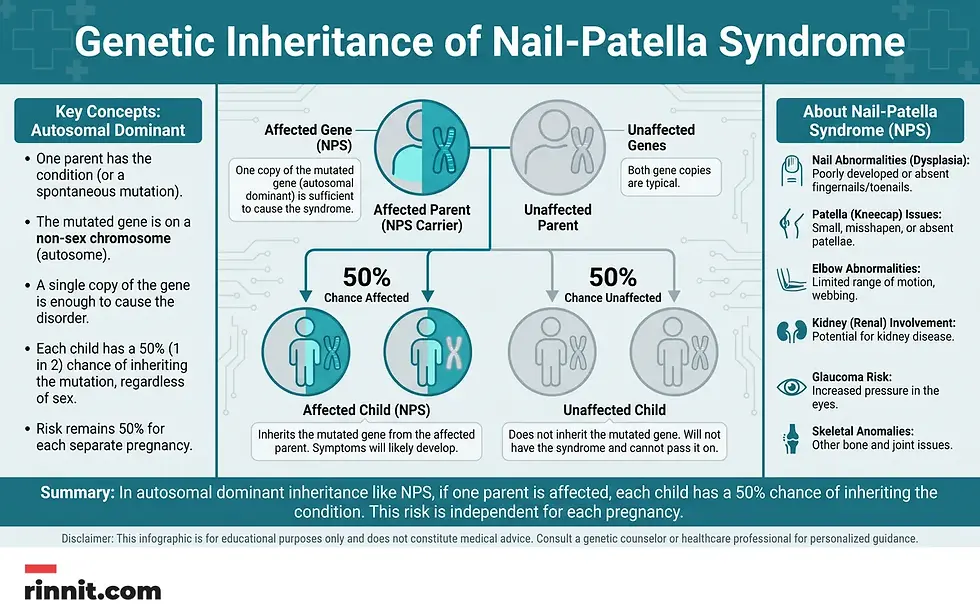
NPS is a genetic condition caused by variants in the *LMX1B* gene. This gene is responsible for producing a protein that acts as a blueprint for the development of limbs, kidneys, and eyes during fetal growth. [1] When this protein does not function correctly, these structures do not form as expected. The syndrome is inherited in an autosomal dominant pattern, meaning a child only needs to inherit one copy of the mutated gene from either parent to develop the condition. [1] [3]
What are the symptoms of nail-patella syndrome?
The signs of Nail-Patella Syndrome can vary significantly even among members of the same family. [3] While some individuals may have very mild symptoms, others may face more significant physical challenges.
Nail and Bone Abnormalities
Fingernail changes: The most common sign is underdeveloped, small, or entirely missing fingernails. The thumbs and index fingers are typically the most severely affected. [1] [3] Nails may appear ridged, pitted, or discolored. [3]
Kneecap (patella) issues: Many individuals have small, misshapen, or absent kneecaps. These are often positioned higher or further to the side than normal, leading to knee instability, pain, and frequent dislocations. [1]
Elbow and pelvic signs: Elbow abnormalities can limit the ability to fully extend or rotate the arms. [1] [3] A unique skeletal feature of NPS is the presence of "iliac horns" — small bony protrusions on the pelvic bone that can often be seen on X-rays. [3]

Internal and Systemic Involvement
Kidney health: Kidney disease may be present in up to 40% of people with NPS. [1] [4] This can range from mild protein in the urine to serious kidney disease that may eventually lead to kidney failure. [1]
Eye pressure: Increased pressure within the eye (ocular hypertension) is common and can progress to glaucoma if not monitored and treated. [1]
Other symptoms: Some individuals may experience decreased muscle mass, scoliosis, thin tooth enamel, or chronic constipation. [1]
How is nail-patella syndrome diagnosed?
Nail-patella syndrome is diagnosed with a physical exam for its classic features, supported by imaging, blood and urine tests, genetic testing and a family history. [1] Because NPS is rare, healthcare providers may use several diagnostic tools to confirm the condition and assess its impact:
Imaging tests: X-rays, CT scans, or MRIs are used to evaluate bone structure, particularly the kneecaps, elbows, and pelvis. [1]
Laboratory testing: Regular blood and urine tests are essential to monitor kidney function and detect early signs of kidney disease. [1]
Genetic testing: A DNA test can confirm the presence of a mutation in the LMX1B gene, providing a definitive diagnosis. [1]
Family history: Reviewing the health history of biological parents is crucial, as about 90% of cases are inherited. [1]
How is nail-patella syndrome managed and treated?
Nail-patella syndrome has no cure, so care focuses on managing symptoms and preventing long-term complications, often through a multidisciplinary team. [1]
Multidisciplinary Care
A team approach is often necessary for effective management. This team typically includes:

Daily Life and Support
Physical therapy: Can help improve joint stability and range of motion. [1]
Pain management: Various strategies, from medication to bracing, may be used to address chronic joint pain.
Regular monitoring: Lifelong screening for kidney and eye issues is vital for early intervention.
Genetic counseling: Families may benefit from counseling to understand the risks of passing the condition to future generations. [1]
Conclusion
Nail-Patella Syndrome is a complex condition that requires lifelong vigilance, particularly regarding kidney and eye health. However, with modern medical management and early intervention, most individuals with NPS lead full, active lives and usually have a normal life expectancy. [1] Understanding the genetic nature of the condition and working closely with a specialized medical team are the most important steps in navigating life with NPS.
Take the next step. If you or a family member has small or missing nails or kneecaps, ask your health care provider about an evaluation, including kidney and eye checks. For more expert resources on managing rare genetic conditions, keep exploring Rinnit.com.
Frequently Asked Questions
How rare is Nail-Patella Syndrome?
Nail-Patella Syndrome is estimated to affect approximately 1 in 50,000 people worldwide.
Can you have NPS without knowing it?
Yes. Some individuals have such mild symptoms — like slightly smaller nails — that they may go years or even their entire lives without a formal diagnosis.
Is the condition always inherited?
About 90% of cases are inherited from a parent. In the remaining 10%, the genetic mutation occurs spontaneously (de novo) in the individual.
Does NPS affect intelligence?
No. Nail-Patella Syndrome does not affect cognitive development or intelligence.
Can people with NPS have children?
Yes. However, there is a 50% chance of passing the genetic mutation to each biological child.
What are "iliac horns"?
Iliac horns are small, bilateral bony growths on the pelvic bone. They are a "pathognomonic" sign, meaning they are almost exclusively found in people with NPS.
Is kidney failure inevitable?
No. Kidney disease may be present in up to 40% of people with NPS, but only a small minority (about 5–10% in one review) progress to kidney failure. Regular monitoring is key.
Can surgery fix the kneecap issues?
In some cases, surgical procedures may be used to stabilize the kneecap or improve joint function, but this depends on the individual's specific anatomy.
Does NPS cause vision loss?
If increased eye pressure leads to glaucoma and remains untreated, it can cause permanent vision loss. Regular eye exams are essential.
Are there specific exercises for NPS?
Low-impact exercises that don't put excessive strain on the joints are often recommended, but you should consult a physical therapist for a personalized plan.
Why are the thumbs affected most?
The LMX1B gene plays a specific role in the development of the "dorsal" (top) side of the limbs, and the thumb is particularly sensitive to these developmental signals.
Can NPS be detected during pregnancy?
If the specific family mutation is known, prenatal genetic testing is possible.
Does the syndrome get worse with age?
While the genetic mutation doesn't change, complications like osteoarthritis or kidney issues can develop or progress as a person gets older.
Is there a special diet for NPS?
There is no specific diet, but maintaining a healthy weight is important to reduce stress on unstable joints, and a kidney-friendly diet may be recommended if renal issues are present.
Where can I find support for NPS?
Organizations like Nail Patella Syndrome Worldwide (NPSW) provide resources and community support for affected families.
Related Reading
Read next on Rinnit.com:
References
Cleveland Clinic. Nail-Patella Syndrome: Symptoms & Causes. Cleveland Clinic. February 12, 2025. https://my.clevelandclinic.org/health/diseases/nail-patella-syndrome
Hoover-Fong JE, et al. Nail-Patella Syndrome. In: GeneReviews®. Seattle (WA): University of Washington, Seattle; 1993. PMID 20301311. https://www.ncbi.nlm.nih.gov/books/NBK1132/
National Library of Medicine. Nail-patella syndrome. MedlinePlus. April 1, 2013. https://medlineplus.gov/genetics/condition/nail-patella-syndrome/
Lemley KV. Kidney disease in nail-patella syndrome. Pediatr Nephrol. 2009;24(12):2345-2354. PMID 18535845. https://doi.org/10.1007/s00467-008-0836-8
Harita Y, et al. Spectrum of LMX1B mutations: from nail-patella syndrome to isolated nephropathy. Pediatr Nephrol. 2017;32(10):1845-1850. PMID 27450397. https://doi.org/10.1007/s00467-016-3462-x
Medical disclaimer
This article is for general informational purposes only and should not be used as a substitute for professional medical advice, diagnosis, or treatment. Always seek the advice of your physician or other qualified health provider with any questions you may have regarding a medical condition.



Comments