Myokymia: Why Your Eyelid Twitches and When to Get Help

Updated: 2 days ago
Medically reviewed by Dr. Baraa Alnahhal, MD · Last reviewed: October 2026
Quick Answer: What is myokymia?
Myokymia is slow, uncontrollable eyelid twitching that causes gentle, rippling muscle contractions. It is very common and usually harmless, and many cases improve within days or weeks when factors such as poor sleep, caffeine, stress or dry eyes are addressed. See a provider if twitching lasts for weeks, spreads beyond the eyelid or interferes with daily life.
What the research says
Direct research on everyday eyelid myokymia is limited, and medicines are an occasional trigger. A case report described a 39-year-old woman with distressing one-sided eyelid twitching who was not a smoker, drinker or caffeine abuser and had no evident stress, sleep deprivation or eye strain. The twitching stopped when metformin was discontinued and returned when it was reintroduced, and her vitamin B12 level was borderline low (Ahsan and Nizami, Indian J Pharmacol, 2024). This is a single case, not evidence of how common the effect is. [1]
A persistent or worsening pattern is the reason clinicians look further. A case report described a 58-year-old woman with a 5-month history of gradually worsening one-sided facial spasms and mild lower eyelid twitching; MRI showed a high-grade glial mass. This is rare, and the authors emphasized that eyelid myokymia and hemifacial spasm are often underdiagnosed or misdiagnosed (Kakouri et al., Ophthalmic Plast Reconstr Surg, 2025). [2]
Botulinum toxin has been tested in randomized trials for blepharospasm, a related eyelid condition. In a Cochrane review of three trials (313 participants), a single botulinum toxin type A treatment reduced blepharospasm severity by 0.93 points on the Jankovic Rating Scale at four to six weeks compared with placebo (95% CI 0.61–1.25), but increased the risk of eyelid ptosis (RR 4.02, 95% CI 1.61–10.00) and vision complaints (RR 5.73, 95% CI 1.79–18.36). One trial estimated the effect lasted 10.6 weeks (range 6.1–19.1) (Duarte et al., Cochrane Database Syst Rev, 2020). [3]

What is myokymia?
Myokymia is a form of uncontrolled muscle movement that most commonly affects the eyelids. It produces slow, gentle and often rippling contractions that you may feel and may see in a mirror.
The term can describe twitching in other muscles, but it is most often used for eyelid myokymia. The eyelids connect with the brain through the facial nerve, the seventh of the 12 cranial nerves. Disruptions in the brain or facial nerve can create faulty signaling that leads to twitching.
Most eyelid myokymia is temporary and does not signal a dangerous problem. Rarely, it can be associated with a more serious condition, which is why a changing or disruptive pattern deserves medical attention.
What does myokymia feel like?
The key feature is a twitching sensation around the eye. The movement may be visible when you look in a mirror, but it can also be subtle enough that you mainly feel it.
Typical feature | What it may look or feel like |
Speed | Slow rather than rapid or forceful |
Movement | Gentle, constant or rippling, almost like waves on water |
Duration | Usually seconds to minutes; sometimes hours; rarely constant |
Location | Often one eye at a time, with the lower eyelid more commonly affected |
Spread | Both eyes can be involved; rarely, both upper and lower lids of one eye twitch |
Associated movement | In some cases, eyelid twitching can also make the eyeball move, a pattern called nystagmus |
What myokymia is not automatically telling you
An eyelid twitch alone does not identify its cause. The same symptom can occur after poor sleep, stress, caffeine use, dry eyes, nicotine use or heavy exertion, and it can also occur with medication effects, injury or nervous-system disease. A provider looks at the full pattern rather than one isolated twitch.
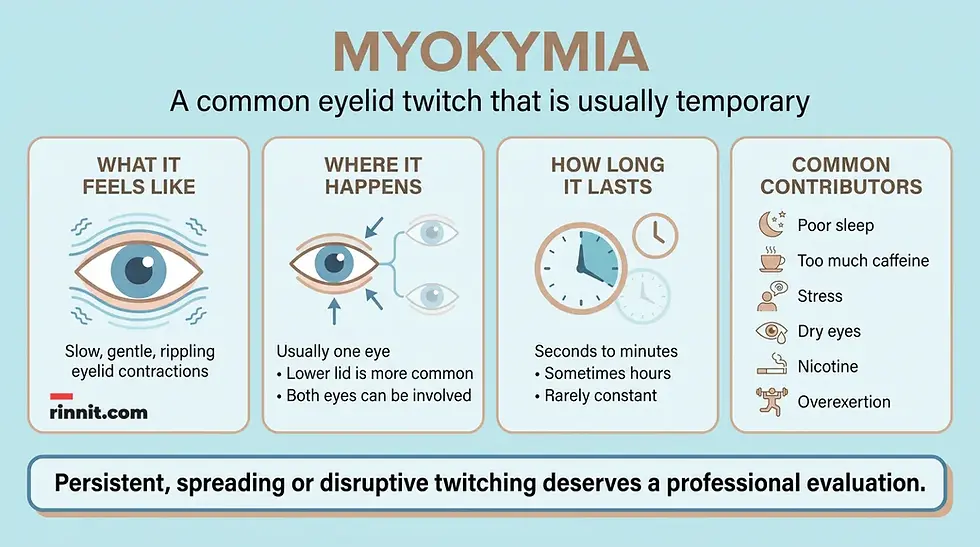
What causes and triggers eyelid twitching (myokymia)?
Myokymia can happen when the signaling pathway that controls the eyelid is disrupted or more excitable than usual. The most common contributors are everyday factors that affect sleep, alertness, eye comfort or the nervous system.
Possible contributor | How it may fit the pattern |
Tiredness or sleep deprivation | Twitching may appear when you are not getting enough quality sleep |
Caffeine | Intake, especially too much, can contribute to twitching |
Nicotine | Smoking, vaping or smokeless nicotine products may contribute |
Dry eyes | Eye-surface discomfort may occur alongside twitching |
Severe fatigue or overexertion | Heavy physical or mental demands may precede episodes |
Stress | Emotional or physical stress may contribute |
Medication effects | Some medicines affect the nervous system and may be involved |
Less common causes include nerve or brain injuries, nervous-system diseases such as demyelinating diseases including multiple sclerosis, and tumors or other growths. These possibilities do not mean that a routine eyelid twitch is caused by a serious disease. They are part of the wider evaluation when the pattern does not behave like a brief, self-limited episode.
When should you get medical advice?
Most myokymia does not need urgent treatment, but get a clinical evaluation if the twitching lasts for weeks, becomes constant, spreads across the face or interferes with daily activities. It is reasonable to arrange a clinical evaluation when the twitching:
Does not go away after a few weeks.
Happens more often or lasts longer than it used to.
Becomes constant.
Spreads from the eyelid to other parts of the face.
Interferes with work, reading, driving or another usual activity.
Occurs alongside an eyeball movement or another change that concerns you.
A clinician can help determine whether the twitching is likely to be ordinary eyelid myokymia, whether a medication or health issue may be contributing, and whether another specialist should be involved.
If you have sudden, severe or rapidly changing symptoms beyond the typical eyelid twitch, seek prompt medical care rather than relying on self-care alone.
How is myokymia diagnosed?
An eye care specialist or another healthcare provider can usually evaluate eyelid myokymia with a physical exam and a neurological exam. The provider may watch the twitching, ask about its timing and pattern, and look for signs that suggest another cause.
Additional testing is more likely when twitching lasts longer, disrupts usual activities, spreads, becomes more frequent or gets worse. In those circumstances, a provider may recommend imaging such as a CT scan or MRI.
What to track before an appointment
A brief symptom record can make the visit more useful. Note when the twitching began, which eyelid is involved, how long episodes last, how often they occur and whether they spread. It can also help to record recent changes in sleep, caffeine, nicotine, stress, dry-eye symptoms, exertion or medication.
Do not stop a prescribed medicine on your own. If you think a medication may be contributing, ask the prescribing clinician whether a change is appropriate.
How is myokymia treated?
Treatment depends on how long the twitching lasts, how much it affects daily life and whether another condition or medication is contributing.
Address possible contributors
For many people, the first approach is to reduce factors that may contribute to twitching. Options may include limiting caffeine, improving sleep quality, managing stress, limiting alcohol and reducing or quitting nicotine. Reducing overexertion and addressing dry-eye concerns may also be part of a broader care plan.
These steps are not a guarantee that twitching will stop immediately. They are practical ways to address common contributors while you watch the pattern.
Review medicines with a provider
If a medication appears to be involved, a healthcare provider may recommend changing to another medicine. Any medication change should be guided by the clinician who prescribed it or another qualified provider.
Injections for persistent or disruptive twitching
Medication injections may be an option when myokymia is consistent, lasts for at least three months or interferes with daily routines. Neurotoxins such as onabotulinumtoxinA temporarily block nerve signals traveling to the eyelids. The injections are placed around the eye just beneath the skin, not into the eye itself.
These medicines temporarily paralyze the related muscles, so twitching is reduced or stopped until the effect wears off. Treatment decisions should be individualized by a qualified clinician.
If a more serious condition is involved
When myokymia is linked to another condition, treatment focuses on that underlying issue. The appropriate plan depends on the finding and may involve another specialist.

How long does myokymia last?
Episodes commonly last seconds to minutes, although some people experience twitching for hours. Rarely, the movement becomes constant.
Most cases go away within days or weeks without treatment. If twitching continues beyond a few weeks, occurs more often, spreads or disrupts your routine, arrange an evaluation.
When onabotulinumtoxinA is used, it usually begins working within a few days, and many people notice an effect after about a week. The average effective period is about 79 days, although the duration can vary by a few weeks in either direction.
Can myokymia be prevented?
Myokymia has no single prevention method that stops every episode, because it can have different contributors. However, steps that address common triggers may reduce the chance of developing it or reduce recurrence.
Prevention focus | Practical direction |
Sleep | Aim for enough quality sleep and address sleep deprivation |
Caffeine | Limit intake, especially if you notice a connection with twitching |
Nicotine | Reduce or quit smoking, vaping and smokeless nicotine products |
Stress | Use stress-management strategies that are realistic for your routine |
Eye comfort | Discuss persistent dry eyes with an eye care specialist |
Exertion | Balance heavy activity with adequate rest and recovery |
Follow-up | Seek evaluation when the twitching persists, spreads, worsens or becomes disruptive |
How is myokymia related to other facial movements?
Eyelid myokymia usually remains limited to the eyelid. If the movement spreads to other parts of the face, a provider may consider related movement conditions such as blepharospasm, hemifacial spasm or Meige syndrome.
These conditions are not interchangeable with a routine eyelid twitch. A change in location, frequency or severity is a reason to arrange an evaluation rather than assume the same trigger is responsible.
What questions should you ask about myokymia at an appointment?
Useful questions about myokymia include whether it is eyelid myokymia or another facial movement, which triggers or medicines may contribute and whether an exam or scan is needed.
Does this pattern look like eyelid myokymia or another facial movement?
Could sleep, caffeine, nicotine, dry eyes, stress or exertion be contributing?
Could one of my medicines be involved?
Do I need a physical exam, neurological exam, CT scan or MRI?
What changes should prompt follow-up?
If treatment is appropriate, what benefits, limitations and side effects should I understand?
Conclusion
Myokymia is usually a common, temporary eyelid twitch that feels more alarming than it is. Brief, gentle rippling episodes often improve within days or weeks, especially when poor sleep, caffeine, stress, dry eyes, nicotine use or overexertion are addressed.
Persistent, spreading, worsening or disruptive twitching deserves a closer look. An eye care specialist or another healthcare provider can evaluate the pattern, rule out other causes and discuss treatment if self-care is not enough.
Frequently Asked Questions
Is myokymia the same as an eyelid twitch?
Myokymia is the medical term most often used for a slow, uncontrollable eyelid twitch that creates gentle, rippling contractions. Not every eyelid twitch has the same cause, so a provider may use the full symptom pattern to decide whether it fits myokymia or another condition.
Is myokymia dangerous?
Most eyelid myokymia is harmless and temporary. It is worth arranging an evaluation if it lasts longer, becomes constant, happens more often, spreads beyond the eyelid, worsens or interferes with your usual activities.
Why does my eyelid twitch when I am tired?
Tiredness and sleep deprivation are common contributors to myokymia. Other common contributors include caffeine, nicotine, dry eyes, severe fatigue, overexertion and stress.
Can stress cause eyelid twitching?
Stress may contribute to myokymia. Managing stress and improving sleep may help, although persistent twitching should still be evaluated rather than attributed to stress automatically.
Should I stop caffeine to treat myokymia?
Limiting caffeine may help if caffeine is contributing to the twitching. A gradual, practical reduction may be easier to maintain. If twitching persists or is disruptive, ask a healthcare professional for an evaluation.
How long should I wait before seeing a provider?
Most episodes go away within days or weeks. Arrange an evaluation if the twitching does not go away after a few weeks, becomes more frequent or constant, spreads, worsens or interferes with daily life.
What tests might be used for myokymia?
A physical exam and neurological exam are commonly used. If the twitching is longer-lasting, more disruptive, spreading or worsening, a provider may recommend imaging such as a CT scan or MRI.
Can myokymia affect both eyes?
Yes. It usually affects one eye at a time, but both eyes can be involved. The lower eyelid is more commonly affected, and rarely both upper and lower lids of one eye twitch.
Can myokymia make the eyeball move?
In some cases, eyelid twitching can also make the eyeball move. This is called nystagmus and should be discussed with an eye care specialist or another healthcare provider.
Can myokymia be treated with injections?
For persistent or disruptive cases, a provider may consider injections using a neurotoxin such as onabotulinumtoxinA. The injections are placed around the eye beneath the skin, not into the eye, and their effect is temporary.
Related Reading
Blepharospasm: The Uncontrollable Eyelid Spasms That Can Force Your Eyes Shut — and How Treatment Keeps Them Open explains a stronger, ongoing eyelid spasm that needs medical care.
What Is Benign Fasciculation Syndrome? Symptoms, Causes, Diagnosis, and Treatment Explained explains harmless muscle twitching in other parts of the body.
Dry Eyes: Symptoms, Causes, Treatment & Relief — Complete Guide explains dry eye, a common trigger for eyelid twitching.
Botox Injections: Uses, Results, Side Effects and Aftercare explains injections sometimes used for persistent eyelid twitching.
References
Ahsan M, Nizami DJ. Metformin-induced eyelid myokymia. Indian J Pharmacol. 2024;56(5):358-360. PMID 39687960. https://doi.org/10.4103/ijp.ijp_284_24
Kakouri A, Chen Y, McCulley TJ. Isolated hemifacial spasm as the presenting sign of cerebral glioblastoma. Ophthalmic Plast Reconstr Surg. 2025;41(2):e71-e73. PMID 39660646. https://doi.org/10.1097/IOP.0000000000002838
Duarte GS, Rodrigues FB, Marques RE, et al. Botulinum toxin type A therapy for blepharospasm. Cochrane Database Syst Rev. 2020;11(11):CD004900. PMID 33211907. https://doi.org/10.1002/14651858.CD004900.pub3
Disclaimer
This article is for general educational purposes and is not a substitute for professional medical advice, diagnosis or treatment. Always seek the advice of a qualified healthcare professional with any questions about a medical condition or treatment.
An eye care specialist or another healthcare provider can assess persistent, spreading, worsening or disruptive twitching. Do not use this article to diagnose yourself or to stop or change a medicine.



Comments