What Is Myasthenia Gravis? A Plain-Language Guide to This Muscle Weakness Condition

Updated: 1 day ago
Medically reviewed by Dr. Baraa Alnahhal, MD · Last reviewed: October 17, 2026
Quick Answer
Myasthenia gravis is a condition in which nerve-to-muscle communication fails, causing muscles to weaken and tire easily, with weakness improving after rest and returning with use. [1] It is diagnosed through a neurological exam, antibody blood tests and nerve stimulation testing. [2] There is no cure, but treatment, from medication to thymus gland surgery, can significantly improve strength and daily life.
What the research says
Removing the thymus gland improved outcomes in a landmark trial. In 126 people aged 18 to 65 with generalized, nonthymomatous, antibody-positive MG, thymectomy plus prednisone beat prednisone alone over 3 years: average disease-severity score 6.15 vs. 8.99 (lower is better), alternate-day prednisone dose 44 mg vs. 60 mg, need for azathioprine 17% vs. 48%, and hospitalization for exacerbations 9% vs. 37%. (Wolfe et al., New England Journal of Medicine, 2016 [6])
A newer targeted therapy helped far more people respond than placebo. In a phase 3 trial of 167 adults with generalized MG, 68% (44 of 65) of antibody-positive patients on efgartigimod had a sustained improvement of at least 2 points on the MG-ADL daily-living scale in the first treatment cycle, versus 30% (19 of 64) on placebo (odds ratio 4.95, 95% CI 2.21–11.53). (Howard et al., The Lancet Neurology, 2021 [7])
MG affects roughly 12 in every 100,000 people worldwide. A meta-analysis of 63 studies estimated a global prevalence of 12.4 per 100,000 people (95% CI 10.6–14.5). (Salari et al., Journal of Translational Medicine, 2021 [8])
Ocular MG becomes generalized in a sizable share of people, but estimates vary widely. In a systematic review and meta-analysis of 31 studies of people who first had only eye symptoms, the proportion who developed generalized MG ranged from 11% to 84%, with a pooled proportion of 39% (95% CI 32%–47%; low-certainty evidence). Anti-acetylcholine receptor antibody positivity was associated with conversion (pooled RR 1.30, 95% CI 1.05–1.56; very low certainty). (Fang et al., Neurology, 2023 [9])
In children, MG often starts in the eyes, and crisis and remission both occur. In a pooled analysis of 11 studies of 1,109 patients with juvenile MG, 60.6% had ocular symptoms first and ptosis was the most common initial presentation (77.7%). A history of myasthenic crisis was reported in 10.6%, and completely stable remission was achieved in 23.7%. (Lin et al., Front Neurol, 2023 [10])
Evidence comparing newer targeted therapies is still limited. In a Bayesian network meta-analysis of 13 randomized trials (872 participants) of 10 targeted drugs for generalized MG, only batoclimab significantly reduced the quantitative MG score compared with placebo; the authors noted wide credible intervals because of small numbers of studies and participants and called for more long-term research. (Ma et al., CNS Drugs, 2024 [11])
What Is Myasthenia Gravis (MG)?
Myasthenia gravis is a condition that happens when communication between nerves and muscles breaks down. This causes muscles to feel weak and get tired quickly. [1]
The condition may affect any of the muscles you control — called voluntary muscles. Certain muscle groups are more commonly affected than others. These include the muscles in the face, throat, arms, and legs. [1]
Your eyelids may droop, you may have double vision or trouble speaking and eating, and you may have difficulty holding up your head because of weak neck muscles. Myasthenia gravis can happen at any age. [1] It is more common in people younger than 40 who were assigned female at birth, and in people older than 60 who were assigned male at birth. [1] [3]
There is no way to prevent or cure myasthenia gravis. But treatment can help manage symptoms. [1]
With treatment, most people with myasthenia gravis live to an average life expectancy, and some go into remission, either temporarily or permanently. [3]

Myasthenia gravis happens when antibodies block the receptor sites on muscle cells — so the nerve's chemical messenger (acetylcholine) cannot get through, and the muscle receives fewer signals. Restored with rest, this signal gap is why weakness comes and goes.
What Does the Weakness Feel Like?
Symptoms of myasthenia gravis may come and go. They usually get better when the weak muscle is rested but get worse again when the muscle is used. [1] Symptoms often progress and may be at their worst one or two years after the disease begins. [1]
Eye muscles. In more than half of people with myasthenia gravis, the first symptoms involve the eye muscles. This includes drooping of one or both eyelids, called ptosis, and double vision, called diplopia. The double vision may affect horizontal or vertical vision, and it may improve or stop when one eye is closed. [1]
Face and throat muscles. In about 15% of people, the first symptoms involve the face and throat muscles. This can make it hard to speak (soft or nasal speech), swallow (choking easily, difficulty eating, drinking, or taking pills, and liquid occasionally coming out of the nose), and chew (the chewing muscles may tire halfway through a meal — especially when eating something hard to chew, such as steak). It can also affect facial expressions, so a person might struggle to fully raise their eyebrows or hold a smile because the muscles tire quickly. [1]
Neck and limb muscles. The condition also may cause weakness in the neck, arms, and legs. These symptoms may happen later as the condition worsens. [1] Weakness in the legs can affect how you walk, and weak neck muscles can make it hard to hold up your head. [1]
First-Symptom Area | How Common | What People Notice |
Eye muscles | More than half of people with MG | Drooping eyelids (ptosis), double vision (diplopia) that may clear when one eye is closed |
Face and throat muscles | About 15% of people with MG | Soft or nasal speech, choking or trouble swallowing, chewing muscles tiring mid-meal, harder-to-control facial expressions |
Neck, arms, and legs | Often appears later, as MG worsens | Trouble holding up the head, difficulty walking, weakness in the arms and legs |
What Causes Myasthenia Gravis?
The exact cause of myasthenia gravis is not known, but it is an autoimmune condition — a condition in which the immune system creates antibodies that mistakenly attack healthy cells or tissue. Antibodies are proteins that normally help fight unhealthy or foreign substances in the body, such as bacteria or viruses. [1]
In myasthenia gravis, the immune system mistakenly makes antibodies that stop the neurotransmitter acetylcholine from communicating with muscles. [1] Nerves communicate with muscles by releasing chemicals called neurotransmitters that send signals between cells. In MG, the antibodies destroy or block the path to muscle cells called receptor sites. With fewer receptor sites available, the muscles receive fewer nerve signals — and this causes muscle weakness. [1]
Myasthenia gravis also may happen when antibodies block proteins called MuSK (muscle-specific receptor tyrosine kinase) or LRP4 (lipoprotein-related protein 4). These proteins work together to form strong connections between nerve cell signals and muscles. When antibodies block MuSK or LRP4, the signal between nerves and muscles is limited or does not get through, leading to muscle weakness. [1]
A type of myasthenia gravis called seronegative myasthenia gravis — also known as antibody-negative myasthenia gravis — happens when no known antibodies are found. [1] Researchers generally believe this type is still caused by issues with the immune system, but the antibodies involved are not yet known.
The thymus gland's role. The thymus gland is part of the immune system and sits in the upper chest beneath the breastbone. Researchers believe it makes or helps make the antibodies that block acetylcholine. [1] The thymus is large in babies and small in healthy adults. [1] In some adults with myasthenia gravis, the thymus is larger than usual, and some people with MG also have tumors of the thymus gland called thymomas. These tumors are cancer, but they usually are not malignant — meaning they typically do not spread throughout the body — and they may be removed with surgery. [1]
Rare forms affect children: children born to people with myasthenia gravis may rarely have the condition at birth (neonatal myasthenia gravis), and with immediate treatment they usually recover within two months after birth. [1] Some children are born with a rare hereditary form called congenital myasthenic syndrome, which is often treated with medicine to manage symptoms.
Other guidance puts recovery from neonatal myasthenia gravis at two to three months after birth. Congenital myasthenic syndrome is caused by gene changes and is not an autoimmune disorder. [3]
What Makes Symptoms Get Worse?
Myasthenia gravis symptoms can worsen with fatigue, illness, surgery, stress, certain medicines, pregnancy and menstrual periods. [1]
Fatigue
Illness or infection
Surgery
Stress
Some medicines, including beta blockers, quinidine gluconate and quinine sulfate (such as Qualaquin), phenytoin (such as Dilantin), and some anesthetics and antibiotics
Pregnancy
Menstrual periods
Who Is at Higher Risk?
Certain factors may increase the likelihood of having myasthenia gravis, although its exact cause is not fully understood.
Risk Factor | What the Evidence Shows |
Genetics | A personal or family history of autoimmune conditions may put you at higher risk [1] |
Thymus gland issues | Having an enlarged thymus or a thymoma may play a role [1] |
Age and sex assigned at birth | More common in people younger than 40 assigned female at birth, and in people older than 60 assigned male at birth |
Lifestyle and health | Stress, infections, and some medicines may trigger the condition in some people [1] |
These factors increase the risk but do not mean you will get myasthenia gravis.
What Complications Can Happen?
Complications of myasthenia gravis are treatable, but some can be life-threatening. The most serious is myasthenic crisis — a life-threatening condition that happens when the muscles that control breathing become too weak to work. [1] Emergency treatment and mechanical assistance with breathing are needed, and medicines and therapies that filter the blood help people breathe on their own. [1]
About 15% to 20% of people with myasthenia gravis have at least one myasthenic crisis. [3]
Some people with myasthenia gravis also have tumors in their thymus glands (thymomas) under the breastbone. Most of these tumors are not malignant — meaning they likely will not spread — and can be removed with surgery. [1]
People with myasthenia gravis often have other autoimmune conditions as well. The table below explains each one in plain language.
Associated Condition | What It Is, in Plain Terms |
Thyroid disease | The thyroid is a gland in the neck that helps manage metabolism (how the body uses energy). If it is too active or not active enough, you may struggle with body temperature, weight, and other symptoms [1] |
Rheumatoid arthritis | A condition that causes inflammation and pain, typically in the bones of the joints [1] |
Lupus | A condition in which the immune system attacks healthy tissues throughout the body, potentially damaging the skin, joints, kidneys, heart, and brain — with symptoms ranging from fatigue and joint pain to kidney inflammation |
How Is Myasthenia Gravis Diagnosed?
A healthcare professional will talk to you about your symptoms, review your medical history, and perform a physical exam. They also perform a neurological exam, which may test reflexes, muscle strength, muscle tone, the senses of touch and sight, coordination, and balance. [2]
Several other tests may be used to confirm the diagnosis:
Test | What It Does |
Ice pack test | For a droopy eyelid, a bag of ice is placed on the eyelid for two minutes. If the eyelid is less droopy afterward, this can point to MG [2] |
Blood test | May show the antibodies that interrupt the receptor sites where nerves signal muscles to move [2] |
Repetitive nerve stimulation | Electrodes on the skin send small pulses of electricity to a nerve to measure whether it can send signals to the muscle; the nerve is tested several times to see if signaling worsens with fatigue [2] |
Single-fiber electromyography (EMG) | A fine wire electrode is inserted through the skin into a muscle to measure electrical activity traveling between the brain and that single muscle fiber [2] |
Imaging (CT scan or MRI) | Checks for a tumor or other concerns with the thymus gland [2] |
Pulmonary function tests | Measure whether the condition is affecting breathing [2] |
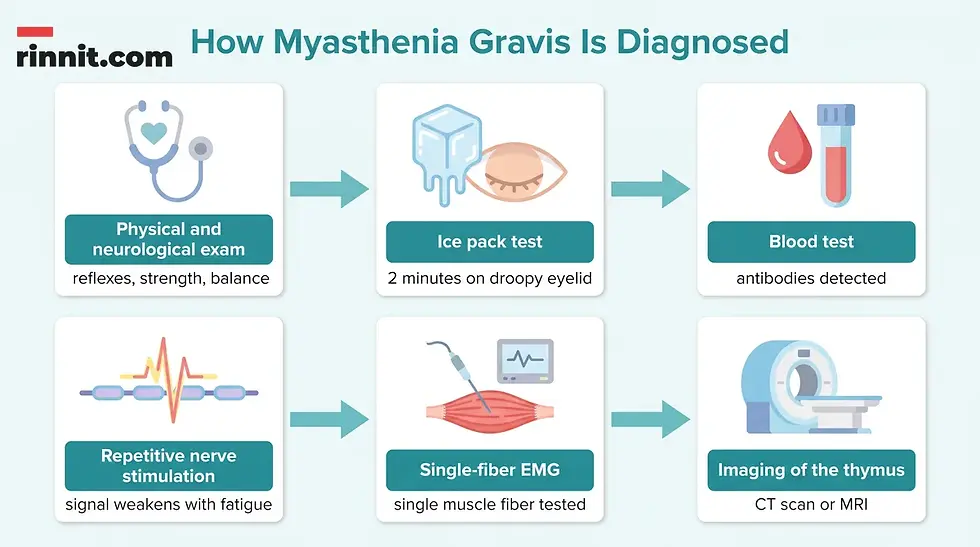
Diagnosis combines a physical and neurological exam with up to six supporting tests — including the simple ice pack test and blood testing for the antibodies that interrupt nerve-to-muscle signals.
How Is Myasthenia Gravis Treated?
Various treatments, alone or together, can help with symptoms. Your treatment depends on your age, how severe your disease is, and how fast it is progressing. [2]
Medicines
Cholinesterase inhibitors. Medicines such as pyridostigmine (Mestinon, Regonol) improve communication between nerves and muscles. These medicines are not a cure, but they may improve muscle contraction and strength in some people. Possible side effects include gastrointestinal upset, diarrhea, nausea, and too much saliva and sweat. [2]
Corticosteroids. Medicines such as prednisone block the immune system, making it less able to produce antibodies. Long-term use can lead to serious side effects, including bone thinning, weight gain, diabetes, and a higher risk of some infections. [2]
Immunosuppressants. Other medicines that change the immune system may be prescribed, including azathioprine (Azasan, Imuran), mycophenolate mofetil (Cellcept), cyclosporine (Sandimmune, Gengraf, and others), methotrexate (Trexall), or tacrolimus (Astagraf XL, Prograf, and others). These can take months to work and might be used with corticosteroids. Side effects such as a higher risk of infection and liver or kidney damage can be serious. [2]
Intravenous (IV) Therapies
These therapies are usually used for a short time to treat symptoms that suddenly get worse, and also may be used before other therapies or surgery. [2]
Plasmapheresis uses a blood-filtering machine similar to the one used for dialysis to remove the antibodies that block signals from nerve endings to your muscles. The benefits usually last only a few weeks, and having the procedure several times can make it hard to find veins for further treatments. Risks include a drop in blood pressure, bleeding, heart rhythm conditions, muscle cramps, and occasionally an allergic reaction to the solutions used to replace the plasma. [2]
Intravenous immunoglobulin (IVIG) provides your body with typical antibodies, which alters the immune system response. Benefits are usually seen in less than a week and can last 3 to 6 weeks. [2] Side effects are usually mild and may include chills, dizziness, headaches, and fluid retention. [2]
Rituximab (Rituxan) is a medicine injected into a vein that works by targeting proteins on B-cells. [2] Similar B-cell-depleting monoclonal antibodies may increase over time. These medicines are usually used when other treatments do not work, and they can have serious side effects. [2]
Newer Targeted Therapies
Neonatal Fc receptor blockers stick to and block a protein called the neonatal Fc receptor, which lowers the amount of certain antibodies in the body — including the ones that cause MG symptoms. Examples include efgartigimod (Vyvgart), given through an IV or injection every week for 4 weeks (usually repeated several times), and rozanolixizumab (Rystiggo), given as an injection under the skin every week for 6 weeks (usually repeated several times). [2]
Molecular therapies target specific molecules in a cell and work on a part of the immune system called the complement system. These include eculizumab (Soliris) and ravulizumab (Ultomiris), given through an IV every 2 to 6 weeks (you must have a meningococcus vaccination or be on antibiotics to prevent meningococcus infection) [2], and zilucoplan (Zilbrysq), a daily at-home injection that blocks a harmful protein and helps stop muscle damage. Newer therapies called FcRN receptor blockers target a protein in the cells that breaks down the harmful antibodies more quickly. CAR T-cell therapy is being studied for people with MG who do not respond to standard therapies. [2]
Surgery: Removing the Thymus Gland
Some people with myasthenia gravis have tumors in their thymus glands — called thymomas. If you have a thymoma, you will likely need surgery to remove the thymus gland, a procedure called a thymectomy.
Even if you don't have a thymus tumor, removing the gland might improve your symptoms — though it may take years to see the benefits. [2] The surgery can be done as open surgery (the surgeon splits the breastbone, called the sternum) or as minimally invasive surgery:
Video-assisted thymectomy: a small opening in the neck or a few small openings in the side of the chest, using a long, thin camera called a video endoscope and small instruments. [2]
Robot-assisted thymectomy: several small openings in the side of the chest, using a robotic system with a camera and mechanical arms. [2]
Minimally invasive surgeries may cause less blood loss and less pain, may increase survival rates, and may shorten hospital stays. [2] Your surgeon decides the best approach based on your thymus gland, tumor, and overall health.

Treatment works on three levels — medicines that improve nerve-muscle communication, short-term IV therapies for sudden worsening, and surgery to remove the thymus gland that drives the immune attack. Treatment choice depends on your age, how severe the disease is, and how fast it is progressing.
How Can I Protect My Energy at Home?
People with myasthenia gravis can save energy by adjusting eating routines, making the home safer, using electric tools, wearing an eye patch for double vision and planning ahead.
Adjust your eating routine. Try to eat when you have good muscle strength. Take your time chewing your food and take a break between bites. You might find it easier to eat small meals several times a day. Also, try eating mainly soft foods and avoid foods that require more chewing, such as raw fruits or vegetables. [2]
Use safety precautions at home. Install grab bars or railings where you need support, such as next to bathtubs or stairs. Keep floors clean and move area rugs to prevent tripping. Outside your home, keep paths, sidewalks, and driveways cleared of leaves, snow, and other debris. [2]
Use electric appliances and power tools. To save your energy, try an electric toothbrush, electric can openers, and other electrical tools. [2]
Wear an eye patch. If you have double vision, an eye patch can help. Try wearing one to write, read, or watch television, and switch the eye patch to the other eye regularly to help reduce eyestrain. [2]
Plan ahead. If you have chores, shopping, or errands to do, plan the activity for times during the day when you typically have the most energy. [2]
When Should I Call 911?
Call 911 (or your local emergency number) or seek emergency care immediately if you have sudden trouble breathing — this may be a myasthenic crisis, a life-threatening condition in which the muscles that control breathing become too weak to work. It requires emergency treatment and mechanical assistance with breathing. [1]
What is the bottom line on myasthenia gravis?
Myasthenia gravis is a condition in which the immune system mistakenly interrupts the signals between nerves and muscles, causing weakness that comes and goes with activity. The eyes, face, throat, neck, arms, and legs are most often affected. There is no cure, but there is real help: medicines that improve nerve-muscle communication, immune-modifying treatments, short-term blood-filtering therapies, and surgery on the thymus gland can all improve strength and quality of life. The most important first step is getting medical advice for persistent or worsening weakness — especially trouble breathing, swallowing, or double vision — because early, steady treatment can make a meaningful difference.
Take the Next Step
Bring this guide to your appointment. If you notice weakness that improves with rest but returns with use — drooping eyelids, double vision, trouble swallowing or chewing, or a hard-to-hold head — don't wait it out. See your healthcare professional and bring your full symptom list. Early diagnosis matters because myasthenia gravis is very treatable, and people who get treated usually get back to a much more comfortable, capable daily life.
Frequently Asked Questions
What is myasthenia gravis?
Myasthenia gravis is an autoimmune condition in which the immune system creates antibodies that block or destroy the receptor sites on muscle cells, so the nerve's chemical messenger (acetylcholine) cannot get through. This makes muscles weak and quick to tire, especially the muscles of the eyes, face, throat, neck, arms, and legs.
Why does the weakness come and go?
Weakness usually gets better when the tired muscle is rested and gets worse again when the muscle is used. With fewer receptor sites available, the muscles receive fewer nerve signals — and those signals recover when the muscle rests.
Is myasthenia gravis the same as chronic fatigue?
No. MG causes weakness in specific voluntary muscles that worsens with use and improves with rest, often starting with the eyes (drooping eyelids or double vision). Fatigue alone, without specific muscle weakness, has many other possible causes.
How is myasthenia gravis diagnosed?
Through a physical and neurological exam (testing reflexes, strength, tone, senses, coordination, and balance) plus supporting tests: an ice pack test on a droopy eyelid, a blood test for antibodies, repetitive nerve stimulation, single-fiber EMG, imaging of the thymus (CT or MRI), and pulmonary function tests.
Is myasthenia gravis life-threatening?
The most serious complication — myasthenic crisis — happens when the muscles that control breathing become too weak to work, requiring emergency treatment and mechanical breathing assistance. It is treatable, which is why sudden trouble breathing needs immediate emergency care.
Can myasthenia gravis be cured?
There is no way to prevent or cure it. But treatment — from cholinesterase inhibitors to IV therapies and thymus gland surgery — can significantly manage symptoms and improve strength.
Does removing the thymus gland help?
If you have a thymoma (a thymus tumor, usually not malignant), surgery to remove the thymus — called a thymectomy — is likely. Even without a tumor, removing the gland might improve symptoms, though it may take years to see the benefits. Minimally invasive versions of the surgery may mean less pain, less blood loss, and shorter hospital stays.
What can I do at home to manage symptoms?
Eat soft foods at small, frequent meals when your strength is best; install grab bars and clear tripping hazards; use electric appliances to save energy; wear an eye patch (switching eyes regularly) for double vision; and plan errands around the times of day when you typically have the most energy.
Related Reading
If you found this guide helpful, explore these related Rinnit.com articles:
References
Mayo Clinic Staff. Myasthenia gravis - Symptoms & causes. Mayo Clinic. June 5, 2026. https://www.mayoclinic.org/diseases-conditions/myasthenia-gravis/symptoms-causes/syc-20352036
Mayo Clinic Staff. Myasthenia gravis - Diagnosis & treatment. Mayo Clinic. June 5, 2026. https://www.mayoclinic.org/diseases-conditions/myasthenia-gravis/diagnosis-treatment/drc-20352040
National Institute of Neurological Disorders and Stroke. Myasthenia Gravis. NINDS. March 13, 2026. https://www.ninds.nih.gov/health-information/disorders/myasthenia-gravis
Myasthenia Gravis Foundation of America. Overview of MG. MGFA. Accessed October 15, 2026. https://myasthenia.org/understanding-mg/overview-mg/
Hehir MK, et al. Diagnosis and Management of Myasthenia Gravis. Continuum (Minneap Minn). 2022;28(6):1615-1642. PMID 36537972. https://doi.org/10.1212/CON.0000000000001161
Wolfe GI, et al. Randomized Trial of Thymectomy in Myasthenia Gravis. N Engl J Med. 2016;375(6):511-522. PMID 27509100. https://doi.org/10.1056/NEJMoa1602489
Howard JF, et al. Safety, efficacy, and tolerability of efgartigimod in patients with generalised myasthenia gravis (ADAPT): a multicentre, randomised, placebo-controlled, phase 3 trial. Lancet Neurol. 2021;20(7):526-536. PMID 34146511. https://doi.org/10.1016/S1474-4422(21)00159-9
Salari N, et al. Global prevalence of myasthenia gravis and the effectiveness of common drugs in its treatment: a systematic review and meta-analysis. J Transl Med. 2021;19(1):516. PMID 34930325. https://doi.org/10.1186/s12967-021-03185-7
Fang CEH, Bokre D, Wong SH. Clinical characteristics associated with secondary generalization in patients with ocular myasthenia gravis: a systematic review and meta-analysis. Neurology. 2023;101(16):e1594-e1605. PMID 37643888. https://doi.org/10.1212/WNL.0000000000207642
Lin Y, Kuang Q, Li H, et al. Outcome and clinical features in juvenile myasthenia gravis: a systematic review and meta-analysis. Front Neurol. 2023;14:1119294. PMID 36970540. https://doi.org/10.3389/fneur.2023.1119294
Ma Y, Nie X, Zhu G, et al. The efficacy and safety of different targeted drugs for the treatment of generalized myasthenia gravis: a systematic review and Bayesian network meta-analysis. CNS Drugs. 2024;38(2):93-104. PMID 38300476. https://doi.org/10.1007/s40263-024-01062-7
Medical disclaimer
This article is for general informational purposes only and does not constitute medical advice. Always consult a qualified healthcare professional for diagnosis and treatment decisions.



Comments