Misophonia: Symptoms, Causes, and Coping Strategies

Updated: 2 days ago
Medically reviewed by Dr. Baraa Alnahhal, MD · Last reviewed: October 2026
Misophonia is a disorder in which you have a decreased tolerance to specific sounds, and to things you can sense (see, touch and so on) that are related to them. Trigger sounds cause intense, sometimes overpowering emotions such as anger, anxiety or disgust. Misophonia does not yet have official recognition as a distinct disorder, but experts recognize it, and a formal consensus definition now exists for research, diagnosis and treatment [1].
Quick Answer: What is misophonia?
Misophonia is a condition in which specific trigger sounds, such as chewing, breathing or tapping, cause unusually strong emotional, physical and behavioral fight-or-flight reactions. It can develop at any age, most often in the early teens, and its cause is unknown. It is not directly dangerous, and while therapy cannot cure it, therapy and sound-masking tools help people cope. [1]
What the research says
Brain imaging shows altered activity in the auditory cortex and salience network. In a study of 21 patients with misophonia and 23 matched controls, misophonia-related video clips triggered anger, disgust and sadness, and the emotional changes were associated with increases in heart rate. Brain scans showed increased activation of the right insula, right anterior cingulate cortex and right superior temporal cortex when patients watched the misophonic clips compared with neutral clips (Schröder et al., Sci Rep, 2019 [2]).
A cognitive-behavioral program helped about half of treated youth in a small trial. In a randomized trial of 43 youth with misophonia, 10 telehealth sessions of a transdiagnostic cognitive-behavioral therapy (UP-C/A; n = 29) were compared with psychoeducation and relaxation training (n = 14). Overall, 47% of youth were treatment responders, including 54% with UP-C/A versus 25% with psychoeducation and relaxation. UP-C/A produced greater improvement on some but not all outcome measures, and the authors called for larger trials with follow-up (Lewin et al., Behav Ther, 2026 [3]).
Distress intolerance may be one way therapy works. In the same 43 youth, greater distress intolerance and anxiety sensitivity were linked to more severe misophonia before treatment. Distress intolerance improved more with UP-C/A than with psychoeducation and relaxation, and that improvement helped explain the drop in misophonia symptoms. The authors described the findings as preliminary (Cepeda et al., J Clin Psychol, 2026 [4]).
What is misophonia, and how is it defined?
Misophonia is a disorder where you have a decreased tolerance to specific sounds and the things you can sense related to them. Some people have only one trigger sound, while others have several. Reactions also vary in severity: some people cannot control the emotions they feel but can control their responses, some cannot control either and react impulsively, and in the most severe cases people may be unable to do certain things or be in specific environments [1].
The American Psychiatric Association does not yet recognize misophonia in the DSM-5, but in 2022 an expert committee created a consensus definition for research, diagnosis and treatment [1].
Who it affects and how common it is
Misophonia can affect anyone but seems to be more common in women, with estimates ranging from 55% to 83% of cases. It can develop at any age but is most likely to develop in the early teen years. Available research indicates it may affect approximately 1 in 5 people during their lifetime [1].
What are common misophonia triggers?
Any sound can trigger misophonia, but some are much more likely to. Sounds on TV, radio or other devices can also trigger it, though the reaction may not be as intense as when the source is close to you [1].
Sound type | Examples |
Eating and drinking noises | Smacking lips; chewing (especially with the mouth open) food or gum; crunching; slurping; loud swallowing or gulping. |
Breathing noises | Snoring, sniffling or nose blowing; heavy breathing. |
Activity and movement noises | Tapping fingers or toes; clicking a pen; loud typing; eating utensil sounds. |
Mouth and throat noises | Throat clearing; coughing; loud kissing. |
Other | Ticking (watch or clock); plumbing (toilet flushing or water dripping); ringing (bell or phone); animal sounds; rustling (paper or plastic). |
What are the fight-or-flight symptoms of misophonia?
The symptoms of misophonia revolve around how you react to trigger sounds, and the reactions all seem to fall under the natural fight-or-flight instincts. They can be emotional, physical or behavioral. When symptoms are less severe, you may only have emotional and body reactions, and when they are more severe you may also have a behavioral reaction [1].
Emotional reactions
Anger
Anxiety
Disgust
Fear
Irritation, which can escalate rapidly into anger or even rage
Body reactions
Blood pressure increases
Chest pressure or tightness
Goosebumps
Heart rate increases
Sweating
Behavioral reactions
Avoiding situations where trigger sounds can happen
Leaving the area when a trigger sound happens
Verbal or vocal reactions, such as talking or yelling at whoever or whatever made the sound
Non-violent action to stop the sound
Violent action to stop the sound (rare)
In very severe cases, a person may react so strongly that they do not have time to think before behaving in a way that upsets others. It is common to recognize and regret this afterward, but still struggle to control similar reactions in the future [1].

Trigger sounds can cause emotional, physical and behavioral reactions.
What causes misophonia, and who is at risk?
Experts do not know what causes misophonia, but they suspect a combination of factors: brain structure differences, other conditions, and family history or genetics [1].
Brain structure differences
People with misophonia are more likely to have certain differences in brain structure and activity, including more connections and activity in and between areas of the brain that control how you process sounds and manage emotions. Cleveland Clinic compares it to turning on a radio left at maximum volume: the sudden intense noise can instinctively and mistakenly send you into fight-or-flight mode [1].

Misophonia is linked to an exaggerated response between auditory and emotional regions of the brain.
Associated conditions
Misophonia is more likely to happen in people with certain conditions [1]:
Neurodivergent conditions and other brain disorders: ADHD, autism spectrum disorder and Tourette syndrome.
Mental health conditions: major depressive disorder, OCD, PTSD and borderline personality disorder.
Hearing-related conditions or symptoms: hearing loss, tinnitus and hyperacusis.
It is also more common in people who have obsessive-compulsive traits but do not fully meet the criteria for OCD. Just under 24% of people with these traits also have misophonia [1].
Family history and genetics
There is evidence that misophonia may run in families, and experts think at least one genetic mutation plays a role, but more research is needed to confirm this [1].
How is misophonia diagnosed?
A healthcare provider can recognize the most common features of misophonia by asking about what you experience, and based on your answers can tell you whether you seem to have it. However, that is not the same as a formal diagnosis [1].
How can misophonia be managed, and what coping strategies help?
Misophonia is not an officially recognized condition, but its effects can still be treated with psychotherapy, coping strategies and tools like earplugs or noise-canceling headphones. Because of its similarities and links to conditions such as OCD and PTSD, people with misophonia may benefit from psychotherapy. Therapy cannot cure it, but it can help you [1]:
Identify your triggers
Find ways to minimize or prevent trigger sounds
Develop coping strategies to avoid impulsive reactions to trigger sounds
Reduce your sensitivity to existing triggers
Treatments for related conditions, such as anxiety or OCD, may also help with misophonia symptoms, and your provider can tell you what they recommend [1].
Other things that may help
Earplugs or noise-canceling headphones or earbuds
Listening to something to keep your brain's hearing-related processes focused on something other than listening for a trigger sound
Noise generator sounds, especially white, pink or brown noise
Workplace accommodations, such as headphones provided by your employer or adjustments in policy that help you avoid triggers
Online and social media groups where people with misophonia share tips and resources
Your healthcare provider may be able to provide resources to help you acquire workplace accommodations [1].
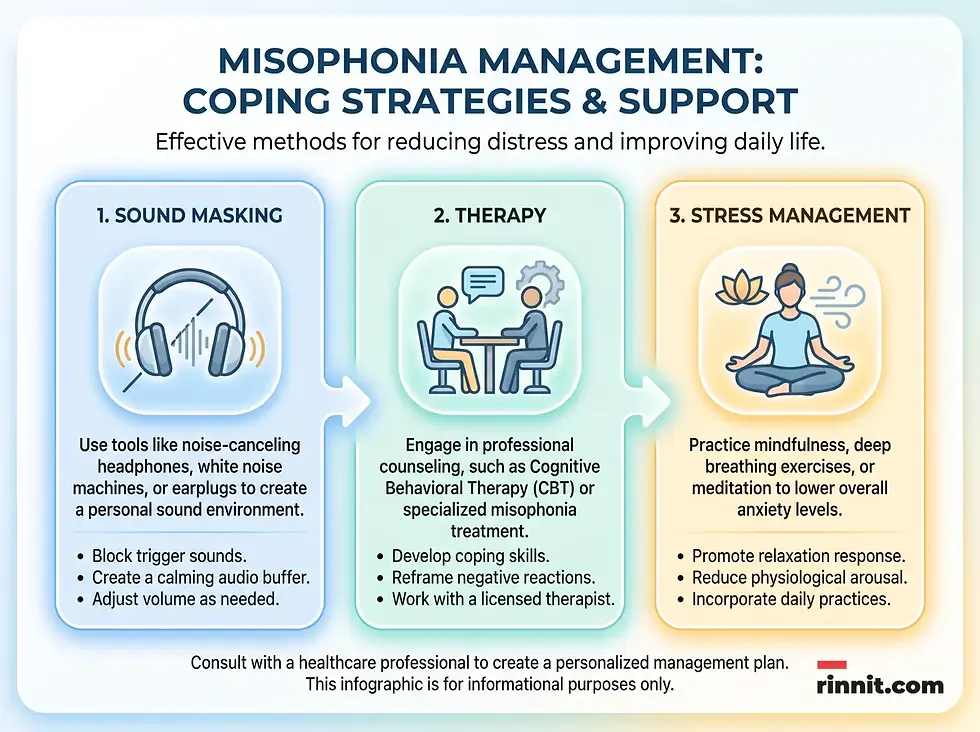
Sound masking, therapy and stress management can all be part of a coping plan.
What is the outlook for misophonia, and can it be prevented?
When misophonia is mild, it may be a minor concern, and you can control your reactions and your emotions quickly. In more severe cases, the reactions can feel overwhelming, and the fight-or-flight behaviors can be very hard, if not impossible, to control. Your reaction to trigger sounds may worsen over time, and you may develop reactions to new triggers [1].
Available research indicates that misophonia is a lifelong condition, but more research is needed to confirm that. It is not dangerous or life-threatening directly, but it can negatively affect your mental health, relationships and well-being. Misophonia happens unpredictably and for unknown reasons, so there is no way to prevent it or reduce your risk of developing it [1].
When should you see a provider about misophonia?
Misophonia may be unpleasant or annoying but often is not severe enough to disrupt your life. If your symptoms disrupt your social or professional activities, talk to a healthcare provider, who can help you learn more or find a specialist [1].
When to get help right away: people with severe misophonia, especially those with other mental health conditions, may have a higher risk of self-harm or suicidal thoughts. If you have thoughts like this, get help immediately. In the United States you can call or text 988, local crisis lines may offer help elsewhere, and you can call 911 or your local emergency number if you or someone you know is in immediate danger [1].
What is the bottom line on misophonia?
Misophonia is more than a simple dislike of noise. It is a real condition that can be troubling, and some trigger sounds are so common it can feel like there is no escape. More research is needed on how to diagnose and treat it, but you can learn ways to manage it and limit its effects, so you can focus more on what you enjoy and worry less about sounds you dislike [1].
Frequently Asked Questions
What is misophonia?
Misophonia is a disorder where you have a decreased tolerance to specific sounds, and to things you can sense that are related to them, leading to intense emotional and physical reactions [1].
Is misophonia a formal diagnosis?
Not yet. The DSM-5 does not recognize it, but an expert committee created a consensus definition in 2022 for research, diagnosis and treatment [1].
How common is misophonia?
Available research indicates it may affect approximately 1 in 5 people during their lifetime [1].
Does misophonia affect men and women differently?
Misophonia seems to be more common in women, with estimates ranging from 55% to 83% of cases occurring in women [1].
What are the most common triggers?
Common triggers include eating and drinking noises such as smacking and slurping, breathing noises, and activity noises such as pen clicking or typing, along with throat sounds and others such as ticking or rustling [1].
Can misophonia cause physical symptoms?
Yes. Body reactions can include increased heart rate and blood pressure, sweating, chest tightness and goosebumps [1]. In a brain imaging study, emotional reactions to trigger clips were associated with increases in heart rate [2].
Is misophonia related to OCD or anxiety?
Misophonia is more common in people with obsessive-compulsive traits (just under 24% of people with these traits also have misophonia), and it is more likely in people with OCD. Anxiety and misophonia are distinct, but they can be linked and people can have both [1].
Can children have misophonia?
Yes. It can develop at any age, but it is most likely to develop in the early teen years [1]. A small randomized trial in youth found that cognitive-behavioral therapy helped about half of those treated [3].
How is misophonia managed?
Management can include psychotherapy, earplugs or noise-canceling headphones, noise generator sounds, focusing your hearing on something else, and workplace accommodations. Treating related conditions may also help [1].
Is there a cure for misophonia?
Mental health therapies cannot cure a condition like misophonia, but they can help you identify triggers, cope and reduce your sensitivity. Experts need more research before agreeing on the best treatments [1].
Related Reading
Understanding Hyperacusis: When Everyday Sounds Become Unbearable explains a related condition where normal sounds feel too loud or painful.
What Is Tinnitus? A Plain-Language Guide to Ringing in the Ears explains ringing or buzzing in the ears and how it is managed.
Cognitive Behavioral Therapy (CBT): What It Is, What It Treats and What to Expect describes the talk therapy most often used to manage misophonia.
Anxiety Disorders: Symptoms, Types, Causes, Treatment & Complete Guide covers anxiety conditions that often occur alongside misophonia.
References
Cleveland Clinic. Misophonia. Cleveland Clinic. June 20, 2023. https://my.clevelandclinic.org/health/diseases/24460-misophonia
Schröder A, van Wingen G, Eijsker N, et al. Misophonia is associated with altered brain activity in the auditory cortex and salience network. Sci Rep. 2019;9(1):7542. PMID 31101901. https://doi.org/10.1038/s41598-019-44084-8
Lewin AB, Milgram L, Cepeda SL, et al. Treatment of youth misophonia: a randomized controlled trial comparing transdiagnostic cognitive-behavioral therapy to psychoeducation and relaxation training. Behav Ther. 2026;57(1):63-78. PMID 41620246. https://doi.org/10.1016/j.beth.2025.04.006
Cepeda SL, Milgram L, Bigler ME, et al. Impacts of distress intolerance and anxiety sensitivity on the maintenance and treatment of youth misophonia. J Clin Psychol. 2026;82(5):676-689. PMID 41557948. https://doi.org/10.1002/jclp.70095
Medical disclaimer
This article is for informational purposes only and is not a substitute for professional medical advice, diagnosis, or treatment. The clinical information in this guide reflects source material last reviewed in June 2023.



Comments