Understanding Mast Cells: The Body’s Primary Alarm System

Updated: 3 days ago
Medically reviewed by Dr. Baraa Alnahhal, MD · Last reviewed: October 2026
Mast cells are immune cells that act as your body’s alarm system. They watch for harmful invaders such as parasites and, when they recognize one, send signals that open blood vessels, fill tissues with fluid, and contract muscles in the airways and gut. Sometimes they activate when they should not, which causes allergic reactions [1].
Quick Answer: What are mast cells?
Mast cells are immune cells made in the bone marrow that mature in tissues throughout the body. When they detect pathogens, toxins or allergens, they release chemicals such as histamine to alert other immune cells. When overactive, they can cause allergies, allergic asthma and anaphylaxis, and rarely disorders such as mast cell activation syndrome (MCAS) and mastocytosis. [1]
What the research says
Mast cell activation is normal, and the problem is activation out of proportion to the threat. A review describes mast cell activation as common and possibly necessary for survival, and defines mast cell activation syndrome as a group of disorders with episodic multisystem symptoms caused by mast cell mediator release, with many areas still needing research (Akin, J Allergy Clin Immunol, 2017 [2]).
Omalizumab may help people whose MCAS does not respond to standard treatment. A systematic review of 9 studies covering 28 patients with refractory MCAS (75% non-clonal, 25% clonal) found that 61% had a partial response and 5 patients had a complete response to omalizumab, with no major adverse events reported; this is a small body of mostly case-level evidence (Matheny et al., Allergy Asthma Proc, 2025 [3]).
A common genetic trait can raise tryptase levels. A review describes hereditary alpha-tryptasemia as a common trait caused by extra copies of the TPSAB1 gene that accounts for most baseline serum tryptase levels above 8 ng/mL, diagnosed by tryptase genotyping; its link to mastocytosis and to severe anaphylaxis is still debated (Rama and Gulen, Curr Allergy Asthma Rep, 2026 [4]).
What Are Mast Cells?
Mast cells are part of your immune system. They are made in your bone marrow, then move through your bloodstream into your tissues. The mature mast cells live in tissues throughout your body to help protect you from hazards around you, and they can help fight infections and regulate your organs [1].
When your mast cells are overprotective, you may react to harmless things in your environment, as happens in people with seasonal allergies or allergic asthma. Mast cell activation can sometimes cause anaphylaxis, a serious allergic reaction [1].
Feature | Description |
Origin | Bone marrow. |
Journey | They move through the bloodstream into tissues, where they mature. |
Where they live | Tissues throughout the body, mostly the airways, lungs, and GI tract, and around blood vessels and nerves. Very few are found in the bloodstream. |
Main role | Detecting harmful invaders and sending alarm signals to other immune cells. |
What is the anatomy of mast cells, and where are they found?
Unlike most white blood cells, very few mast cells are found in your bloodstream. You are most likely to be exposed to something harmful by inhaling it, eating it, or getting it through a break in your skin, which is why mast cells are mostly found in the tissues of your airways and lungs and your GI tract. They also surround your blood vessels and nerves [1].
A mast cell has a nucleus surrounded by hundreds of granules, which are storage pouches. The granules hold chemical messengers called mediators that signal your body when something might harm you [1].
Key Chemical Mediators
Histamine: opens up your blood vessels so fluid and immune cells can enter your tissues, constricts your airways and GI tract, and creates mucus, all to force out pathogens [1].
Proteases (including tryptase, chymase, and carboxypeptidase A): enzymes that break down proteins, including connective tissue, so immune cells can move into the area more easily [1].
Cytokines and chemokines: small proteins that signal immune cells to multiply, make blood vessels “sticky” to catch immune cells and guide them into tissues, and recruit cells to clean up and repair damage [1].
Heparin: prevents blood clots, which helps keep blood vessels open [1].
Mast cells also have many receptors on their surface, specially shaped proteins that fit with signaling proteins like a lock and key. The best known is the IgE receptor, but mast cells also have receptors for other antibodies such as IgG and receptors that directly detect pathogens (toll-like receptors) [1].
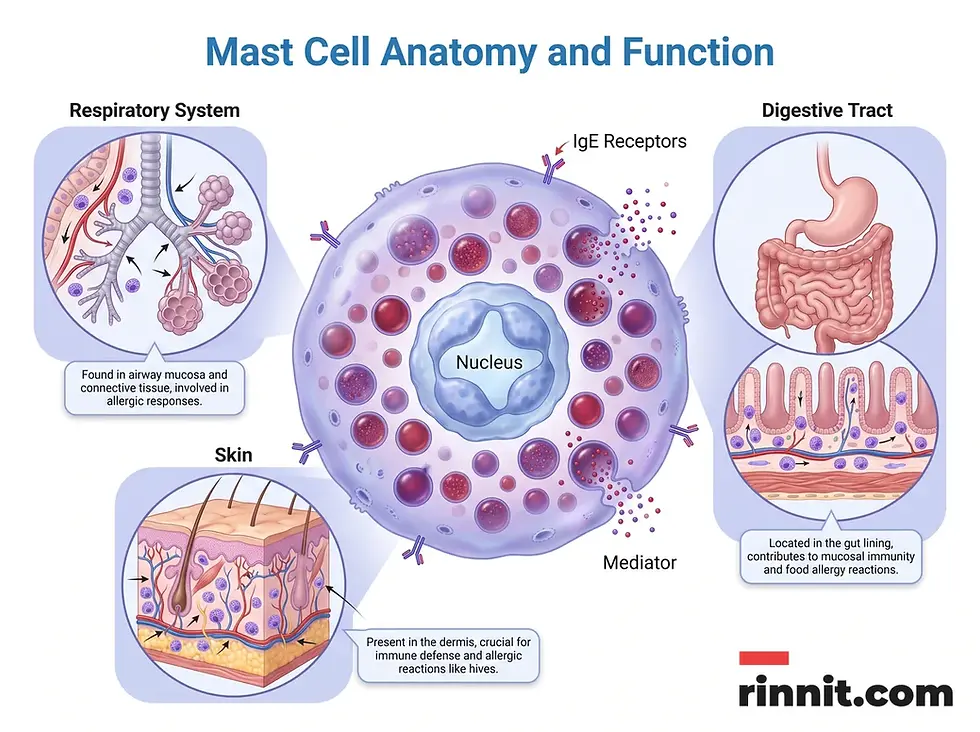
Mast cells sit in the airways, skin, and gut, ready to release mediators when they are activated.
How do mast cells work?
Mast cells stand guard, ready to start a quick response. Their surface receptors act like antennas that pick up immune signals. When your B cells identify an invader, they make large amounts of antibodies against it, and immunoglobulin E (IgE) is the antibody that alerts mast cells. IgE latches onto the IgE receptors on mast cells, and the next time the same pathogen or allergen enters your body, the IgE catches it like a fishing lure and switches the mast cell on [1].
The Degranulation Process
Once switched on, mast cells release histamine and their other mediators from their granules (degranulation). This triggers a series of events that [1]:
Open blood vessels and break down connective tissue, so immune cells can move into the area.
Fill tissues with fluid (swelling), which brings in immune cells and moves invaders out to your lymph nodes to be destroyed.
Create mucus.
Contract smooth muscles that line your airways and GI tract in a wave-like motion to push out harmful substances.
This can make your skin flushed, swollen, or itchy, give you a runny nose, sneezing, and coughing, and even cause diarrhea or vomiting. In extreme cases, it can cause swelling of the airways and a life-threatening drop in blood pressure (severe anaphylaxis). Anaphylaxis is an emergency: use an epinephrine auto-injector if you have one and call 911 [1].

IgE on a mast cell catches an allergen, and the mast cell releases histamine, which causes symptoms in the lungs, gut, and skin.
What roles do mast cells play in homeostasis?
Beyond defense, mast cells help regulate your tissues and organs and keep them in balance (homeostasis). They play a role in blood vessel growth, bone growth, and cell growth and repair in your airways [1].
What are the common and rare mast cell disorders?
Common mast cell disorders include environmental allergies, asthma, food allergies, and hives [1]. Some rare disorders include [1]:
Condition | Characteristics |
Mast cell activation syndrome (MCAS) | Repeated episodes of allergic or anaphylaxis symptoms without a known trigger. |
Mastocytosis | Too many mast cells build up in the body. |
Hereditary alpha-tryptasemia | A condition you are born with that causes higher levels of tryptase, an enzyme mast cells make. Most people with this genetic condition have no symptoms. |
Symptoms of Mast Cell Activation
The histamine released in mast cell disorders can lead to symptoms such as [1]:
Discolored, hot, or itchy skin.
Swelling (edema).
Shortness of breath.
Episodes of anaphylaxis.
How are mast cell disorders evaluated and treated?
If your provider thinks you have a mast cell disorder, they might check for signs of mast cell activation in your urine, blood, bone marrow, or skin. They might also do an allergy skin test or blood tests to identify triggers, and a lab may do genetic testing to look for inherited conditions that could cause your symptoms [1].
Management Strategies
Treatment depends on your symptoms and what is causing them. It might include [1]:
Avoiding known triggers.
Medications to manage symptoms: antihistamines, acid reducers, and leukotriene-modifying medications such as montelukast.
Mast cell stabilizers: medications that prevent mast cells from degranulating.
Medications to reduce or treat anaphylactic episodes: epinephrine and omalizumab.
Cytoreductive therapy or chemotherapy: providers sometimes use chemotherapy medications to treat aggressive mastocytosis.

Managing mast cell health combines trigger avoidance with medical treatment and emergency care.
Are Mast Cells Good or Bad?
Most people have never heard of mast cells until they are making them sick, so it is easy to think they are bad. But mast cells defend your body against harmful invaders and help regulate your organs, so most of the time they are good [1].
What is the bottom line on mast cells?
Mast cells are a vital but often overlooked part of your health. As your body’s alarm system, they protect you from pathogens and toxins and help regulate your organs, and they cause problems mainly when they are too enthusiastic [1].
Your next step: if you have recurring allergic symptoms or signs of mast cell activation, such as itchy or swollen skin, shortness of breath, or episodes of anaphylaxis, see a healthcare provider for an evaluation and a treatment plan that fits you [1].
Frequently Asked Questions
What is the main function of mast cells?
Mast cells act as an alarm system for the immune system, detecting harmful invaders such as pathogens and toxins and triggering protective responses.
Where are mast cells made?
Mast cells are made in the bone marrow, then move through the bloodstream into tissues such as the airways, lungs, and GI tract, where they mature.
What is degranulation?
Degranulation is the release of histamine and other chemical messengers from a mast cell’s storage granules when the cell is activated.
How do mast cells help with homeostasis?
Mast cells help regulate blood vessel growth, bone growth, and cell growth and repair in the airways.
What is the difference between mast cells and other white blood cells?
Unlike many white blood cells, mast cells do not destroy pathogens themselves. They sit in tissues and signal other immune cells when something harmful is present.
What triggers mast cell activation?
Triggers include pathogens such as viruses, bacteria, and parasites, toxins such as venom from bee stings or snake bites, and allergens that IgE antibodies recognize.
What is mast cell activation syndrome (MCAS)?
MCAS is a rare condition in which a person has repeated episodes of allergic or anaphylaxis symptoms without a known trigger.
Are mast cells always bad?
No. Mast cells defend the body against harmful invaders and help regulate organs, so most of the time they are beneficial.
How are mast cell disorders diagnosed?
Providers may check urine, blood, bone marrow, or skin for signs of mast cell activation, do allergy skin tests or blood tests to find triggers, and use genetic testing for inherited conditions.
What is the role of histamine in mast cells?
Histamine opens blood vessels, creates mucus, and constricts the airways and GI tract to help push out harmful substances.
Related Reading
Mast Cell Activation Syndrome: Symptoms, Diagnosis, and Care explains a condition where mast cells release chemicals too easily.
Systemic Mastocytosis: Symptoms, Causes, Diagnosis, and Treatment Explained covers a rare disorder with too many mast cells in the body.
Anaphylaxis: Symptoms, Triggers, and Why Epinephrine Is the Only Emergency Treatment explains severe allergic reactions and why epinephrine comes first.
Hives and Angioedema: Symptoms, Causes, Treatment & Complete Guide describes itchy welts and swelling caused by mast cell histamine.
References
Cleveland Clinic. Mast Cells. Cleveland Clinic. May 16, 2024. https://my.clevelandclinic.org/health/body/mast-cells
Akin C. Mast cell activation syndromes. J Allergy Clin Immunol. 2017;140(2):349-355. PMID 28780942. https://doi.org/10.1016/j.jaci.2017.06.007
Matheny MV, Craig T, Al-Shaikhly T. Systematic review of omalizumab for refractory clonal and non-clonal mast cell activation syndrome. Allergy Asthma Proc. 2025;46(1):11-18. PMID 39741373. https://doi.org/10.2500/aap.2025.46.240076
Rama TA, Gulen T. Hereditary alpha-tryptasemia and mastocytosis: what we know and what we need to learn. Curr Allergy Asthma Rep. 2026;26(1). PMID 41801525. https://doi.org/10.1007/s11882-026-01262-9
Medical disclaimer
This article is for informational purposes only and is not a substitute for professional medical advice, diagnosis, or treatment. The clinical information in this guide reflects source material last reviewed in May 2024.



Comments