Lumbar Drain: Uses, Placement, Recovery and Risks

Updated: 2 days ago
Written and medically reviewed by Dr. Baraa Alnahhal, MD · Last reviewed: November 2026 · How we review
Quick Answer: What is a lumbar drain?
A lumbar drain is a small, flexible tube placed in the lower back that drains cerebrospinal fluid (CSF). It's used to treat CSF leaks, help manage normal pressure hydrocephalus and relieve pressure on the brain or nerves after surgery. Placing it takes about 30 minutes, and it usually stays in for a few days, rarely more than five. [1]
What the research says
A preventive drain before endovascular aortic aneurysm repair did not clearly lower spinal cord injury. In 28 studies of 4,814 people having endovascular repair of thoracic or thoracoabdominal aortic aneurysms, spinal cord ischemia occurred in about 5% of people with or without a CSF drain (OR 0.67, not significant), and about 10% of drained patients had a drain-related complication. (Frankort et al., European Journal of Vascular and Endovascular Surgery, 2023) [2]
Drain complications are common, though serious ones are less frequent. Across 730 drain placements in people having complex endovascular aortic repair, drain-related problems affected 25.6% of patients and major complications 6.1%, including bleeding inside the skull (2.8%) and a blood clot in the spine (1.4%); drain-related deaths were 1.4%. (Leone et al., Journal of Vascular Surgery, 2024) [3]
Key takeaways
A lumbar drain is a thin catheter in the lower spine that drains and monitors cerebrospinal fluid. [1]
It treats CSF leaks, helps manage normal pressure hydrocephalus and relieves pressure on the brain or nerves after surgery. [1]
It is placed under local anesthetic in about 30 minutes, usually between the L4 and L5 vertebrae. [1]
You need to rest in bed while it is in, and staff control how much fluid drains. [1]
It usually stays in no more than five days, because the risk of infection rises after that. [1]
Why is a lumbar drain used?
Cerebrospinal fluid cushions the brain and spinal cord. A lumbar drain lets your care team remove, measure or test this fluid. Its main purposes are to: [1]
Remove extra CSF
Measure how much CSF there is
Test CSF for abnormal cells or proteins
Monitor pressure inside the skull (intracranial pressure)
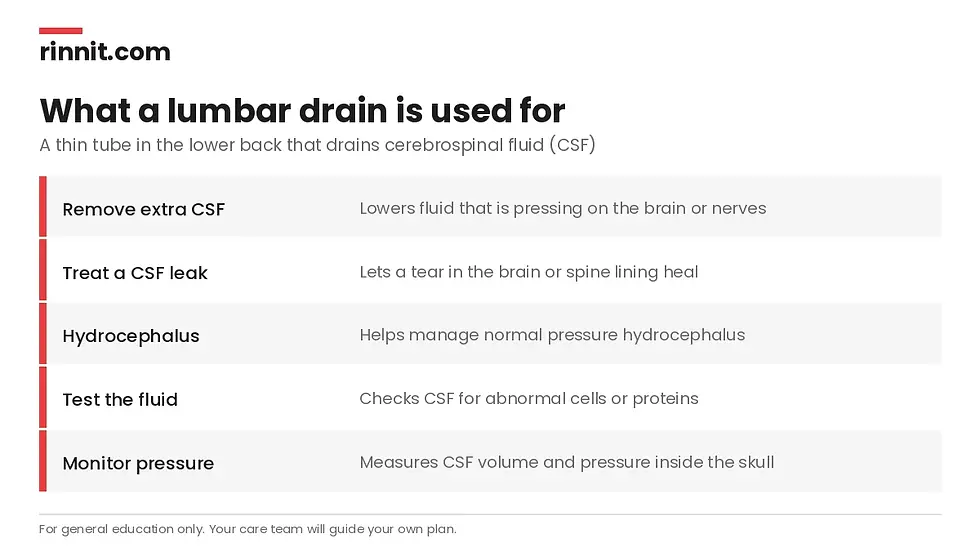
The main reasons a lumbar drain is placed.
Common conditions it helps treat include: [1]
CSF leaks, where fluid escapes through a tear in the lining around the brain or spinal cord
Normal pressure hydrocephalus, a buildup of fluid in the brain
Pressure on the brain or nerves after surgery
A surgeon may place a drain right after an operation, or weeks or months later if a problem appears. [1]
How do you prepare for a lumbar drain?
Before the procedure, your provider does a physical and neurological exam and orders tests. An MRI or CT scan is often used to choose where the drain will go. [1]
You may get antibiotics to lower the risk of infection, or a medicine that reduces how much CSF your body makes. You will also sign a consent form. [1]
How is a lumbar drain placed?
The drain goes into the lower back, about two to three inches above the buttocks. It usually enters between the L4 and L5 vertebrae, sometimes slightly higher, and reaches the fluid-filled space around the spinal cord (the subarachnoid or intrathecal space). Placement takes about 30 minutes. [1]
The steps are: [1]
You lie on your side.
The skin is cleaned and the insertion site is marked.
A local anesthetic numbs the area.
A needle is inserted into the spinal canal, sometimes with X-ray guidance.
The catheter is threaded through the needle.
The needle is removed, leaving the thin tube in place.
The tube is connected to a collection bag or reservoir.
The catheter is secured with stitches or sticky dressings and covered with a bandage.

The main steps of lumbar drain placement.
What happens while the drain is in place?
Most people stay in the hospital for a few days. The drain stays in until your CSF levels are stable. [1]
While the drain is in | What to expect |
Rest | Stay in bed so the drain does not move out of place |
Getting up | Ask a caregiver before you sit up or get out of bed |
Lying position | You can usually lie on your belly or side, and often on your back later |
Drain control | Staff open or close the drain to control how much fluid comes out |
Checks | Staff check on you, measure CSF pressure and change full bags |
Sources: [1]
Standing up with the drain open can drain too much fluid, which is why caregivers control it. [1]
How is a lumbar drain removed?
Once your CSF levels are stable, a member of your care team removes the catheter. You may need to lie flat for a set time afterward to help prevent problems such as a headache. [1]
What are the benefits and risks?
A lumbar drain can stop a CSF leak, keep CSF levels in a safe range, allow testing of the fluid, and give access to the spine for medicine or surgery. It can be lifesaving when too much fluid raises pressure on the brain. In two studies, 98% of lumbar drains stopped CSF leaks, although complications can be frequent. [1]
Risk | What it means |
Infection | Bacteria get into the fluid; the risk rises after about five days |
Headache, nausea and vomiting | Often linked to changes in fluid pressure |
Over-drainage | Too much CSF comes out |
Bleeding | Including, rarely, bleeding inside the skull |
Pneumocephalus | Air gets into the space around the brain |
Catheter problems | The tube moves or pulls out and may need replacing |
Sources: [1]
What is recovery like?

Key numbers for a lumbar drain.
A lumbar drain usually stays in for no more than five days, because the risk of infection rises after that. [1]
After it is removed, rest and avoid strenuous activity or heavy lifting until your provider says it is safe. [1]
When to call your doctor
Tell your care team right away, in the hospital or after you go home, if you have: [1]
New pain
A severe headache
Nausea
Conclusion
A lumbar drain is a short-term tool that lets doctors remove, measure and test the fluid around your brain and spinal cord. It is most often used to help a CSF leak heal or to relieve pressure after surgery.
Most drains stay in for only a few days. Resting as instructed, letting staff control the drain and reporting new pain or a bad headache quickly all help keep the process safe.
Keep learning: Read our guide to CSF leaks, or learn more about cerebrospinal fluid and what it does.
FAQ
What is a lumbar drain?
A lumbar drain is a small, flexible tube placed in the lower back that drains cerebrospinal fluid from around the spinal cord.
Why would someone need a lumbar drain?
It is used to treat CSF leaks, help manage normal pressure hydrocephalus, relieve pressure on the brain or nerves after surgery, and test or measure CSF.
Is a lumbar drain the same as a lumbar puncture?
Both use a needle in the lower back, but a lumbar drain leaves a thin tube in place for days so fluid can keep draining.
Is placing a lumbar drain painful?
A local anesthetic numbs the skin before the needle goes in, which helps limit pain during placement.
How long does it take to place a lumbar drain?
Placing a lumbar drain usually takes about 30 minutes.
How long does a lumbar drain stay in?
Usually a few days, and typically no more than five days because the infection risk rises after that.
Can I get out of bed with a lumbar drain?
You need to rest in bed and ask a caregiver before sitting up or getting out of bed, so the drain stays in place.
How well does a lumbar drain work for a CSF leak?
In two studies, 98% of lumbar drains stopped CSF leaks.
What are the risks of a lumbar drain?
Risks include infection, headache, nausea, bleeding, too much fluid draining, air around the brain and the tube moving or pulling out.
When should I call my doctor about a lumbar drain?
Call right away if you have new pain, a severe headache or nausea, in the hospital or after going home.
How do I prepare for a lumbar drain?
Your provider does a physical and neurological exam and orders tests, and an MRI or CT scan is often used to choose where the drain will go. You may get antibiotics to lower the risk of infection or a medicine that reduces how much CSF your body makes, and you will sign a consent form [1].
Related Reading
References
Cleveland Clinic. Lumbar Drain: What It Is, Purpose, Procedure & Complications. Cleveland Clinic. Last updated July 29, 2024. https://my.clevelandclinic.org/health/procedures/lumbar-drain
Frankort J, Mees B, Doukas P, et al. Systematic review of the effect of cerebrospinal fluid drainage on outcomes after endovascular descending thoracic/thoraco-abdominal aortic aneurysm repair. Eur J Vasc Endovasc Surg. 2023;66(4):501-512. PMID 37182608. https://doi.org/10.1016/j.ejvs.2023.05.006
Leone N, D'Oria M, Mani K, et al. Systematic review and meta-analysis of cerebrospinal fluid drain-related mortality and morbidity after fenestrated-branched endovascular aortic repair. J Vasc Surg. 2024;80(2):586-594.e5. PMID 38636609. https://doi.org/10.1016/j.jvs.2024.04.038
Medical disclaimer
This article is for general education only and does not replace advice from a qualified healthcare professional. Talk to your doctor about your own situation before making decisions about your health. If you think you have a medical emergency, call your local emergency number right away.



Comments