Living Donor Liver Transplant: Who Can Donate, Surgery, Risks and Recovery

Updated: 3 days ago
Written and medically reviewed by Dr. Baraa Alnahhal, MD · Last reviewed: November 2026 · How we review
Quick Answer: What is a living donor liver transplant?
A living donor liver transplant is surgery in which a healthy adult gives part of their liver, usually one lobe, to a person with liver failure. The donor's remaining liver and the transplanted section grow back to full size within a few months. Donors are 18 to 60, in good health, and need six to eight weeks before normal activities. [1]
What the research says
Giving the smaller left lobe is easier on donors. In a pooled analysis of 67 studies, right-lobe donors were more likely to have major complications than left-lobe donors (RR 1.63), with no difference in donor deaths. Recipients of either lobe had similar long-term graft and overall survival. (Acuna et al., Transplantation, 2022) [2]
Keyhole donor surgery shortens the hospital stay. Across 575 donors who had pure laparoscopic surgery, overall complications were 10.8%, major complications 1.6% and there were no deaths. The hospital stay was about 0.7 days shorter than with open surgery, though the operation took about 29 minutes longer. (Papoulas et al., Journal of Minimal Access Surgery, 2022) [3]
Children do especially well with living donor livers. In 1,622 children who received a living donor liver and 6,326 who received a deceased donor liver, living donation was linked to better patient survival (1-year HR 0.58), better graft survival (HR 0.56) and less rejection (OR 0.66). (Barbetta et al., Transplantation Direct, 2021) [4]
Key takeaways
A living donor gives part of their liver, typically one lobe for an adult recipient and less for a child. [1]
Both the donor's liver and the recipient's new liver regrow to full size, usually within two to three months. [1]
Donors must be 18 to 60, healthy, free of substance use and donating without payment. [1]
Expect about one week in the hospital and six to eight weeks before returning to regular activities. [1]
Living donation is a one-time option: transplant teams do not accept a second donation from the same person. [1]
What is a living donor liver transplant?
In a living donor liver transplant, a healthy person donates a section of their liver to someone whose liver is failing. For an adult recipient this is typically one lobe; a child needs a smaller piece. [1]
This works because the liver can regenerate. The section given to the recipient grows into a full-sized liver, and the donor's remaining liver grows back to full size too. Both reach full size within a few months. [1]
Living donation is one option within liver transplantation. For the full picture of who needs a new liver and how a transplant from a deceased donor works, see our guide to liver transplant.
Who can be a living liver donor?
Transplant teams look for donors who meet these basic requirements: [1]

Basic eligibility for living liver donors.
Requirement | What it means |
Age 18 to 60 | Donors must be adults within this age range |
No substance use | No history of substance use |
Good physical health | Confirmed with blood tests and heart tests |
Healthy liver | Confirmed with liver function tests, because liver disease can be silent |
Mental and emotional readiness | Good psychological health and a clear understanding of the risks |
No financial gain | Accepting money or gifts for a donation is illegal |
Sources: [1]
Can you donate to a specific person?
Not always. A directed donation to someone you know requires a compatible blood type and a liver of comparable size. If you do not match, a paired exchange may be possible. You can also make a non-directed donation to a stranger on the waiting list and choose whether to stay anonymous. [1]
How does the donor evaluation work?
The process starts when you contact a transplant hospital. A coordinator collects your information and, if you seem eligible, arranges a full evaluation. [1]
You may meet an anesthesiologist, a hepatologist (liver specialist), an independent donor advocate, a psychologist, a social worker and a transplant surgeon. Two independent teams review you: a donor advocacy team focused on your safety, and the liver transplant selection committee, which makes the final decision. [1]
How do you prepare for living liver donation?
Plan for about a week in the hospital and up to six weeks of recovery at home. You may need time off work or help with childcare. [1]
What happens during living donor liver transplant surgery?
The donor and the recipient have surgery at the same time, in nearby operating rooms. [1]
You receive general anesthesia, so you are fully asleep. [1]
The surgeon reaches the liver through a few small incisions (laparoscopic surgery, each about half an inch) or, when keyhole surgery is not possible, through one 6- to 12-inch incision. [1]
The donated section is disconnected from its blood vessels and bile ducts. [1]
The section is moved to the recipient and attached to the recipient's blood vessels and bile ducts. [1]
The donor operation takes about four to six hours. Minimally invasive surgery may be offered at some centers. [1]
Living donor liver transplant at a glance
Item | Typical detail |
What is donated | One liver lobe for an adult; less for a child |
Anesthesia | General (you are asleep) |
Donor surgery time | About 4 to 6 hours |
Incisions | A few half-inch cuts (laparoscopic) or one 6- to 12-inch cut (open) |
Hospital stay | About 1 week |
Liver regrowth | Full size in about 2 to 3 months |
Sources: [1]
What are the benefits of living donor liver transplant?
More than 15,000 people in the U.S. join the liver transplant waiting list each year, and over 2,000 die or become too sick for a transplant while waiting for a deceased donor's liver. [1]
Compared with waiting for a deceased donor, recipients of a living donor liver generally have shorter waits, healthier donor livers, higher success rates and longer life expectancy. [1]
Most donors also report psychological benefits, such as higher self-esteem and a sense of personal growth, and nearly all say they would make the same choice again. [1]
What are the risks for a living liver donor?
Living donation is major surgery. The reported death rate for living liver donors is about 0.2%, or about 1 in 500 donors. [1]
Type of risk | Examples |
General surgical risks | Bleeding, blood clots, infection, nerve injury, paralytic ileus (bowel slowdown) and pneumonia |
Liver-specific risks | Bile duct injury, abdominal adhesions, incisional hernia and a low platelet count after surgery |
Emotional and practical | Anxiety about the outcome, pain after surgery, lost wages during recovery and the chance the transplant fails |
Sources: [1]

Donation does not appear to affect long-term health. Past donors report general health and quality-of-life scores equal to or higher than the general population. Some report lingering tiredness, digestive problems or emotional difficulties, which are not expected and should improve with support. [1]
What is recovery like for a living liver donor?
The first week in the hospital is the most intensive part of recovery. After that, most donors can care for themselves at home. [1]
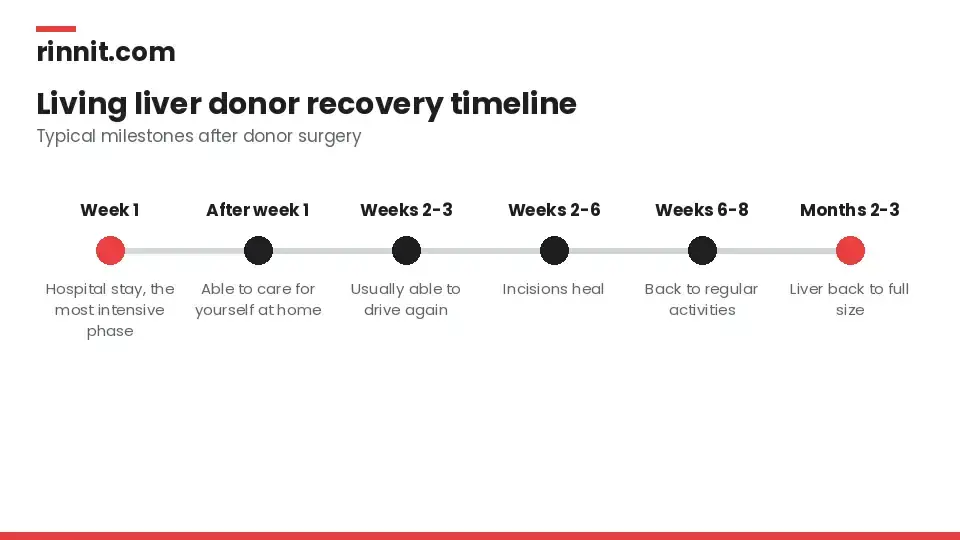
Most donors return to regular activities in six to eight weeks.
Time after surgery | Typical milestone |
First week | Hospital stay |
After week 1 | Able to care for yourself at home |
2 to 3 weeks | Able to drive |
2 to 6 weeks | Incisions heal |
6 to 8 weeks | Back to regular activities |
2 to 3 months | Liver back to full size |
First year | Regular check-ups with your surgeon |
Sources: [1]
Can you donate part of your liver twice?
No. Living liver donation is a one-time option, because a second operation would carry an unacceptable risk. [1]
When should a living donor call the transplant team?
Contact your transplant team if you have questions or worries at any point during recovery, and get urgent help for severe belly pain, fever, heavy bleeding, yellowing of the skin or eyes, or trouble breathing. Your team will give you specific warning signs to watch for before you go home.
Conclusion
A living donor liver transplant lets a healthy adult give part of their liver to someone with liver failure, and both livers regrow to full size within a few months. For recipients, it can mean a shorter wait and better results than waiting for a deceased donor. For donors, it means major surgery, about a week in the hospital and six to eight weeks of recovery, with a small but real risk. [1]
If you are thinking about donating, take your time, ask your transplant team every question you have and make sure you understand the risks and the recovery before you decide.
Keep learning: Read our guides to liver transplant, cirrhosis of the liver and acute liver failure. For more on donating while alive, see organdonor.gov's guide to living donation.
FAQ
What is a living donor liver transplant?
It is surgery in which a healthy adult gives part of their liver, usually one lobe, to a person with liver failure. Both livers then regrow to full size.
Does a donated liver grow back?
Yes. The donor's remaining liver and the transplanted section both grow back to full size, usually within two to three months.
Who can be a living liver donor?
Donors are usually 18 to 60, in good physical and mental health, with a healthy liver, no history of substance use and no payment for donating.
Can I donate part of my liver to a family member?
Often, if your blood type is compatible and your liver is a comparable size. If not, a paired exchange may be possible.
How long does living donor liver surgery take?
The donor operation takes about four to six hours under general anesthesia.
How long is the hospital stay for a living liver donor?
Most donors stay in the hospital for about one week.
How long is recovery after donating part of your liver?
Most donors drive again in two to three weeks and return to regular activities in six to eight weeks.
What are the risks of living liver donation?
Risks include bleeding, infection, blood clots, bile duct injury, hernia and pneumonia. The reported death rate is about 0.2%, or 1 in 500 donors.
Does living liver donation affect long-term health?
It does not appear to. Past donors report general health and quality of life equal to or higher than the general population.
Can you donate part of your liver more than once?
No. Living liver donation is a one-time option because a second operation would be too risky.
How do I prepare for living liver donation?
Plan for about a week in the hospital and up to six weeks of recovery at home, which may mean time off work or help with childcare [1]. You may also need to adjust your diet or stop alcohol or other substances, stop certain medicines, have CT or MRI scans so surgeons can map your liver, and sign an informed consent form [1].
Does living liver donation hurt, and what anesthesia is used?
You have general anesthesia, so you feel no sensation and have no awareness during the four- to six-hour operation [1]. Afterward, tubes help manage your pain during the week in the hospital, and some postoperative pain despite medication is a known downside to consider [1].
When should a liver transplant recipient call the transplant team?
If you received a liver transplant, stay in touch with your transplant team and tell them about any important changes in your health [5]. Signs of infection after the transplant include fever, diarrhea, jaundice, and drainage, redness, swelling or tenderness at the surgical wound [6].
Related Reading
Learn more in our guide to Cirrhosis of the Liver: What It Is, How Permanent Scarring Damages Your Liver, and What Treatment Involves.
Learn more in our guide to Acute Liver Failure (Fulminant Hepatic Failure): Symptoms, Causes, and Emergency Treatment.
Learn more in our guide to Liver Cancer: A Comprehensive Guide to Symptoms, Causes, and Treatment.
Learn more in our guide to Biliary Atresia in Newborns: Symptoms, Causes, and Treatment.
References
Cleveland Clinic. Living Liver Donation & Transplant: Surgery & Recovery. Cleveland Clinic. Last updated March 14, 2025. https://my.clevelandclinic.org/health/procedures/21083-living-donor-liver-transplant
Acuna SA, Zhang W, Yoon PD, et al. Right Lobe Versus Left Lobe Living Donor Liver Transplantation: A Systematic Review and Meta-analysis of Donor and Recipient Outcomes. Transplantation. 2022;106(12):2370-2378. PMID 35802908. https://doi.org/10.1097/TP.0000000000004213
Papoulas M, Hakeem AR, Heaton N, et al. Pure laparoscopic versus open donor hepatectomy for adult living donor liver transplantation - A systematic review and meta-analysis. J Minim Access Surg. 2022;18(1):1-11. PMID 35017391. https://doi.org/10.4103/jmas.JMAS_103_21
Barbetta A, Butler C, Barhouma S, et al. Living Donor Versus Deceased Donor Pediatric Liver Transplantation: A Systematic Review and Meta-analysis. Transplant Direct. 2021;7(10):e767. PMID 34557584. https://doi.org/10.1097/TXD.0000000000001219
Mayo Clinic. Liver transplant. Mayo Clinic. Last updated January 23, 2026. https://www.mayoclinic.org/tests-procedures/liver-transplant/about/pac-20384842
MedlinePlus. Liver transplant. MedlinePlus. Last updated April 27, 2026. https://medlineplus.gov/ency/article/003006.htm
Medical disclaimer
This article is for general education only and does not replace advice from a qualified healthcare professional. Talk to your doctor about your own diagnosis and treatment, and seek emergency care right away for severe or sudden symptoms.



Comments