Laryngectomy: Procedure, Recovery, Breathing, Speech and Life After Surgery

Updated: 3 days ago
Medically reviewed by Dr. Baraa Alnahhal, MD · Last reviewed: October 2026
Quick Answer: What is a laryngectomy?
A laryngectomy is surgery to remove part or all of the larynx, or voice box, recommended when it is severely diseased or damaged, including from laryngeal cancer or irreversible trauma. A partial laryngectomy removes part of it, a total one removes all of it. The surgery changes breathing, eating and communication, and the care team supports recovery and stoma care. [1][3]
What the research says
Pharyngocutaneous fistula, an abnormal opening between the throat and skin, is a common complication after total laryngectomy, and several patient and treatment factors raised the risk. A meta-analysis of 52 studies (8,605 patients) found an overall fistula incidence of 21% (1,808 of 8,605). Previous radiotherapy was associated with the largest increase in odds (OR 2.41; 95% CI 2.00–2.90), followed by coronary artery disease (OR 1.82; 1.36–2.45), smoking (OR 1.62; 1.27–2.07) and chronic obstructive pulmonary disease (OR 1.62; 1.19–2.22) (Wang et al., Eur Arch Otorhinolaryngol, 2020). [4]
Both voice prosthesis speech and esophageal speech are effective ways to restore voice after total laryngectomy, though prosthesis speech scored better on voice handicap. A meta-analysis of 15 articles (1,085 patients; 869 using a voice prosthesis and 216 using esophageal speech) found a better, lower Voice Handicap Index score with prosthesis speech (31.93 ± 12.11 vs 35.39 ± 20.6; P = 0.003), but no significant difference in voice-related quality of life (8.27 ± 5.98 vs 9.27 ± 2.02; P = 0.19) (Maniaci et al., J Voice, 2024). [5]
Tracheoesophageal speech and the electrolarynx are more often successful than esophageal speech. A systematic review of 22 mostly small cohort and descriptive studies reported much higher success rates with the electrolarynx and tracheoesophageal speech, better satisfaction and self-assessed quality of life with tracheoesophageal speech, and lower satisfaction with the electrolarynx because of its mechanical voice; prosthesis complications and frequent replacement remain a problem (Xi, Int J Evid Based Healthc, 2010 ). [6]

What is a laryngectomy?
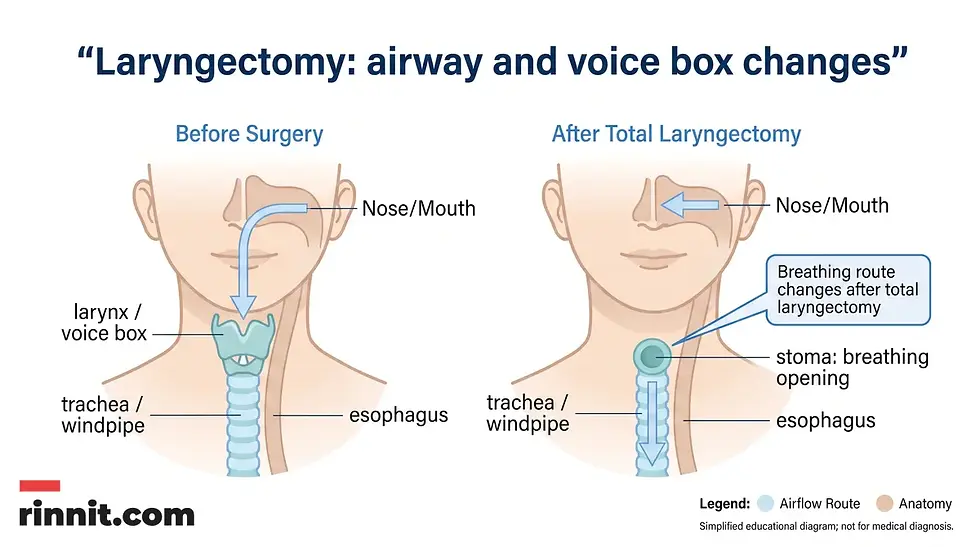
A laryngectomy is surgery to remove part or all of the larynx, also called the voice box. The larynx sits above the trachea, or windpipe, and connects the mouth and nose to the lungs. It plays an important role in breathing, swallowing and speaking. [1]
A healthcare provider may recommend a laryngectomy when the voice box is severely damaged or diseased. Common reasons include laryngeal cancer and irreversible injury or trauma to the larynx. [1]
The operation may be partial or total. The amount of larynx removed affects the changes a person experiences afterward, so it is important to ask the surgical team which structures are involved and what that may mean for breathing, swallowing and communication.
How is a partial laryngectomy different from a total laryngectomy?
Preparation, recovery and rehabilitation after a partial or total laryngectomy depend on the planned operation and the person's health.
A person’s preparation, recovery and rehabilitation depend on the planned operation and their health. A general description cannot replace the surgeon’s explanation of the specific procedure.
Why might someone need a laryngectomy?
Two common reasons for laryngectomy are laryngeal cancer and irreversible injury or trauma to the larynx. [1] In either situation, the provider weighs the condition of the voice box and the available treatment options.
Treatment approaches have changed over time, and fewer people need laryngectomies than in earlier years. This trend is associated with fewer people smoking and newer ways to treat the throat without removing the voice box. [1]
A person can ask the treating team why laryngectomy is being considered, whether the planned surgery is partial or total, and which changes are expected afterward.
How should someone prepare for laryngectomy?
Before surgery, the healthcare provider performs a physical examination and may order tests to assess readiness. Possible tests include a chest X-ray to check the lungs, an EKG to check heart rhythm and blood tests. [1][2]
People may also meet with speech-language pathologists and swallowing therapists. These specialists help prepare for recovery and life after surgery. A dietitian may discuss an eating plan, and a person who smokes may be offered help with quitting. [1][3]
Before the operation, the care team gives instructions about medications, eating, drinking and other precautions. Most people need to stop blood thinners, and some may need to stop eating and drinking the night before. [1] Medication changes and fasting should be followed only as directed by the treating team.
What happens during laryngectomy surgery?
Laryngectomy is performed under general anesthesia. The surgeon makes an incision at the front of the neck and removes part or all of the larynx. Nearby lymph nodes or throat tissue may also be removed, depending on the operation. [1][2][3]
The surgeon creates a stoma, a new opening in the neck that allows breathing. A tube goes into the stoma. In some cases, the surgeon places an optional voice prosthesis by making a small opening between the windpipe and the esophagus. The incision is then closed with stitches. [1][3]
The exact steps depend on the type and extent of surgery. A surgeon can explain which structures will be involved and how the planned procedure may affect recovery.
What happens after surgery?
A hospital stay may last one to two weeks. At first, food is provided through a tube. Once it is safe to swallow, the care team helps the person begin eating by mouth again. [1]
After total laryngectomy, people learn new ways to breathe, eat and communicate. A speech therapist supports communication, and the healthcare team teaches the person how to care for the stoma. [1][2] The team’s post-surgery instructions are the primary guide for recovery.
Recovery is different for each person. The early period may involve changes in breathing, eating, speaking and energy. These changes can feel overwhelming, and it is reasonable to ask the healthcare team for explanations, practical support and emotional resources.
What is laryngectomy recovery like?
Most people need about two to three weeks to recover from laryngectomy, although recovery may take longer depending on the operation and how quickly healing occurs. [1] Hospital recovery and full adjustment are not always the same process; rehabilitation and learning new communication methods can continue after discharge.
The care team may coordinate surgical follow-up, speech-language support, swallowing therapy and stoma education. Follow the individual instructions provided by the treating team rather than relying on a general online timeline.

How does breathing change after laryngectomy?
A laryngectomy creates a stoma, a new opening in the neck for breathing. After total laryngectomy, the person learns to breathe through this new route and receives instruction on stoma care from the healthcare team. [1][2]
A stoma can require ongoing attention, and care difficulties or irritation are possible complications. [1] This article does not provide home airway-care or suctioning instructions because those steps must be taught and tailored by the treating team.
Trouble breathing after surgery is an emergency. Call 911 or the local emergency number or go to an emergency room right away if breathing becomes difficult. [1]
How does eating and swallowing change?
The larynx plays a role in swallowing, and eating can be different after surgery. During the initial hospital period, food may be given through a tube. Once swallowing is safe, the care team helps the person return to eating by mouth. [1]
Swallowing therapists can help prepare a person for recovery. [1] A person should ask the team what the planned surgery may mean for eating, how swallowing will be assessed and which signs should prompt a call.
Can someone speak after a laryngectomy?
After total laryngectomy, the vocal cords are removed, so the voice sounds different. People can learn new ways to communicate with support from a speech-language pathologist. [1] The most appropriate option depends on the person’s surgery, health, healing and preferences.
Communication option | How it works |
Voice prosthesis | A small device can let air from the lungs move into the throat to create vocal sound. [1] A healthcare provider helps determine whether it is appropriate. |
Electrolarynx | |
Esophageal speech | |
Nonverbal communication | Sign language, typing, gestures, facial expressions and writing can help communicate, especially during early recovery or when speech is not available. [1] |
The goal is not to force one communication method. Speech-language professionals can help a person explore tools and techniques that fit their needs.
What are the risks and complications?
Like any major surgery, laryngectomy has risks. Possible complications include damage to nearby organs such as the windpipe or esophagus, fistulas, limited neck or shoulder movement, low thyroid function and stoma irritation or care difficulties. [1]
Eating, swallowing or speaking may be difficult, especially at first. [1] These changes can improve with recovery and rehabilitation, but the course varies. A care team can explain which complications are most relevant to the planned operation.
Possible risk or change | What to discuss with the care team |
Damage to nearby organs | Which nearby structures are involved and how they will be monitored. |
Fistula | What this complication means and which follow-up symptoms matter. |
Neck or shoulder movement | Whether rehabilitation or therapy may be part of recovery. |
Low thyroid function | Whether thyroid health will be monitored after surgery. |
Stoma irritation or care difficulties | How stoma care will be taught and whom to contact with concerns. |
Eating or swallowing difficulty | How swallowing will be assessed and when tube feeding may change. |
Speaking difficulty | Which communication support will be available from speech-language specialists. |
Will more cancer treatment be needed?
When laryngectomy is used to treat cancer, the operation may remove the cancer, but additional treatment may still be needed. Radiation and chemotherapy are examples. [1]
The oncology and surgical teams can explain whether additional treatment is part of the plan, why it is recommended and how it may interact with recovery and rehabilitation.
When should someone call a healthcare provider?
Call the healthcare provider if fever, pus around the incision or other signs of infection develop after laryngectomy. [1] The treating team should also be contacted when recovery symptoms are concerning or unclear.
Chest pain or trouble breathing requires immediate emergency help. Call 911 or the local emergency number or go to an emergency room right away. [1]
What questions should you ask before laryngectomy surgery?
Topic | Questions to discuss |
Reason for surgery | Why is laryngectomy being considered, and what condition is it treating? |
Type of surgery | Is the planned procedure partial or total, and which structures may be removed? |
Breathing | Will a stoma be created, and how will the team teach stoma care? |
Eating | How might swallowing change, and when might tube feeding be used? |
Communication | When should speech-language support begin, and which communication options may fit? |
Testing | Which physical examinations or tests are needed before surgery? |
Medications | Which medication, blood-thinner, eating or drinking instructions apply? |
Recovery | How long might the hospital stay and early recovery last? |
Additional treatment | Will radiation or chemotherapy be part of the cancer-treatment plan? |
Urgent symptoms | Which symptoms require a call to the team or emergency help? |
How can people get emotional support and adjust after a laryngectomy?
Facing laryngectomy can bring fear, frustration and other strong emotions. People do not have to manage those feelings alone. A healthcare provider can connect patients and families with resources, and a counselor or a local or online support group may also help. [1]
Learning more about the planned operation can make decisions feel more manageable. A speech-language pathologist, swallowing therapist, nurse, surgeon and other members of the team may each answer different questions about life after surgery.
Conclusion: Prepare with your care team and plan for a new way to breathe, eat and communicate
Laryngectomy removes part or all of the larynx and may be recommended for laryngeal cancer or irreversible injury or trauma. Partial and total procedures have different effects, but either can change breathing, swallowing, speaking and daily routines. [1][3]
A total laryngectomy creates a new breathing opening in the neck and may require learning new communication methods. Recovery can include a hospital stay, temporary tube feeding, speech-language support, swallowing therapy and stoma education. Risks include infection-related concerns, fistulas, damage to nearby structures, movement limitations, low thyroid function and difficulties with the stoma, eating, swallowing or speaking. [1]
The treating team can explain the reason for surgery, the planned extent, expected recovery, communication options, additional treatment and urgent symptoms. Clear questions and ongoing support are important parts of preparing for life after laryngectomy.
Frequently Asked Questions
What is a laryngectomy?
A laryngectomy is surgery to remove part or all of the larynx, or voice box. The larynx supports breathing, swallowing and speaking, so the operation can affect all three functions. [1]
Why is a laryngectomy performed?
Common reasons include laryngeal cancer and irreversible injury or trauma to the larynx. A provider may recommend it when the voice box is severely diseased or damaged. [1]
What is the difference between partial and total laryngectomy?
A partial laryngectomy removes part of the larynx. A total laryngectomy removes all of it. The treating surgeon can explain how the planned extent may affect breathing, eating and communication. [1]
Is a laryngectomy performed under general anesthesia?
What is a stoma after laryngectomy?
A stoma is a new opening in the neck created to help a person breathe. The healthcare team teaches the person how to care for it after surgery. [1]
How long is the hospital stay?
The hospital stay may last one to two weeks. [1] The exact course depends on the procedure, healing and the person’s care needs.
How long does laryngectomy recovery take?
Most people need about two to three weeks to recover, but recovery can take longer depending on the operation and how quickly healing occurs. [1] Rehabilitation and adjustment may continue after the early recovery period.
Can someone speak after a total laryngectomy?
Yes, people can learn new ways to communicate with help from a speech-language pathologist. Options may include a voice prosthesis, electrolarynx, esophageal speech and nonverbal communication. [1]
How does eating change after laryngectomy?
Food may initially be given through a tube. Once swallowing is safe, the care team helps the person return to eating by mouth. [1]
What are common complications?
Possible complications include damage to nearby organs, fistulas, limited neck or shoulder movement, low thyroid function, stoma irritation or care difficulties and trouble eating, swallowing or speaking, especially at first. [1]
When is laryngectomy recovery an emergency?
Call 911 or the local emergency number or go to an emergency room immediately for chest pain or trouble breathing. Call the healthcare provider for fever, pus around the incision or other signs of infection. [1]
Will radiation or chemotherapy be needed after laryngectomy?
Additional cancer treatment may still be needed after surgery. [1] The care team can explain whether radiation or chemotherapy is part of the individual plan.
What is an electrolarynx?
An electrolarynx is a handheld device you hold against your neck. It makes vibrations that help you speak. The voice sounds robotic, but the device is easy to learn. [1]
Will my voice sound the same?
No. Because the vocal cords are removed, your voice will sound different. How it sounds depends on the method you use, and a speech-language pathologist can help you find the right option. [1]
Can I swim after a laryngectomy?
Ask your care team first. Water entering the stoma can reach the lungs, so swimming and bathing require special precautions and equipment.
Are there support groups for people who have had a laryngectomy?
Yes. Ask your provider about local or online support groups, and consider speaking with a counselor, who can help you through treatment. [1]
Related guides
Related guides on laryngectomy cover the larynx, laryngeal cancer, throat cancer and voice disorders.
References
Cleveland Clinic. Laryngectomy. Cleveland Clinic. Last updated September 8, 2025. https://my.clevelandclinic.org/health/treatments/24072-laryngectomy
Macmillan Cancer Support. Laryngectomy. Macmillan Cancer Support. Reviewed June 1, 2022. https://www.macmillan.org.uk/cancer-information-and-support/treatments-and-drugs/laryngectomy
Johns Hopkins Medicine. Laryngectomy Surgery. Johns Hopkins Medicine. July 17, 2024. https://www.hopkinsmedicine.org/health/treatment-tests-and-therapies/laryngectomy
Wang M, Xun Y, Wang K, et al. Risk factors of pharyngocutaneous fistula after total laryngectomy: a systematic review and meta-analysis. Eur Arch Otorhinolaryngol. 2020;277(2):585-599. PMID 31712878. https://doi.org/10.1007/s00405-019-05718-9
Maniaci A, Lechien JR, Caruso S, et al. Voice-related quality of life after total laryngectomy: systematic review and meta-analysis. J Voice. 2024;38(2):539.e11-539.e19. PMID 34763996. https://doi.org/10.1016/j.jvoice.2021.09.040
Xi S. Effectiveness of voice rehabilitation on vocalisation in postlaryngectomy patients: a systematic review. Int J Evid Based Healthc. 2010;8(4):256-258. PMID 21091891. https://doi.org/10.1111/j.1744-1609.2010.00177.x
Disclaimer
This article is for general educational purposes and is not a substitute for professional medical advice, diagnosis or treatment. Always seek the advice of a qualified healthcare professional with any questions about a medical condition or treatment.
Do not attempt home airway procedures based on this article. The treating surgical, nursing, speech-language and swallowing teams should provide the individual care plan, and emergency services should be contacted for chest pain or trouble breathing.



Comments