Large Granular Lymphocytic Leukemia: Understanding Chronic LGL

Updated: 3 days ago
Medically reviewed by Dr. Baraa Alnahhal, MD · Last reviewed: October 2026
Large granular lymphocytic (LGL) leukemia is a rare, typically slow-growing cancer of white blood cells. It often shows up as fatigue, frequent infections, or an enlarged spleen, and some people have no symptoms at all. It is not currently curable, but many people live with it as a chronic condition through watchful waiting or immunosuppressive treatment, and about 75% of people with the chronic forms are alive five years after diagnosis [1].
Quick Answer: What is large granular lymphocytic leukemia?
Large granular lymphocytic (LGL) leukemia is a rare chronic blood cancer in which certain T cells or natural killer cells become abnormal and build up in the blood and bone marrow. Most people are diagnosed in their 60s. It often causes anemia and neutropenia. It cannot be cured, but it can be managed with monitoring or, for symptoms, immunosuppressive therapy. [1]
What the research says
STAT3 gene changes are common in LGL leukemia. Researchers found STAT3 mutations in 31 of 77 patients (40%), and patients with these mutations presented more often with neutropenia and rheumatoid arthritis than patients without them (Koskela et al., N Engl J Med, 2012 [2]).
Immunosuppressive drugs help about 60% of people who need treatment. A review reported that roughly half of people with LGL leukemia need treatment, and that methotrexate, cyclosporine, and cyclophosphamide have a cumulative response rate of about 60% (Zawit et al., Cancers, 2021 [3]).
Ruxolitinib helped many people whose disease had returned or stopped responding. In a series of 21 patients with relapsed or refractory disease, 18 (86%) responded, including 3 complete and 15 partial responses; the median response lasted 4 months over a median follow-up of 9 months, so longer-term data are still needed (Marchand et al., Br J Haematol, 2024 [4]).
What Is Large Granular Lymphocytic Leukemia?
Large granular lymphocytic (LGL) leukemia is a rare form of chronic leukemia that affects lymphocytes, the white blood cells that fight viruses and make antibodies to help fight infection [1]. In LGL leukemia, certain T cells or natural killer (NK) cells mutate and become abnormal. These cells accumulate in the blood and bone marrow and can keep the bone marrow from producing normal blood cells [1].
This leads to blood-count problems. People with LGL often develop neutropenia, meaning low numbers of granulocytes and a higher risk of infection, and they may develop anemia because LGL cells affect red blood cell production [1]. The disease is very rare, affecting about 1 in 1 million people worldwide, and most people are in their 60s when they are diagnosed [1].
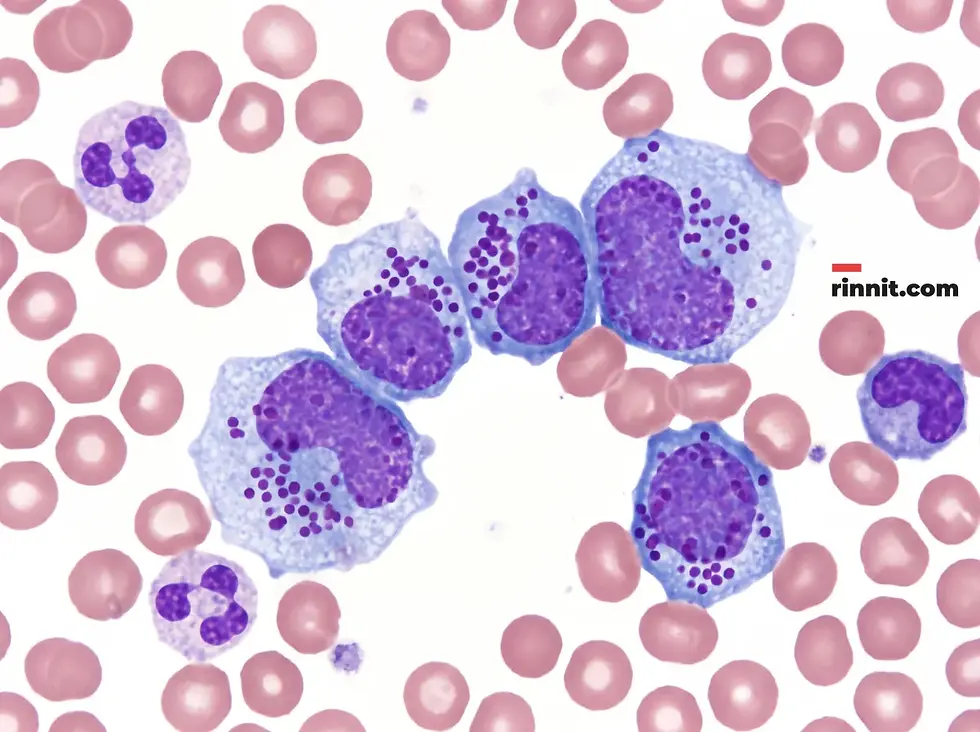
Large granular lymphocytes on a blood smear: the visible granules in the cytoplasm give the disease its name.
Types of LGL Leukemia
Type | Cell origin | Progression speed |
|---|---|---|
T-cell LGL (T-LGL) | Cytotoxic T cells | Slow-growing (chronic) |
Chronic lymphoproliferative disorder of NK cells (CLPD-NK) | Natural killer (NK) cells | Slow-growing (chronic) |
Aggressive LGL leukemia | NK cells | Fast-growing (rare) |
What are the symptoms of large granular lymphocytic leukemia, and what conditions are linked?
Many people with LGL leukemia have no symptoms at the time of diagnosis. In one study, about one-third had no symptoms and learned they had LGL because blood tests showed unusually low red blood cell or neutrophil levels [1]. When symptoms do occur, they usually relate to the blood-count problems the leukemia causes.
Common symptoms include:
Extreme fatigue: the most common symptom, likely caused by anemia [1].
Frequent fevers and recurring infections: fevers are often caused by bacterial infections linked to low neutrophil counts [1].
Enlarged spleen (splenomegaly): infections and some types of anemia may cause the spleen to enlarge [1].

Extreme tiredness is the most common LGL symptom and is likely due to anemia.
Associated Health Conditions
LGL leukemia is often linked with autoimmune disease. About 30% of people with the condition also have rheumatoid arthritis and other autoimmune diseases, and another 25% to 30% have another kind of lymphoma or other cancer [1]. Anemia is also common, and some people have hemolytic anemia, in which red blood cells are destroyed rather than under-produced [1]. Lymphocytosis, a high lymphocyte count, is another linked finding [1]. Clinical research from organizations like the American Society of Hematology helps improve understanding of these complex interactions.
What causes large granular lymphocytic leukemia, and how is it diagnosed?
Healthcare providers aren't sure what causes LGL leukemia, but they believe it is linked to immune responses, autoimmune diseases, or other cancers [1]. Many people also carry mutated forms of two genes, STAT3 and STAT5B, which play roles in cell immunity and in how cells divide and multiply [1]. These are somatic mutations, meaning they are acquired in the leukemia cells [2][5].
Diagnostic Testing
Providers typically use blood tests and genetic analyses to diagnose LGL leukemia and to rule out other conditions, including myelodysplasia and rheumatoid arthritis [1]. Common tests include:
Complete blood count (CBC) with differential: measures all of your blood cells, including the number of each type of white blood cell, such as neutrophils.
Peripheral blood smear: examines blood cells under a microscope so the large granular lymphocytes can be counted.
Flow cytometry and immunophenotyping: laboratory tests that analyze markers on cell surfaces to diagnose and classify the type of leukemia.
T-cell receptor (TCR) gene rearrangement analysis and genetic testing: looks for problems in the genes that control how T cells work, and may test for STAT3 and STAT5 mutations.
Bone marrow examination: used to look at blood cell production and to rule out other conditions, including myeloid mutations.
How is large granular lymphocytic leukemia treated and managed?
Because LGL leukemia is usually slow-growing, treatment is tailored to your symptoms and blood counts. If you have T-LGL or CLPD-NK without symptoms, your provider may recommend watchful waiting, which means monitoring your health, typically with blood tests every few months, and watching for symptoms [1].
People with symptoms may receive:
Immunosuppressive therapy: medicines such as methotrexate, cyclosporine, or cyclophosphamide that suppress the abnormal immune response [1][3].
Steroids: used alongside immunosuppressive therapy [1].
Sequential or low-intensity treatment: providers may use one treatment after another, or low-intensity forms of treatment [1].

Regular monitoring and an individualized plan are central to managing LGL leukemia.
LGL leukemia can be treated but not cured [1]. About 75% of people with T-LGL and CLPD-NK are alive five years after diagnosis, and about 10% die of severe infections that are complications of the leukemia [1]. Because the condition is so rare, many people seek out doctors who specialize in it [1].
What is the bottom line on large granular lymphocytic leukemia?
Large granular lymphocytic leukemia is rare but manageable. In most people it grows slowly, and with regular monitoring and appropriate treatment, people treated for LGL can typically live normal lives, although some already have serious blood disorders that affect their quality of life [1].
Your next step: if you or a loved one has been diagnosed, work with a hematologist who specializes in rare leukemias. Keep up regular check-ups, eat a healthy diet, get enough rest, and ask your provider about vaccinations and other ways to avoid infection [1].
Frequently Asked Questions
What is the life expectancy for someone with LGL leukemia?
About 75% of people with the common chronic types (T-LGL and CLPD-NK) are alive five years after diagnosis, and most live with it as a chronic condition for many years [1].
Is LGL leukemia considered a cancer?
Yes. It is a rare type of chronic blood cancer that affects white blood cells called lymphocytes.
Can LGL leukemia be cured?
Not currently. It can be treated and managed, and many people live with it for a long time [1].
What is the most common symptom of LGL?
Extreme fatigue, which is likely caused by anemia (low red blood cell levels) [1].
How rare is LGL leukemia?
LGL leukemia affects about 1 in 1 million people worldwide [1].
What is the difference between T-LGL and CLPD-NK?
T-LGL starts in cytotoxic T cells, while CLPD-NK starts in natural killer (NK) cells. Both grow slowly and behave like chronic diseases [1].
Does rheumatoid arthritis cause LGL leukemia?
Rheumatoid arthritis is not a proven cause, but the link is strong: about 30% of people with LGL leukemia also have rheumatoid arthritis and other autoimmune diseases [1].
What causes the frequent infections in people with LGL?
Neutropenia, a condition in which the body makes too few neutrophils, the white blood cells that fight bacterial infection [1].
Is LGL leukemia hereditary?
The exact cause is unknown, and it is not described as an inherited condition [1]. The STAT3 mutations found in many people's leukemia cells are somatic, meaning they are acquired in the cells rather than inherited [2].
What does watchful waiting mean for LGL?
Your provider monitors your health and blood counts, typically with blood tests every few months, and starts treatment only if symptoms appear or blood counts worsen [1][3].
References
Cleveland Clinic. Large Granular Lymphocytic Leukemia. Cleveland Clinic. September 3, 2022. https://my.clevelandclinic.org/health/diseases/24128-large-granular-lymphocytic-leukemia
Koskela HLM, Eldfors S, Ellonen P, et al. Somatic STAT3 mutations in large granular lymphocytic leukemia. N Engl J Med. 2012;366(20):1905-1913. PMID 22591296. https://doi.org/10.1056/NEJMoa1114885
Zawit M, Bahaj W, Gurnari C, et al. Large granular lymphocytic leukemia: from immunopathogenesis to treatment of refractory disease. Cancers (Basel). 2021;13(17):4418. PMID 34503230. https://doi.org/10.3390/cancers13174418
Marchand T, Pastoret C, Damaj G, et al. Efficacy of ruxolitinib in the treatment of relapsed/refractory large granular lymphocytic leukaemia. Br J Haematol. 2024;205(3):915-923. PMID 38639192. https://doi.org/10.1111/bjh.19476
Lamy T, Moignet A, Loughran TP. LGL leukemia: from pathogenesis to treatment. Blood. 2017;129(9):1082-1094. PMID 28115367. https://doi.org/10.1182/blood-2016-08-692590
Medical disclaimer
This article is for informational purposes only and is not a substitute for professional medical advice, diagnosis, or treatment. The clinical information in this guide reflects source material last reviewed in September 2022.



Comments