Kleine-Levin Syndrome: Understanding "Sleeping Beauty Syndrome"

Updated: 2 days ago
Medically reviewed by Dr. Baraa Alnahhal, MD · Last reviewed: October 2026
Quick Answer: Key Facts About Kleine-Levin Syndrome
Kleine-Levin syndrome (KLS), or Sleeping Beauty Syndrome, is a rare disorder causing episodes of excessive sleep of 16-20 hours a day, behavioral changes and overeating. It typically begins in early adolescence, primarily affects men and occurs in 1 to 2 cases per million people. Episodes last 2 days to several weeks. Treatment manages symptoms, and episodes decrease over time.
Feature | Details |
Common Name | "Sleeping Beauty Syndrome" or KLS |
Primary Symptoms | Excessive sleep (16-20 hours/day), behavioral changes, hyperphagia |
Typical Age | Early adolescence; primarily affects men |
Prevalence | 1 to 2 cases per million people |
Episode Duration | 2 days to several weeks (average 10 days) |
Primary Treatment | Symptom management (Lithium, stimulants, rest) |
Long-term Outlook | Median course of 14 years; episodes decrease over time |
What the research says
Infections are the most common trigger, and lithium is the best-supported way to reduce relapses. A systematic review of 186 cases found that episodes were most often precipitated by infections (38.2%), followed by head trauma (9%) and alcohol (5.4%); among treated patients, only lithium had a higher reported response rate for stopping relapses (41%) than no medication (19%), while stimulants reduced sleepiness in 40% of cases (Arnulf et al., Brain, 2005) [2]
Symptoms are not identical in everyone. In an analysis of 475 case reports (364 males, 111 females), recurrent hypersomnolence was present in 94.3% of cases, compulsive eating in 59.6% and increased sexual drive in 33.7%; the opposite symptoms, such as loss of appetite or reduced sexual drive, were also reported, and precipitating factors were recorded more often in males (67.3%) than in females (49.6%) (Billiard & Jaussent, Sleep Med, 2024) [3]
Genetic and brain-imaging clues are emerging, but the cause is still unknown. A review reports a link to variation in the TRANK1 gene and uncommon variants in LMOD3, lower circadian activity amplitude during episodes, a higher risk of later psychiatric disorders, and functional brain imaging that is often abnormal both during and between episodes (Qasrawi & BaHammam, Curr Sleep Med Rep, 2023) [4]
What is Kleine-Levin Syndrome?
Kleine-Levin syndrome (KLS) is a neurological disorder that is as mysterious as it is rare. Often referred to by the evocative name "Sleeping Beauty Syndrome," it is characterized by recurring episodes of extreme hypersomnia—where a person may sleep for 16 to 20 hours a day—combined with significant changes in behavior and cognitive function. During these episodes, which can last for days or weeks, the individual is nearly impossible to wake and, when awake, often appears confused or detached from reality. [1]
This condition is exceptionally rare, with an estimated occurrence of only one to two cases per million people. It most commonly begins during early adolescence and is more frequently diagnosed in males than in females. Despite the dramatic nature of the episodes, KLS is not considered a lifelong condition for most; symptoms typically decrease in both frequency and severity over a period of about 14 years. [1]
What are the symptoms of Kleine-Levin syndrome (KLS)?
A KLS episode is defined by symptoms that persist for at least two days. While the primary sign is an inability to stay awake, the syndrome also impacts a person's physical and mental state in several other ways. [1]
Category | Common Symptoms |
Sleep Pattern | Extreme sleepiness, sleeping up to 20 hours per day. |
Appetite | Increased appetite or compulsive eating (hyperphagia). |
Behavioral | Irritability, behavioral changes, and increased sex drive (hypersexuality). |
Cognitive | Confusion, hallucinations, and temporary memory loss (amnesia). |
Emotional | Feelings of anxiety or depression during or after an episode. |
Between these episodes, most individuals return to their normal behavior and do not experience any symptoms, although some may have mild, lingering cases of memory loss regarding what occurred while they were ill.

What are the possible causes and triggers of Kleine-Levin syndrome?
The exact cause of Kleine-Levin syndrome remains unknown, though several theories are currently being explored by researchers. One leading theory suggests that an illness or injury might cause damage to the hypothalamus, the part of the brain responsible for regulating sleep, appetite, and body temperature.
Many patients report that their episodes are preceded by a flu-like illness or infection, leading some to speculate that KLS could be an autoimmune response where the body mistakenly attacks healthy tissue. There is also evidence of a genetic link, with specific mutations on genes like LMOD3 and TRANK1 being studied. Common triggers for an episode include: [1]
Flu-like illnesses or infections.
Stress and physical exertion.
Head trauma.
The use of drugs or alcohol.

How is Kleine-Levin syndrome diagnosed and managed?
Diagnosing KLS is a complex process because there is no single test to confirm its presence. Instead, healthcare providers must work by process of elimination, ruling out other conditions with similar symptoms, such as narcolepsy or certain psychiatric disorders. A typical evaluation may include sleep studies (polysomnography), MRI imaging, and blood tests. [1]
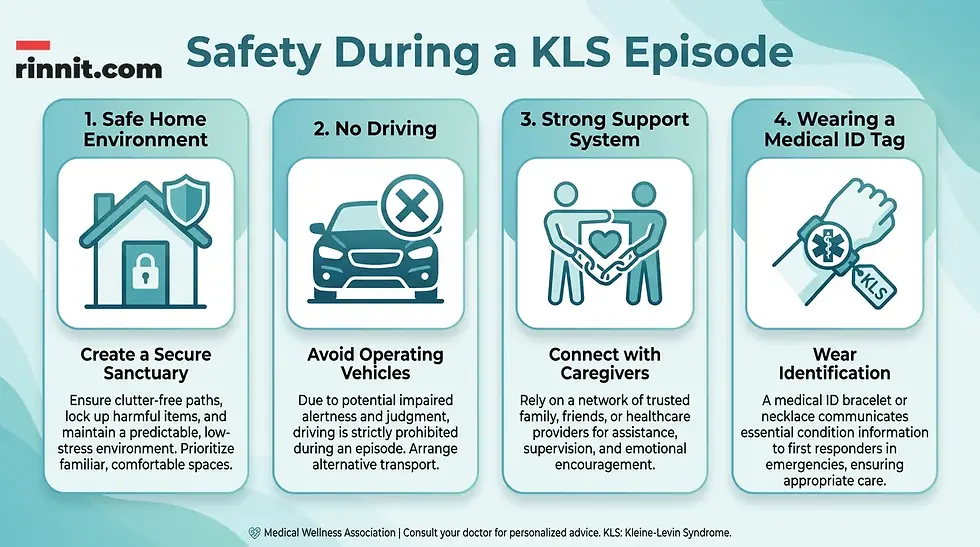
Management focuses on providing a safe environment and relieving specific symptoms. During an episode, the most important step is to allow the body to sleep as much as it needs.
Medications: Lithium may be prescribed to reduce the frequency of episodes, while stimulants or wake-promoting agents can help manage excessive sleepiness. In very long episodes, IV steroids may be considered.
Safety and Support: Patients must avoid driving or operating heavy machinery during an episode. A strong support system of family and friends is essential to help manage daily needs like eating and hygiene when the patient is awake but confused. [1]
What is the long-term outlook for Kleine-Levin syndrome?
The prognosis for individuals with Kleine-Levin syndrome is generally fair. While the condition can be disruptive during the teenage years and early adulthood, the median duration is approximately 14 years. Over time, episodes usually become less severe and happen less often. Medical professionals consider the condition "cured" if a patient remains episode-free for six consecutive years. [1]
Learn more. For more information on rare sleep disorders and neurological health, visit Rinnit.com.
Frequently Asked Questions
Can someone be woken up during a KLS episode?
While they can be woken briefly to eat or use the restroom, they are often extremely lethargic, confused, and will quickly fall back into a deep sleep.
Is Kleine-Levin syndrome the same as narcolepsy?
No. While both involve excessive sleepiness, KLS is episodic (occurring in clusters) and includes behavioral changes that are not typical of narcolepsy.
Does KLS affect intelligence?
No. KLS does not affect a person's baseline intelligence, though cognitive function is significantly impaired during an episode.
Can adults develop KLS?
While it most often starts in adolescence, it can occasionally affect older adults, though this is even rarer.
Is there a specific diet for KLS?
There is no medical diet, but since hyperphagia (excessive eating) is a symptom, families often need to monitor food intake during an episode.
Are the hallucinations in KLS scary?
The hallucinations in KLS can be. Patients may feel detached from reality or experience a "dream-like" state while awake, which can be distressing.
Can KLS be prevented?
Currently, there is no known way to prevent the onset of KLS as the cause is not yet understood.
Is KLS hereditary?
There is evidence of a genetic component, and it sometimes runs in families, but it is not always passed from parent to child.
What should I do if I think my child has KLS?
Keep a detailed log of their sleep patterns and behavioral changes and consult a pediatric neurologist or sleep specialist.
Does KLS cause permanent memory loss?
Most memory loss is specific to the events that occurred during the episode itself, rather than a loss of long-term memories.
Can stress really trigger an episode?
Yes, significant emotional or physical stress has been identified as a common trigger for the onset of a KLS cluster.
How do I handle the hypersexuality symptom?
Hypersexuality can be one of the most challenging behavioral symptoms. It is important to discuss this with a healthcare provider who can offer management strategies and supportive therapy.
Is Lithium safe for teenagers with KLS?
Lithium is a common treatment, but it requires careful monitoring by a doctor to manage potential side effects and ensure proper dosage.
Should a person with KLS go to school during an episode?
No. It is impossible for them to function or learn effectively, and they require a safe, home-based environment for rest.
What is "familial hibernation syndrome"?
Familial hibernation syndrome is simply another name for KLS, highlighting the way the episodes resemble a state of hibernation.
Related Reading
References
Cleveland Clinic. Kleine-Levin Syndrome. Cleveland Clinic. Last updated July 13, 2022. https://my.clevelandclinic.org/health/diseases/23484-kleine-levin-syndrome
Arnulf I, et al. Kleine-Levin syndrome: a systematic review of 186 cases in the literature. Brain. 2005;128(Pt 12):2763-76. PMID 16230322. https://doi.org/10.1093/brain/awh620
Billiard M, et al. Kleine-Levin syndrome. Clinical boarderlands based on a thorough analysis of 475 case reports. Sleep Med. 2024;121:135-143. PMID 38968752. https://doi.org/10.1016/j.sleep.2024.06.003
Qasrawi SO, et al. An Update on Kleine-Levin Syndrome. Curr Sleep Med Rep. 2023;9(1):35-44. PMID 36590182. https://doi.org/10.1007/s40675-022-00246-1
Medical disclaimer
The information provided in this article is for educational purposes only and should not be considered medical advice. Always consult with a qualified healthcare provider for diagnosis and treatment of any medical condition.



Comments