Kikuchi Disease: Understanding Rare Lymph Node Swelling

Updated: 2 days ago
Medically reviewed by Dr. Baraa Alnahhal, MD · Last reviewed: October 2026
Quick Answer: Key Facts About Kikuchi Disease
Kikuchi disease, or Kikuchi-Fujimoto disease, is a condition causing swollen neck lymph nodes, fever and fatigue, typically in people aged 30 and under. Its cause is unknown but may involve an immune response to viruses. Diagnosis uses an exam, blood tests and lymph node biopsy. Treatment relieves symptoms, with corticosteroids for severe cases, and most recover within 6 months.
Feature | Details |
Common Name | Kikuchi-Fujimoto Disease (KFD) |
Primary Symptoms | Swollen neck lymph nodes, fever, fatigue |
Typical Age | People aged 30 and under |
Cause | Unknown; likely immune response to viruses or genetics |
Diagnosis | Physical exam, blood tests, and lymph node biopsy |
Treatment | Symptom relief (NSAIDs, rest), corticosteroids for severe cases |
Prognosis | Excellent; most recover within 6 months, though it can recur |
What the research says
A biopsy is what settles the diagnosis. A comprehensive review notes that Kikuchi-Fujimoto disease is often mistaken for non-Hodgkin lymphoma, that the diagnosis is made exclusively from histopathology, and that an early lymph node biopsy avoids unnecessary investigations and therapeutic trials; skin involvement occurs in about 30%–40% of cases (Mahajan et al., World J Clin Cases, 2023) [2]
Treatment is mostly about easing symptoms. A review describes the condition as self-limited, with NSAIDs for pain and corticosteroids and hydroxychloroquine considered in severe cases (Ahmed et al., Cureus, 2021) [3]
Brain and nerve complications are rare but documented. A systematic review of 75 case reports and series (81 cases) found that meningitis, most often aseptic, was the most frequently reported neurological complication, followed by encephalitis, encephalopathy and eye-related complications, and almost every study reported improvement after treatment (Ahmed et al., Clin Neurol Neurosurg, 2025) [4]
What is Kikuchi Disease?
Kikuchi disease, formally known as Kikuchi-Fujimoto disease (KFD), is a rare condition that causes lymph nodes to become swollen and painful. While these symptoms can appear in various parts of the body, they most frequently occur on one side of the neck. The disease is often accompanied by a low-grade fever and persistent fatigue, creating a clinical picture that can initially resemble more common infections or even serious conditions like lymphoma. [1]
Despite its alarming presentation, Kikuchi disease is typically not serious. It is a self-limiting illness, meaning it often resolves without specific medical treatment as the body heals naturally. It is most commonly diagnosed in young adults and individuals under the age of 30. Because the condition can recur, long-term monitoring through regular check-ups is recommended for those who have experienced an episode. [1]

What are the symptoms of Kikuchi disease?
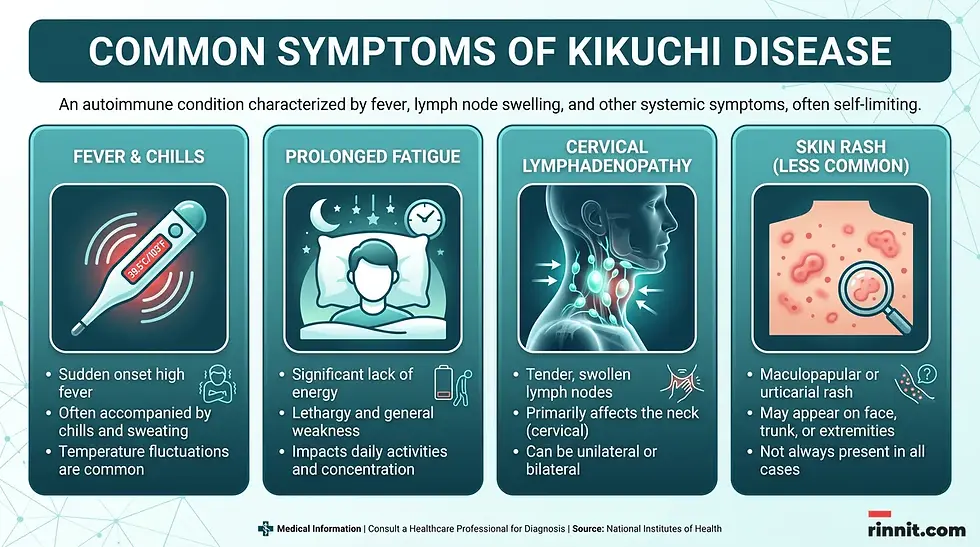
The symptoms of Kikuchi-Fujimoto disease typically develop gradually over a period of two to five weeks. Patients often experience a combination of systemic and localized signs. [1]
Category | Common Symptoms |
Lymphatic | Swollen, painful lymph nodes (usually on one side of the neck). |
Systemic | Low-grade fever (99.5°F to 100.3°F), fatigue, and night sweats. |
Respiratory | Sore throat and a persistent cough. |
Gastrointestinal | Nausea, vomiting, and unintentional weight loss. |
Neurological | Frequent headaches. |
Dermatological | Development of a skin rash. |
Recovery from these symptoms can be a slow process, sometimes taking up to six months. During this time, significant rest is often required to manage the fatigue associated with the disease.
What are the possible causes and risk factors of Kikuchi disease?
The exact cause of Kikuchi disease remains a mystery to medical experts. However, current research suggests it may be an unusual immune system reaction to certain environmental or biological triggers. [1]
Viral and Bacterial Triggers
Many experts believe that KFD is triggered by an abnormal response to common infections. Suspected viral culprits include the Epstein-Barr virus, Cytomegalovirus, Hepatitis B, HIV, and the Human Papillomavirus (HPV).
Genetics and Autoimmune Links
There is evidence to suggest that inheriting certain genes may increase a person's susceptibility to the condition. Additionally, Kikuchi disease has been observed in individuals with existing autoimmune disorders, such as systemic lupus erythematosus (SLE), rheumatoid arthritis, and Sjögren syndrome.
How is Kikuchi disease diagnosed, and how are other conditions ruled out?
Because the symptoms of Kikuchi disease overlap with other illnesses, a thorough diagnostic process is necessary. A healthcare provider will typically begin with a physical examination to feel the size and tenderness of the lymph nodes.
To confirm the diagnosis and rule out more serious conditions like tuberculosis or lymphoma, doctors often perform a lymph node biopsy. This involves taking a small sample of the affected tissue for microscopic examination. Blood tests may also be ordered to check for signs of viral infections or to assess overall immune function. [1]
How is Kikuchi disease managed and treated?
Kikuchi disease has no specific cure because the condition is expected to resolve on its own. Instead, medical management focuses on relieving symptoms and ensuring patient comfort during the recovery period. [1]
Pain and Fever Management: Nonsteroidal anti-inflammatory drugs (NSAIDs) are commonly recommended to reduce pain, fever, and headaches.
Corticosteroids: In more severe cases where lymph node swelling is significant or symptoms are particularly distressing, a doctor may prescribe corticosteroids to reduce inflammation.
Rest and Recovery: Because fatigue is a primary symptom, prioritizing extra rest is essential for a full recovery.
While complications are extremely rare, the disease has been linked to conditions like hemophagocytic lymphohistiocytosis (HLH) or aseptic meningitis in very isolated cases.

Learn more. For more information on rare immune conditions and lymphatic health, visit Rinnit.com.
Frequently Asked Questions
Is Kikuchi disease contagious?
No. While it may be triggered by a viral infection, Kikuchi disease itself is an immune system reaction and cannot be passed from person to person.
How rare is Kikuchi disease?
Kikuchi disease is considered very rare, though its exact prevalence is difficult to determine because it is often misdiagnosed as other more common conditions.
Can children get Kikuchi disease?
Yes, it primarily affects people under 30, including children and adolescents.
Will the swelling in my neck leave a scar?
No. The lymph nodes swell internally and typically return to their normal size as the disease resolves, leaving no external scarring.
Does Kikuchi disease lead to cancer?
No. Kikuchi disease is a benign (non-cancerous) condition. However, a biopsy is often done to ensure the symptoms aren't caused by something else, like lymphoma.
How do I know if the disease is coming back?
Recurrence is possible. If you notice swollen lymph nodes or a return of fever and fatigue after you have recovered, you should contact your healthcare provider.
Is there a specific diet for Kikuchi disease?
There is no specific medical diet, but maintaining a healthy, balanced diet can support your immune system during the recovery process.
Can I exercise while I have Kikuchi disease?
You should listen to your body. Due to the significant fatigue associated with the condition, most patients need to limit strenuous activity until they have fully recovered.
How long does a biopsy take?
A lymph node biopsy is a relatively quick procedure, often performed in an outpatient setting, though the results may take a few days to process.
Are there any long-term effects of Kikuchi disease?
Most people recover completely with no long-term health issues, though the small risk of recurrence means you should keep up with regular medical check-ups.
Why is it called Kikuchi-Fujimoto disease?
Kikuchi-Fujimoto disease is named after the two Japanese scientists, Dr. Kikuchi and Dr. Fujimoto, who independently described the condition in 1972.
Can Kikuchi disease affect other organs?
While it primarily affects the lymph nodes, it can very rarely lead to complications involving the brain lining (meningitis) or the blood system (HLH).
Should I see a specialist for Kikuchi disease?
You may be referred to an infectious disease specialist or a rheumatologist to help manage the diagnosis and recovery.
What is a low-grade fever exactly?
In the context of Kikuchi disease, this is typically defined as a temperature between 99.5°F and 100.3°F.
Does the rash from Kikuchi disease itch?
The appearance of the rash can vary, and while some patients report itching, others may have a rash that is simply visible without discomfort.
Related Reading
References
Cleveland Clinic. Kikuchi-Fujimoto Disease: What It Is, Symptoms & Treatment. Cleveland Clinic. Last updated January 5, 2026. https://my.clevelandclinic.org/health/diseases/kikuchi-disease
Mahajan VK, et al. Kikuchi-Fujimoto disease: A comprehensive review. World J Clin Cases. 2023;11(16):3664-3679. PMID 37383134. https://doi.org/10.12998/wjcc.v11.i16.3664
Ahmed Z, et al. Kikuchi-Fujimoto Disease: A Rare Cause of Cervical Lymphadenopathy. Cureus. 2021;13(8):e17021. PMID 34522502. https://doi.org/10.7759/cureus.17021
Ahmed HS, et al. Neurological manifestations and complications of Kikuchi-Fujimoto disease: A comprehensive systematic review. Clin Neurol Neurosurg. 2025;251:108818. PMID 40056750. https://doi.org/10.1016/j.clineuro.2025.108818
Medical disclaimer
The information provided in this article is for educational purposes only and should not be considered medical advice. Always consult with a qualified healthcare provider for diagnosis and treatment of any medical condition.



Comments