Kidney Donation: Eligibility, Surgery, Risks and Recovery for Living Donors

Updated: 3 days ago
Written and medically reviewed by Dr. Baraa Alnahhal, MD · Last reviewed: November 2026 · How we review
Quick Answer: What is kidney donation?
Kidney donation is surgery that removes a healthy kidney from a donor so it can be transplanted into someone whose kidneys have stopped working. Living donors must be at least 18. Most donors stay in the hospital two to three days and return to activities in four to six weeks. People with one kidney can live long, healthy lives. [1]
What the research says
Long-term health risks for living donors are low. A review of 52 studies comparing 118,426 living kidney donors with 117,656 nondonors found no higher risk of death, heart disease, high blood pressure, type 2 diabetes or psychological problems in donors. The relative risk of kidney failure was higher, but the absolute risk stayed low at about 0.5 cases per 1,000 person-years, and preeclampsia occurred in about 5.9 per 100 pregnancies in female donors. (O'Keeffe et al., Annals of Internal Medicine, 2018) [2]
Keyhole surgery means less pain and a shorter hospital stay. A review of 13 randomized trials with 1,280 living donors found that, in the 7 trials (815 donors) comparing the two, laparoscopic donor nephrectomy needed less pain medicine and a shorter hospital stay than open surgery, with no overall difference in complications. Laparoscopic surgery was switched to open surgery in only 6 of 587 donors (1.02%). (Kourounis et al., Cochrane Database of Systematic Reviews, 2024) [3]
Quality of life usually returns to normal within a year. A review of prospective studies found that donors' quality of life dips shortly after surgery, mainly physical functioning, but returns to baseline or is only slightly lower by 3 to 12 months, mostly for fatigue, with scores comparable to the general population. (Wirken et al., American Journal of Transplantation, 2015) [4]
Key takeaways
Kidney donation gives a healthy kidney to a person with kidney failure, freeing them from dialysis. [1]
Living donors must be at least 18, and there is no upper age limit. Pregnancy, a BMI of 35 or higher, and smoking, vaping or tobacco use can rule you out. [1]
Most donor surgeries are laparoscopic, take about two to three hours and are done under general anesthesia. [1]
Most donors leave the hospital in two to three days and resume usual activities in four to six weeks. [1]
Long-term risks such as high blood pressure and protein in the urine are rare, and studies show donating does not shorten a donor's lifespan. [1] [2]
What is kidney donation?
Kidney donation is surgery to remove one kidney from a living donor, or both kidneys from a deceased donor, and transplant it into someone whose kidneys no longer work. The surgery to remove a donor's kidney is called a donor nephrectomy. [1]
People with one working kidney can still live long, healthy lives. After donation, your remaining kidney grows bigger and stronger to make up for the lost function. [1]
Why is kidney donation done?
Kidney donation treats kidney failure, which happens when both kidneys stop working as they should. Kidney failure can cause fluid buildup, dangerous potassium levels and heart problems, and without dialysis or a transplant it is fatal. [1]
Kidney transplants are common. In 2022, surgeons performed more than 25,000 kidney transplants in the United States. Most people wait an average of three to five years on a transplant list, so a living donor can shorten that wait. [1]
What are the types of kidney donation?
There are several ways to donate a kidney as a living donor. [1]
Type | What it means |
Living related | The donor is a blood relative of the recipient, such as a parent or sibling |
Living unrelated | The donor is not a blood relative, such as a friend |
Directed | The donor chooses who receives the kidney |
Paired kidney exchange | Two donor-recipient pairs whose blood or tissue types do not match swap donors, with help from a national registry |
Nondirected (altruistic) | The donor gives a kidney to someone they do not know |
Sources: [1]
A match between a parent and child is at least a 50% chance. [1]
Who can be a living kidney donor?
To donate a kidney, you must be at least 18 years old. There is no upper age limit. A transplant team checks your health history, family history of kidney disease, medicines and organ function. [1]
Pregnancy: You cannot donate while pregnant.
Weight: A body mass index (BMI) of 35 or higher can rule you out.
Tobacco: Current smoking, vaping or tobacco use can rule you out.
Mental readiness: A psychological evaluation checks that you are ready, and a living donor advocate makes sure no one is pressuring you to donate.
Sources: [1]
How do you prepare for kidney donation?
Before surgery, you have a series of tests to make sure donating is safe for you. [1]
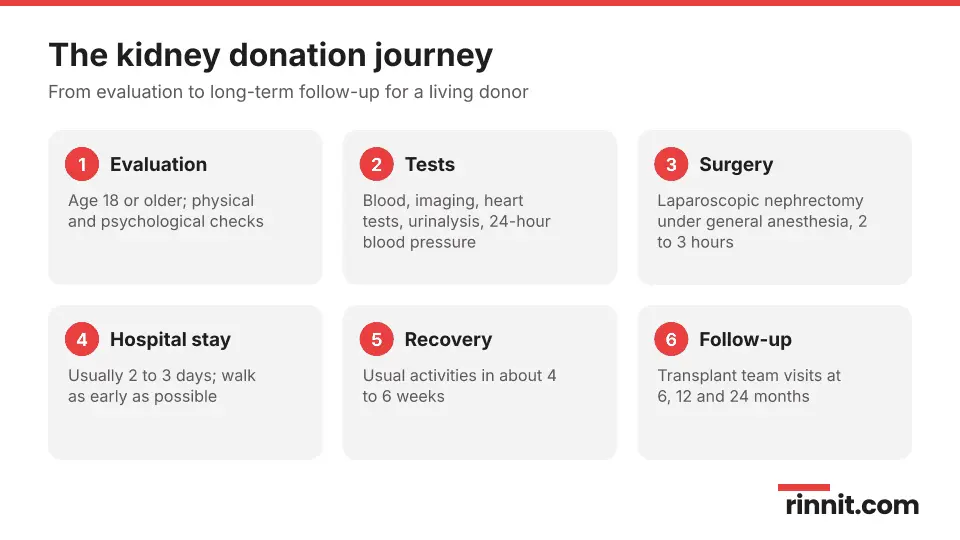
Blood tests and antibody tests
Age-appropriate cancer screenings, such as a colonoscopy, and for females a mammogram and Pap smear
Imaging, such as X-rays and CT scans
Heart tests, including an EKG, an exercise stress test and an echocardiogram
Urinalysis
A 24-hour blood pressure monitor
A pregnancy test
The anesthesiologist will usually review your health records before surgery. [1]
What happens during kidney donation surgery?
Your care team includes a urologist or transplant surgeon and an anesthesiologist. [1]
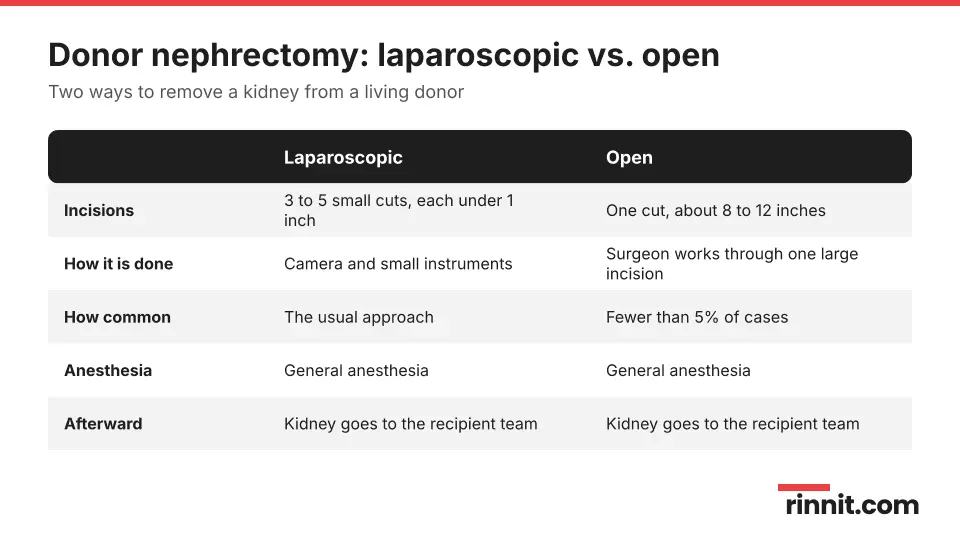
You receive general anesthesia, so you are asleep and do not feel pain.
A catheter is placed to drain your bladder. It stays in for about 24 hours after surgery.
In the usual laparoscopic approach, the surgeon makes three to five small incisions, each generally less than 1 inch (2.5 cm) long, and removes the kidney with a camera and small instruments.
In the less common open approach, used in fewer than 5% of cases, the surgeon makes one incision about 8 to 12 inches (20 to 30 cm) long.
The kidney is taken to a separate operating room, where the recipient's surgical team transplants it.
Sources: [1]
Kidney donation at a glance
Item | Typical detail |
Minimum donor age | 18 years, with no upper age limit |
Usual surgery | Laparoscopic nephrectomy |
Anesthesia | General anesthesia |
How long it takes | About two to three hours |
Hospital stay | Two to three days |
Back to usual activities | About four to six weeks |
Follow-up | 6, 12 and 24 months after donation |
Sources: [1]
What happens after kidney donation?
After surgery, your incisions are covered with bandages and you move to a recovery room. Your care team will: [1]
Manage your pain
Give you IV fluids until you are awake and can drink safely
Slowly reintroduce food
Ask you to walk as early as possible
Pain, tenderness or itching at the incisions for a few days, and tiredness in the first few weeks, are common. Most people stay in the hospital for two to three days. A family member or friend will need to drive you home and help care for you for at least a week. [1]
You see the transplant surgeon and a nephrologist (kidney specialist) within the first week after you leave the hospital. Transplant team visits continue for two years, at 6, 12 and 24 months, along with visits to your primary care physician. Staples or permanent stitches can usually be removed after a few weeks. [1]
How long does recovery from kidney donation take?
Most people return to their usual activities about four to six weeks after donating. [1]
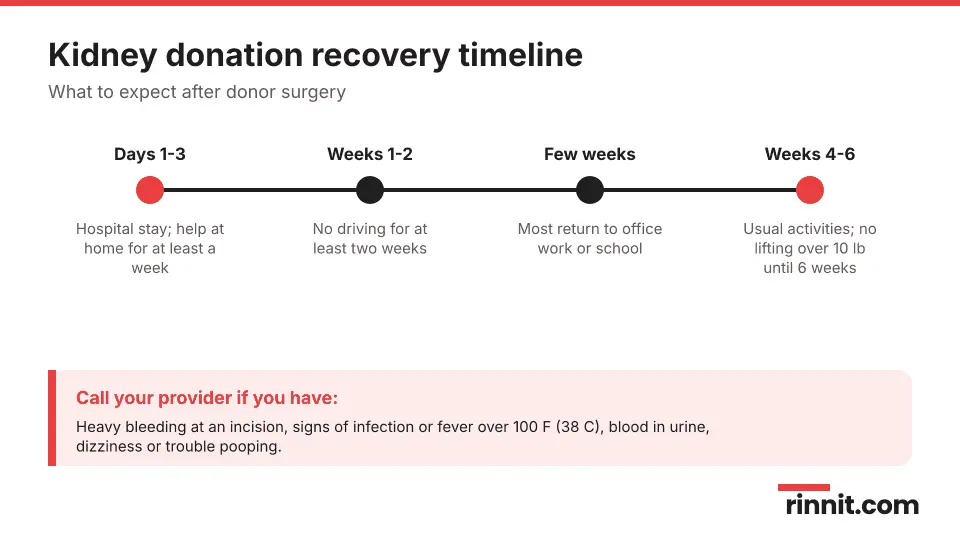
Driving: Do not drive for at least two weeks.
Lifting: Do not lift anything heavier than 10 pounds (4.5 kg), about a gallon of milk, for at least six weeks.
Pregnancy: Do not get pregnant for at least one year.
Work and school: Most people return to school or office work within a few weeks. Physically demanding jobs may need four to six weeks.
Sources: [1]
What are the benefits of kidney donation?
Many donors find it rewarding to see a loved one feel better and stop dialysis. For the recipient, a living donor kidney offers several advantages: [1]
It treats kidney failure and removes the need for ongoing dialysis.
It lasts about 15 to 20 years, compared with about 10 to 15 years for a deceased donor kidney.
It usually starts working quickly and has a lower risk of rejection, especially from a relative.
The surgery date can be planned, so the recipient can prepare.
Studies show that donating does not shorten a donor's lifespan. The risk of kidney failure later in life is higher than in similar nondonors but stays low, and donors who ever need a kidney get priority on the waiting list. [1]
What are the risks of kidney donation?
Like any major surgery, kidney donation carries some risks. [1]
Complication | What it means |
Blood clots | Clots that can form in the veins after surgery |
Infection | A bacterial infection, often at the incision |
Anesthesia complications | Problems related to general anesthesia |
Bowel obstruction | A blockage in the intestines |
Pneumonia | A lung infection after surgery |
Hernia | Tissue pushing through a weak spot near an incision |
Nerve damage | Mainly a risk with open surgery |
Scarring | Scars where the incisions were made |
Sources: [1]
You will lose some kidney function, but your remaining kidney compensates. Rare long-term effects of living with one kidney include high protein in the urine (proteinuria), a lower estimated glomerular filtration rate (eGFR, a measure of how much blood your kidneys filter), high blood pressure and preeclampsia during pregnancy. [1] [2]
What is the outlook for kidney recipients?
Kidney transplant recipients have high survival rates: more than 90% at one year, more than 85% at three years, nearly 80% at five years and nearly 70% at 10 years. [1]
When should you call your provider after kidney donation?
Contact your provider right away if you have any of these signs: [1]
Heavy bleeding at an incision
Signs of infection, such as discolored drainage, a bad smell from the incision, or a fever over 100°F (37.8°C)
Blood in your urine
Dizziness or lightheadedness
Trouble pooping
Does a kidney donor get paid?
No. Receiving money to donate a kidney is illegal in the United States and most other countries. The recipient's health insurance usually covers the donor's medical costs, but it may not cover nonmedical expenses such as missed work, travel, lodging or childcare. [1]
Questions to ask your provider
Am I a good candidate to donate a kidney?
Will my surgery be laparoscopic or open?
How long will I need to be off work?
What follow-up visits and tests will I need?
Which costs will the recipient's insurance cover, and which will I pay?
Conclusion
Kidney donation gives a person with kidney failure a working kidney and a life without dialysis. For living donors, the surgery is usually laparoscopic, takes about two to three hours and is followed by a two- to three-day hospital stay and a return to usual activities in four to six weeks. [1]
Serious long-term problems are rare, and studies show that donating does not shorten a donor's lifespan. A careful evaluation before surgery, regular follow-up afterward and knowing the warning signs to watch for help keep donors healthy. [1] [2]
Keep learning: Read our guides to kidney transplant, organ donation and transplantation and radical nephrectomy. For more on treatment options, see the National Institute of Diabetes and Digestive and Kidney Diseases guide to choosing a treatment for kidney failure.
FAQ
What is kidney donation?
Kidney donation is surgery that removes a healthy kidney from a donor and transplants it into someone whose kidneys no longer work.
Who can donate a kidney?
You must be at least 18, with no upper age limit, and pass physical and psychological evaluations. Pregnancy, a BMI of 35 or higher, and tobacco use can rule you out.
How long does kidney donation surgery take?
The donor surgery usually takes about two to three hours.
Is kidney donation surgery painful?
You are under general anesthesia, so you feel no pain during surgery. Soreness or itching at the incisions for a few days and tiredness for a few weeks are common.
What tests are done before donating a kidney?
Tests include blood and antibody tests, cancer screenings, imaging, heart tests, a urinalysis, 24-hour blood pressure monitoring and a pregnancy test.
How long is the hospital stay after donating a kidney?
Most donors stay in the hospital for two to three days.
How long does it take to recover from kidney donation?
Most people return to usual activities in four to six weeks. Avoid driving for two weeks and lifting more than 10 pounds (4.5 kg) for six weeks.
Can you live a normal life with one kidney?
Yes. People with one working kidney can live long, healthy lives, and the remaining kidney grows to make up for lost function.
What are the risks of donating a kidney?
Surgical risks include blood clots, infection, bowel obstruction, pneumonia and hernia. Rare long-term effects include protein in the urine and high blood pressure.
When should I call my doctor after kidney donation?
Call for heavy bleeding at an incision, signs of infection or a fever over 100°F (37.8°C), blood in your urine, dizziness or trouble pooping.
How do I prepare for kidney donation?
Before you can donate, a group of healthcare providers will evaluate you to make sure you're physically and mentally able to donate a kidney [1]. The anesthesiologist will usually review your health records before surgery to make sure you won't have any problems with anesthesia [1].
Related Reading
Learn more in our guide to End-Stage Renal Disease: Symptoms, Causes, and Treatment.
Learn more in our guide to Chronic Kidney Disease: What It Is, Its 5 Stages, Causes, and How It's Treated.
Learn more in our guide to Polycystic Kidney Disease (PKD): Symptoms, Types, and Treatment Options Explained.
Learn more in our guide to Diabetic Nephropathy (Diabetic Kidney Disease): Symptoms, Causes, Diagnosis & Treatment — Complete Guide.
References
Cleveland Clinic. Kidney Donation: Living Donor, Eligibility, Process & Risks. Cleveland Clinic. Last updated July 11, 2024. https://my.clevelandclinic.org/health/procedures/7457-kidney-donation
O'Keeffe LM, Ramond A, Oliver-Williams C, et al. Mid- and Long-Term Health Risks in Living Kidney Donors: A Systematic Review and Meta-analysis. Ann Intern Med. 2018;168(4):276-284. PMID 29379948. https://doi.org/10.7326/M17-1235
Kourounis G, Tingle SJ, Hoather TJ, et al. Robotic versus laparoscopic versus open nephrectomy for live kidney donors. Cochrane Database Syst Rev. 2024;5(5):CD006124. PMID 38721875. https://doi.org/10.1002/14651858.CD006124.pub3
Wirken L, van Middendorp H, Hooghof CW, et al. The Course and Predictors of Health-Related Quality of Life in Living Kidney Donors: A Systematic Review and Meta-Analysis. Am J Transplant. 2015;15(12):3041-3054. PMID 26414703. https://doi.org/10.1111/ajt.13453
Medical disclaimer
This article is for general education only and does not replace advice from a qualified healthcare professional. Talk to your doctor about your own diagnosis and treatment, and seek emergency care right away for severe or sudden symptoms.



Comments