Intra-Aortic Balloon Pump (IABP)

Updated: 3 days ago
Medically reviewed by Dr. Baraa Alnahhal, MD · Last reviewed: October 2026
Quick Answer: What is an intra-aortic balloon pump (IABP)?
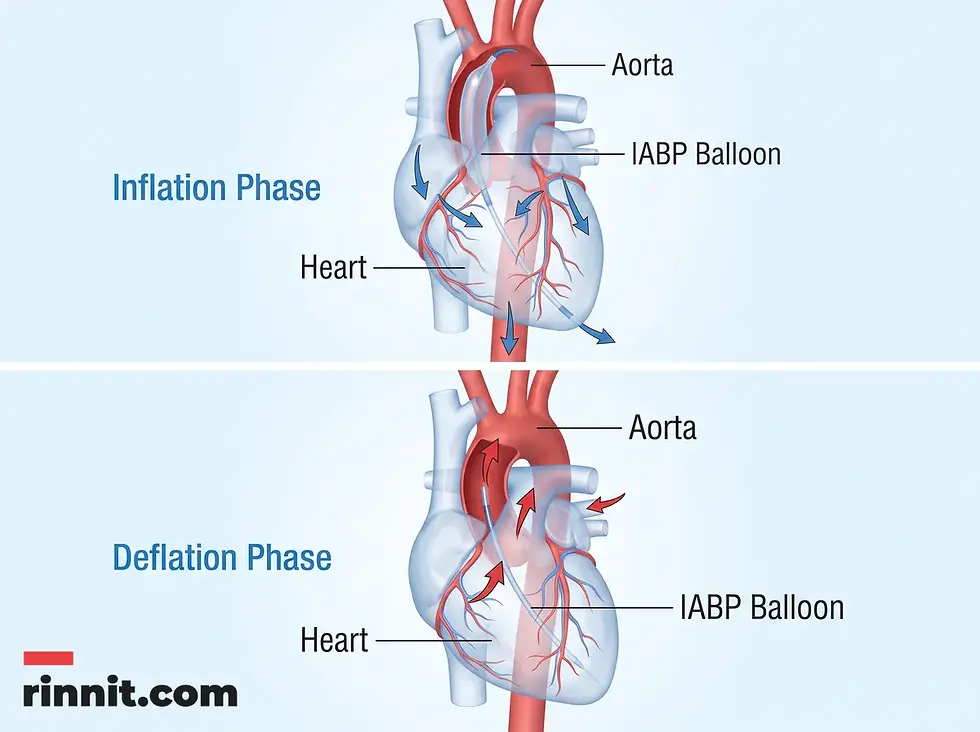
An intra-aortic balloon pump (IABP) is a thin, inflatable device placed in the thoracic aorta to assist heart function. It deflates when the heart pumps and inflates when the heart rests, improving circulation to the body and heart. Providers use it to treat cardiogenic shock, heart failure and complications after major cardiac surgery, providing critical mechanical support.
What the research says
A balloon pump did not improve 30-day survival in cardiogenic shock after a heart attack. In the IABP-SHOCK II trial, 600 patients with cardiogenic shock after a heart attack, all planned for early treatment to reopen the blocked artery, were randomly assigned to an IABP or no IABP. At 30 days, 39.7% of the IABP group and 41.3% of the control group had died (relative risk 0.96; P = 0.69), with no significant differences in major bleeding, leg circulation problems, sepsis or stroke. (Thiele et al., N Engl J Med, 2012) [2]
There was still no survival difference after six years. Long-term follow-up of the same trial, completed for 591 of 600 patients at a median of 6.2 years, found that 66.3% had died with the IABP versus 67.0% without it (relative risk 0.99). Repeat heart attack, stroke, repeat procedures, heart-related hospital stays and survivors' quality of life also did not differ. (Thiele et al., Circulation, 2019) [3]
Pooled trial data show better blood-flow measures but no proven survival benefit. A Cochrane review of 7 randomized trials with 790 patients with a heart attack and cardiogenic shock found no clear difference in 30-day deaths with an IABP (hazard ratio 0.95). The authors concluded the device may improve some blood-flow measurements, but there is no convincing evidence that it improves survival in this setting. (Unverzagt et al., Cochrane Database Syst Rev, 2015) [4]
Understanding the Intra-Aortic Balloon Pump
The intra-aortic balloon pump (IABP) serves as a critical mechanical assistant for patients whose hearts are temporarily unable to pump sufficient blood. The device consists of a thin, flexible balloon that is positioned in the thoracic aorta—the primary artery that carries oxygen-rich blood from the heart to the rest of the body. By alternating between inflation and deflation, the IABP optimizes the timing of blood flow, ensuring that vital organs receive the oxygen they require while the heart muscle is allowed to rest and recover.
"An intra-aortic balloon pump (IABP) is a device that controls blood flow from your heart. It deflates when your heart pumps blood out and inflates when your heart rests between beats." [1]
How the Device Functions
The operation of an IABP is precisely timed to the patient's cardiac cycle through a specialized control machine. This machine uses small bursts of helium to inflate the balloon. Helium is used because it is very light, so the balloon can inflate and deflate quickly; a leak is rare but can let gas bubbles into the bloodstream, so the machine alarms and the team acts at once if one is detected. The two primary phases of the pump's cycle provide distinct benefits to the circulatory system:
Phase | Action | Primary Benefit |
Systole | Deflation | Reduces resistance, helping the heart pump blood to the body. |
Diastole | Inflation | Increases blood pressure in the aorta, improving flow to the heart and limbs. |
Indications and Patient Eligibility
Healthcare providers primarily recommend the use of an IABP when a patient enters cardiogenic shock, a condition where the heart suddenly cannot pump enough blood to meet the body's needs. This state often arises from severe cardiac events or underlying diseases. However, not all patients are suitable candidates for this therapy, as certain vascular conditions can make the placement of the device dangerous.
Common Reasons for IABP Use
Acute Congestive Heart Failure: Sudden worsening of the heart's ability to circulate blood.
Heart Attacks: Damage to the heart muscle that impairs pumping efficiency.
Arrhythmias: Abnormal heart rhythms that disrupt regular blood flow.
Post-Surgical Support: Assistance for the heart following open-heart surgery or high-risk coronary interventions.
Contraindications
Certain conditions prevent the safe use of an IABP. These include aortic aneurysms or dissections, which involve damage to the wall of the primary artery. Additionally, patients with severe peripheral artery disease or uncontrolled sepsis are generally not considered candidates for this procedure due to the increased risk of vascular complications.
The Placement Procedure
The insertion of an IABP is a precise medical procedure that can take place in a cardiac catheterization lab or an operating room. If a patient is already undergoing heart surgery, the device is placed while they are under general anesthesia. In other cases, healthcare providers use local anesthesia to numb the insertion site, typically in the groin area.
Catheter Insertion: A hollow tube is inserted into a large artery in the leg.
Balloon Threading: The thin balloon is threaded through the catheter and advanced toward the heart.
Imaging Guidance: Providers use real-time X-ray imaging to ensure the balloon is correctly positioned in the thoracic aorta.
Machine Connection: The device is attached to a bedside console that regulates the inflation and deflation cycles.

Risks and Safety Considerations
While an IABP is a lifesaving tool, it is an invasive device that carries inherent risks. Most complications are related to the physical presence of the catheter in the arterial system or the mechanics of the balloon itself. Healthcare teams monitor patients closely in the intensive care unit to detect and manage these issues immediately.
Potential Risk | Description |
Balloon Rupture | A rare event that can lead to the formation of blood clots. |
Bleeding | Excessive blood loss at the insertion site in the leg. |
Incorrect Positioning | If the balloon moves, it may block blood flow to the kidneys or other organs. |
Infection | The risk of bacteria entering the body through the catheter site. |
Artery Injury | Damage to the vessel walls during insertion or while the device is in place. |
Recovery and Long-Term Outlook
Most patients only require the support of an IABP for a few days while their heart recovers from an acute injury or surgery. During this time, the patient must remain in bed with the head of the bed slightly elevated. It is crucial to keep the leg containing the catheter straight to prevent the device from shifting out of its optimal position. To further ensure safety, providers typically administer heparin, a blood-thinning medication, to prevent clots from forming around the catheter.
The Weaning Process
As the heart begins to show signs of improvement, providers initiate a "weaning" process. This involves temporarily stopping or reducing the frequency of the pump's cycles to observe how well the heart functions on its own. If the heart maintains stable blood pressure and adequate circulation, the device is removed. In severe cases where the heart does not recover, the IABP may serve as a "bridge" until a heart transplant or a long-term mechanical assist device becomes available.

Conclusion
The intra-aortic balloon pump can give short-term mechanical support when the heart is at its weakest, although a large trial found it did not improve survival in shock after a heart attack, so doctors now use it selectively. By precisely managing blood flow within the aorta, this device buys time for the heart muscle to heal and ensures that the rest of the body continues to receive life-sustaining oxygen. If you or a loved one are recovering from a major cardiac event, the medical team will use this technology as part of a comprehensive plan to restore heart health.
When to Contact Your Healthcare Provider
If you have recently undergone a procedure involving an IABP, monitor your recovery closely after discharge. Contact your provider immediately if you experience:
Fever or signs of infection at the incision site, such as redness or swelling.
Increased shortness of breath or heart palpitations.
Sudden swelling in the hands or ankles.
Unexplained weight gain of more than five pounds in a single week.
Frequently Asked Questions
1. What is the primary purpose of an IABP?
The primary purpose of an intra-aortic balloon pump is to help the heart pump more blood when it is unable to do so effectively on its own, typically following a heart attack or surgery.
2. How long does an IABP stay in place?
Most patients only need an IABP for a few days, though in some cases it may remain in place for up to 30 days or longer while waiting for further treatment.
3. Does the IABP placement hurt?
The procedure is performed under local or general anesthesia to minimize pain. Patients may feel some temporary chest discomfort during the placement, but this usually subsides quickly.
4. Why is helium used in the balloon?
Helium is used because it is very light and allows rapid inflation and deflation. A leak is rare, but it can let gas bubbles into the blood, so the team monitors the pump closely.
5. Can I move my leg while the IABP is inserted?
No, you must keep the leg containing the catheter straight to prevent the balloon from moving out of its correct position in the aorta.
6. Who should not receive an IABP?
People with aortic aneurysms, aortic dissection, severe peripheral artery disease, or uncontrolled sepsis are generally not candidates for an IABP.
7. What is cardiogenic shock?
Cardiogenic shock is a life-threatening condition where the heart suddenly cannot pump enough oxygen-rich blood to the vital organs.
8. How is the IABP removed?
Once the heart is strong enough to pump on its own, the healthcare provider will deflate the balloon and carefully withdraw the catheter from the artery.
9. What is heparin used for during IABP therapy?
Heparin is a blood thinner administered to prevent blood clots from forming on the catheter or balloon while it is inside the artery.
10. Where is the IABP balloon positioned?
The balloon is positioned in the thoracic aorta, which is the part of the body's main artery located within the chest.
11. When should I call my doctor after an intra-aortic balloon pump?
Let your care team know if you have signs of infection or complications, including excessive swelling or redness around the incision site, fever, heart palpitations or increased shortness of breath. [1] Also report swelling in your ankles or hands, or weight gain of more than five pounds in one week. [1]
Related Reading
References
[1] Cleveland Clinic. Intra-Aortic Balloon Pump (IABP). Cleveland Clinic. July 18, 2022. https://my.clevelandclinic.org/health/treatments/23527-intra-aortic-balloon-pump
[2] Thiele H, Zeymer U, Neumann FJ, et al. Intraaortic balloon support for myocardial infarction with cardiogenic shock. N Engl J Med. 2012;367(14):1287-1296. doi:10.1056/NEJMoa1208410. PMID: 22920912. https://pubmed.ncbi.nlm.nih.gov/22920912/
[3] Thiele H, Zeymer U, Thelemann N, et al. Intraaortic balloon pump in cardiogenic shock complicating acute myocardial infarction: long-term 6-year outcome of the randomized IABP-SHOCK II trial. Circulation. 2019;139(3):395-403. doi:10.1161/CIRCULATIONAHA.118.038201. PMID: 30586721. https://pubmed.ncbi.nlm.nih.gov/30586721/
[4] Unverzagt S, Buerke M, de Waha A, et al. Intra-aortic balloon pump counterpulsation (IABP) for myocardial infarction complicated by cardiogenic shock. Cochrane Database Syst Rev. 2015;(3):CD007398. doi:10.1002/14651858.CD007398.pub3. PMID: 25812932. https://pubmed.ncbi.nlm.nih.gov/25812932/
Medical Disclaimer
This article is for informational purposes only and does not constitute medical advice. Always seek the advice of your physician or other qualified health provider with any questions you may have regarding a medical condition. Never disregard professional medical advice or delay in seeking it because of something you have read here.



Comments