Mastering Insulin Pen Injections: A Complete Guide to Safe Administration

Updated: 2 days ago
Medically reviewed by Dr. Baraa Alnahhal, MD · Last reviewed: October 2026
An insulin pen is a pen-shaped device with preloaded insulin and a single-use needle that delivers insulin into the tissue under your skin. Most people find pens easier to use than a syringe and vial, and studies show better dosing accuracy and consistency, but safe results still depend on good technique and rotating your injection sites [1].
Quick Answer: What is an insulin pen?
An insulin pen is an injection device that delivers preloaded insulin under the skin for people with diabetes. You attach a new needle, prime the pen, dial your dose, insert at a 90-degree angle and hold for 6 to 10 seconds. Rotating injection sites keeps skin healthy, and low blood sugar is the most common side effect. [1]
What the research says
Lumps from repeated injections are common and often missed by touch. A systematic review of 20 studies with 5,067 insulin-treated patients found that ultrasound detected insulin-induced lipohypertrophy in 57.6% to 100% of patients, compared with 27.9% to 79.7% by physical examination, and that subclinical lipohypertrophy was reported in 13.0% to 55% of cases (Yang et al., Diabetes Metab Syndr Obes, 2025 [2]).
Not rotating sites raises the odds of lipohypertrophy. In a systematic review and meta-analysis of people using insulin pumps, the odds of lipohypertrophy were higher with improper site rotation (prevalence odds ratio 2.59, 95% CI 1.39 to 4.83), although the evidence was limited to 9 studies; this was in pump users, and pens follow the same rotation principle (Mader et al., J Diabetes Sci Technol, 2025 [3]).
Smart pens add tracking, but few people use them yet. A review reports that connected pens and pen caps can record doses automatically, track insulin on board, calculate boluses, and send missed-dose alerts, yet only a small percentage of insulin users use them, partly because of limited clinician awareness, training, and setup (Lingen et al., Endocr Connect, 2023 [4]).
Understanding Insulin Pen Technology
An insulin pen looks like a writing pen, but it has a single-use needle for a point and insulin for its “ink.” Compared with drawing insulin from a vial, pens are typically easier to handle, which can help if holding a vial and drawing up insulin is difficult. Some people also prefer pens to insulin pumps because they do not have a device attached to their body [1].
There are several types of pens. They vary by whether they are disposable or reusable, which type of insulin they use (long-acting, rapid-acting, intermediate-acting, short-acting, or mixed), and whether they have digital components [1]:
Pen type | Description | Key features |
Disposable | You throw away the whole pen once the insulin runs out or expires. | No cartridge changes. You can discard the pen, without the needle, in regular trash. |
Reusable | You replace the insulin cartridge and keep using the same pen. | Uses replaceable reservoirs (cartridges). |
Smart or connected | A digital pen, or a cap that attaches to certain pens, that sends the time and amount of each dose to an app on your phone. | May track active insulin, help calculate a bolus, alert you to missed injections, and monitor insulin temperature and expiration date. |
Manual | A pen with no digital app. | You may need to write down each dose in a logbook. |
Parts of an Insulin Pen
All pens have similar basic parts [1]:
Insulin reservoir: a clear plastic container that lets you see how much insulin is left and whether it is cloudy or clear.
Pen cap: protects the reservoir when you are not using the pen.
Rubber seal: where you attach a single-use needle.
Needle: each one comes in a sterile container, is used for one injection, and then thrown away. Needles come in different sizes, so ask your provider which is best for you.
Dosage knob and dosage window: you turn the knob to select your dose, and the window shows the number of units.
Injection button: you press it to give the dose once the needle is in.
Label: shows the type and brand of insulin and its expiration date.

Gather your pen, a new needle, an alcohol wipe, and a sharps container before you start.
Preparing Your Pen
Before an injection, choose a clean, dry work area. You will need the prescribed pen (make sure you pick the correct one if you use more than one), a pen needle and an alcohol wipe, and a container for used needles, such as a hard plastic container with a screw-on or tight lid or a commercial sharps container [1].
Steps for preparing your pen [1]:
Wash your hands.
Remove the cap of the insulin pen.
If the insulin looks cloudy, roll the pen in your hands and turn it from side to side for one full minute. You do not need to roll it if the insulin is completely clear. Do not shake the pen.
Wipe the rubber stopper with an alcohol wipe.
Attach a new pen needle: pull off the paper tab, screw the needle onto the pen, remove the outer cap (keep it, because you will need it to remove the needle later), and then remove the inner cap.
Prime the pen. Priming removes air bubbles and makes sure the needle is open and working, and you must do it before each injection. Turn the dosage knob to 2 units, point the pen upward, and push the knob all the way in. At least one drop of insulin should appear, and you may need to repeat this until a drop appears.
Turn the dosage knob to select the dose your provider prescribed.
Check that the dose is correct, and set the pen down without letting the needle touch anything.
Proper Injection Technique
Wrap the fingers of your writing hand around the pen, keeping your thumb free to press the injection button.
Insert the needle into your skin with a quick motion at a 90-degree angle. The needle should go all the way into your skin.
Slowly push the injection button all the way in to deliver your full dose, and hold the pen at the site for 6 to 10 seconds so the insulin is absorbed. Then pull the needle out.
Carefully put the outer cap back on the needle, unscrew the needle (it should come off with the cap), and drop it into your sharps container.
Put the pen cap back on and store the pen at room temperature.
You may bleed a little at the injection spot. If you do, apply pressure with a clean alcohol wipe or cotton ball and cover the site with a bandage if needed [1].
Injection Sites and Rotation Strategy
Recommended injection sites are your lower belly, the front and sides of your thighs, your upper and outer arms, and your buttocks [1]. Do not inject [1]:
Within 2 inches (5 centimeters) of your belly button (navel).
Into the middle of your abdomen.
Into or near scar tissue or stretch marks.
Near joints.
Into your groin area.
You also need to rotate your injection sites. Using the same site repeatedly can cause hardened areas under your skin (lipohypertrophy) and lipodystrophy, a complete or partial loss or abnormal distribution of fat tissue in the area, and both keep insulin from working properly. Rotating makes your injections easier, safer, and more comfortable. If you use the same area, inject at least 1.5 inches away from your last injection spot. Different parts of your body can absorb insulin differently depending on the type of insulin you take [1].

Rotate your injections within each area, and keep at least 1.5 inches from your last spot.
Disposal and Storage
Put every used needle in a needle-safe sharps container. If you have a disposable pen, you can throw it away, without a needle attached, in your regular trash once the insulin is gone or expired [1].
You can store open insulin pens at room temperature, about 68 to 72 degrees Fahrenheit (20 to 22 degrees Celsius), and you should avoid temperatures that are too hot or too cold because they can change how insulin works. Store unopened pens in the refrigerator, where they are good until the expiration date on the box. Write the date on the pen when you first open it, because most pens are good for 28 days once opened. Check with your pharmacist or the pen’s drug insert for exact temperature limits and expiration dates [1].
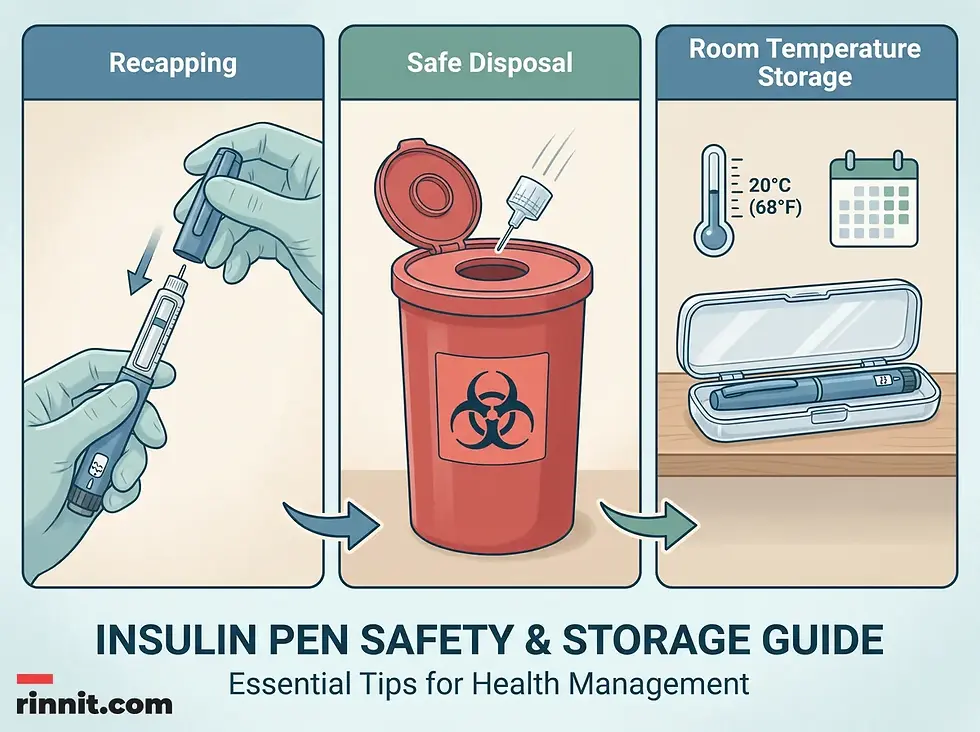
Recap the pen, discard needles in a sharps container, and store open pens at room temperature.
Benefits and Safety Considerations
People typically find pens easier to use than a syringe and vial, and studies show that pens improve dosing accuracy and consistency compared with syringes. Possible downsides are [1]:
Depending on your health insurance, pens may cost more than syringes with a vial of insulin.
Pens still require multiple daily injections, compared with insulin pump therapy, which may cause more frequent skin bruising.
The most common side effect of any insulin injection, including pens, is low blood sugar (hypoglycemia), which happens when your blood sugar falls below 70 milligrams per deciliter (mg/dL). Make sure you know how to treat low blood sugar before you start using insulin [1].
When to See Your Healthcare Provider
If you are starting pens for the first time, a healthcare provider, likely a certified diabetes care and education specialist (CDCES), will teach you how to use the pen, so do not hesitate to ask questions. You will then see your diabetes provider regularly to make sure your plan is working. If you often have high or low blood sugar, reach out to your provider, because your insulin needs may need to be adjusted [1].
Bottom Line
Insulin pens are one option for taking insulin to manage diabetes, and they combine convenience with accurate dosing. Correct preparation, priming, injection, and site rotation help keep your insulin therapy effective and comfortable [1].
Your next step: ask your healthcare provider or diabetes educator to watch you use your pen and to help you choose the pen type and needle size that suit you [1].
Frequently Asked Questions
What is the difference between a disposable and a reusable insulin pen?
You throw away a disposable pen entirely once the insulin runs out or expires. With a reusable pen, you replace the insulin cartridge and keep using the same pen.
Why must I prime the insulin pen before every injection?
Priming removes air bubbles from the needle and makes sure the needle is open and working. You must do it before each injection.
How long should I hold the pen in place after injecting?
Hold the pen at the injection site for 6 to 10 seconds after pushing the button so the insulin is absorbed, and then pull the needle out.
Where are the best places to inject insulin?
Recommended sites are your lower belly, the front and sides of your thighs, your upper and outer arms, and your buttocks.
What happens if I do not rotate my injection sites?
Using the same spot repeatedly can cause hardened areas under the skin (lipohypertrophy) or lipodystrophy, a loss or abnormal distribution of fat tissue, and both keep insulin from working properly.
Can I reuse the same needle for multiple injections?
No. Pen needles are single-use, so use each needle for one injection and then discard it in a sharps container. Never share an insulin pen with anyone else, even if you change the needle, because it can spread blood-borne infections.
How should I store my insulin pen?
Store open pens at room temperature, about 68 to 72 degrees Fahrenheit (20 to 22 degrees Celsius), and unopened pens in the refrigerator. Most pens are good for 28 days once opened, so check the label or ask your pharmacist.
What are smart insulin pens?
Smart (connected) pens, or caps that attach to certain pens, send the time and amount of each dose to a phone app. The app may also track active insulin, help calculate a bolus, alert you to missed injections, and monitor insulin temperature and expiration date.
Is it normal to see a small drop of blood after injecting?
Yes, you may bleed a little at the injection spot. Apply pressure with a clean alcohol wipe or cotton ball and cover the site with a bandage if needed.
What areas should I avoid when injecting insulin?
Avoid injecting within 2 inches (5 centimeters) of your navel, the middle of your abdomen, scar tissue, stretch marks, areas near joints, and your groin.
What is the most common side effect of insulin pens?
Low blood sugar (hypoglycemia), which happens when blood sugar falls below 70 mg/dL, is the most common side effect of any insulin injection. Make sure you know how to treat it before you start insulin.
Related Reading
Insulin: The Essential Hormone for Blood Sugar Management explains how insulin controls blood sugar.
Diabetic Hypoglycemia: Symptoms, Causes & How to Treat Low Blood Sugar Fast — Complete Guide covers low blood sugar signs and fast treatment.
Lipohypertrophy: Understanding Injection-Related Fatty Lumps explains lumps at injection sites and how to prevent them.
Diabetes Medications: Types, How They Work, and Side Effects — Complete Guide compares diabetes medicines and how they work.
References
Cleveland Clinic. Insulin Pens. Cleveland Clinic. February 12, 2024. https://my.clevelandclinic.org/health/treatments/17923-insulin-pen-injections
Yang H, Zhang L, Dong Q, et al. The distinct ultrasound characteristics and prognostic features of insulin-induced lipohypertrophy: a systematic review. Diabetes Metab Syndr Obes. 2025;18:941-954. PMID 40176968. https://doi.org/10.2147/DMSO.S413623
Mader JK, Fornengo R, Hassoun A, et al. Existing knowledge gaps in risk factors and consequences of lipohypertrophy in people using continuous subcutaneous insulin infusion therapy: a systematic review and meta-analysis. J Diabetes Sci Technol. 2025;20(4):1424-1434. PMID 40119628. https://doi.org/10.1177/19322968251319806
Lingen K, Pikounis T, Bellini N, et al. Advantages and disadvantages of connected insulin pens in diabetes management. Endocr Connect. 2023;12(11):e230108. PMID 37610002. https://doi.org/10.1530/EC-23-0108
Medical disclaimer
This article is for informational purposes only and is not a substitute for professional medical advice, diagnosis, or treatment. Always follow the dosing, injection, and storage instructions your healthcare provider and your insulin label give you. The clinical information in this guide reflects source material last reviewed in February 2024.



Comments