Ileocecectomy: Procedure, Recovery, and Outcomes

Updated: 3 days ago
Medically reviewed by Dr. Baraa Alnahhal, MD · Last reviewed: October 2026
Quick Answer: What Is an Ileocecectomy?
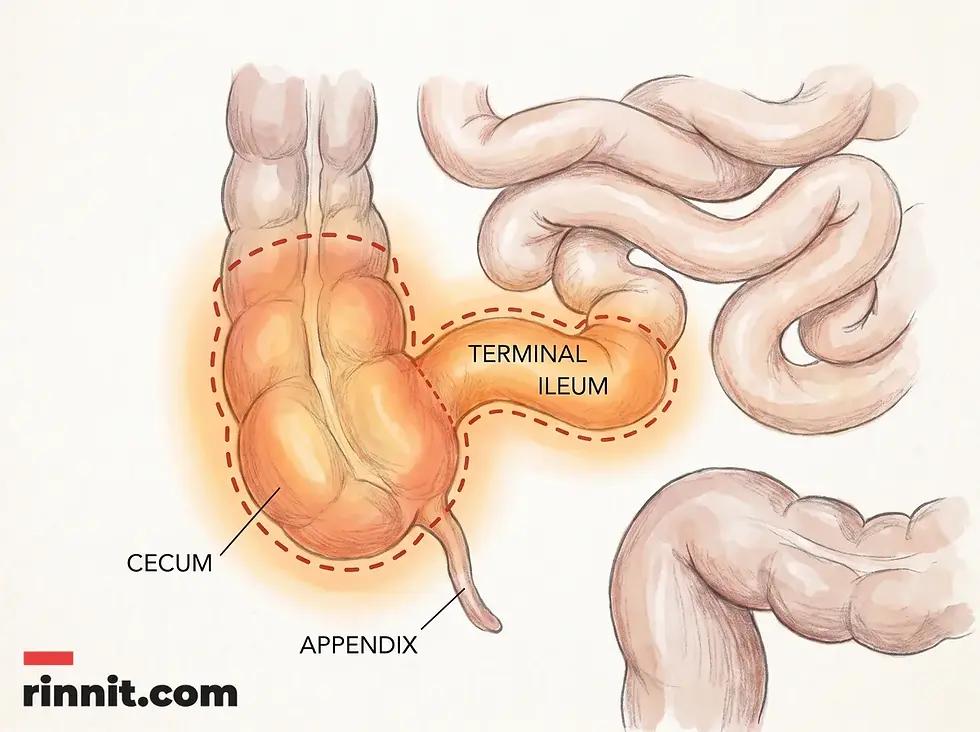
An ileocecectomy is a bowel resection surgery that removes the terminal ileum, the end of the small intestine, and the cecum, the start of the large intestine. Because they share a blood supply, both are usually removed together when one is damaged by disease such as Crohn's or cancer. The surgeon then joins the healthy ends, called anastomosis. [1]
What the research says
Surgery was a reasonable alternative to infliximab in a randomized trial. In the LIR!C trial of 143 adults with limited, non-stricturing ileocaecal Crohn's disease who had not responded to conventional therapy, quality of life at 12 months was similar after laparoscopic ileocaecal resection and infliximab (mean IBDQ score 178.1 vs 172.0; difference 6.1 points, 95% CI −4.2 to 16.4). Over a median 4 years of follow-up, 37% of the infliximab group went on to have a resection, and 26% of the resection group received anti-TNF therapy (Ponsioen et al., Lancet Gastroenterol Hepatol, 2017 [2]).
Robotic and laparoscopic bowel surgery have comparable safety. A meta-analysis of 11 studies (5,566 patients with inflammatory bowel disease) found a lower overall complication rate with robotic than with conventional laparoscopic resections (p = 0.03), while laparoscopy had a shorter operative time; anastomotic leaks (p = 0.84), conversion to open surgery (p = 0.15), and 30-day mortality did not differ (Zaman et al., J Crohns Colitis, 2024 [3]).
The Purpose of Ileocecectomy
The ileocecal region is a common site for inflammation and scarring, particularly in patients with Crohn’s disease. When this area becomes too narrow or damaged, surgery is necessary to restore normal function. In some cases, healthcare providers recommend an early ileocecectomy for Crohn’s disease to potentially reduce the need for long-term medication and prevent future damage.
Common Indications for Surgery
Condition | Impact on the Ileocecal Region |
Crohn’s Disease | Causes chronic inflammation, narrowing (strictures), and scarring. |
Appendicitis | Severe infection of the appendix, which is attached to the cecum. |
Intestinal Cancer | Presence of neuroendocrine tumors or other malignancies in the terminal ileum or cecum. |
Fistulas or Ulcers | Abnormal connections or deep sores that cannot be managed with medication alone. |
The Surgical Procedure
An ileocecectomy can be performed through two primary methods: open abdominal surgery (laparotomy) or minimally invasive surgery (laparoscopic or robotic). The choice depends on the patient’s condition and the surgeon’s expertise.
During the procedure, the surgeon removes the diseased sections of the ileum and cecum, along with the appendix. The new ends of the bowel are examined for healthy blood flow before being reconnected through an anastomosis. If there are concerns about the bowel’s ability to heal immediately, a temporary ostomy may be created to redirect waste to an opening in the abdomen.
Comparison of Surgical Approaches
Feature | Open Surgery | Minimally Invasive Surgery |
Incision Size | One long abdominal incision. | Several small "keyhole" incisions. |
Tools Used | Standard surgical instruments. | Camera (laparoscope) and specialized tools. |
Recovery Time | Typically longer due to larger wound. | Generally faster with less postoperative pain. |
Gas Usage | Not required. | Carbon dioxide used to expand the abdomen. |
Risks and Benefits
The primary benefit of an ileocecectomy is the relief of chronic symptoms and the prevention of further bowel damage. For Crohn’s patients, while the disease may eventually return, it is often milder and easier to manage after the damaged section is removed.

Potential Risks to Consider
While generally safe, all major surgeries carry inherent risks.
Anastomotic Leak: The new connection between the bowels may fail to heal properly, potentially leading to abdominal infection.
Permanent Ostomy: If complications prevent a successful reconnection, a temporary ostomy may become permanent.
General Risks: These include bleeding, blood clots, and wound infections, though these are statistically low.
Recovery and Long-Term Outlook
Patients typically stay in the hospital for up to one week following surgery. During the initial days, the bowels may be slow to resume function, requiring a liquid diet. Most patients can return to normal activities within one to two months.

When to Contact a Healthcare Provider
During the recovery period, patients should monitor for signs of complications, including:
Worsening abdominal pain that is not managed by medication.
Fever or chills.
Persistent nausea or vomiting.
Signs of infection at the incision site (redness, swelling, or drainage).
Frequently Asked Questions
How long does an ileocecectomy take?
The duration varies based on the complexity and the surgical method used, but most procedures are completed within two to four hours.
Will I need an ostomy bag after surgery?
Most patients do not need a permanent ostomy. A temporary ostomy may be used if the bowel needs more time to heal before reconnection.
Can Crohn’s disease return after an ileocecectomy?
Yes, Crohn’s disease can reappear in other parts of the intestine, but surgery often provides years of symptom-free remission.
What can I eat immediately after surgery?
You will likely start with a clear liquid diet, gradually progressing to soft foods as your bowel function returns to normal.
How soon can I return to work?
Most patients return to light duty or office work within four to six weeks, though strenuous activity should be avoided for at least two months.
Is an ileocecectomy the same as a hemicolectomy?
No, an ileocecectomy is more localized, removing only the end of the small intestine and the start of the large intestine, whereas a hemicolectomy removes half of the colon.
Will my digestion be different after surgery?
Many people adjust well, but because the end of the small intestine absorbs vitamin B12 and bile acids, some develop looser stools (bile acid diarrhea) or low vitamin B12 over time, so your doctor may check your B12 levels.
How is the anastomosis performed?
The surgeon uses specialized staples or sutures to securely join the two healthy ends of the intestine together.
What happens to my appendix during the surgery?
The appendix is attached to the cecum, so it is automatically removed during an ileocecectomy if it has not been removed previously.
How long is the hospital stay?
Most patients remain in the hospital for three to seven days to ensure their bowels are working and pain is well-managed.
How do I prepare for an ileocecectomy?
Before scheduling surgery, your healthcare team assesses your overall health to make sure you're in good condition for it. [1] This may include blood tests, a CT scan, an EKG and a colonoscopy. [1]
When should I call my doctor after an ileocecectomy?
Call your provider if you have unusual symptoms during recovery, such as worsening pain, fever, or nausea or vomiting. [1]
Will I have pain after an ileocecectomy?
You'll be able to go home once you can eat and have bowel movements normally and manage your pain with over-the-counter medicines. [1] Tell your provider if your pain gets worse during recovery. [1]
Related Reading
References
Cleveland Clinic. Ileocecectomy. Cleveland Clinic. Last updated March 11, 2026. https://my.clevelandclinic.org/health/procedures/ileocecectomy
Ponsioen CY, de Groof EJ, Eshuis EJ, et al. Laparoscopic ileocaecal resection versus infliximab for terminal ileitis in Crohn's disease: a randomised controlled, open-label, multicentre trial. Lancet Gastroenterol Hepatol. 2017;2(11):785-792. PMID 28838644. https://doi.org/10.1016/S2468-1253(17)30248-0
Zaman S, Mohamedahmed AYY, Abdelrahman W, et al. Minimally invasive surgery for inflammatory bowel disease: a systematic review and meta-analysis of robotic versus laparoscopic surgical techniques. J Crohns Colitis. 2024;18(8):1342-1355. PMID 38466108. https://doi.org/10.1093/ecco-jcc/jjae037
Medical disclaimer
This article is for general informational purposes and is not a substitute for professional medical advice, diagnosis, or treatment. Always consult a qualified healthcare professional about any medical condition.


Comments