Ice Burns: Symptoms, First Aid, and Prevention Strategies

Updated: 2 days ago
Medically reviewed by Dr. Baraa Alnahhal, MD · Last reviewed: October 2026
Quick Answer
Ice burns are a type of thermal burn caused by intense cold, grouped with frostbite. Unlike heat burns, they may not cause pain right away. They range from frostnip to deep frostbite. For first aid, slowly rewarm the area in lukewarm water, never using hot water, direct heat or rubbing. Wrapping ice packs in a towel helps prevent them. [1]
What the research says
Cold burns are uncommon, and first aid is often missing. In an 11-year review at a regional burns centre in the UK (23 patients with cold burns), only 8 patients had received first aid. All but one patient were managed without surgery, and one needed a skin graft because of delayed healing. Of 52 clinicians who answered a survey, 90% said clearer guidelines for cold burns should exist. (Nizamoglu et al., Burns Trauma, 2016)
For severe frostbite, the evidence for the drug iloprost is still mostly observational. A scoping review of 20 studies (254 patients and more than 1,000 frostbitten digits) found that the larger case series showed lower amputation rates than in untreated patients. Most studies were retrospective case series, and the authors noted a shortage of randomized trials. (Gauthier et al., Int J Circumpolar Health, 2023)
A 2026 cohort links iloprost with fewer amputations. Among 257 adults with grade 2 to 4 frostbite treated in two Canadian cities, iloprost was associated with a lower likelihood of any amputation (odds ratio 0.49, 95% CI 0.25 to 0.96). In grade 3 injuries, amputation rates were 30% with iloprost versus 52% without. More than 80% of grade 4 patients needed amputation regardless of treatment, and adverse events occurred in 61% of iloprost-treated patients, most commonly headache. (O'Dochartaigh et al., BMJ Open, 2026)
What are ice burns?
Ice burns are a type of thermal burn that you can get from intense cold. Most thermal burns come from hot things, but extreme cold causes similar damage. [1]
Ice isn't the only cold thing that can burn you, which is why experts group ice burns as a type of cold burn. Frostbite is another example. [1]
Cold burns can be especially dangerous because you may not feel the damage happening. Heat burns immediately activate your sense of pain, but cold-related burns may not. Cold burns usually aren't deadly, but they can still cause serious injuries. [1]
What are the symptoms and three stages of cold injury from an ice burn?
Experts use a three-type system for cold injuries, including cold and ice burns. Knowing the stage helps you decide whether first aid at home is enough. [1]

Stage | Depth | Symptoms | Reversible? |
Frostnip | Superficial cold burn | Pale skin, peeling, and tingling or aching that turns into numbness. [1] | Yes. Frostnip is reversible. [1] |
Superficial frostbite | Partial-thickness cold burn | Pale or grayed skin, blisters and numbness. [1] | No. Needs medical attention. [1] |
Deep frostbite | Full-thickness cold burn | Darkened or blackened skin, complete loss of feeling, and stiffness and loss of muscle control. [1] | No. Needs medical attention. [1] |
What causes ice and cold burns?
Cold and ice burns can happen in many ways. [1]
Ice and cold packs held directly against the skin for too long
Refrigerants from home and automobile air conditioning systems
Gases that are supercooled to a liquid form (hydrogen, helium, nitrogen and oxygen)
Dry ice (frozen carbon dioxide) used in shipping, science and industry
Aerosol cans, because the propellant gas can cause cold burns when used improperly, especially when inhaled
Exposure to cold weather
What makes a cold burn severe
A cold pack or plastic bag of regular ice cubes held directly on bare skin may take minutes to cause a cold burn. Extremely cold materials, such as liquid gases or dry ice, can cause deep, severe cold burns in seconds. [1]
What complications can ice burns cause?
Cold burns cause cell damage and disrupt blood flow in the affected area, and most complications involve the area that was burned. [1]
Amputation
Chronic pain and cold intolerance
Compartment syndrome
Complex regional pain syndrome
Infections
Joint stiffness and muscle atrophy
Tingling
Large, deep cold burns can also send you into shock, which needs shock first aid right away. [1]
How are ice burns diagnosed?
Healthcare providers can diagnose ice burns and similar cold injuries with a physical exam, looking closely at the injury and asking how it happened. Tests such as magnetic resonance angiography can show problems with blood circulation from the burn and help determine how severe it is. [1]
What is the first aid for ice burns?
First aid for ice and cold burns starts with slowly rewarming the affected body part. [1]

Loosen any clothing needed so it can't affect circulation. [1]
Immerse the body part in lukewarm water. If you can't immerse it, pour warm water over it. [1]
If the body part is frozen to something, pour lukewarm water on it until you can pull it away. Once it's free, immerse it in lukewarm water or keep pouring lukewarm water over it. [1]
Cover it with a bandage if needed, but be careful not to wrap it too tightly. [1]
What not to do
Rewarming has to happen slowly, because warming too fast can do even more damage to the burned tissue. Only start rewarming if there's no risk of the body part refreezing, since warming and then refreezing can do even more damage. [1]
You can self-treat minor ice and cold burns that cause only frostnip. Burn ointments or aloe vera can soothe the area, and you can cover it with a clean bandage if needed. [1]
When should you get medical care for an ice burn?
You can self-treat frostnip, but partial-thickness and full-thickness cold burns always need medical attention. Get professional care if: [1]
The burned area feels hard to the touch, looks or feels waxy, or looks and stays much darker than unburned skin
The area hurts very badly, or it doesn't regain feeling after several minutes
Blisters form on or around the area
Your skin froze to something and tore when you pulled away (this always needs professional care)
Get emergency medical care if you have a cold or ice burn on your face, if you inhale any amount of supercooled gas, or if you show any symptoms of shock after a cold or ice burn. When in doubt, err on the side of caution. [1]
Professional treatment
More severe cold burns need medical treatment, which can include [1]
Additional rewarming treatment
Debridement (cleaning the burn and removing dead or dying tissue)
Bandaging or covering the burn, and skin grafts
Medicines such as pain relievers, antibiotics for infections and anti-inflammatory medicines like corticosteroids
IV fluids
Clot-breaking medicine (tPA) or IV blood thinners such as heparin or iloprost (Aurlumyn) to try to restore circulation
Surgery, especially for emergencies like compartment syndrome, and amputation as a last resort
Specialists also follow evidence-graded frostbite guidelines that cover prevention, rewarming and other treatments. (McIntosh et al., Wilderness Environ Med, 2024)
What is the outlook for ice burns?
Minor ice and cold burns usually heal easily and quickly. Deeper and larger cold burns need immediate care, and the outlook is generally better when care starts right away. Even without major complications, many people with cold or ice burns have lingering effects for weeks, months or longer. [1]
How can you prevent ice burns?
Ice and cold burns are usually preventable. The main strategy is protecting yourself from potential sources. [1]
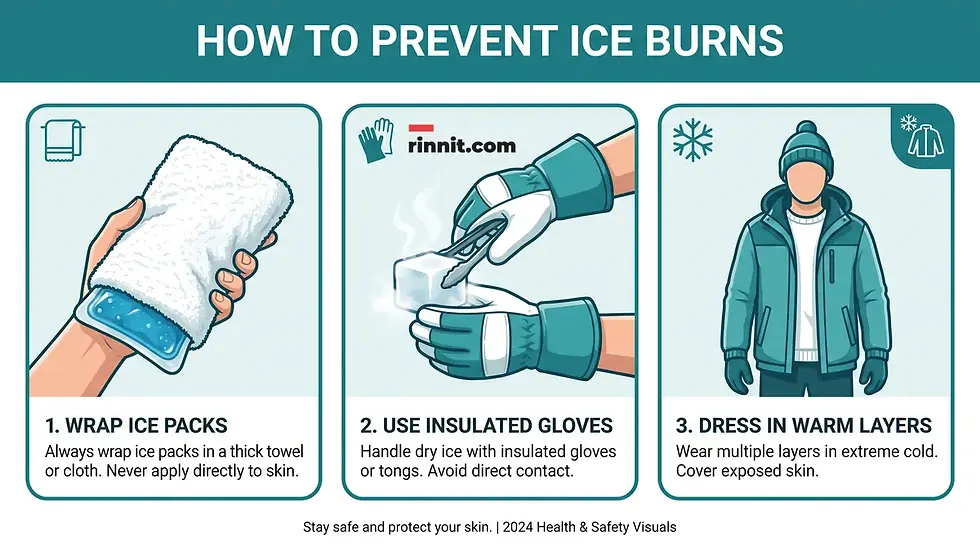
Wrap cold and ice packs: never put an ice or cold pack directly on your skin. Wrap it in a towel or another cloth. [1]
Limit contact time: longer contact usually means a worse burn, so check your skin often. A common rule of thumb is about 20 minutes at a time with a break in between. [1]
Dress warmly: frostbite is preventable with the right clothing. [1]
Gear up: insulated gloves, boots and other protective gear are a must when handling anything cold enough to burn you. [1]
Know your limits: leave home and car air conditioning repairs to trained professionals with the right gear. [1]
Secure aerosols: keep aerosol cans out of easy reach and follow the instructions on the can to avoid harm from inhaling the contents. [1]
Related reading
Frequently Asked Questions
Can I get a burn from a regular ice cube?
Yes. A cold pack or a plastic bag of regular ice cubes held directly on your skin may take only minutes to cause a cold burn.
Why shouldn't I use hot water to warm an ice burn?
Rewarming has to happen slowly. If it happens too fast, it can do even more damage to the burned tissue, so use lukewarm water.
Is an ice burn the same as frostbite?
Ice burns are a type of cold burn. Frostbite is another example of a cold burn, and it is the more serious part of the cold injury spectrum.
What should I do if my skin is frozen to a metal object?
Pour lukewarm water on it until you can pull it away. If your skin tears when you pull away, you always need professional medical care.
Can I use a hair dryer to warm my frozen fingers?
No. Direct heat such as a hair dryer, space heater or hot towel can cause further damage. Use lukewarm water instead.
How long does it take for an ice burn to happen?
A cold pack or bag of ice may take minutes. Extremely cold materials such as liquid gases or dry ice can cause deep burns in seconds.
What does a deep cold burn look like?
Deep frostbite causes darkened or blackened skin, complete loss of feeling, and stiffness and loss of muscle control.
Should I pop blisters caused by a cold burn?
No. Blisters mean at least a partial-thickness cold burn, which always needs medical attention. Leave the blisters alone and let a clinician decide how to manage them.
Can inhaling aerosol spray cause a cold burn?
The propellant gas in aerosol cans can cause cold burns when the can is used improperly, especially when inhaled. Inhaling any amount of supercooled gas needs emergency medical care.
What is compartment syndrome?
Compartment syndrome is a serious complication in which swelling raises pressure inside a muscle compartment and can cut off blood flow. It is an emergency and may need surgery.
Are ice burns permanent?
Frostnip is reversible, but superficial and deep frostbite aren't. Even without major complications, many people have lingering effects for weeks, months or longer.
Can I use ice on a heat burn?
No. Ice can add a cold burn on top of the heat burn. Cool, not ice-cold, running water is the standard first aid for heat burns.
Is tingling a good sign during rewarming?
Tingling or aching as feeling returns is common. But get medical care if the area hurts very badly or doesn't regain feeling after several minutes.
Should I rewarm if the area might refreeze?
No. Only start rewarming if there's no risk of the body part refreezing, because warming and then refreezing can do even more damage.
Can I go into shock from an ice burn?
Yes. Cold burns that are large and deep enough can cause shock, which needs shock first aid and emergency care right away.
Can cold burns come from air conditioning refrigerant?
Yes. Refrigerants from home and car air conditioning systems are a recognized cause, which is why those repairs are best left to trained professionals.
References
Cleveland Clinic. Ice Burns. Cleveland Clinic. Last updated April 8, 2026. https://my.clevelandclinic.org/health/diseases/ice-burns
Nizamoglu M, et al. Cold burn injuries in the UK: the 11-year experience of a tertiary burns centre. Burns Trauma. 2016;4:36. PMID 27843971. https://doi.org/10.1186/s41038-016-0060-x
Gauthier J, et al. Iloprost for the treatment of frostbite: a scoping review. Int J Circumpolar Health. 2023;82(1):2189552. PMID 36966492. https://doi.org/10.1080/22423982.2023.2189552
O'Dochartaigh D, et al. Comparison of iloprost therapy versus non-iloprost therapy for severe frostbite: a retrospective cohort study of two Canadian cities. BMJ Open. 2026;16(5):e110475. PMID 42150831. https://doi.org/10.1136/bmjopen-2025-110475
McIntosh SE, et al. Wilderness Medical Society Clinical Practice Guidelines for the Prevention and Treatment of Frostbite: 2024 Update. Wilderness Environ Med. 2024;35(2):183-197. PMID 38577729. https://doi.org/10.1177/10806032231222359
Medical disclaimer
This article is for general educational purposes only and is not a substitute for professional medical advice, diagnosis, or treatment. If you think you may have a medical emergency, call your doctor or 911 immediately.



Comments