Frostbite: Symptoms, the 3 Stages, and How to Rewarm Safely Without Causing More Damage

Updated: 2 days ago
Medically reviewed by Dr. Baraa Alnahhal, MD · Last reviewed: September 2026
Frostbite is an injury caused by freezing of the skin and underlying tissues, and its early stage is called frostnip — a cold feeling followed by numbness. It most often affects the fingers, toes, ears, cheeks, chin, and tip of the nose, and the risk rises sharply in cold weather that is also wet and windy. Frostbite develops in three stages: frostnip (pain, tingling, numbness — no permanent damage), superficial frostbite (patchy, warm-feeling skin; blisters forming 12 to 36 hours after rewarming), and deep frostbite (white or blue-gray skin, large blood blisters, and tissue that can turn black and hard). Mild frostbite improves with rewarming, but anything more serious needs a healthcare professional, because frostbite can cause permanent damage to skin, muscle, and bone. Safe first aid means warm-water soaking — never direct heat, never rubbing. Severe cases can need blood-flow medication, surgery, or amputation, so early action matters.
Quick Answer
What is frostbite? An injury caused by freezing of the skin and underlying tissues; its early stage is called frostnip.
What does it look and feel like? Numbness, tingling, patches of skin in shades of red, white, blue, gray, purple or brown, cold hard waxy-looking skin, clumsiness from joint stiffness, pain, and blistering after rewarming.
Where does it happen most? Fingers, toes, ears, cheeks, chin, and tip of the nose — and it can occur even on skin covered by gloves or clothing.
How serious is it? Frostnip causes no permanent skin damage; superficial frostbite can blister; deep frostbite can kill tissue down to bone and sometimes requires amputation.
What is the safest first aid? Get out of the cold, remove wet clothes and rings, soak the area in warm water about 30 minutes — never direct heat, never rubbing, never rewarming if refreezing is possible.
When is it an emergency? Intense pain after rewarming, intense shivering, slurred speech, drowsiness, or trouble walking — these can signal frostbite plus hypothermia.
How is severe frostbite treated? Rewarming baths, pain medicine, antibiotics, blood-flow medications, debridement, and in the worst cases surgery or amputation.

What is frostbite?
Frostbite is an injury caused by freezing of the skin and underlying tissues. The early stage of frostbite is called frostnip. It causes a cold feeling followed by numbness. As frostbite gets worse, the affected skin may change color and become hard or waxy-looking.
Exposed skin is at risk in conditions that are freezing cold and windy or wet. Importantly, frostbite also can occur on skin covered by gloves or other clothing — being "covered up" is not a guarantee of safety.
The good news: mild frostbite gets better with rewarming. The caution: seek medical attention for anything more serious than mild frostbite, because the condition can cause permanent damage to skin, muscle, bone, and other tissue.
What are the symptoms?
Symptoms of frostbite include numbness, tingling, pain, and blistering after rewarming. The skin may develop patches in shades of red, white, blue, gray, purple, or brown — the color of affected skin depends on how serious the frostbite is and the usual skin color. The skin can feel cold, hard, and waxy-looking, and joint stiffness can cause clumsiness.
Because of the numbness, you may not notice you have frostbite until someone points it out. Color changes also might be difficult to see on brown and Black skin, which makes checking skin by feel — and having a companion watch for you — especially important in extreme cold.
Frostbite is most common on the fingers, toes, ears, cheeks, chin, and tip of the nose.
The 3 stages of frostbite
Frostbite occurs in several stages, and the stage determines both what you can do at home and whether professional care is needed.
Frostnip: the early stage — pain, tingling, and numbness, with no blisters and no permanent damage to the skin
Mild to moderate (superficial): slight skin color changes; skin may begin to feel warm, a sign of serious skin involvement; rewarming may leave the skin looking patchy, stinging, burning, and swelling; a fluid-filled blister may form 12 to 36 hours after rewarming; usually no permanent damage if treated properly
Deep: all layers of the skin and the tissues below are affected, and skin turns white or blue-gray; large blood blisters may appear 24 to 48 hours after rewarming; weeks after the injury, tissue may turn black and hard as it dies
The warm feeling in the superficial stage is deceptive — it signals serious skin involvement, not recovery.
What causes frostbite?
The most common cause of frostbite is exposure to freezing cold, and the risk rises if the weather also is wet and windy. Frostbite also can be caused by direct contact with ice, freezing metals, or very cold liquids. That last point matters more than most people realize: frostbite can happen in an instant if bare skin touches something cold, such as freezing metal.
Who is at higher risk?
Risk rises with no protective clothing in freezing conditions (exposed skin freezes fastest), diabetes, poor blood flow, exhaustion, or congestive heart failure (circulation problems make tissues freeze more easily), regular tobacco smoking (impairs blood flow to the skin), impaired judgment in cold conditions (people may stay out too long or fail to notice early signs), prior frostbite or cold injury (previously damaged skin is more vulnerable), being an infant or older adult (harder time producing and retaining body heat), and high altitude in cold conditions (thin air increases cold stress on the body).
What are the possible complications?
Frostbite is not just a skin problem. Its complications range from long-term sensitivity to tissue death: hypothermia (a serious condition in which the body loses heat faster than it can be produced, and people with frostbite might also have it), increased sensitivity to cold and a higher risk of future frostbite, long-term numbness in the affected area, hyperhidrosis (excessive sweating in the affected area), changes in or loss of nails, growth problems in children if frostbite damages a bone's growth plate, infection (frostbitten tissue is vulnerable), tetanus (frostbite increases the risk), and gangrene, where dead tissue can lead to amputation.
When to seek emergency care
Seek emergency care for intense pain even after taking a pain reliever and rewarming, intense shivering, slurred speech, drowsiness, or trouble walking. These symptoms may mean frostbite is accompanied by hypothermia. In babies, watch for cold skin, a change in skin color, and very low energy.
While you wait for emergency medical help or an appointment, take these steps as needed: get out of the cold and remove wet clothing; if you suspect hypothermia, wrap up in a warm blanket until help arrives; protect the injured area from further damage; don't walk on frostbitten feet or toes if possible; take a pain reliever if needed; and drink a warm, nonalcoholic beverage if possible.
Frostbite first aid: do this, never do that

The safe steps
If you suspect hypothermia, call for emergency help. Protect the injured area from further damage — and do not try to rewarm the frostbitten skin if it might freeze again; refreezing thawed tissue does more damage.
Get out of the cold, remove wet clothes, and wrap up in a warm blanket. If possible, soak the skin with frostbite in a tub or sink of warm water for about 30 minutes. For frostbite on the nose or ears, cover the area with warm, wet cloths for about 30 minutes. Another option is to warm the affected skin with body heat — for example, tuck frostbitten fingers under an armpit.
Take a nonprescription pain reliever if needed, and drink a warm, nonalcoholic beverage. Remove rings or other tight items before the injured area swells with rewarming.
The dangerous mistakes
Do not apply direct heat — do not warm the skin with a heating pad, a heat lamp, a blow-dryer, or a car heater. Do not rub the frostbitten skin. And don't walk on frostbitten feet or toes if possible.
How is frostbite diagnosed?
Diagnosing frostbite is based on your symptoms and a review of recent activities during which you were exposed to cold. Your healthcare team may have you undergo X-rays or an MRI to look for bone or muscle damage. It may take 2 to 4 days after rewarming to tell the extent of tissue damage — so the first few days are a waiting period, not a sign that something is wrong.
How is frostbite treated?
After providing first aid, seek treatment from a healthcare professional if you have frostbite. Treatment may involve rewarming, medicine, wound care, surgery, or other steps depending on how serious the injury is.
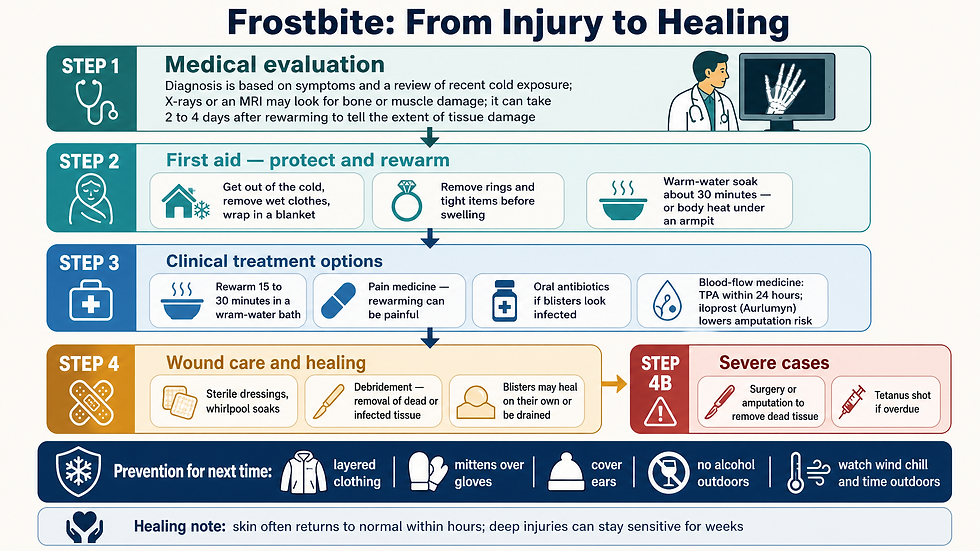
If the skin hasn't been rewarmed already, the care team uses a warm-water bath for 15 to 30 minutes; the skin may turn soft, and you may be asked to gently move the affected area as it rewarms. Rewarming can be painful, so a pain reliever may be given. Once the skin thaws, the area may be loosely wrapped with sterile sheets, towels, or dressings, and raising the affected area can reduce swelling. Whirlpool soaks keep the skin clean and naturally remove dead tissue. If the skin or blisters look infected, oral antibiotics may be prescribed.
An intravenous medicine called TPA (tissue plasminogen activator) restores blood flow and may lower the risk of amputation in severe frostbite; it can cause serious bleeding, so it is used in serious situations and within 24 hours of cold exposure. Iloprost (Aurlumyn), recently FDA-approved for severe frostbite in adults, improves blood flow and can reduce the risk of finger or toe amputation, with side effects including headache, flushing, and heart palpitations. Debridement removes damaged, dead, or infected tissue so the skin can heal properly. Blisters can act as a natural dressing; depending on the type, the team may leave them to heal on their own or drain them. People who have experienced severe frostbite may in time need surgery or amputation to remove dead or decaying tissue.
Recovery and home care
After rewarming, your skin may stop tingling and return to its usual color within a few hours. Deep tissue injury may heal slowly and be very sensitive to the touch for weeks. Take all medicines as prescribed by your healthcare team. For mild frostbite, a nonprescription pain reliever can help ease symptoms.
How can frostbite be prevented?
Frostbite can be prevented, and the habits are straightforward: limit time outdoors in freezing, wet, or windy weather (frostbite can happen in an instant if bare skin touches freezing metal); pay attention to forecasts and wind chill, not just temperature; dress in loose layers so trapped air insulates you; use moisture-wicking undergarments so dry skin stays warmer than damp skin; add a fleece or wool middle layer for insulation; wear a windproof, waterproof outer layer; change wet gloves, hats, and socks quickly; wear a hat or headband that covers your ears; choose mittens over gloves, with wicking liners underneath; use well-fitting, moisture-wicking, insulating socks and liners; watch for early symptoms such as slight skin color changes, prickling, and numbness, and seek warm shelter; plan ahead by carrying emergency supplies and telling others your route; skip alcohol outdoors, since it causes the body to lose heat faster and can impair judgment; eat well and stay hydrated before going out; and keep moving to get blood flowing, without exhausting yourself.
How to prepare for your appointment
Seek medical care if you suspect you have frostbite. For serious frostbite, you may be told to go to an emergency room. List any symptoms you have and how long you've had them — details about your cold exposure help the team know if symptoms have changed. List your key medical information, including any other conditions and all medicines, nonprescription medicines, and supplements you take. Make a note of the date of your last tetanus shot; if you haven't had one within five years, your healthcare team may recommend a shot, since frostbite increases the risk of tetanus.
Bottom line
Frostbite is a deceptive injury. It starts as a cold feeling and numbness — symptoms you might shrug off — and numbness itself hides how far the damage has gone, because you may not notice frostbite until someone else points it out. The three stages map clearly onto the risk: frostnip heals without permanent damage, superficial frostbite brings blisters within 12 to 36 hours of rewarming, and deep frostbite can turn tissue black and hard within weeks.
The response that matters most is disciplined first aid. Warm-water rewarming, removed rings and wet clothes, and a warm blanket do real good. Direct heat, rubbing, walking on frozen toes, and rewarming when refreezing is possible do real harm. And because frostbite can travel with hypothermia — signaled by shivering, slurred speech, drowsiness, and trouble walking — knowing when to call for emergency help is part of staying safe in the cold.
Your next step: If you notice numbness, tingling, or color changes after cold exposure, get indoors, rewarm gently, and have anything beyond frostnip checked by a healthcare professional. If your last tetanus shot was more than five years ago, mention it at your appointment.
FAQ
What is the difference between frostnip and frostbite?
Frostnip is the early stage of frostbite. Its symptoms are pain, tingling, and numbness, and it doesn't cause permanent damage to the skin. Once frostbite progresses past frostnip to the superficial or deep stages, it can damage deeper tissue and requires medical attention.
What does frostbite look like?
Frostbitten skin may show patches in shades of red, white, blue, gray, purple, or brown, depending on severity and your usual skin color. It can feel cold, hard, and waxy-looking. In deep frostbite, skin turns white or blue-gray, large blood blisters can appear 24 to 48 hours after rewarming, and weeks later the tissue may turn black and hard as it dies.
Where does frostbite happen most often?
It is most common on the fingers, toes, ears, cheeks, chin, and tip of the nose. It also can occur on skin covered by gloves or other clothing, and it can happen in an instant when bare skin touches freezing metal or very cold liquids.
What is the safest way to rewarm frostbitten skin?
Soak the skin in a tub or sink of warm water for about 30 minutes, or cover the nose or ears with warm, wet cloths. You can also warm the area with body heat, such as tucking frostbitten fingers under an armpit. Never apply direct heat (heating pad, heat lamp, blow-dryer, car heater), never rub the skin, and never rewarm if the skin might freeze again.
How long does frostbite take to heal?
After rewarming, skin may stop tingling and return to its usual color within a few hours. Deep tissue injury may heal slowly and remain very sensitive to the touch for weeks. It can also take 2 to 4 days after rewarming to learn the full extent of tissue damage.
Is frostbite a medical emergency?
Frostbite itself needs professional care unless it is mild frostnip. It becomes an emergency when paired with signs of hypothermia — intense shivering, slurred speech, drowsiness, or trouble walking — or when pain stays intense even after a pain reliever and rewarming. In those cases, seek emergency care immediately.
Can frostbite be prevented?
Yes. Limit time outdoors in freezing, wet, or windy conditions; dress in loose, layered, windproof, and moisture-wicking clothing; wear mittens and a hat that covers the ears; change out of wet gear quickly; carry emergency supplies; avoid alcohol outdoors; eat well and stay hydrated; and keep moving.
References
This article is for general informational purposes and is not a substitute for professional medical advice, diagnosis, or treatment. Always consult a qualified healthcare professional about any medical condition.
Comments