Hyperlexia: A Complete Guide to Symptoms, Types, and Management

Updated: 2 days ago
Medically reviewed by Dr. Baraa Alnahhal, MD · Last reviewed: October 2026
Quick Answer
Hyperlexia is word reading far ahead of language comprehension, usually starting very early, with an intense interest in letters and numbers. About 84% of children with hyperlexia are on the autism spectrum. There are three types. Type I usually needs no treatment, while Types II and III may benefit from speech, occupational and psychological therapy and suitable school placement. [1]
What the research says
Hyperlexia is a recurring feature of the autism spectrum. A systematic review of 82 cases and group studies (912 participants, 315 of them hyperlexic) concluded that hyperlexia, or a hyperlexic-like profile, characterises a substantial portion of the autistic spectrum, in which the parts of the typical reading system are altered and dissociated. (Ostrolenk et al., Neurosci Biobehav Rev, 2017)
Comprehension can be targeted, but the evidence is early. In a small study of 30 preschoolers (8 with autism and hyperlexia, 7 with autism alone and 15 typically developing), a 6-week parent-supported, tablet-based program was followed by a significant rise in reading comprehension scores in the autism-and-hyperlexia group compared with the typically developing group (p = .023). All groups gained in receptive but not expressive language. (Macdonald et al., J Autism Dev Disord, 2022)
What is hyperlexia?
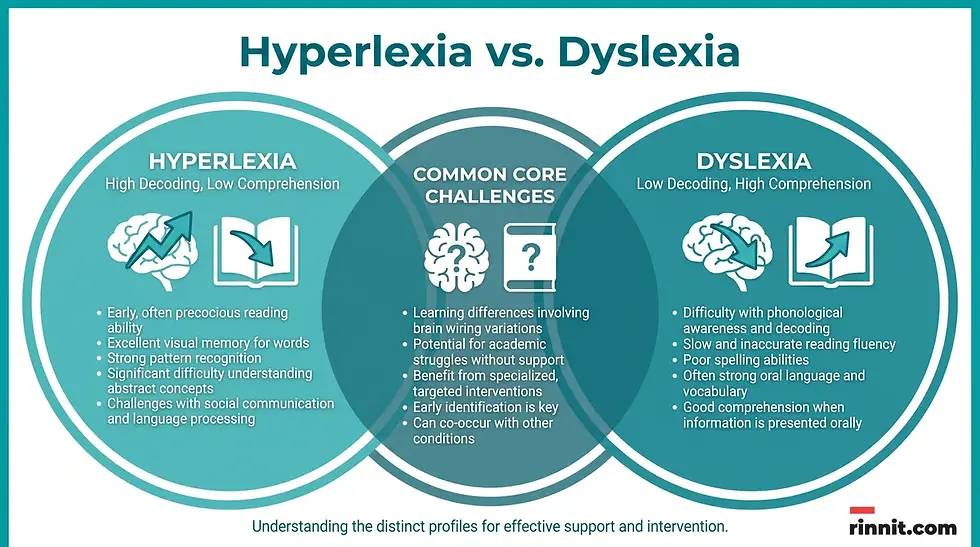
Hyperlexia is a learning difference in which a child begins reading words remarkably early, sometimes teaching themselves with little or no formal instruction. The term combines "hyper," meaning better than, and "lexia," meaning language or reading. The defining feature is a gap between reading skill and comprehension: a child may sound out an entire book but be unable to explain what it means. [1]
Hyperlexia is the opposite of dyslexia. Children with dyslexia struggle with reading and spelling but usually understand what they read, while children with hyperlexia decode well but understand little of it. Dyslexia is far more common, affecting up to 20% of people in the U.S. [1] Hyperlexia is frequently associated with autism: about 84% of children with hyperlexia are on the autism spectrum, but only 6% to 14% of autistic children also have hyperlexia. [1]
The three types of hyperlexia
Researchers have described three types, and knowing which one a child has helps guide support and school placement. [1]

Type | Description |
Hyperlexia I | Typically developing children who learn to read early and far above their expected level. Some researchers say this should not be called hyperlexia, and most agree it needs no treatment. [1] |
Hyperlexia II | Associated with autism spectrum disorder. Children take an early interest in letters and numbers, prefer books to other toys and show other typical signs of autism. Therapists often use the child's reading skills as a tool for treatment. [1] |
Hyperlexia III | Similar to Type II, but the symptoms reduce over time and disappear with age. Children have advanced reading and delayed verbal language, and show some signs of autism but typical social communication skills. [1] |
Symptoms and developmental signs
The most obvious signs are advanced word reading and an intense interest in letters and numbers. A child may look like an exceptional reader without understanding what they read. [1]
Common characteristics
Quick learning ability: Learns to read fast with little instruction, sometimes by repeating words they hear and see often. [1]
Love for books: Prefers books and other reading materials to other toys, and may spell words in the air with their fingers or out loud. [1]
Reduced comprehension: Has advanced reading skills but lower-than-average learning skills, such as trouble understanding how to play a game or put together a puzzle. [1]
Signs of a developmental disorder: May show behavioral issues or be unable to communicate or speak like typically developing children of the same age. [1]
Causes
The exact cause of hyperlexia is unknown. Most researchers believe it develops from a combination of genetic and environmental factors that affect brain development. Because the cause is unclear, there is no known way to prevent it. [1]
Diagnosis
There is no single test for hyperlexia, and it can be hard to diagnose because it does not always stand alone. It is not a diagnosis in the DSM-5, and it is usually assessed as part of an evaluation for autism or other developmental conditions. A pediatrician may refer a child to a child psychologist or speech-language pathologist. They may use tests of language understanding, along with vision, hearing and reflex tests, and will likely recommend autism-specific evaluation tools to confirm or rule out autism. [1]
Management and treatment

Treatment depends on the type and on the child's needs. Children with Type I typically do not need treatment, while those with Type II or Type III may benefit from a combination of therapies. [1]
Speech therapy: A speech-language pathologist uses the child's reading strengths to build language and social skills, such as understanding spoken language, writing and speaking. [1]
Occupational therapy: Focuses on areas such as sleeping, feeding, self-care, writing and taking part in school and social activities. [1]
Psychological therapy: A child psychologist works on emotional, behavioral and learning needs. [1]
Educational placement: Type II children may do better in a special education classroom or a one-on-one setting, since a typical classroom may be too stimulating. Type III children often benefit from a typical classroom, which gives more chances to build social skills. [1]
When to see a provider: Many children who read early are simply gifted. Talk to your child's pediatrician if early reading comes with trouble understanding speech, following games or puzzles, or communicating and interacting with others. As with other learning differences, earlier evaluation helps maximize a child's potential.
Questions to ask your child's provider
What type of hyperlexia does my child have?
Does this mean my child could have autism, too?
What treatment methods or therapies do you recommend?
Will my child grow out of hyperlexia?
What can I do to help my child thrive?
Conclusion
Hyperlexia is a paradox of child development: a striking talent for reading paired with difficulty understanding. The reading strength can be a source of pride, but the comprehension and social challenges that often come with it need dedicated support. Identifying the type, evaluating for autism when appropriate, and starting targeted therapy early can help children use their reading strengths to work on their areas of difficulty. [1]
Frequently Asked Questions
What is the main difference between hyperlexia and giftedness?
Gifted early readers understand what they read. Children with hyperlexia can decode words but understand little of what the words mean.
Does hyperlexia always mean a child has autism?
No. About 84% of children with hyperlexia are autistic, but not all are. Type I describes typically developing early readers, and in Type III the autism-like signs fade with age.
At what age does hyperlexia usually appear?
Hyperlexia is usually noticed in toddlers or preschool-aged children who read words or show an intense interest in letters far earlier than their peers.
Can hyperlexia be cured?
Hyperlexia is a learning difference, not a disease to be cured. Type III symptoms reduce over time and disappear with age, and Type II can be supported effectively with therapy.
How is hyperlexia different from dyslexia?
Hyperlexia and dyslexia are opposites. Dyslexia involves trouble with reading and spelling but usually good comprehension. Hyperlexia involves advanced word reading but weaker comprehension.
Should I be worried if my 2-year-old is reading?
Early reading can mean giftedness or hyperlexia. If your child also has trouble understanding speech or interacting with others, talk to a pediatrician.
What is decoding in reading?
Decoding is using knowledge of letter-sound relationships to pronounce written words correctly.
What kind of toys do children with hyperlexia prefer?
Children with hyperlexia often prefer books and other reading materials to other toys.
Can speech therapy help with comprehension?
Yes. A speech-language pathologist can use the child's reading ability to build language understanding and social communication.
Is hyperlexia listed in the DSM-5?
No. It is not a DSM-5 diagnosis, but it is often seen in autistic children and is considered during autism evaluations.
What causes the intense interest in letters and numbers?
The exact cause is unknown. Researchers believe genetic and environmental factors that affect brain development play a role.
Will a child with Type III hyperlexia always have social delays?
No. Children with Type III show some autism-like signs but have typical social communication skills, and the symptoms reduce and disappear with age.
Can hyperlexia be prevented?
No. Because the exact cause is unknown, there is no known way to prevent it.
Can children with hyperlexia attend regular classrooms?
It depends on the type. Children with Type II may do better in a special education or one-on-one setting, while children with Type III often benefit from a typical classroom.
What should I ask my doctor about hyperlexia?
Ask which type your child has, whether an autism evaluation is needed, which therapies are recommended, and how you can support your child at home and school.
Related Reading
Autism Assessment: Screening Tools, Diagnostic Tests and What to Expect explains how autism is evaluated, since hyperlexia often occurs with it.
Developmental Language Disorder (DLD): What It Is, Symptoms, Causes, Diagnosis, Treatment and Outlook — What You Need to Know covers ongoing trouble understanding and using spoken language in children.
Speech Therapy: What It Is, Who Needs It, and How It Works describes how speech and language therapy works and who it helps.
Dyslexia: Signs, Causes, Diagnosis & Treatment explains a reading difference that contrasts with early advanced reading.
References
Cleveland Clinic. Hyperlexia. Cleveland Clinic. Last updated December 6, 2024. https://my.clevelandclinic.org/health/diseases/hyperlexia
Ostrolenk A, Forgeot d'Arc B, Jelenic P, et al. Hyperlexia: Systematic review, neurocognitive modelling, and outcome. Neurosci Biobehav Rev. 2017;79:134-149. PMID 28478182. https://doi.org/10.1016/j.neubiorev.2017.04.029
Macdonald D, Luk G, Quintin EM. Early Reading Comprehension Intervention for Preschoolers with Autism Spectrum Disorder and Hyperlexia. J Autism Dev Disord. 2022;52(4):1652-1672. PMID 34046778. https://doi.org/10.1007/s10803-021-05057-x
This article is for general educational purposes only and is not a substitute for professional medical advice, diagnosis, or treatment. Always seek the advice of your physician or other qualified healthcare provider with any questions you may have about a medical condition. Never disregard professional medical advice or delay seeking care because of something you have read here. If you think you may have a medical emergency, call your doctor or emergency services immediately.



Comments