Hyperkeratosis: A Complete Guide to Causes, Symptoms, and Management

Updated: 2 days ago
Medically reviewed by Dr. Baraa Alnahhal, MD · Last reviewed: October 2026
Quick Answer
Hyperkeratosis is thickening of the skin's outer layer caused by overproduction of keratin. It may be pressure-related, such as calluses, or non-pressure-related, such as genetic forms. Causes include friction, sun exposure, infections and genetics. It causes rough, scaly or thickened patches, usually painless. Treatment depends on the type and includes medicated creams, cryotherapy, chemical peels and professional filing. [1]
What the research says
Precancerous lesions rarely become cancer, but they still need watching. A systematic review of 24 studies found that actinic keratosis progressed to squamous cell carcinoma at 0% to 0.075% per lesion-year, and up to 0.53% per lesion in people with a prior non-melanoma skin cancer. The authors noted the data are limited and that no reliable overall estimate can be given. (Werner et al., Br J Dermatol, 2013)
Few actinic keratoses clear without treatment. In a pooled analysis of the placebo arms of randomized trials (38 records), only 8% of participants (95% CI 6–10%) had complete clearance without active treatment, and 0% of organ transplant recipients did. (Steeb et al., Sci Rep, 2022)
Combining cryotherapy with a topical treatment clears more lesions. In a meta-analysis of nine randomized trials (1,644 patients), complete clearance was higher with cryosurgery plus a topical treatment than with cryosurgery alone (risk ratio 1.74, 95% CI 1.25–2.43), with similar tolerability. The studies were at high risk of selective reporting bias. (Heppt et al., Br J Dermatol, 2018)
What is hyperkeratosis?
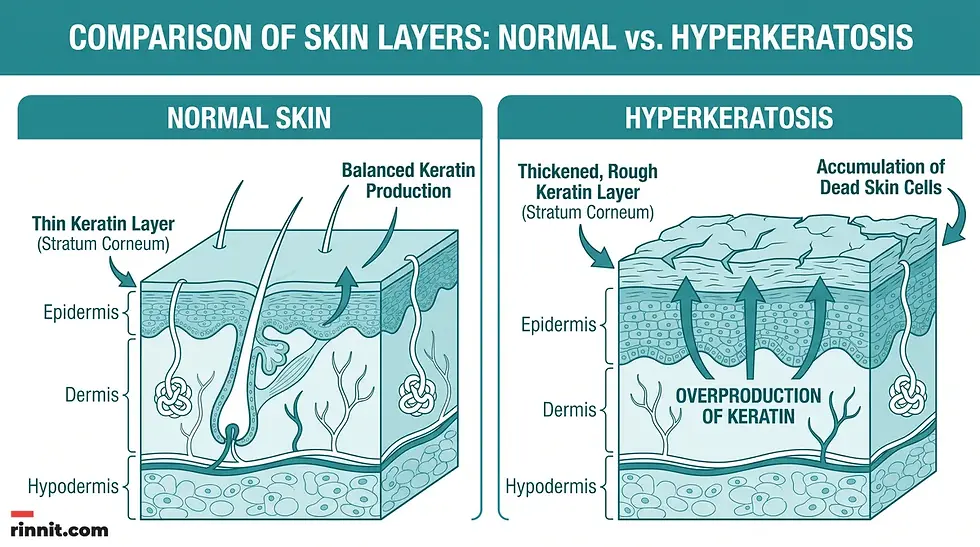
Hyperkeratosis is a condition in which the skin's outer layer becomes abnormally thick. It happens when the body produces too much keratin, a structural protein that normally protects the skin from environmental damage. It most often affects the hands and feet, but it can appear anywhere on the body, including the mouth, nose and nails. Anyone can develop it: some people are born with it, while others develop it in childhood or adulthood. [1]
Providers generally group hyperkeratosis into two types. Pressure-related hyperkeratosis comes from inflammation, irritation or constant rubbing, as with corns and calluses. Non-pressure-related hyperkeratosis is driven mainly by genetics, as in epidermolytic hyperkeratosis. [1]
Common forms and their characteristics
Hyperkeratosis is not a single disease but a group of skin conditions. Each form has its own appearance and underlying trigger. [1]

Type | Description |
Actinic keratosis | Reddish, scaly growths caused by chronic sun exposure. Considered precancerous. [1] |
Corns and calluses | Hardened layers of skin that form to protect against friction and pressure. [1] |
Keratosis pilaris | Tiny, rough bumps, usually on the upper arms, often called "chicken skin." [1] |
Seborrheic keratosis | Noncancerous black or brown patches on the back, face, neck or shoulders. [1] |
Psoriasis and eczema | Inflammatory skin conditions that cause silvery scales or dry, itchy patches. [1] |
Other forms include subungual hyperkeratosis, a chalky substance under the nails, and retention hyperkeratosis, in which skin cells do not shed properly and can lead to acne. Warts, which are caused by HPV infection, also fall under the hyperkeratosis umbrella. [1]
Causes and risk factors
The triggers for skin thickening range from outside stressors to inherited traits. Chronic pressure or rubbing is a leading cause of localized thickening on the hands and feet, while allergies, autoimmune disease and chronic inflammation of the skin (dermatitis) are more likely to cause widespread scaly patches. [1]
Primary triggers
Environmental factors: Chronic sun exposure is the main driver of actinic keratosis. [1]
Biological triggers: Allergies, skin infections such as HPV, and vitamin A deficiency. [1]
Medical influences: Reactions to certain medicines, including chemotherapy drugs, and to chemicals such as tattoo ink. [1]
Genetic predisposition: Inherited mutations can cause skin thickening that is present from birth. [1]
Lifestyle can also raise risk. Ill-fitting shoes can cause corns, and skipping sun protection increases the risk of precancerous growths. [1]
Diagnosis
A proper diagnosis is the first step toward effective management. A provider will ask about your family history of skin conditions, sun exposure, allergies, autoimmune disease and medicines, then examine the skin closely. They may use a dermatoscope, a handheld device that gives off light, to look for scaling. If hyperkeratosis is suspected, a skin biopsy or allergy testing may be used to confirm the cause. [1]
Treatment options
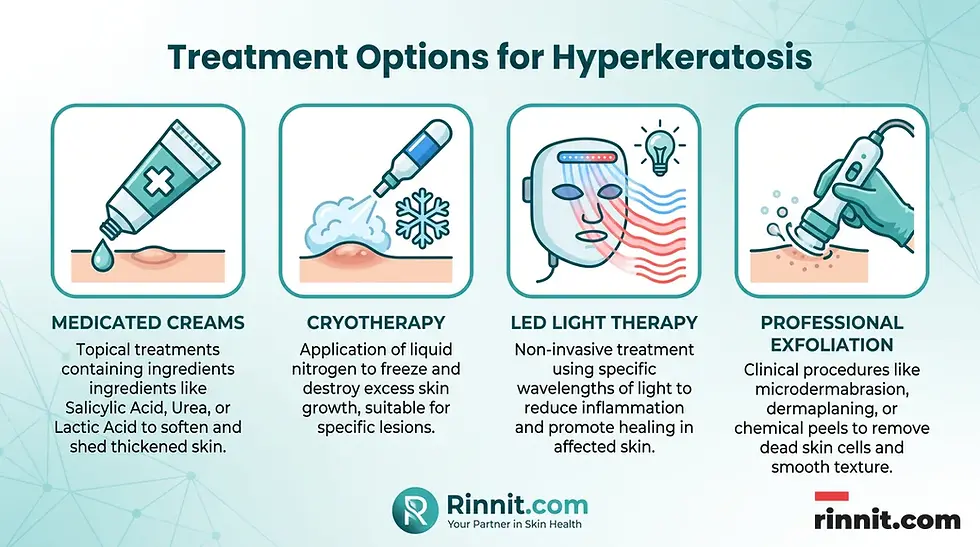
Treatment depends on the type of hyperkeratosis. Results can appear immediately or take several months, and a provider will review progress at follow-up visits and change the plan if one treatment is not working. [1]
Method | Target condition |
Topical corticosteroids | Eczema, lichen planus and nail-related thickening. [1] |
Cryotherapy (freezing) | Warts, seborrheic keratosis and actinic keratosis. [1] |
Chemical peels and LED light therapy | Chemical peels are used for actinic keratosis. LED light therapy is used for actinic keratosis, eczema and psoriasis. [1] |
Professional filing | Painful corns and calluses. [1] |
Some conditions, such as keratosis pilaris, may stop on their own, while others need long-term management. There is no cure for epidermolytic hyperkeratosis, although medicines can ease symptoms. Without monitoring and treatment, actinic keratosis can develop into squamous cell carcinoma. [1]
When to see a provider: Get a rough, scaly or thickened patch checked if it is new, changing, or not going away. During treatment, tell your provider about pain, pus, redness or swelling. Patches in sun-exposed areas deserve prompt attention because actinic keratosis can progress to skin cancer.
Prevention and daily care
Protect your skin from the sun: Limit sun exposure, wear broad-spectrum sunscreen with at least SPF 30 and cover up with protective clothing to lower the risk of actinic keratosis. [1]
Choose comfortable shoes: This helps prevent corns and calluses. [1]
Avoid going barefoot in public areas: Gyms, locker rooms and pools are common places to pick up warts. [1]
Be gentle with your skin: Use soap-free cleansers or mild soaps, avoid hot baths, keep skin clean and moisturized, and do not pick at scaly patches. [1]
Check before trying home remedies: Talk to your provider first, because improper filing or harsh chemicals can cause infection or more irritation. [1]
Conclusion
Hyperkeratosis is a visible sign of the skin responding to pressure, genetics or environmental stress. Many forms are benign and mainly a cosmetic concern, while others, such as actinic keratosis, need medical attention to prevent complications. Good skin care, sun protection and a prompt visit to a provider when a patch changes or persists allow most people to manage the condition well. [1]
Frequently Asked Questions
What is the most common cause of hyperkeratosis?
For many people it is pressure or friction, which leads to calluses. Sun exposure and genetics are also major contributors, depending on the type.
Is hyperkeratosis cancerous?
Most forms are noncancerous. However, actinic keratosis is considered precancerous and can develop into squamous cell carcinoma if it is not monitored and treated.
Can hyperkeratosis be cured?
Many forms can be managed or removed, such as warts and calluses. Genetic forms such as epidermolytic hyperkeratosis have no cure, but their symptoms can be treated.
Does hyperkeratosis cause pain?
Usually not. Pain is mostly linked to calluses, corns and plantar warts.
What does keratosis pilaris look like?
Keratosis pilaris appears as tiny, rough bumps, often described as goosebumps or chicken skin, usually on the back of the upper arms.
How do providers treat warts?
Common treatments include freezing (cryotherapy), laser therapy and shave removal.
Can vitamin A deficiency cause skin thickening?
Yes. Vitamin A deficiency is a recognized cause of hyperkeratosis.
Are hot baths good for hyperkeratosis?
No. Hot baths can dry the skin and worsen irritation. Lukewarm water and soap-free cleansers or mild soaps are recommended.
What is subungual hyperkeratosis?
Subungual hyperkeratosis is a thickening of the skin under a fingernail or toenail, often appearing as a chalky buildup.
Can I use home remedies for calluses?
Talk to your provider before trying home remedies. Improper filing or harsh chemicals can lead to infection or more irritation.
What is a dermatoscope?
A dermatoscope is a handheld device that provides light and magnification so a provider can examine skin features that are hard to see with the naked eye.
Is hyperkeratosis contagious?
Generally no. However, warts are caused by HPV infection and can spread.
How long does treatment take to show results?
The time to see results varies. Some treatments, such as cryotherapy, can work quickly, while medicated creams may take several months to clear a patch.
Can tattoo ink cause hyperkeratosis?
Yes. Some people react to chemicals in tattoo ink, which can cause localized skin thickening.
What SPF is recommended to help prevent sun-related hyperkeratosis?
A broad-spectrum sunscreen with an SPF of at least 30 is recommended, along with limiting sun exposure and wearing protective clothing.
Related Reading
Corns and Calluses: Symptoms, Causes, Treatment and Prevention explains the most common pressure-related types of thickened skin and their treatment.
Keratosis Pilaris: Symptoms, Causes & Treatment Guide covers the rough, bumpy skin form of hyperkeratosis and how to manage it.
Actinic Keratosis: Symptoms, Causes, Diagnosis, and Treatment Options explains sun-damaged scaly patches that need a doctor to check them.
Common Warts: Symptoms, Causes, Prevention, and Treatment Explained explains virus-caused skin growths and the treatments that remove them.
References
Cleveland Clinic. Hyperkeratosis. Cleveland Clinic. Last updated November 17, 2023. https://my.clevelandclinic.org/health/diseases/hyperkeratosis
Werner RN, Sammain A, Erdmann R, et al. The natural history of actinic keratosis: a systematic review. Br J Dermatol. 2013;169(3):502-18. PMID 23647091. https://doi.org/10.1111/bjd.12420
Steeb T, Petzold A, Hornung A, et al. Spontaneous regression rates of actinic keratosis: a systematic review and pooled analysis of randomized controlled trials. Sci Rep. 2022;12(1):5884. PMID 35393452. https://doi.org/10.1038/s41598-022-09722-8
Heppt MV, Steeb T, Ruzicka T, et al. Cryosurgery combined with topical interventions for actinic keratosis: a systematic review and meta-analysis. Br J Dermatol. 2018;180(4):740-748. PMID 30447074. https://doi.org/10.1111/bjd.17435
This article is for general educational purposes only and is not a substitute for professional medical advice, diagnosis, or treatment. Always seek the advice of your physician or other qualified healthcare provider with any questions you may have about a medical condition. Never disregard professional medical advice or delay seeking care because of something you have read here. If you think you may have a medical emergency, call your doctor or emergency services immediately.
Medical disclaimer
The information provided in this article is for educational purposes only and should not be used as a substitute for professional medical advice, diagnosis, or treatment. Always seek the advice of your physician or other qualified health provider with any questions you may have regarding a medical condition.



Comments