Histoplasmosis: Symptoms, Causes & Treatment

Updated: 2 days ago
Medically reviewed by Dr. Baraa Alnahhal, MD · Last reviewed: September 2026
TL;DR: Histoplasmosis is an infection caused by a fungus often found in bird and bat droppings. People get it by breathing in airborne fungal cells called spores, which get stirred up during demolition, construction, or cleanup. In the United States, it is most common in Midwestern states along the Mississippi and Ohio river valleys, and it also occurs in Africa, Asia, Australia, and parts of Central and South America. Most people never develop symptoms and never know they were infected. But the disease can be dangerous for infants and people with weakened immune systems — its most serious form (disseminated histoplasmosis) is often deadly without treatment. Mild cases most often need no treatment, while serious, chronic, or disseminated cases require antifungal medicines for three months to a year.
Quick Answer: What Is Histoplasmosis?
Quick Answer: Histoplasmosis is a fungal infection breathed in from spores in soil contaminated by bird and bat droppings. Key facts:
Cause: spores of the fungus Histoplasma capsulatum released when contaminated soil is disturbed
Where: most common in US Midwestern states in the Mississippi and Ohio river valleys; also Africa, Asia, Australia, Central and South America
Symptoms: most people have none; when present — fever, chills, headache, muscle aches, dry cough, chest pain, tiredness, appearing 3–17 days after exposure
Two serious forms: chronic (lungs; mimics tuberculosis) and disseminated (can affect nearly any organ; often deadly without treatment)
Highest risk: infants/children under 2, adults 55+, and people with weakened immune systems (HIV/AIDS, chemotherapy, corticosteroids, TNF inhibitors, transplant drugs)
Not contagious — cannot spread from person to person
Treatment: mild cases usually need none; serious cases get antifungal medicines for 3 months to a year
See a doctor if flu-like symptoms follow exposure to bird or bat droppings — very important with a weakened immune system
What Is Histoplasmosis?
Histoplasmosis (his-tuh-PLAZ-moh-sis) is an infection caused by a fungus that is often found in bird and bat droppings. People get the infection by breathing in airborne cells, called spores, from the fungus. These spores often get into the air during demolition, construction, or cleanup projects.
The fungus thrives in damp soil that is rich in organic material, especially the droppings from birds and bats. It is common in chicken and pigeon coops, old barns, caves, and parks.
In the United States, histoplasmosis is common in Midwestern states in the Mississippi and Ohio river valleys. The disease also occurs in Africa, Asia, Australia, and parts of Central and South America.

Most people with histoplasmosis never get symptoms and don't know they have the condition. But histoplasmosis can be dangerous for others, mainly infants and people with weakened immune systems. The good news is that treatments can help even the most serious forms of histoplasmosis.
Histoplasmosis Symptoms
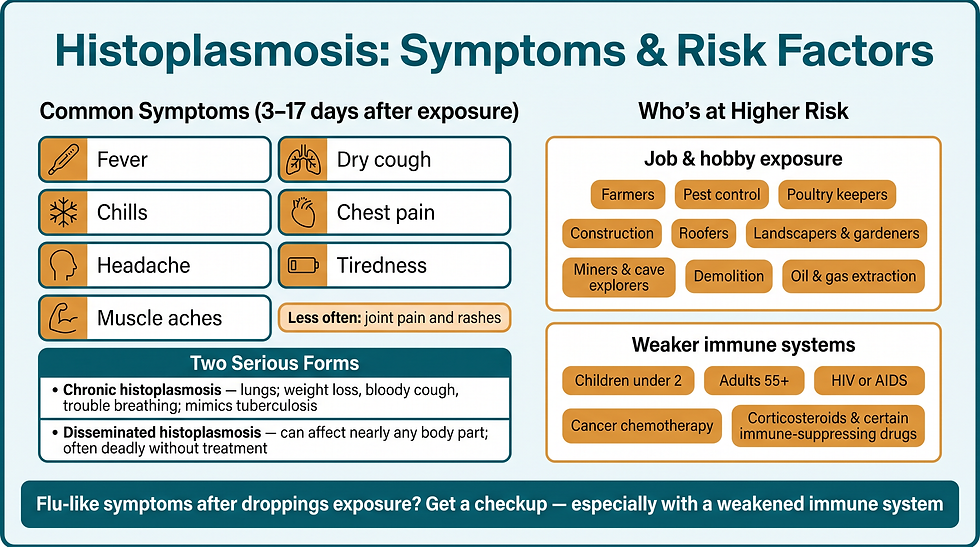
The mildest forms of histoplasmosis cause no symptoms. But serious infections can be life-threatening. When symptoms happen, they often appear 3 to 17 days after someone breathes in the spores that cause the infection.
Symptom | What you notice |
Fever | Elevated body temperature |
Chills | Feeling cold and shivering |
Headache | Head pain |
Muscle aches | Sore, aching muscles |
Dry cough | Cough without mucus |
Chest pain | Discomfort in the chest |
Tiredness | Ongoing fatigue |
Less often, some people also get joint pain and rashes.
Chronic Histoplasmosis
A long-term form of histoplasmosis affects the lungs. It is called chronic histoplasmosis. It mainly affects people who have weakened immune systems or underlying lung conditions.
Symptoms of chronic histoplasmosis can include weight loss, a bloody cough, and trouble breathing. Chronic histoplasmosis symptoms sometimes seem like those of tuberculosis.
Severe (Disseminated) Histoplasmosis
The most serious type of histoplasmosis happens mainly in infants and in people with weakened immune systems. It is called disseminated histoplasmosis. It can affect nearly any part of the body, including the mouth, liver, brain, spinal cord, skin, and adrenal glands. Without treatment, disseminated histoplasmosis often is deadly.
When to See a Doctor
Call your healthcare professional if you get flu-like symptoms after being exposed to bird or bat droppings. It is very important to get a checkup if you have a weakened immune system.
Causes: What Causes Histoplasmosis?
Histoplasmosis is caused by cells, also called spores, from the fungus Histoplasma capsulatum. The spores can float into the air when dirt or other material is disturbed.
The fungus thrives in damp soil that is rich in organic material, especially the droppings from birds and bats. It is common in chicken and pigeon coops, old barns, caves, and parks.
Fact | Detail |
Not contagious | Histoplasmosis can't be spread from person to person |
Can recur | If you've had the infection, you can get it again — the repeat illness will likely be milder the second time |
Risk Factors
The chances of getting histoplasmosis symptoms rise with the number of spores you breathe in. People more likely to be exposed to the spores include:
Exposure group | Why |
Farmers | Work in soil and barn areas where the fungus thrives |
Pest control workers | Handle droppings and infested spaces |
Poultry keepers | Regular contact with chicken coops |
Construction workers | Disturb contaminated soil and structures |
Roofers | Work on structures where birds roost |
Landscapers and gardeners | Dig and disturb soil regularly |
Miners and cave explorers | Work in bat-rich cave environments |
Demolition workers | Disturb contaminated buildings and soil |
Oil and gas extraction workers | Work in exposed outdoor sites |
People Most at Risk of Severe Infection
Children younger than age 2 and adults age 55 and older have weaker immune systems. Because of this, they are more likely to get the most serious form of the disease, called disseminated histoplasmosis. Other factors that can weaken the immune system include:
Immune-weakening factor | Context |
HIV or AIDS | Weakens the body's main infection defenses |
Cancer chemotherapy | Suppresses white blood cell production |
Corticosteroid medicines | Such as prednisone |
Tumor necrosis factor (TNF) inhibitors | Often used to control rheumatoid arthritis |
Transplant rejection medicines | Prevent the body from rejecting a transplanted organ |
Complications
Histoplasmosis can cause many serious health conditions, even in otherwise healthy people. Infants, older adults, and people with weakened immune systems can get complications that often are life-threatening.
Complication | What happens |
Acute respiratory distress syndrome (ARDS) | Lung damage causes air sacs to fill with fluid, keeping the lungs from getting enough air and reducing oxygen in the blood |
Heart concerns (pericarditis) | The body's defenses react with too much inflammation; when the tissue surrounding the heart becomes inflamed, fluid may build up and the heart can have trouble pumping blood |
Adrenal insufficiency | Histoplasmosis can harm the adrenal glands so they don't make enough key hormones; also called Addison's disease |
Meningitis | An infection of the fluid and thin sheets of tissue that surround the brain and spinal cord |
How Is Histoplasmosis Diagnosed?
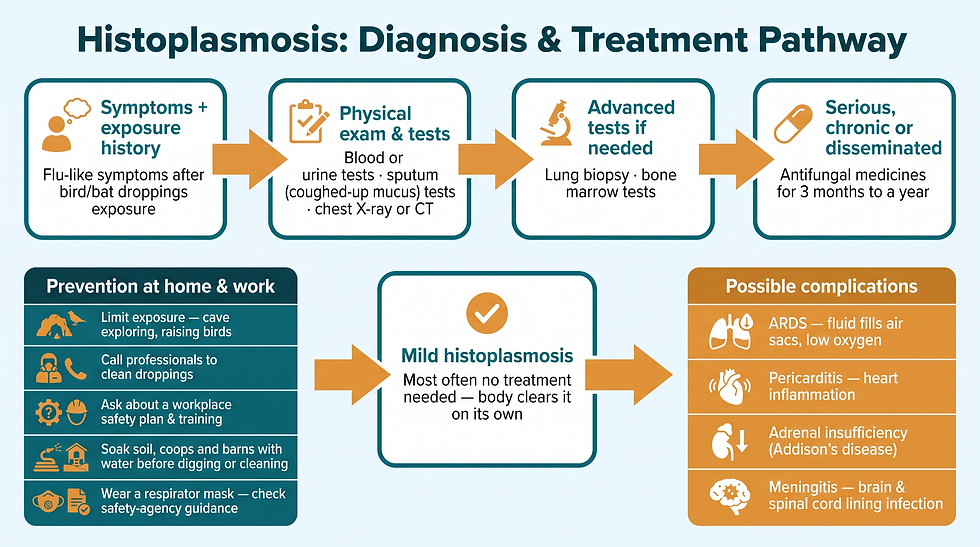
To find out if histoplasmosis is the cause of your symptoms, your healthcare professional gives you a physical exam. You are asked about your medical history and whether you have recently gone to a place where the disease is common.
Test | What it involves |
Blood or urine tests | Detect signs of the infection in the bloodstream or urine |
Sputum tests | Tests of a saliva and mucus sample coughed up or removed from the lungs |
Imaging exam | A chest X-ray or a CT scan of the lungs |
Biopsy | A procedure to remove a small piece of lung tissue |
Bone marrow tests | Tests on the soft tissue inside bones |
Histoplasmosis Treatment
Most often, treatment isn't needed for mild histoplasmosis — the body typically clears it on its own. But if your symptoms are serious or if you have chronic or disseminated histoplasmosis, you'll likely need treatment.
Treatment involves taking one or more medicines that treat infections caused by fungus. These medicines are called antifungals. If you have a serious form of the disease, you might need to keep taking medicines for three months to a year.
Prevention
It can be hard not to breathe in the spores that cause histoplasmosis. That's especially true in areas where the fungus is widespread. But you can take the following steps to help lower the risk of infection:
Prevention step | Details |
Limit exposure | Stay away from projects and activities that might expose you to the fungus, such as cave exploring and raising birds like pigeons or chickens |
Call professionals for cleanup | If you live in an area with lots of bird or bat droppings, it is risky to clean up the droppings yourself — call a company that removes hazardous waste |
Take safety measures at work | If your job involves working where the fungus is common, ask your employer about a site safety plan and training to protect yourself |
Spray surfaces that might be tainted | Before digging soil or working somewhere that could harbor the fungus, soak the area with water to help prevent spores from being released |
Wear a respirator mask | Check guidance from your country's work safety and health agency for the right type of protective mask for your level of exposure |
Preparing for Your Appointment
You are likely to start by seeing your primary healthcare professional. Then you might be referred to a specialist in infectious diseases. Depending on your symptoms and how serious your infection is, you also might see other healthcare professionals — these could include a lung specialist called a pulmonologist and a heart specialist called a cardiologist.
What You Can Do
List item | Details |
Your symptoms | Include any that don't seem related to the reason for your checkup; note when your symptoms began |
Key personal information | Include whether you've been to areas where you might have been exposed — for example, places with lots of birds or bats |
All medicines | Vitamins and other supplements you take, including doses |
Questions to ask | Write down your questions before the visit |
Conclusion: Don't Ignore the Exposure Link
Histoplasmosis is easy to overlook because most people never feel it at all. The risk rises sharply when flu-like symptoms follow a specific, often-forgotten exposure: disturbed soil in areas rich with bird or bat droppings — chicken coops, old barns, caves, demolition sites, and parks in the Mississippi and Ohio river valleys. Most cases resolve on their own, but chronic and disseminated forms can mimic tuberculosis, damage the heart and lungs, and be deadly without treatment. If your symptoms could trace back to droppings exposure, getting checked early is the safest course — especially if you are under 2, over 55, or living with a weakened immune system.
If you develop fever, chills, cough, or chest pain after exposure to bird or bat droppings, call your healthcare professional — and get a checkup promptly if you have a weakened immune system.
Frequently Asked Questions
What is histoplasmosis?
Histoplasmosis is an infection caused by a fungus often found in bird and bat droppings. People get it by breathing in airborne fungal cells called spores, which get into the air during demolition, construction, or cleanup projects. Most people never develop symptoms.
Is histoplasmosis contagious?
No. Histoplasmosis can't be spread from person to person. It is spread only by breathing in fungal spores from contaminated soil. However, if you've had the infection, you can get it again — the repeat illness will likely be milder.
Where is histoplasmosis most common?
In the United States, it is common in Midwestern states in the Mississippi and Ohio river valleys. The disease also occurs in Africa, Asia, Australia, and parts of Central and South America.
What are the symptoms of histoplasmosis?
The mildest forms cause no symptoms. When symptoms occur, they usually appear 3 to 17 days after breathing in the spores and can include fever, chills, headache, muscle aches, dry cough, chest pain, and tiredness. Less often, people get joint pain and rashes.
Who is at risk of severe histoplasmosis?
Children younger than 2 and adults 55 and older are more likely to get the most serious form (disseminated histoplasmosis) because of weaker immune systems. Higher risk also comes with HIV or AIDS, cancer chemotherapy, corticosteroid medicines such as prednisone, TNF inhibitors used for rheumatoid arthritis, and transplant rejection medicines.
Can histoplasmosis be confused with tuberculosis?
Yes. The chronic form affects the lungs and causes weight loss, a bloody cough, and trouble breathing — symptoms that sometimes seem like those of tuberculosis.
Does histoplasmosis need treatment?
Most often, no treatment is needed for mild histoplasmosis. But if symptoms are serious or if you have chronic or disseminated histoplasmosis, treatment with antifungal medicines is usually needed — potentially for three months to a year.
How can I prevent histoplasmosis?
Limit exposure to high-risk activities (cave exploring, raising pigeons or chickens), hire professionals to clean large amounts of droppings, ask your employer about safety plans and training, soak soil and roost areas with water before digging or cleaning, and wear a respirator mask appropriate for your exposure level.
References
Histoplasmosis — Symptoms & causes (source dated May 16, 2025)
Histoplasmosis — Diagnosis & treatment (source dated May 16, 2025)
This article is for general information only and is not a substitute for professional medical advice. Seek care from a qualified healthcare professional for diagnosis and treatment decisions.
Comments