Heterotopic Ossification: Symptoms, Causes, and Treatment Options

Updated: 2 days ago
Medically reviewed by Dr. Baraa Alnahhal, MD · Last reviewed: October 2026
Quick Answer
Heterotopic ossification is the formation of bone in soft tissues such as muscles and fat. [1] [2] It is usually caused by major trauma, orthopedic surgery or rare genetic mutations, and people with spinal cord or head injuries are at high risk. [1] Symptoms include pain, swelling and a hard lump that may limit joint movement. [1] Treatment includes physical therapy, NSAIDs and surgery. [1]
What the research says
The best way to prevent HO after hip replacement is still debated. A systematic review of high-risk hip-replacement patients found that 76.6–88.9% of NSAID-treated patients had no HO, versus 28.6–97.4% across radiotherapy studies, and concluded NSAIDs may work better than radiotherapy; non-selective and COX-II selective NSAIDs performed similarly (RR 1.00, 95% CI 0.80–1.26). (Shapira et al., Hip Int, 2022) [5] A network meta-analysis reached a different ranking: radiation was the most efficacious option and selective NSAIDs the safest. (Cai et al., Int J Surg, 2019) [6]
Radiotherapy reduces severe HO but has trade-offs. A meta-analysis of 7 randomized trials (933 patients: 594 radiotherapy, 339 control) found radiotherapy significantly reduced severe HO. It did not meaningfully reduce mild-to-moderate HO after non-hip surgery, and elbow radiotherapy was linked to a higher risk of nonunion. (Wen et al., Calcif Tissue Int, 2025) [7]
Prevention options are limited because the exact trigger is still unknown. A systematic review (637 relevant articles out of 7,891 identified) noted that HO is most common after joint replacement and trauma, that the exact cellular event has not been identified, and that prevention is therefore restricted to anti-inflammatory medication and radiation. (Edwards and Clasper, J R Army Med Corps, 2015) [8]
What is heterotopic ossification?
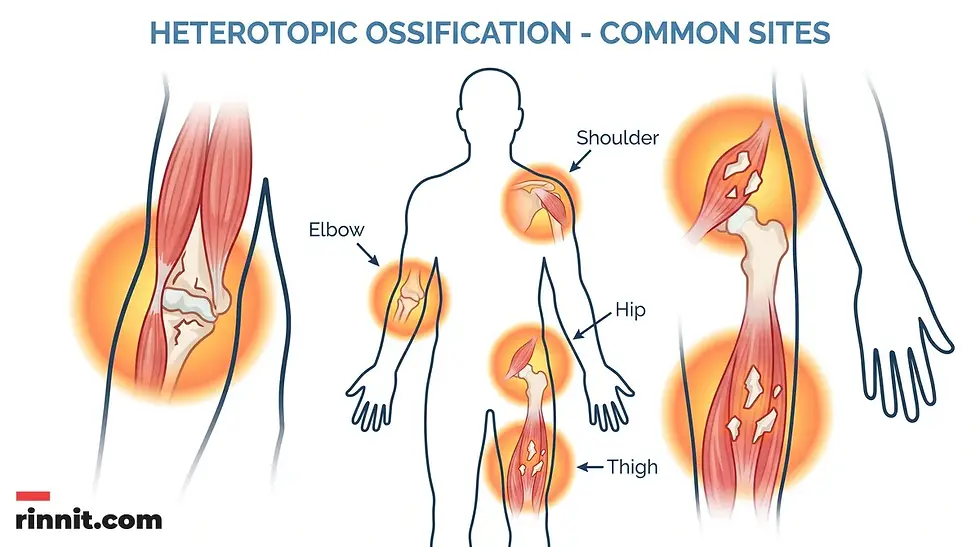
Heterotopic ossification (HO) is a medical condition characterized by the development of bone tissue in soft tissues where it does not belong. [1] [2] [3] These fragments of bone are known as extraskeletal bone. [1] While bone is essential for the skeletal system, its growth in muscles, tendons, or ligaments can lead to significant health complications.
For many individuals, these bone fragments are small and may not cause noticeable symptoms. However, larger growths can become problematic, particularly if they form near joints, where they can cause stiffness and severely restrict a person's range of motion. [1]
Types of heterotopic ossification
Medical professionals categorize heterotopic ossification into two primary types based on their cause and severity.
Type | Characteristics | Prevalence |
Nongenetic (traumatic) | Triggered by physical trauma, such as a fracture, burn, or major surgery (for example, hip replacement). | Most common; affects people of all ages. |
Genetic | Caused by rare genetic mutations (for example, FOP or POH). | Extremely rare; fewer than 5,000 cases worldwide. |
Who is at risk for heterotopic ossification?
While anyone can develop nongenetic HO, certain groups are at a significantly higher risk due to the nature of their injuries or medical history. [1]
Traumatic amputations: More than 90% of people who undergo an amputation after a traumatic injury develop some form of HO. [1]
Spinal cord injuries: Approximately 20% to 30% of individuals with spine injuries are affected. [1]
Head trauma: Between 10% and 20% of people with closed-head injuries develop the condition. [1]
Orthopedic surgery: Patients undergoing total hip replacements may develop minor HO, though it rarely causes severe symptoms. [1]
Demographically, men are slightly more likely than women to develop HO, and about half of all nongenetic cases occur in adults in their 20s and 30s. [1]
What causes bone to grow in soft tissue?
The exact biological mechanism is still being studied, but HO is most often a response to severe trauma. [1] [8] When the body attempts to heal from a major injury or the "trauma" of surgery, the healing process can misfire, causing soft tissue cells to transform into bone-forming cells. [2]
Common triggers
Bone fractures and burns: Severe physical damage can trigger the ossification process. [1]
Joint replacements: The disruption of tissue during surgery can sometimes lead to bone growth around the new joint. [1]
Genetic diseases: Rare conditions like fibrodysplasia ossificans progressiva (FOP) cause the body's connective tissue to permanently turn into bone, often leading to severe disability. In FOP, biopsies, surgery and injections into muscle can trigger new bone growth, so they are usually avoided. [1]

Symptoms and warning signs
The symptoms of heterotopic ossification often change as the condition progresses.
Early stages: You may experience localized pain, swelling, and tenderness in the affected area. [1]
Advancing stages: A noticeable bump may form under the skin. This lump can grow quickly and may feel tender to the touch. [1]
Later stages: The lump hardens into bone. If it is located near a joint like the hip or elbow, it can cause significant stiffness and a loss of flexibility. [1]
In rare genetic cases, symptoms can be even more severe, including misshapen toes or fingers and difficulty breathing if the spine or chest wall is affected. [1]
How is heterotopic ossification diagnosed?
Doctors use a combination of physical exams and advanced imaging to identify and grade HO.
Imaging tests: X-rays, CT scans, MRIs, and ultrasounds are the primary tools used to visualize bone growth in soft tissue. [1]
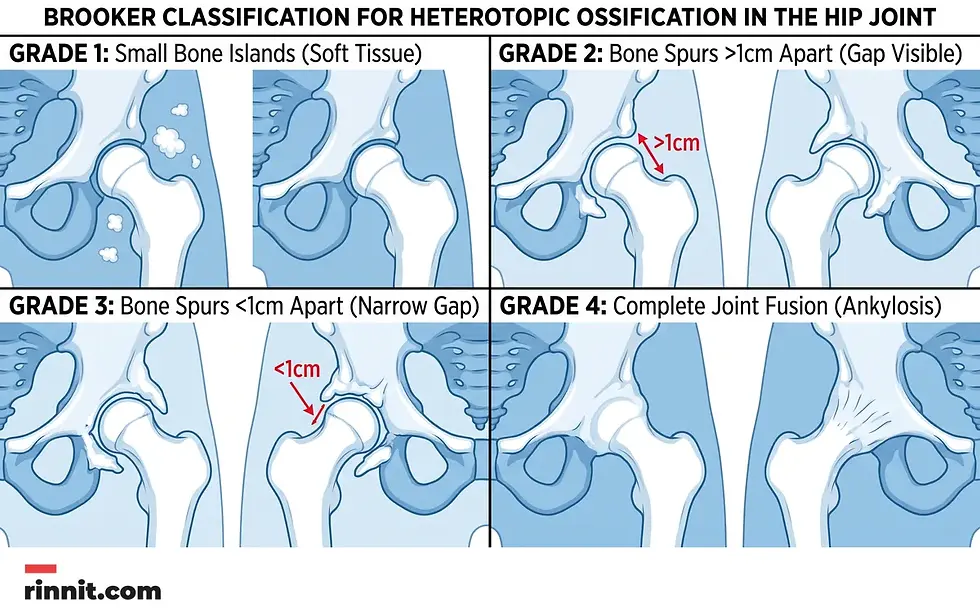
Brooker classification: For patients with HO after a hip replacement, doctors use this grading scale (Grades 1 to 4) to determine how much the bone growth has progressed and how much it affects joint function. [1]
Treatment and management options
The goal of treatment is to manage pain and maintain as much joint mobility as possible.
Nonsurgical approaches
For most injury-related cases, doctors recommend conservative treatments first:
Physical therapy: Specialized exercises to increase range of motion and reduce stiffness. [1]
Medications: Nonsteroidal anti-inflammatory drugs (NSAIDs) can help reduce pain and may even slow the growth of new bone. Corticosteroids are sometimes used for genetic flare-ups. [1]
RICE method: Rest, ice, compression, and elevation are essential for managing early-stage swelling after an injury.
Surgical intervention
Surgery to remove the bony growths is typically a last resort. [1] It is only recommended when the HO causes severe pain or prevents a person from performing daily activities. [1] Because surgery itself is a form of trauma, there is a risk that the bone could grow back. [1] [3] To prevent this, doctors often follow surgery with radiation therapy or specific medications. [1]
Can heterotopic ossification be prevented?
While there is no guaranteed way to prevent HO [1], there are steps you can take to lower your risk, especially if you are scheduled for surgery.
Pre-surgical medication: Taking NSAIDs before or immediately after an orthopedic surgery has been shown to decrease the risk of postoperative bone growth. [1]
Injury management: Treating all physical injuries immediately with the RICE method can help manage the body's inflammatory response.
Healthy habits: Maintaining strength and flexibility through regular exercise can help protect your joints and soft tissues. [1]
Conclusion
Heterotopic ossification is a complex response to trauma, but for most, it is a manageable condition. By recognizing the early signs of pain and swelling and working closely with physical therapists and orthopedic specialists, patients can maintain their mobility and achieve a full recovery.
Looking for more orthopaedic health tips? Visit Rinnit.com for expert-reviewed resources on injury recovery and joint health.
Frequently Asked Questions
Is heterotopic ossification the same as a bone spur?
While both involve extra bone growth, bone spurs (osteophytes) typically form on existing bones due to wear and tear, whereas HO is bone forming entirely within soft tissue like muscle.
Can heterotopic ossification go away on its own?
Once heterotopic bone has matured it usually does not go away on its own, but small growths that cause no problems may never need surgery, and physical therapy helps keep the joint moving. [1]
Does osteoporosis increase the risk of HO?
No, there is no proven medical link between osteoporosis (bone thinning) and the development of heterotopic ossification. [1]
How common is the genetic form of HO?
The genetic form of HO is extremely rare, with experts estimating fewer than 5,000 cases worldwide. [1]
Is HO painful?
Yes, pain and tenderness are among the most common symptoms, especially as the bony growths increase in size. [1]
What is ankylosis?
Ankylosis is the total fusion of a joint caused by bone growth, which results in complete rigidity and loss of movement. [1]
Can children get heterotopic ossification?
Yes, nongenetic HO can affect people of all ages [1], and rare genetic forms often appear in early childhood. [4]
What specialists treat HO?
Treatment is usually managed by orthopedic surgeons, physical therapists, and sometimes geneticists for rare types.
Can I exercise with HO?
Yes, and it is often encouraged. However, you should work with a physical therapist to ensure you are doing exercises that improve mobility without causing further injury.
What is FOP?
Fibrodysplasia ossificans progressiva (FOP) is a rare genetic disease where muscle and connective tissue are gradually replaced by bone.
How long does recovery take?
Recovery time varies based on the severity. Nonsurgical treatment may take a few months, while surgical recovery can take longer and requires careful monitoring.
Is HO contagious?
No, it is a physiological response to trauma or a genetic condition; it cannot be passed from person to person.
What is the Brooker classification?
The Brooker classification is a 4-grade system used by doctors to measure the severity of bone growth around the hip joint after surgery. [1]
Can radiation therapy prevent HO?
Yes, a single low dose of radiation is sometimes used after surgery to prevent the regrowth of heterotopic bone.
What should I do if I feel a hard lump after an injury?
You should consult a healthcare provider for imaging tests to determine if the lump is heterotopic ossification or another type of tissue growth.
Related Reading
Fibrodysplasia Ossificans Progressiva (FOP): Causes, Symptoms, and Management explains the rare genetic form of bone growth in soft tissue.
Spinal Cord Injury Guide: Symptoms, Causes, Diagnosis, and Treatment covers spinal cord injuries, a major risk factor for this condition.
Hip Replacement Surgery: Procedure, Recovery Time and Risks describes hip replacement, a common surgery linked to extra bone growth.
Understanding NSAIDs: A Comprehensive Guide to Nonsteroidal Anti-Inflammatory Drugs explains the anti-inflammatory medicines used to help prevent it.
References
Cleveland Clinic. Heterotopic Ossification. Cleveland Clinic. Last updated March 21, 2022. https://my.clevelandclinic.org/health/diseases/22596-heterotopic-ossification
Meyers C, et al. Heterotopic Ossification: A Comprehensive Review. JBMR Plus. 2019;3(4):e10172. PMID 31044187. https://doi.org/10.1002/jbm4.10172
Shehab D, et al. Heterotopic ossification. J Nucl Med. 2002;43(3):346-353. PMID 11884494. https://pubmed.ncbi.nlm.nih.gov/11884494/
Sahu K, et al. Progressive Osseous Heteroplasia: A Rare Case Report. Indian Dermatol Online J. 2020;11(4):604-606. PMID 32832452. https://doi.org/10.4103/idoj.IDOJ_502_19
Shapira J, et al. Efficacy of NSAIDs versus radiotherapy for heterotopic ossification prophylaxis following total hip arthroplasty in high-risk patients: a systematic review and meta-analysis. Hip Int. 2022;32(5):576-590. PMID 33736491. https://doi.org/10.1177/1120700021991115
Cai L, et al. Optimal strategies for the prevention of heterotopic ossification after total hip arthroplasty: A network meta-analysis. Int J Surg. 2019;62:74-85. PMID 30615954. https://doi.org/10.1016/j.ijsu.2018.12.011
Wen L, et al. Effectiveness of Radiotherapy in Preventing Heterotopic Ossification: A Meta-analysis of Randomized Controlled Trials Beyond Total Hip Arthroplasty. Calcif Tissue Int. 2025;116(1):106. PMID 40788554. https://doi.org/10.1007/s00223-025-01416-3
Edwards DS, et al. Heterotopic ossification: a systematic review. J R Army Med Corps. 2015;161(4):315-321. PMID 25015927. https://doi.org/10.1136/jramc-2014-000277
Medical disclaimer
This article is for general educational purposes only and is not a substitute for professional medical advice, diagnosis, or treatment. Always seek the advice of your physician or other qualified health provider with any questions you may have regarding a medical condition.



Comments