Fibrodysplasia Ossificans Progressiva (FOP): Causes, Symptoms, and Management

Updated: 3 days ago
Medically reviewed by Dr. Baraa Alnahhal, MD · Last reviewed: October 2026
Source currency note: This guide reflects medical information reviewed in November 2022, with newer treatment information from 2024–2025 published research. Always confirm current guidance with your healthcare professional.
Quick Answer
Fibrodysplasia ossificans progressiva is a very rare genetic condition in which muscles, tendons and ligaments gradually turn into bone, restricting movement over time. It is caused by an ACVR1 gene mutation. A malformed, short big toe visible at birth is the key early sign. Any trauma, including surgery or falls, can trigger flare-ups, so avoiding injury is central. [3]
What the research says
There is now a treatment that targets new bone formation in some countries. A 2025 expert review reports that palovarotene, a retinoic acid receptor gamma agonist, is the first approved FOP treatment in the U.S., Canada, and Australia (it remains unapproved in Europe), that post hoc analyses of its trials indicate modest benefits for inhibiting new heterotopic ossification, and that its long-term risks and benefits remain unknown (Verheij et al., Expert Opinion on Pharmacotherapy, 2025 [1]).
Benefits come with significant risks. A 2024 review of the palovarotene program found that post hoc analyses of phase II and phase III trials showed significant disease-modifying effects, but with significant risks such as premature growth plate closure in some younger participants (Hsiao and Pacifici, JBMR Plus, 2024 [2]).
What is fibrodysplasia ossificans progressiva?
Fibrodysplasia ossificans progressiva (FOP) is a genetic condition in which the body's muscle tissue and connective tissues, such as tendons and ligaments, turn into bone on the outside of the skeleton (heterotopic ossification). This new bone restricts movement and can cause a loss of mobility over time. Symptoms appear during childhood and usually begin at the neck and shoulders before moving to other areas of the body [3].
Feature | Detail |
Prevalence | An estimated 1 in 2 million people worldwide |
Primary indicator | Malformed big toe visible at birth |
Progression pattern | Starts at the neck and shoulders and moves downward |
Major risk | Physical trauma, surgery, or illness triggering permanent bone growth |

FOP is extremely rare, which makes it hard for many healthcare providers to recognize. Early diagnosis is vital so that unnecessary procedures that could worsen the condition are avoided [3].
Symptoms and early indicators
The most dramatic symptoms of FOP appear during childhood, but one important sign is present from birth [3].
The big toe sign
A symptom that leads to an FOP diagnosis is a malformed, short big toe that sometimes grows inward and over the second toe. Growth differences of the big toes are visible at birth, even before other symptoms appear. Nearly 50% of people with FOP also have thumb malformations similar to the big toe [3].
Flare-ups and progression
Symptoms arise during flare-ups, which are the body's reaction to trauma such as an injury, surgery, or a viral illness like the flu. Flare-ups cause painful swelling of soft tissue that can look like tumors, and the area may be red to purple and hot to the touch. After new bone forms, the swelling decreases, which can take anywhere from a few days to a month [3].
Initial sites: Symptoms usually begin in the neck and shoulders in early childhood [3].
Mobility loss: Over time, bone growth progresses throughout the body, leading to joint stiffness, locked joints, and permanent immobility. Bone development can be rapid in some cases and very slow in others [3].
Other effects: Scoliosis or kyphosis, hearing impairment, and difficulty eating or speaking because bone growth keeps the mouth from opening fully [3].
Symptom | Description |
Myositis | Painful muscle inflammation and swelling during flare-ups |
Heterotopic ossification | Bone forming in muscles, tendons, and ligaments |
Restricted breathing | Extra bone around the rib cage limiting how the lungs expand |
Joint locking | Permanent loss of motion in affected joints |
Causes and genetic foundation
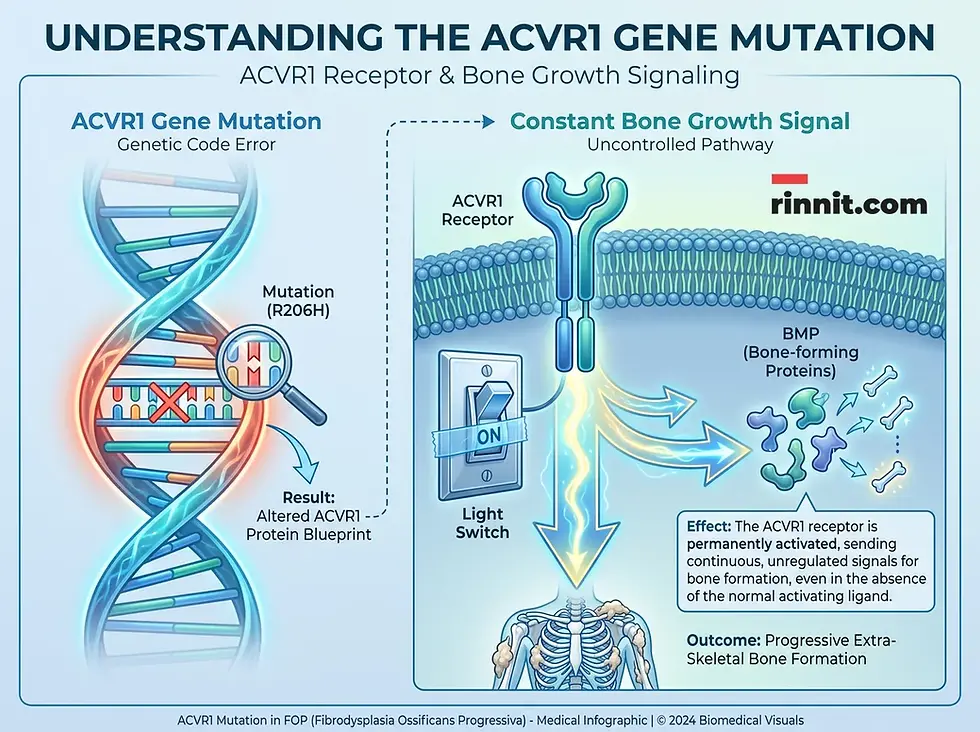
FOP is caused by a mutation of the ACVR1 gene. This gene gives your body instructions to make type 1 receptors for a protein called bone morphogenic protein (BMP), found in muscles and cartilage. BMP controls how bones and muscles grow and develop. The mutation makes the receptor, like a light switch, stay on when it should turn off [3].
Inheritance patterns
FOP is an autosomal dominant condition, which means only one biological parent needs to pass the altered gene to a child. If a parent has the gene, there is a 50% chance that the child will inherit the condition. However, most cases occur because of a new (de novo) mutation of the ACVR1 gene, with no link to family history. This happens randomly [3].
Diagnosis and critical warnings
Diagnosis of FOP begins with a physical examination that identifies the symptoms, a review of medical history, and a genetic test, which is a blood test to identify the gene mutation. Imaging tests such as X-rays help examine new bone growth over muscle and connective tissue [3].
The danger of biopsies
FOP can be misdiagnosed as cancer, juvenile fibromatosis, or fibrous dysplasia, because the condition is extremely rare and very few healthcare providers encounter it. A biopsy of an FOP swelling often looks similar to a cancerous tumor. If a healthcare provider suspects FOP, they will not perform a diagnostic biopsy, because the procedure can cause severe bone growth flare-ups. The most important symptoms that lead to an FOP diagnosis are malformed big toes and soft tissue swelling that forms throughout the body [3].
Diagnostic tool | Purpose |
Clinical exam | Identifying the malformed big toe and swelling patterns |
Genetic test | Confirming the ACVR1 mutation with a blood sample |
X-ray or imaging | Showing heterotopic bone growth |
Biopsy | Avoided: can trigger a severe flare-up |
Management and treatment
There is no cure for FOP. Treatment aims to reduce symptoms, especially the flare-ups that ignite the bone-growing process, and is unique to each person. Because trauma can trigger new bone growth, surgery to remove the extra bone is not a safe option [3].
Medication and flare-up care
Medicines to reduce swelling and pain during flare-ups can include corticosteroids, nonsteroidal anti-inflammatory drugs (NSAIDs), and muscle relaxants. In some countries, palovarotene is now approved to reduce new heterotopic bone formation; see the research box above for what is and is not yet known about its benefits and risks [3].
Supportive care
Genetic counseling: Social, emotional, and health-related support for you and your family [3].
Occupational therapy: Helping people adapt to limited mobility and find new ways to do daily tasks [3].
Mobility aids: Wheelchairs, braces, and other equipment as the condition progresses [3].
Respiratory care: Preventative antibiotic therapy to avoid respiratory infections, since breathing can become difficult when the rib cage is affected [3].
Reducing the risk of flare-ups
Preventing symptoms means avoiding trauma to muscles and tissues. You can reduce the risk of flare-ups by the following steps [3].
Avoid situations where you might get an injury, fall, or broken bone.
Get vaccines as subcutaneous injections instead of intramuscular injections.
Ask for alternative diagnostic tests rather than a biopsy or procedures where tissue is removed.
Choose dental procedures that do not stretch the jaw or use local anesthetic injections.
Take preventative steps to avoid viral illnesses such as the flu.

Outlook and quality of life
FOP is a lifelong condition with no cure, and the outlook is poor because of severe symptoms, including respiratory infections and restricted mobility that becomes worse over time. Life expectancy is reduced into early adulthood, most people are completely immobile by age 30, and the most common cause of death is a respiratory infection. Research and clinical trials for new treatment options are in progress to help reduce symptoms and prolong life [3].
If you have trouble breathing, contact your local emergency number or go to the emergency room immediately. Also see your healthcare provider if you have severe pain, swelling that is not going away, limited mobility or locked joints, or you cannot eat. [3]
If you suspect a child may have FOP, especially if they have a malformed big toe, consult a genetic specialist promptly. Make sure all medical providers are aware of the FOP diagnosis to prevent dangerous procedures such as biopsies or intramuscular injections.
Frequently Asked Questions
What is the “big toe sign” in FOP?
The big toe sign is a malformation in which the big toe is short and often grows inward over the second toe. It is visible at birth and is the most important early clue for diagnosis.
Can the extra bone be surgically removed?
No. Surgery is a known trigger of flare-ups, and any surgical incision or trauma to the muscle can cause even more bone to form in that area.
What triggers a flare-up in FOP?
Flare-ups can be triggered by trauma such as an injury, a fall, or surgery, and by viral illnesses such as the flu.
Is FOP contagious?
No. FOP is a genetic condition caused by a mutation in the ACVR1 gene. It cannot be caught from another person.
How rare is FOP?
FOP is very rare, occurring in an estimated 1 out of every 2 million people worldwide.
Does FOP affect intelligence?
In most cases it does not, but in severe cases people might experience challenges with cognitive function and learning.
Can FOP be prevented?
No. It results from a genetic mutation and most cases are new, random mutations. If a parent has FOP, there is a 50% chance of passing it to a child, and genetic counseling is recommended.
Why are biopsies dangerous for FOP?
A biopsy involves cutting into the tissue, which the body treats as an injury. This can trigger a severe flare-up and new bone formation at the site.
What are the main complications of FOP?
The main complications of FOP include permanent loss of mobility, difficulty breathing because bone around the rib cage limits lung expansion, difficulty eating or speaking because the mouth cannot open fully, and susceptibility to respiratory infection or heart failure.
Are there any treatments in development?
Research and clinical trials are ongoing. Palovarotene has been approved in some countries to reduce new heterotopic bone formation, but it has significant risks, and its long-term benefits and risks are not yet known.
References
Verheij VA, Diecidue RJ, Botman E, et al. Palovarotene in fibrodysplasia ossificans progressiva: review and perspective. Expert Opinion on Pharmacotherapy. 2025;26(3):291-299. PMID 39834193. https://doi.org/10.1080/14656566.2025.2452938
Hsiao EC, Pacifici M. Palovarotene (Sohonos), a synthetic retinoid for reducing new heterotopic ossification in fibrodysplasia ossificans progressiva: history, present, and future. JBMR Plus. 2024;9(1):ziae147. PMID 39677926. https://doi.org/10.1093/jbmrpl/ziae147
Cleveland Clinic. Fibrodysplasia ossificans progressiva. Cleveland Clinic. Last updated November 29, 2022. https://my.clevelandclinic.org/health/diseases/24476-fibrodysplasia-ossificans-progressiva
Medical disclaimer
This article was prepared for general information only and is not a substitute for professional medical advice.



Comments