Hemophilia B: Understanding Factor IX Deficiency and Treatment

Updated: 3 days ago
Medically reviewed by Dr. Baraa Alnahhal, MD · Last reviewed: October 2026
Quick Answer
Hemophilia B is a bleeding disorder in which the body lacks clotting factor IX, a protein critical for stopping bleeding. It is X-linked recessive, usually passed from a carrier mother to a son, and is classified as mild, moderate or severe. Bleeding into joints is a common complication. Treatments include factor replacement and new gene therapies. [1]
What the research says
A single gene therapy infusion lowered bleeding in men with hemophilia B. In the phase 3 HOPE-B study of 54 men with factor IX activity of 2% or less, the annualized bleeding rate fell from 4.19 during the lead-in period on factor IX prophylaxis to 1.51 after treatment (rate ratio 0.36). Factor IX activity rose by 36.2 percentage points at 6 months and 34.3 points at 18 months, and no treatment-related serious adverse events occurred. (Pipe et al., N Engl J Med, 2023)
Hemophilia B is less common than hemophilia A but still affects roughly 5 in 100,000 male births. A meta-analysis of registry data from six high-income countries estimated a prevalence at birth of 5.0 per 100,000 males (1.5 per 100,000 for severe disease) and a 24% life expectancy disadvantage in high-income countries. The authors estimate about 1.1 million people worldwide have hemophilia of either type. (Iorio et al., Ann Intern Med, 2019)
What is hemophilia B?

Hemophilia B is a rare inherited blood disorder that interferes with the body's ability to stop bleeding. In a healthy individual, a series of proteins called clotting factors work together to form a stable plug (clot) at the site of a blood vessel injury. In people with Hemophilia B, the body does not produce enough of a specific protein called factor IX (also written as factor 9 or FIX). [1]
Historically, this condition was called "Christmas disease," named after Stephen Christmas, the first person diagnosed with the disorder in 1952. [1] While it shares many symptoms with the more common Hemophilia A, the two are distinct conditions caused by different protein deficiencies.
How is hemophilia B inherited?
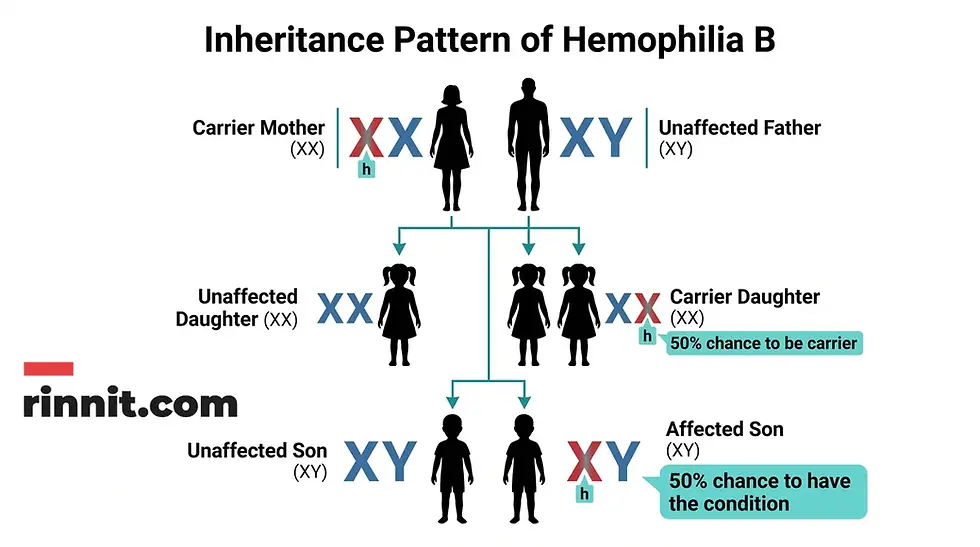
Hemophilia B is primarily a genetic condition caused by a change in the F9 gene. This gene acts as the "instruction manual" for creating factor IX. The disorder follows an X-linked recessive inheritance pattern, which explains why it primarily affects biological males. [1]
The X-linked pattern
The F9 gene is located on the X chromosome. Biological males have one X and one Y chromosome. If they inherit an X chromosome with the changed F9 gene from their mother, they will have Hemophilia B. Biological females have two X chromosomes. If they inherit one changed gene, they become "carriers." Carriers usually do not have symptoms because their second X chromosome provides enough instructions to produce clotting factors, though some may experience mild bleeding issues. [1]
Spontaneous mutations
In about one-third of cases, Hemophilia B occurs without a family history. This happens through a spontaneous mutation, where a mistake occurs during the gene-copying process in the embryo. In these instances, a child can be born with the condition even if neither parent carries the changed gene. [1]
What are the symptoms of hemophilia B?
The main symptom of Hemophilia B is excessive or prolonged bleeding. The severity of these symptoms depends entirely on the level of factor IX present in the blood, measured in international units per deciliter (IU/dl). [1]
Severity Level | Factor IX Level | Typical Symptoms |
Mild | 5% to 40% of normal | Bleeding only after major surgery, tooth extractions, or serious trauma. |
Moderate | 1% to 5% of normal | Occasional spontaneous bleeding; bleeding after minor injuries or bumps. |
Severe | Less than 1% of normal | Frequent spontaneous bleeding into joints and muscles; heavy bruising. |
Common signs in infants and children
In babies and young children, parents may notice large lumps after minor head bumps or bleeding that lasts a long time after a small cut in the mouth. Bruises that are swollen and painful to the touch are often a sign of internal bleeding into a muscle or joint. [1]
How do doctors diagnose this condition?
Diagnosis typically begins with a physical exam and a review of the family's medical history. If a bleeding disorder is suspected, doctors use several specialized blood tests to confirm the diagnosis and determine the severity. [1]
Factor IX assay: This is the definitive test that measures the exact amount of factor IX in the blood.
Complete blood count (CBC): Checks the overall health of blood cells.
Clotting time tests: Tests like Prothrombin Time (PT) and Partial Thromboplastin Time (PTT) measure how long it takes for blood to clot.
Genetic testing: Identifies the specific mutation in the F9 gene to help with family planning and carrier screening.

What are the treatment options for hemophilia B?
While there is currently no permanent cure for Hemophilia B, medical treatments have advanced significantly, allowing most people to lead active lives. The primary goal of treatment is to increase factor IX levels to prevent or stop bleeding. [1]
Factor replacement therapy
The most common treatment involves intravenous infusions of factor IX concentrate. This replaces the missing protein in the blood. For those with severe hemophilia, these infusions may be given regularly (prophylaxis) to prevent bleeding before it starts. [1]
Gene therapy
A newer and revolutionary treatment option is gene therapy. This involves using lab-made copies of the healthy F9 gene to help the body start producing its own factor IX. This can significantly reduce or even eliminate the need for regular infusions for some patients. [1][2]
Living with and managing hemophilia B
Managing a chronic condition like Hemophilia B requires lifelong attention to safety and health. Protecting joints and preventing injuries are the top priorities for both adults and children.
Avoid aspirin and NSAIDs: Do not take medications like aspirin or ibuprofen (NSAIDs), as these interfere with clotting and increase bleeding risk. Use acetaminophen for pain relief instead. [1]
Joint protection: Maintain a healthy weight to reduce stress on the hips and knees. Children should wear protective gear like kneepads during active play. [1]
Safety at home: Use safety straps on highchairs and car seats, and consider padding sharp furniture edges for toddlers. [1]
Emergency planning: Ensure that teachers, coaches, and caregivers know how to respond if an injury occurs. [1]
Conclusion
Hemophilia B is a complex genetic disorder, but with early diagnosis and modern replacement therapies, the outlook is more positive than ever. By working closely with a hematology team and following a personalized treatment plan, individuals with factor IX deficiency can successfully manage their symptoms and protect their long-term joint health.
For more information on managing rare blood disorders and supporting joint health, visit Rinnit.com.
Frequently Asked Questions
Is Hemophilia B the same as Hemophilia A?
No. While the symptoms are similar, they are caused by different protein deficiencies. Hemophilia A is a lack of factor VIII, while Hemophilia B is a lack of factor IX.
Can women have Hemophilia B?
It is very rare for women to have the full disorder, but many are carriers. Carriers can sometimes have mild bleeding symptoms, such as heavy periods.
Why was it called Christmas disease?
Christmas disease was named after Stephen Christmas, the first patient identified with the condition in 1952.
Can you outgrow Hemophilia B?
No. It is a lifelong genetic condition. However, symptoms can be effectively managed with treatment.
Is it safe to exercise with Hemophilia B?
Yes, and it is encouraged to keep joints strong. However, high-impact contact sports like football should be avoided.
How is factor IX measured?
Factor IX is measured in international units per deciliter (IU/dl) to determine the severity of the deficiency.
What is a spontaneous mutation?
A spontaneous mutation is when the genetic change occurs randomly during development, rather than being inherited from a parent.
Can Hemophilia B be detected before birth?
Yes, carrier screening and prenatal testing are available for families with a known history.
What should I do if my child bumps their head?
Any head injury in a child with hemophilia can be serious. Contact your hematologist right away, and go to the emergency room if your child has a large lump, a headache that does not go away, vomiting, unusual sleepiness, or confusion.
Does gene therapy cure the disease?
Gene therapy is not considered a permanent "cure" for everyone, but it can allow the body to produce its own factor IX for many years.
Can I take ibuprofen for a headache?
No. Ibuprofen is an NSAID that can increase bleeding risk. Use acetaminophen instead.
How often do I need infusions?
Infusion frequency depends on severity. Some people only need them after an injury, while others need them several times a week to prevent bleeding.
Are there any dietary restrictions?
There are no specific food restrictions, but a healthy diet helps manage weight and protect joints.
What are the long-term complications?
The most common long-term issue is chronic joint damage (arthropathy) from repeated internal bleeding.
Is Hemophilia B contagious?
No. It is a genetic condition and cannot be spread from person to person.
Related Reading
References
Cleveland Clinic. Hemophilia B. Cleveland Clinic. Last updated July 24, 2025. https://my.clevelandclinic.org/health/diseases/23912-hemophilia-b
Pipe SW, et al. Gene Therapy with Etranacogene Dezaparvovec for Hemophilia B. N Engl J Med. 2023;388(8):706-718. PMID 36812434. https://doi.org/10.1056/NEJMoa2211644
Iorio A, et al. Establishing the Prevalence and Prevalence at Birth of Hemophilia in Males: A Meta-analytic Approach Using National Registries. Ann Intern Med. 2019;171(8):540-546. PMID 31499529. https://doi.org/10.7326/M19-1208
Medical disclaimer
This article is for general educational purposes only and is not a substitute for professional medical advice, diagnosis, or treatment. Always seek the advice of your physician or other qualified healthcare provider with any questions you may have about a medical condition. Never disregard professional medical advice or delay seeking care because of something you have read here. If you think you may have a medical emergency, call your doctor or emergency services immediately.



Comments