Heat Stroke: How to Recognize It, Cool Down Fast, and Prevent a Life-Threatening Emergency

Updated: 2 days ago
Medically reviewed by Dr. Baraa Alnahhal, MD · Last reviewed: October 2026
Heat stroke is the most serious heat illness. It can happen if body temperature rises to 104°F (40°C) or higher, and without fast treatment it can quickly damage the brain, heart, kidneys, and muscles [1]. If you think someone may have heat stroke, call 911 or your local emergency number, start cooling them right away, and don't give fluids while you wait for help [2].
Quick Answer: What is heat stroke and how is it treated?
Heat stroke is a life-threatening condition in which the body overheats and core temperature reaches 104°F (40°C) or higher, causing confusion, hot skin and a rapid pulse. It is a medical emergency: call 911, then cool the person immediately with cool water or ice packs, and do not give fluids. Delay raises the risk of organ damage. [1] [2]
What the research says
Cold-water immersion saved every patient in a large race-medical-tent series. Across 18 years of records from the Falmouth Road Race, 274 runners with exertional heat stroke (average starting rectal temperature 41.44 °C) were treated with cold-water immersion and cooled at an average of 0.22 °C per minute. All 274 survived (100%), and cooling rates did not differ by age, sex, or starting temperature (Demartini et al., Medicine and Science in Sports and Exercise, 2015 [3]).
Water immersion cooled faster than passive cooling. A systematic review and meta-analysis of 63 studies found that immersing overheated adults in water (1–17 °C) lowered core body temperature more effectively than passive cooling, with no single water-temperature range cooling faster than another (Douma et al., Resuscitation, 2020 [4]).
Best practice is not always followed in emergency care. In a survey of 145 emergency medical service directors, 77.9% of those answering did not use rectal thermometry and 70.3% did not use cold-water immersion for exertional heat stroke. Services working with an athletic trainer were more likely to follow best-practice treatment (69.6% vs 36.9%) (Szymanski et al., Medicina, 2020 [5]).
What Is Heat Stroke?
Heat stroke is a condition caused by the body overheating. This usually happens because of exposure to high temperatures or physical activity in high temperatures for too long [1].
There are a few stages of heat injury, and heat stroke is the most serious. It can happen if body temperature rises to 104°F (40°C) or higher. It is most common in the summer months [1].
Heat stroke needs emergency care. If it's not treated, it can quickly damage the brain, heart, kidneys, and muscles. That damage gets worse the longer treatment is delayed, which increases the risk of serious complications or death [1].
The 8 Warning Signs of Heat Stroke
Heat stroke can strike quickly, and its signs aren't always dramatic at first. The main sign is a core body temperature of 104°F (40°C) or higher, but you won't always have a thermometer handy. Knowing all eight warning signs helps you catch the emergency early [1].
High body temperature: a core temperature of 104°F (40°C) or higher is the main sign.
Change in mental state or behavior: confusion, agitation, slurred speech, irritability, delirium, seizures, and coma can all result.
Change in sweating pattern: in heat stroke brought on by hot weather, skin feels hot and dry to the touch. In heat stroke brought on by strenuous exercise, sweating may be profuse.
Nausea and vomiting: feeling sick to the stomach or vomiting.
Flushed skin: skin may turn red as body temperature increases.
Rapid breathing: breathing may become rapid and shallow.
Racing heart rate: the pulse may increase significantly because heat stress places an extreme burden on the heart.
Headache: the head may throb.
Not every sign appears in every person, but any mental-status change combined with overheating should be treated as an emergency.
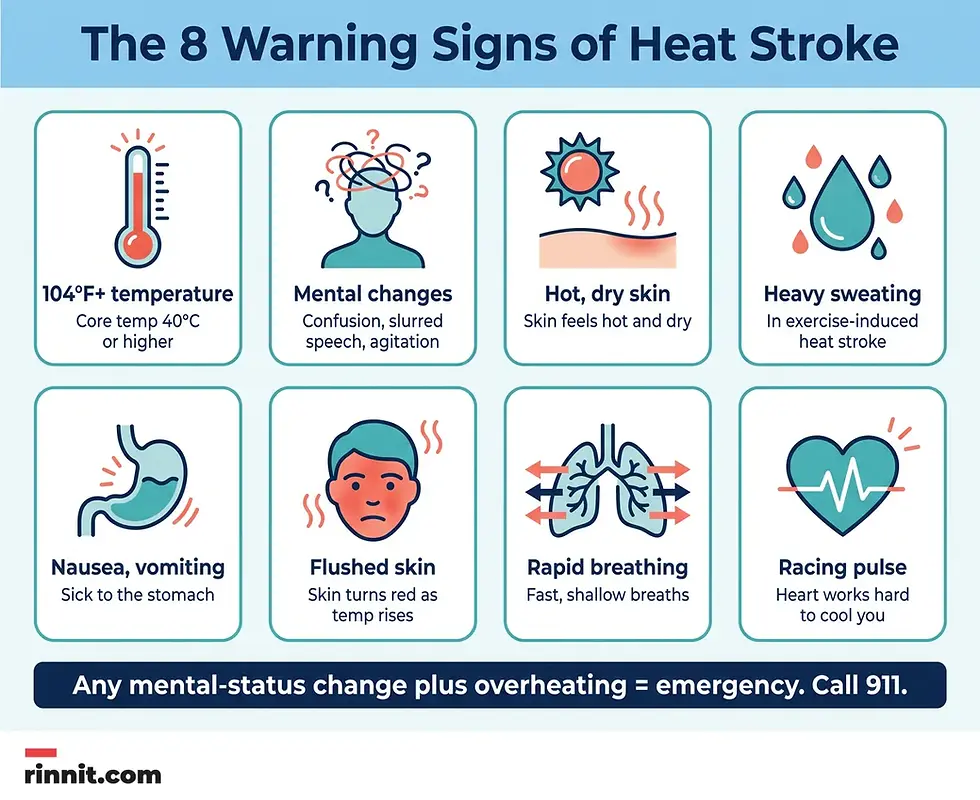
The warning signs of heat stroke. Any mental-status change plus overheating is an emergency.
Is This Heat Stroke or a Milder Heat Illness?
Heat stroke sits at the top of the heat illness ladder. Understanding where symptoms fall on that ladder helps you judge how fast you need to act.
Heat cramps (mildest): painful muscle contractions, often with heavy sweating and thirst.
Heat exhaustion (moderate): heavy sweating, rapid pulse, dizziness, nausea, and headache.
Heat stroke (most serious, life-threatening): core temperature of 104°F (40°C) or higher, with confusion or an altered mental state.
Untreated milder forms can progress to heat stroke. For a full breakdown of the middle stage, read our guide: Heat Exhaustion: How to Recognize It, Cool Down Fast, and Prevent Heatstroke.
When Heat Stroke Becomes an Emergency
Heat stroke is always an emergency. If you think a person may be experiencing heat stroke, seek immediate medical help — call 911 or your local emergency services number [1].
Don't wait to see if symptoms improve. While you wait for emergency help, take immediate action to cool the person [1]:
Get the person into shade or indoors.
Remove excess clothing.
Cool the person by whatever means are available — put them in a cool tub of water or a cool shower, spray with a garden hose, sponge with cool water, fan while misting with cool water, or place ice packs or cold, wet towels on the head, neck, armpits, and groin.
One important rule: don't give the person any fluids while waiting for medical assistance [2].

Heat stroke first aid: call for emergency help, move to a cool place, and cool fast. Do not give fluids while waiting.
Why Your Body Overheats
Your body constantly regulates its temperature. When environmental heat overwhelms that system — because the air is hot and humid, or you're generating heat faster than you can shed it — your core temperature climbs. Once it reaches 104°F (40°C) or higher, the body's own cooling mechanisms can be overwhelmed and organs can begin to suffer damage [1].
The longer the temperature stays elevated, the worse the damage becomes. That's why minutes matter in heat stroke treatment [1].
The Two Types of Heat Stroke
Heat stroke has two distinct forms. The cause matters because it points to different risk groups [1].
Nonexertional (classic) heat stroke: being in a hot environment raises core body temperature. It typically happens after exposure to hot, humid weather, especially for a long period, and most often affects older adults and people with ongoing health conditions.
Exertional heat stroke: intense physical activity in hot weather raises core body temperature. Anyone exercising or working in hot weather can get it, but it is most likely if you're not used to high temperatures.
In either type, your condition can also be brought on by:
Heavy clothing: prevents sweat from evaporating easily and cooling the body.
Alcohol: can affect the body's ability to regulate temperature.
Dehydration: not drinking enough water to replenish fluids lost through sweating.
Who Is Most at Risk
Anyone can develop heat stroke, but several factors increase your risk [1].
Age: the ability to cope with extreme heat depends on the strength of the central nervous system. It is not fully developed in the very young and becomes less responsive after age 65. Both age groups usually have difficulty staying hydrated, which also increases risk.
Exertion in hot weather: military training and sports such as football or long-distance running in hot weather are common situations.
Sudden exposure to hot weather: an early-summer heat wave or travel to a hotter climate raises susceptibility. Limit activity for at least several days to acclimate; risk may remain increased until you've experienced several weeks of higher temperatures.
Lack of air conditioning: fans may make you feel better, but in sustained hot weather, air conditioning is the most effective way to cool down and lower humidity.
Certain medicines: some affect hydration and heat response, including medicines that narrow blood vessels (vasoconstrictors), beta blockers, diuretics, antidepressants, and antipsychotics. ADHD stimulants and illegal stimulants such as amphetamines and cocaine also increase vulnerability.
Certain health conditions: heart or lung disease, being overweight, being inactive, and a history of previous heat stroke all raise risk.
Complications: Why Heat Stroke Is Life-Threatening
Heat stroke can cause a number of complications, depending on how long the body temperature stays high. The two serious ones are [1]:
Vital organ damage: without a quick response to lower body temperature, the brain or other vital organs can swell, possibly resulting in permanent damage.
Death: without prompt and adequate treatment, heat stroke can be fatal.
How Doctors Confirm the Diagnosis
Healthcare professionals can often diagnose heat stroke without testing. However, laboratory tests can confirm the diagnosis, rule out other causes of the symptoms, and find out whether there is organ damage [2]:
Rectal temperature: the most accurate way to determine core body temperature, and more accurate than mouth or forehead readings.
Blood test: checks sodium and potassium and the content of gases in the blood, to see whether the central nervous system has been damaged.
Urine test: checks urine color (usually darker in heat-related illness) and kidney function, which heat stroke can affect.
Muscle damage tests: check for rhabdomyolysis — serious damage to muscle tissue.
X-rays and other imaging tests: check for damage to the internal organs.
Treatment: How the Medical Team Cools a Heat Stroke Body
Heat stroke treatment centers on cooling the body to a standard temperature to prevent or reduce damage to the brain and vital organs [2]:
Immersion in cold water: a bath of cold or ice water has been proved to be the most effective way of quickly lowering core body temperature. The quicker it starts, the less risk of death and organ damage.
Evaporation cooling: if cold water immersion isn't available, cool water is misted on the body while warm air is fanned over the person, causing the water to evaporate and cool the skin.
Ice packs and cooling blankets: the person is wrapped in a special cooling blanket with ice packs applied to the groin, neck, back, and armpits.
Medicine to stop shivering: if cooling treatments cause shivering, a muscle relaxant such as a benzodiazepine may be given, because shivering raises body temperature and makes treatment less effective.
Home Care: What to Do — and What Not to Do — While Waiting for Help
Home treatment isn't enough for heat stroke. If you have symptoms of heat stroke, seek emergency medical help. Others should take steps to cool you off while waiting for emergency help to arrive. Don't drink any fluids while waiting for medical assistance [2].
If you notice signs of a lesser heat illness
In a lesser heat emergency, such as heat cramps or heat exhaustion, these steps may lower your body temperature and help prevent progression to heat stroke [2]:
Get to a cool place: find a shady or air-conditioned spot. Without air conditioning at home, go somewhere with it, such as a mall, store, or public library.
Cool off with damp sheets and a fan: cover the person with damp sheets or spray with cool water, and direct fan air onto them.
Take a cool shower or bath: outdoors with no shelter, soaking in a cool pond or stream can bring your temperature down.
Rehydrate: drink plenty of fluids. Sports drinks can replace salt and water lost through sweating — unless a health professional has restricted your fluid or salt intake.
Avoid certain drinks: sugary or alcoholic beverages can interfere with your body's ability to control temperature, and very cold drinks can cause stomach cramps.
Prevention: Habits That Keep Heat Stroke Away
Heat stroke is predictable and preventable. When temperatures climb, remember these habits [1]:
Wear loose-fitting, lightweight clothing. Excess or tight clothing blocks the body's cooling. Linen, silk, cotton, and hemp are cooling fabrics.
Protect against sunburn. Sunburn impairs your body's ability to cool itself. Wear a wide-brimmed hat and sunglasses, and use broad-spectrum sunscreen with an SPF of at least 15, reapplied every two hours.
Drink plenty of fluids. Staying hydrated helps your body sweat and maintain a normal temperature.
Take extra precautions with certain medicines. Watch for heat-related problems if your medicines affect hydration or heat dissipation.
Never leave anyone in a parked car. This is a common cause of heat-related deaths in children. A parked car in the sun can rise 20°F (more than 11°C) in 10 minutes — even with windows cracked or the car in shade. Keep the car locked.
Take it easy during the hottest parts of the day. If you can't avoid strenuous activity, drink fluids and rest frequently in a cool spot. Schedule exercise or labor for early morning or evening.
Get acclimated. Limit time in the heat until you're conditioned to it. It can take several weeks for your body to adjust.
Be cautious if you're at increased risk. If medicines or conditions raise your risk, avoid the heat and act quickly at the first overheating symptoms. At strenuous hot-weather events, make sure medical services are available.

Eight habits that prevent heat stroke.
Bottom Line
Heat stroke is the point where overheating becomes a race against time. A core temperature of 104°F (40°C) with confusion, hot skin, or a racing pulse means the body is in serious danger, and the brain, heart, kidneys, and muscles are at risk. The two steps that matter most are simple: call for emergency help and start cooling immediately. The good news is that heat stroke is predictable and preventable — loose clothing, hydration, gradual acclimation, and vigilance around high-risk people and parked cars stop most cases before they start.
If you spend hot days outdoors, at work, or on the field, share these signs and steps with your family whenever hot weather arrives. To understand the stage just before heat stroke, read our guide to heat exhaustion.
Your next step: if someone is confused, has hot skin, or is overheating and unwell, call 911 or your local emergency number now, move them somewhere cool, and start cooling them. Don't give fluids while you wait.
Frequently Asked Questions
What is heat stroke?
Heat stroke is the most serious heat illness, caused by the body overheating — usually from prolonged exposure to high temperatures or intense activity in the heat. It occurs when core body temperature reaches 104°F (40°C) or higher and needs emergency care to prevent damage to the brain, heart, kidneys, and muscles.
What are the symptoms of heat stroke?
The main sign is a core temperature of 104°F (40°C) or higher. Others include confusion, agitation, slurred speech, irritability, delirium, seizures or coma; hot and dry skin (or profuse sweating if it's exercise-induced); nausea and vomiting; flushed skin; rapid, shallow breathing; a racing pulse; and a throbbing headache.
What is the difference between heat exhaustion and heat stroke?
Heat exhaustion involves heavy sweating, rapid pulse, dizziness, and nausea, and the body is still trying to cool itself. Heat stroke is more serious and life-threatening: core temperature reaches 104°F (40°C) or higher and mental state changes, because the body's cooling systems have failed.
What should you do if you suspect heat stroke?
Call 911 or your local emergency number immediately. While waiting for help, move the person to shade or indoors, remove excess clothing, and cool them by any means available — a cool tub of water or shower, a hose spray, sponging with cool water, fanning while misting, or ice packs and cold wet towels on the head, neck, armpits, and groin. Don't give fluids while waiting for medical assistance.
What is the fastest way to lower body temperature in heat stroke?
Immersion in a bath of cold or ice water is proved to be the most effective way to quickly lower core body temperature. The quicker cold water immersion begins, the less the risk of death and organ damage.
Can you recover from heat stroke at home?
No. Home treatment isn't enough for heat stroke — it is always a medical emergency. Home cooling steps are only while you wait for emergency help to arrive. Home care steps apply to milder heat illnesses like heat cramps and heat exhaustion, to prevent progression to heat stroke.
Why do some people get heat stroke while others don't?
Risk is highest in the very young (central nervous system not fully developed) and adults over 65 (it becomes less responsive), and in both groups, staying hydrated is harder. Additional risks include exertion in hot weather, sudden exposure to heat, lack of air conditioning, certain medicines, and health conditions such as heart or lung disease.
How does hot weather cause heat stroke?
In nonexertional (classic) heat stroke, exposure to hot, humid weather — especially for a long period — raises core body temperature. This type most often affects older adults and people with ongoing health conditions. Alcohol, heavy clothing, and dehydration can bring it on in either type.
How does exercise cause heat stroke?
Exertional heat stroke is caused by an increase in core body temperature brought on by intense physical activity in hot weather. Anyone exercising or working in hot weather can get it, but it is most likely if you are not used to high temperatures.
How can I prevent heat stroke?
Wear loose, lightweight clothing; protect against sunburn with a hat, sunglasses, and SPF 15+ sunscreen reapplied every two hours; drink plenty of fluids; be careful with heat-affecting medicines; never leave anyone in a parked car (temperature can rise 20°F in 10 minutes); avoid the hottest parts of the day; and get acclimated over several weeks before heavy heat exposure.
References
Mayo Clinic Staff. Heatstroke - Symptoms and causes. Mayo Clinic. September 12, 2024. https://www.mayoclinic.org/diseases-conditions/heat-stroke/symptoms-causes/syc-20353581
Mayo Clinic Staff. Heatstroke - Diagnosis and treatment. Mayo Clinic. September 12, 2024. https://www.mayoclinic.org/diseases-conditions/heat-stroke/diagnosis-treatment/drc-20353587
Demartini JK, Casa DJ, Stearns R, et al. Effectiveness of cold water immersion in the treatment of exertional heat stroke at the Falmouth Road Race. Medicine and Science in Sports and Exercise. 2015;47(2):240-245. PMID 24983342. https://doi.org/10.1249/MSS.0000000000000409
Douma MJ, Aves T, Allan KS, et al. First aid cooling techniques for heat stroke and exertional hyperthermia: a systematic review and meta-analysis. Resuscitation. 2020;148:173-190. PMID 31981710. https://doi.org/10.1016/j.resuscitation.2020.01.007
Szymanski MR, Scarneo-Miller SE, Smith MS, et al. Emergency medical service directors' protocols for exertional heat stroke. Medicina (Kaunas). 2020;56(10):494. PMID 32987646. https://doi.org/10.3390/medicina56100494
Medical disclaimer
This article is for informational purposes only and is not a substitute for professional medical advice, diagnosis, or treatment. The clinical information in this guide reflects source material last reviewed in September 2024.



Comments