Heat Exhaustion: How to Recognize It, Cool Down Fast, and Prevent Heatstroke

Updated: 3 days ago
Medically reviewed by Dr. Baraa Alnahhal, MD · Last reviewed: October 2026
Heat exhaustion is a condition that happens when your body overheats, and its typical warning signs include heavy sweating and a rapid pulse [1]. It is one of three heat illnesses — milder than heatstroke, but serious if ignored. In most cases you can treat it yourself by resting in a cool place, raising your legs, drinking cool fluids, using cooling measures, and loosening clothing [2]. If symptoms do not improve within an hour, or if someone becomes confused, faints, or cannot drink, get medical help right away [1].
Quick Answer: What is heat exhaustion and how is it treated?
Heat exhaustion is a heat illness caused by overheating, often from heat, humidity and strenuous activity, causing heavy sweating, dizziness, a rapid pulse, nausea and headache. Treat it immediately by resting somewhere cool, drinking cool fluids and loosening clothing. Seek medical attention if you do not improve within one hour, as it can progress to life-threatening heatstroke. [1] [2]
What the research says
Heat exhaustion was even more common than heatstroke at a mass-participation race. Over 8 years (2012–2019) at the Falmouth Road Race, medical tents saw 239 heat exhaustion cases and 180 exertional heatstroke cases — 2.76 and 2.07 per 1,000 participants. Race-day heat tracked closely with illness: the wet bulb globe temperature (a measure combining heat and humidity) correlated with total heat illness at r² = 0.912 (Stearns et al., Journal of Athletic Training, 2024 [3]).
Cooling with water beat doing nothing. A systematic review and meta-analysis of 63 studies found that immersing overheated adults in water (1–17 °C) lowered core body temperature faster than passive cooling, and no single water-temperature range cooled faster than another (Douma et al., Resuscitation, 2020 [4]).
What Is Heat Exhaustion?
Heat exhaustion is a condition that happens when your body overheats. The typical warning signs include heavy sweating and a rapid pulse [1].
Heat exhaustion is one of three heat illnesses. Heat cramps are the mildest form, and heatstroke is the most serious. The causes of heat illness include exposure to high temperatures — particularly when there is also high humidity — combined with strenuous physical activity [1].
The most important thing to understand is the stakes: without prompt treatment, heat exhaustion can lead to heatstroke, a life-threatening condition. Fortunately, heat exhaustion is preventable, and in most cases it can be treated at home if you act quickly [1].
The three heat illnesses, from mildest to most serious
Heat cramps (mildest): often heavy sweating, fatigue, thirst, and muscle cramps [1].
Heat exhaustion (moderate): heavy sweating, a rapid pulse, dizziness, nausea, and the other symptoms listed below [1].
Heatstroke (most serious, life-threatening): core body temperature reaches 104°F (40°C) or higher [1].
The 10 Symptoms of Heat Exhaustion
Symptoms may start suddenly or progress gradually over time, especially with prolonged periods of exercise. Knowing all ten warning signs helps you catch the condition early [1].
Cool, moist skin with goose bumps: skin may feel cool and moist even while you are in the heat.
Heavy sweating: more sweating than the activity alone would explain.
Faintness: feeling like you may pass out.
Dizziness: lightheadedness or unsteadiness.
Fatigue: unusual tiredness or exhaustion.
Weak, rapid pulse: a pulse that is fast but feels weak.
Low blood pressure upon standing: blood pressure drops when you stand up.
Muscle cramps: painful muscle contractions.
Nausea: stomach upset or feeling sick.
Headache: aching pain in the head.
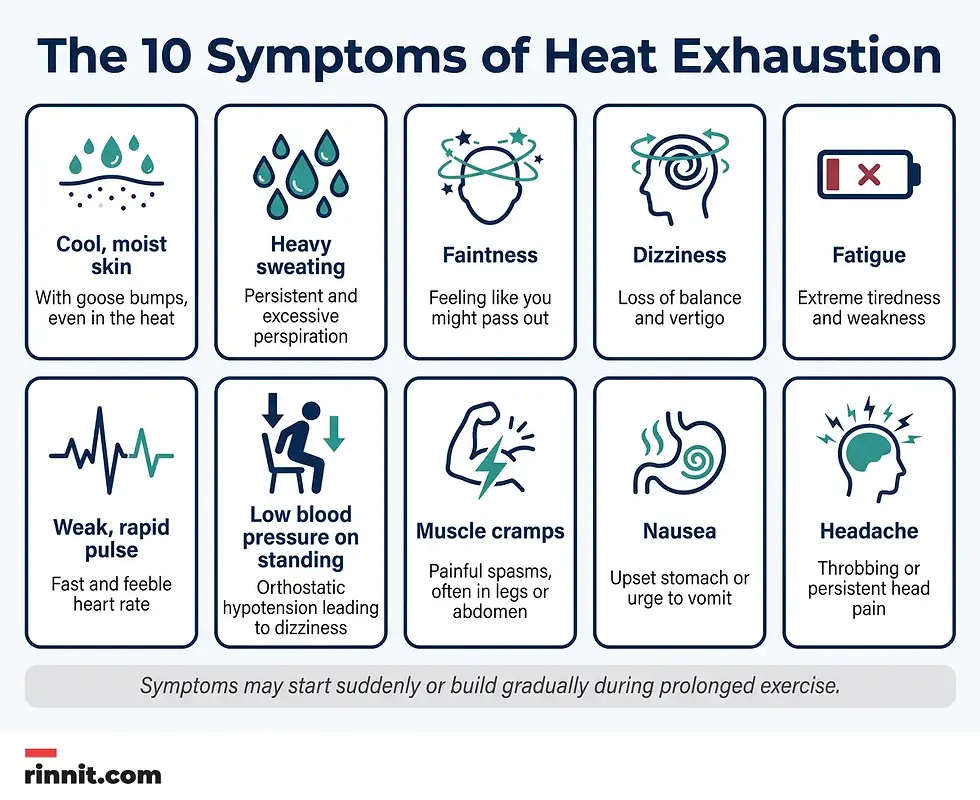
The ten symptoms of heat exhaustion. Symptoms may appear suddenly or build gradually, especially during prolonged exercise.
What to Do Right Now If You Suspect Heat Exhaustion
If you think you have heat exhaustion, take these three steps immediately [1]:
Stop all activity and rest.
Move to a cooler place.
Drink cool water or sports drinks.
Contact your healthcare professional if your symptoms get worse or do not improve within one hour [1].
When heat exhaustion becomes an emergency
If you are with someone who has symptoms of heat exhaustion, seek immediate medical help if the person:
becomes confused or distressed,
loses consciousness, or
cannot drink.
If the person's core body temperature — measured by a rectal thermometer — reaches 104°F (40°C) or higher, get help right away. The person needs immediate cooling and urgent medical attention [1].
Why Your Body Overheats
Your body's own heat, combined with environmental heat, affects your core temperature — your body's inner temperature. Your body constantly works to regulate heat gain in hot weather and heat loss in cold weather to maintain a core temperature that is typical for you. The average core temperature is about 98.6°F (37°C) [1].
In hot weather, your body cools itself mainly by sweating. The evaporation of sweat is what regulates your body temperature. But when you exercise strenuously or otherwise overexert in hot, humid weather, your body becomes less able to cool itself efficiently [1].

When humidity stops sweat from evaporating, cooling fails — and heat illness can progress from heat cramps to heat exhaustion to heatstroke.
Heat cramps: the earliest warning
As a result of this inefficient cooling, heat cramps may start in your body. Heat cramps are the mildest form of heat illness, with symptoms that often include heavy sweating, fatigue, thirst, and muscle cramps. Prompt treatment may prevent heat cramps from progressing to a more serious form of heat illness, such as heat exhaustion [1].
Drinking fluids or sports drinks that have electrolytes — such as Gatorade, Powerade, and others — can help treat heat cramps. Other treatments include moving into cooler temperatures, such as an air-conditioned or shaded place, and resting [1].
Other causes of heat exhaustion
Beyond hot weather and strenuous activity, three other factors can cause heat exhaustion [1]:
Dehydration: lessens your body's ability to sweat and keep an average core temperature.
Alcohol use: can affect your body's ability to regulate temperature.
Overdressing: particularly in clothes that do not allow sweat to evaporate easily.
Who Is Most at Risk
Anyone can get a heat illness, but certain factors increase your sensitivity to heat [1].
Young age or old age: infants, children younger than 4, and adults older than 65 are at higher risk. Children's ability to regulate temperature is not fully developed, and in older adults illness, medicines, or other factors can affect temperature control.
Certain medicines and drugs: some affect hydration and heat response, including some blood pressure and heart medicines (such as beta blockers and diuretics), antihistamines, tranquilizers, and antipsychotics. Cocaine and amphetamines can raise core temperature.
Obesity: excess weight can affect temperature regulation and cause the body to keep more heat.
Sudden temperature changes: if you are not used to the heat, you are more susceptible. Traveling from a cold climate to a warm one, or an early heat wave, puts you at risk before your body has adjusted.
A high heat index: when humidity is high, sweat cannot evaporate as easily. When the heat index is 91°F (33°C) or higher, take precautions to keep cool.
Complications: The Danger of Leaving Heat Exhaustion Untreated
If heat exhaustion is not treated, it can lead to heatstroke. Heatstroke is a life-threatening condition that happens when your core body temperature reaches 104°F (40°C) or higher [1].
Heatstroke needs immediate medical attention to prevent permanent damage to your brain and other vital organs — damage that can result in death. This is why the one-hour window matters and why a temperature of 104°F or higher is always an emergency [1].
How Doctors Diagnose Heat Exhaustion
If you need medical attention for heat exhaustion, the healthcare team may take your rectal temperature to confirm the diagnosis and rule out heatstroke. If the care team suspects your heat exhaustion may have progressed to heatstroke, you could need further tests [2]:
Blood test: checks for low blood sodium or potassium and the content of gases in your blood.
Urine test: checks the concentration and makeup of your urine, and kidney function, which can be affected by heatstroke.
Muscle function tests: check for rhabdomyolysis — serious damage to your muscle tissue.
X-rays and other imaging: check for damage to your inner organs.
Treatment: Four Steps You Can Take at Home
In most cases, you can treat heat exhaustion yourself [2]:
Rest in a cool place. An air-conditioned building is best. If that is not an option, find a shady spot or sit in front of a fan. Rest on your back with your legs raised higher than your heart level.
Drink cool fluids. Stick to water or sports drinks. Do not drink alcoholic beverages, which can add to dehydration.
Try cooling measures. If possible, take a cool shower, soak in a cool bath, or put towels soaked in cool water on your skin. If you are outdoors with no shelter, soaking in a cool pond or stream can help bring your temperature down.
Loosen clothing. Remove any unnecessary clothing and make sure your clothes are lightweight and nonbinding.

Four steps to treat heat exhaustion at home. No improvement in one hour means seek medical attention.
A critical rule: if you do not begin to feel better within one hour of using these treatment measures, seek prompt medical attention [2].
How the medical team cools a body in heatstroke
To cool your body back to its typical temperature, a healthcare team may use heatstroke treatment techniques [2]:
Immersion in cold water: a bath of cold or ice water is the most effective way to quickly lower core body temperature. The quicker cold water immersion begins, the less risk of organ damage and death.
Evaporation cooling: if immersion is not an option, cool water is misted on your body while warm air is fanned over you; the water evaporates and cools your skin.
Ice packs and cooling blankets: you are wrapped in a special cooling blanket with ice packs applied to your groin, neck, back, and armpits.
Medicine to stop shivering: if cooling treatments make you shiver, the care team may give a muscle relaxant such as a benzodiazepine; shivering increases body temperature and makes treatment less effective.
Prevention: Eight Habits That Keep Heat Illness Away
You can prevent heat exhaustion and other heat illnesses. When temperatures climb, remember these habits [1]:
Wear loose-fitting, lightweight clothing. Too much clothing or tight clothing won't allow your body to cool properly.
Protect against sunburn. Sunburn affects your body's ability to cool itself. Wear a wide-brimmed hat and sunglasses, and use broad-spectrum sunscreen with an SPF of at least 30, reapplied every two hours.
Drink plenty of fluids. Staying hydrated helps your body sweat and keeps your temperature from rising too high.
Be careful with certain medicines. Watch for heat-related issues if you take medicines that affect hydration and heat response.
Never leave anyone in a parked car. This is a common cause of heat-related deaths in children. A car parked in the sun can rise 20°F (more than 11°C) in just 10 minutes. Keep parked cars locked.
Take it easy during the hottest parts of the day. If you can't avoid strenuous activity, drink fluids and rest often in a cool spot. Schedule exercise or physical labor for early morning or evening.
Get acclimated. Limit time working or exercising in heat until you're conditioned to it. It can take several weeks for your body to adjust.
Be cautious if you're at increased risk. If you take medicines or have a condition — including a history of prior heat illness — that raises your risk, avoid the heat and act quickly if overheating symptoms appear. For strenuous events in hot weather, make sure medical services are ready.
Bottom Line
Heat exhaustion is your body's clear signal that it is overheating — heavy sweating, dizziness, a weak rapid pulse, nausea, and headache should never be brushed off in hot weather. The good news is that most cases respond to four simple steps: rest in a cool place, drink cool fluids, apply cooling measures, and loosen your clothing. The danger lies in waiting too long. Symptoms that persist beyond an hour, or a core temperature of 104°F (40°C) or higher, mark the crossing into heatstroke — a life-threatening emergency that can permanently damage the brain and other organs.
If you or someone you care for spends hot days working or exercising outdoors, keep these signs and steps front of mind, and share them with your family whenever hot weather arrives.
Your next step: if you notice the early signs of overheating, stop, cool down, and drink cool fluids now. If symptoms don't improve within an hour, or you see confusion, fainting, or an inability to drink, seek emergency care right away.
Frequently Asked Questions
What is heat exhaustion?
Heat exhaustion is a condition that happens when your body overheats, often from high temperatures combined with high humidity and strenuous physical activity. Symptoms may include heavy sweating and a rapid pulse, and it is one of three heat illnesses — milder than heatstroke but capable of progressing to it without prompt treatment.
What are the symptoms of heat exhaustion?
The ten symptoms are cool, moist skin with goose bumps in the heat; heavy sweating; faintness; dizziness; fatigue; a weak, rapid pulse; low blood pressure upon standing; muscle cramps; nausea; and headache. Symptoms may start suddenly or build gradually.
How is heat exhaustion treated?
In most cases, treat it yourself: rest in a cool place (air conditioning is best, otherwise shade or a fan), lie on your back with your legs raised above heart level, drink cool water or sports drinks, take a cool shower or bath or apply wet towels, and loosen or remove unnecessary clothing. If you don't feel better within one hour, seek prompt medical attention.
When is heat exhaustion an emergency?
Seek immediate medical help if someone becomes confused or distressed, loses consciousness, or cannot drink. If a rectal thermometer shows a core body temperature of 104°F (40°C) or higher, get help right away — the person needs immediate cooling and urgent medical attention.
What is the difference between heat exhaustion and heatstroke?
Heat exhaustion is overheating with symptoms like heavy sweating and a rapid pulse; heatstroke is the most serious heat illness, occurring when core body temperature reaches 104°F (40°C) or higher. Heatstroke is life-threatening and can cause permanent damage to the brain and other vital organs.
Can heat exhaustion turn into heatstroke?
Yes. If heat exhaustion is not treated, it can lead to heatstroke, a life-threatening condition that needs immediate medical attention to prevent permanent organ damage or death.
Who is most at risk for heat exhaustion?
Infants, children under 4, and adults over 65; people taking certain medicines (beta blockers, diuretics, antihistamines, tranquilizers, antipsychotics) or using cocaine and amphetamines; people with obesity; those not acclimated to heat; and anyone out when the heat index is 91°F (33°C) or higher.
What should I drink for heat exhaustion?
Drink cool water or sports drinks. Sports drinks with electrolytes, such as Gatorade or Powerade, can help. Avoid alcoholic beverages, which can add to dehydration.
Why doesn't my body cool itself in hot, humid weather?
In hot weather your body cools mainly by sweating, and evaporation of sweat regulates temperature. High humidity makes it harder for sweat to evaporate, so the body loses its main cooling mechanism and overheats more easily.
How do I prevent heat exhaustion?
Wear loose, lightweight clothing; protect against sunburn with a hat, sunglasses, and SPF 30+ sunscreen; drink plenty of fluids; schedule activity for early morning or evening; get acclimated over several weeks; never leave anyone in a parked car; be cautious with heat-affecting medicines; and take extra care if you are at higher risk.
References
Mayo Clinic Staff. Heat exhaustion - Symptoms and causes. Mayo Clinic. June 6, 2026. https://www.mayoclinic.org/diseases-conditions/heat-exhaustion/symptoms-causes/syc-20373250
Mayo Clinic Staff. Heat exhaustion - Diagnosis and treatment. Mayo Clinic. June 6, 2026. https://www.mayoclinic.org/diseases-conditions/heat-exhaustion/diagnosis-treatment/drc-20373253
Stearns RL, Hosokawa Y, Belval LN, et al. Exertional heat stroke survival at the Falmouth Road Race: 180 new cases with expanded analysis. Journal of Athletic Training. 2024;59(3):304-309. PMID 37655801. https://doi.org/10.4085/1062-6050-0065.23
Douma MJ, Aves T, Allan KS, et al. First aid cooling techniques for heat stroke and exertional hyperthermia: a systematic review and meta-analysis. Resuscitation. 2020;148:173-190. PMID 31981710. https://doi.org/10.1016/j.resuscitation.2020.01.007
Medical disclaimer
This article is for informational purposes only and is not a substitute for professional medical advice, diagnosis, or treatment. The clinical information in this guide reflects source material last reviewed in June 2026.



Comments