Hamartoma: What It Is, Why It Happens, and How It's Treated

Updated: 2 days ago
Medically reviewed by Dr. Baraa Alnahhal, MD · Last reviewed: October 2026
Quick Answer
A hamartoma is a benign growth made of normal cells growing in a disorganized pattern, not a true cancer [1]. It can appear almost anywhere, including the lungs, heart, brain, breasts and digestive system [1]. Most cause no symptoms unless they press on nearby tissue [1]. Some are linked to rare genetic syndromes [1]. Treatment is usually unnecessary, though surgery or radiation can help [1].
What the research says
A genetic syndrome, not the growth itself, drives the cancer risk. International consensus guidelines describe PTEN hamartoma tumor syndrome as an inherited condition with an increased risk of benign and malignant tumors of the breast, colon, endometrium, thyroid, skin, and kidney, and recommend multidisciplinary surveillance (Dhawan et al., Clin Cancer Res, 2025) [3].
Malignant change is rare but has been reported. A case report described a 67-year-old man whose biopsy-proven lung hamartoma later changed into a chondrosarcoma despite surveillance; the authors question whether lung hamartomas in older adults need closer treatment or surveillance (Schenkel et al., Cureus, 2020) [4].
What Is a Hamartoma?
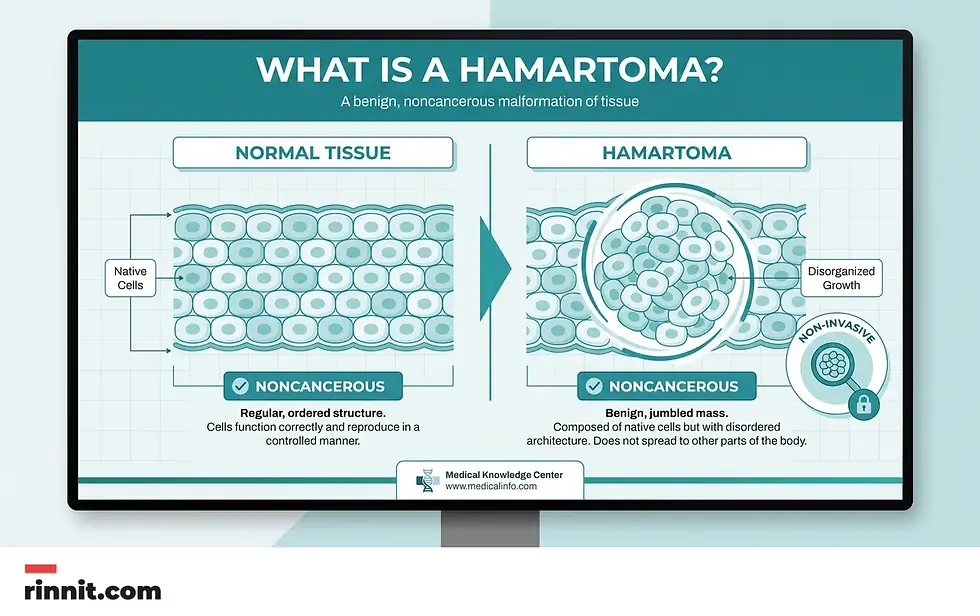
A hamartoma is a tumor-like growth that can develop in virtually any part of the human body [1]. Although the term “tumor” often causes concern, hamartomas are fundamentally noncancerous. They are unique because they are composed of the exact same types of cells and tissues that belong in the area where they form [1]. The primary difference is that in a hamartoma, these normal cells grow together in a disorganized, jumbled fashion [1].
Because they are made of native tissue, hamartomas tend to grow very slowly and do not spread to other parts of the body [1]. Most are considered harmless and are often discovered by accident during medical imaging for an unrelated health concern [1] [5]. However, their presence can sometimes be a sign of a rare genetic condition that may require specialized long-term monitoring.
Feature | Hamartoma | Neoplasm (Tumor) |
Cell Type | Normal, native cells | Abnormal cells |
Growth Pattern | Disorganized but localized | Can be organized or invasive |
Cancer Risk | Almost always benign | Can be benign or malignant |
Spread | Does not spread | Malignant types can spread (metastasize) |
What Are the Different Types of Hamartomas?
Healthcare providers categorize hamartomas based on their location within the body. Each type is named according to the organ or system it affects [1]. While they share the same disorganized growth pattern, their impact on health depends entirely on which tissue is involved.
Type | Location | Potential Impact |
Pulmonary Hamartoma | Lungs | Usually asymptomatic; most common lung growth. |
Breast Hamartoma | Breast Tissue | May be felt as a lump; noncancerous. |
Hypothalamic Hamartoma | Brain (Hypothalamus) | Can cause seizures or developmental delays. |
Cardiac Rhabdomyoma | Heart | May interfere with blood flow in severe cases. |
Hamartomatous Polyps | Digestive System | Can occur in the stomach or intestines. |
Lipofibromatous Hamartoma | Nerves | Often affects the nerves in the hands or arms. |

What Are the Symptoms of a Hamartoma?
In the vast majority of cases, hamartomas do not cause any noticeable symptoms [1]. They are typically slow-growing and remain small enough that they do not interfere with the function of the surrounding organs. Symptoms only emerge when a growth becomes large enough to press against nearby nerves, blood vessels, or tissues [1].
When symptoms do occur, they are specific to the location of the growth. For example, a hamartoma in the brain's hypothalamus might trigger seizures or affect a child's development [1]. A growth in the heart could potentially disrupt normal blood flow [1], while one in the lungs might cause respiratory issues if it blocks an airway. If you experience unusual symptoms related to a specific organ, a healthcare provider can determine if a growth is the cause.
What Causes Hamartomas to Form?
The exact cause of most hamartomas remains unknown to medical experts [1]. However, research has identified a strong link between these growths and certain inherited gene mutations. In these cases, a person may inherit a specific genetic change from one of their biological parents that predisposes them to developing hamartomas [1].
Several rare genetic syndromes are known risk factors for these growths. It is important to note that while the hamartomas themselves are noncancerous, the underlying genetic syndrome might increase the overall risk of developing other types of cancer [1] [3]. Individuals diagnosed with these syndromes often require regular checkups and screenings [1].
PTEN Hamartoma Tumor Syndrome (PHTS): Can cause growths in the breasts, skin, thyroid, and digestive tract [1].
Tuberous Sclerosis: Linked to hamartomas in the eyes, brain, heart, and kidneys [1].
Neurofibromatosis Type 1 (NF1): Often leads to growths on the nerves and skin [1].
Peutz-Jeghers Syndrome (PJS): Causes hamartomatous polyps mainly in the small intestine, stomach, and colon, and raises the risk of several cancers [1].
Pallister-Hall Syndrome (PHS): Specifically associated with hypothalamic hamartomas in the brain [1].
How Are Hamartomas Diagnosed and Treated?
Because most hamartomas do not cause symptoms, they are frequently found during imaging tests like X-rays, CT scans, or MRIs performed for other reasons [1]. If a growth is detected, a healthcare provider may order additional imaging to confirm its characteristics. In cases where the nature of the growth is unclear, a biopsy may be performed to ensure the tissue is not cancerous [1].
Treatment is usually not required for hamartomas that are small and asymptomatic [1]. However, if a growth causes pain, interferes with organ function, or poses a risk due to its location, intervention is necessary. Surgery is the most common method for removing a hamartoma and typically resolves any related issues [1].
In situations where traditional surgery is too risky—such as when a brain hamartoma is located near critical nerves—alternative therapies may be used. These include ablation therapy, which uses extreme heat to destroy the disorganized tissue, or GammaKnife radiosurgery [1], a highly precise form of radiation that targets the growth without damaging surrounding healthy tissue.

Conclusion
Most hamartomas are benign, slow-growing masses that pose no threat to long-term health. While the discovery of any growth can be unsettling, these tumor-like structures are composed of normal cells and rarely become serious. By working closely with a healthcare provider, individuals can monitor these growths and, if necessary, utilize highly effective surgical or specialized treatments to manage them.
Frequently Asked Questions
Q: Is a hamartoma a form of cancer?
A: No, hamartomas are noncancerous (benign) growths made of normal tissue that has grown in a disorganized way.
Q: Can a hamartoma turn into cancer?
A: While extremely rare, it is theoretically possible. However, the vast majority remain benign throughout a person's life.
Q: Do all hamartomas need to be removed?
A: No. Most hamartomas are harmless and do not require treatment unless they cause symptoms or interfere with organ function.
Q: How fast do hamartomas grow?
A: They typically grow very slowly, similar to the surrounding normal tissue.
Q: What is the difference between a hamartoma and a regular tumor?
A: Hamartomas are made of normal cells native to their location, while regular tumors (neoplasms) are made of abnormal cells.
Q: Are hamartomas painful?
A: Most are painless. Pain only occurs if the growth presses on a nerve or sensitive nearby tissue.
Q: Can children be born with hamartomas?
A: Yes, some hamartomas are present at birth, especially those linked to genetic syndromes.
Q: How is a lung hamartoma usually found?
A: They are most often found accidentally on a chest X-ray or CT scan taken for another reason.
Q: Can a hamartoma cause seizures?
A: Yes, specifically hypothalamic hamartomas in the brain can trigger seizures and other neurological issues.
Q: Is surgery for hamartoma risky?
A: Most surgeries are straightforward and successful. Risks only increase if the growth is near critical structures like the brain or heart.
Q: What is a biopsy?
A: A procedure where a small sample of tissue is removed and examined in a lab to confirm the growth is not cancerous.
Q: Are hamartomas hereditary?
A: Some are linked to inherited genetic syndromes, but many occur randomly without a clear family link.
Q: What is ablation therapy?
A: A treatment that uses heat to destroy the disorganized tissue of a hamartoma when surgery is not an option.
Q: Can hamartomas affect vision?
A: If located in the brain near the optic nerve, they could potentially impact vision, though this is rare.
Q: Should I worry if I have a hamartoma?
A: In most cases, no. They are usually harmless, but you should follow your healthcare provider's advice for monitoring.
Related Reading
Understanding Hypothalamic Hamartoma: Causes, Symptoms, and Treatment explains a brain hamartoma that can cause seizures and early puberty.
Pulmonary Nodules: Symptoms, Causes, and Management covers lung spots, including hamartomas, found on imaging.
Tuberous Sclerosis: Symptoms, Causes, Diagnosis and Treatment — What You Need to Know describes a genetic condition that causes hamartomas in many organs.
Cowden Syndrome: Symptoms, Causes, Cancer Screening and What to Expect — What You Need to Know explains a genetic syndrome with multiple hamartomas and cancer screening needs.
Sources
Cleveland Clinic. Hamartoma. Cleveland Clinic. August 29, 2025. https://my.clevelandclinic.org/health/diseases/24652-hamartoma
Ali SA, Mulita F. Hamartoma. In: StatPearls [Internet]. StatPearls Publishing. Last updated March 14, 2023. PMID 32965969. https://pubmed.ncbi.nlm.nih.gov/32965969/
Dhawan A, et al. Cancer and Overgrowth Manifestations of PTEN Hamartoma Tumor Syndrome: Management Recommendations from the International PHTS Consensus Guidelines Working Group. Clin Cancer Res. 2025;31(9):1754-1765. PMID 39937242. https://doi.org/10.1158/1078-0432.CCR-24-3819
Schenkel R, et al. Malignant Degeneration of Biopsy-Proven Hamartoma to Chondrosarcoma. Cureus. 2020;12(12):e12150. PMID 33489562. https://doi.org/10.7759/cureus.12150
Shukla I, et al. Symptomatic Pulmonary Hamartoma. Cureus. 2021;13(9):e18230. PMID 34692355. https://doi.org/10.7759/cureus.18230
Medical disclaimer
This article is for general educational purposes only and is not a substitute for professional medical advice, diagnosis, or treatment. Always seek the advice of your physician or other qualified healthcare provider with any questions you may have about a medical condition. Never disregard professional medical advice or delay seeking care because of something you have read here. If you think you may have a medical emergency, call your doctor or emergency services immediately.



Comments