Golfer's Elbow: Why the Inside of Your Elbow Hurts, and What Actually Heals It

Updated: 2 days ago
Medically reviewed by Dr. Baraa Alnahhal, MD · Last reviewed: October 2026
Quick Answer
Golfer's elbow is pain and tenderness on the inside of the elbow, where forearm tendons attach to the bone, caused by repetitive wrist-bending and gripping. Treatment starts with stopping the painful activity, rest, ice 15 to 20 minutes at a time and an over-the-counter pain reliever. Most people recover, though healing can take several months or longer.
What the research says
Surgery helps most people whose golfer's elbow does not get better with other care. A systematic review of 16 studies covering 479 elbows found surgical success rates of 63% to 100%, with a complication rate of 4.3% (Arevalo et al., Am J Sports Med, 2023) [4].
Eccentric strengthening exercises may ease pain and improve elbow function. A 2026 systematic review of 5 studies with 143 patients found reduced pain and better function with eccentric exercise, although the authors rated the overall certainty of the evidence as low (See et al., Complement Ther Med, 2026) [5].
What Is Golfer's Elbow?
Golfer's elbow, also called medial epicondylitis, is a condition that causes pain on the inner elbow [2]. It causes pain where the tendons from the forearm muscles attach to the bone. The pain also may spread down the forearm and into the wrist.
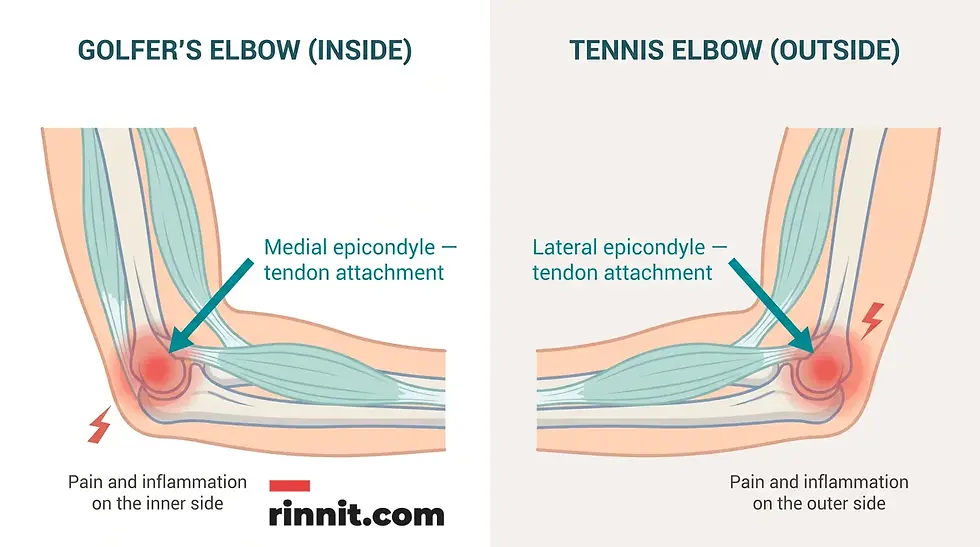
It is similar to tennis elbow, which affects the outside of the elbow. But golfer's elbow happens on the inside of the elbow, closer to the body.
Despite the name, golfer's elbow doesn't happen only to golfers. Anyone who uses their wrists or grips things over and over can develop it. That includes tennis players, pickleball players, and people whose jobs require certain repetitive movements.
The good news is that golfer's elbow typically gets better with rest, simple treatments, and changes to how you use your wrist and arm. Most people return to their usual activities with the right care.
Symptoms: What Golfer's Elbow Feels Like
The pain of golfer's elbow occurs primarily where the tendons of the forearm muscles attach to the bony bump on the inside of the elbow, known as the medial epicondyle. By contrast, the pain of tennis elbow usually occurs at the bony bump on the outside of the elbow, the lateral epicondyle.
The pain can start suddenly or build up over time. It may feel worse when doing activities such as swinging a golf club, pitching a ball, or playing a racquet sport. Shaking someone's hand, turning a doorknob, picking up something with your palm down, and flexing your wrist also may hurt.
Symptom | How It Presents |
Pain and tenderness | Located on the inside of the elbow; can spread down the forearm; often worse with gripping or lifting, especially when using the wrist |
Stiffness | The elbow feels stiff; it may hurt to make a fist |
Weakness | The hands or wrists feel weaker than usual |
Numbness or tingling | May travel into the fingers; more common in the ring and little fingers [2] |
Causes: How Repetitive Motion Injures the Tendons
Golfer's elbow happens when the muscles and tendons that control the wrist and fingers get overused or injured [2]. This typically comes from repeating the same motion too often, especially forceful wrist-bending and finger-bending movements.
Contributing causes include lifting, throwing, or hitting the wrong way; not warming up properly before activity; and having weak or poorly conditioned muscles. To cause golfer's elbow, the provoking activity generally needs to be done for a long period on many days.
Many sports and jobs can lead to this condition:
Activity Type | Examples | How It Triggers the Injury |
Racket sports | Tennis, pickleball | Poor technique, too much topspin, or a racket that is too small or heavy strains the tendons |
Throwing sports | Baseball, softball, football, archery, javelin | Improper pitching technique is a common cause |
Weight training | Biceps curls and similar lifts | Curling the wrists during the completion of a biceps curl overloads the elbow muscles and tendons |
Repetitive work | Construction, plumbing, carpentry | Repeated arm movements day after day |
Risk Factors
You're more likely to get golfer's elbow if you meet any of the following conditions.
Risk Factor | Why It Raises Risk |
Age 40 or older | Tendons change with age |
Repetitive movements for 2 or more hours a day | Sustained overuse of the tendons |
Overweight | Added strain on the body's structures |
Diabetes | Affects tendon health and healing |
Smoking | May affect tendon health and healing |
When to See a Doctor
See your healthcare professional if your pain doesn't improve with rest, ice, and pain medicines you can buy without a prescription.
Get medical help right away if your elbow is swollen and warm to the touch and you have a fever, you can't bend your elbow, your elbow looks odd or out of place, or you think you may have broken a bone.
Diagnosis: How Golfer's Elbow Is Confirmed
To diagnose golfer's elbow, your healthcare professional typically starts by asking about your symptoms and medical history. Then, you'll have a physical exam to check for pain, stiffness, or weakness. Your healthcare professional may press on the inside of your elbow or ask you to move your elbow, wrist, and fingers in different ways to see what causes pain.
Diagnostic Step | What It Involves |
History and physical exam | Questions about symptoms and activities; pressing on the inner elbow; moving the elbow, wrist, and fingers to find what causes pain |
X-ray | Helps rule out other causes of elbow pain, such as a broken bone or arthritis [2] |
Ultrasound | Provides a closer look at the tendons and soft tissues if symptoms are serious or not improving |
MRI | More detailed imaging of the tendons and soft tissues when further detail is needed |
Treatment Options: What Helps and What Doesn't
The first step in treating golfer's elbow is to stop doing activities that cause pain [2]. Giving your arm a break helps the tendons heal.
Most people get better with rest, ice, and pain relief. But healing can take time — sometimes several months or even longer. Even with treatment, some people may have ongoing pain or flare-ups that come and go.
Treatment | How It Works | When It's Used |
OTC pain relievers | Ibuprofen (Advil, Motrin IB, others), naproxen sodium (Aleve), or acetaminophen (Tylenol, others) lessen pain | First-line pain relief; talk with your healthcare professional if you are not sure which one is right for you |
Ice | Ice pack on the elbow 15 to 20 minutes at a time, 3 to 4 times a day for a few days, wrapped in a thin towel; or massage the inside of the elbow with an ice cube for five minutes, 2 to 3 times a day | First-line self-care alongside rest |
Rest | Stop playing golf or doing other activities that strain your elbow until the pain goes away; returning too soon can make the injury worse | First-line and essential |
Brace | A special strap or brace for the forearm reduces strain on the tendons that attach to your elbow | Recommended in some cases |
Stretching and strengthening | Exercises to gently stretch then strengthen the wrist and forearm [2]; building strength gradually has been shown to help tendon healing | As pain allows; physical or occupational therapy may help |
Dry needling (tenotomy) | A small needle pokes the sore tendon to help it heal; sometimes ultrasound-guided | Being studied; considered if rest and self-care haven't helped |
Shockwave therapy | Sound waves applied to the elbow to help it heal | Being studied; discussed case by case |
Platelet-rich plasma (PRP) | A small amount of your blood is drawn, the platelets are concentrated, and they are injected into the sore area, typically ultrasound-guided | Being studied; researchers are still studying how well it works [2] |
Cortisone shots | Injection used rarely for short-term pain relief | Not often used — they don't seem to help long-term and have been found to weaken the tissue |
Surgery (Tenex/PUT) | A tiny tool goes through the skin and removes damaged tissue, guided by ultrasound imaging; a similar device, TenJet, uses water to remove damaged tissue | Rarely needed; considered if symptoms don't improve after 6 to 12 months of other treatments |

Prevention: How to Protect Your Elbows
You can help prevent golfer's elbow by building the habits below.
Prevention Step | What to Do |
Strengthen your forearm muscles | Especially the muscles that flex the wrist; use light weights or squeeze a tennis ball regularly to build strength and protect your tendons from sudden strain |
Warm up and stretch | Walk or jog for a few minutes, then gently stretch your wrists before playing sports or working |
Use good technique | Ask a coach or trainer to check your form during sports or workouts; try to keep your wrist stiff and rigid throughout your sports movement |
Use the right equipment | If your golf clubs are old and heavy, try switching to lighter ones; if you play tennis or pickleball, make sure your racket grip fits your hand and isn't too heavy |
Lift safely | Keep your wrist straight and firm when lifting anything — especially weights — to avoid straining the tendons attached to your elbow |
Rest when needed | If your elbow starts to hurt, stop what you are doing and give it time to heal; pushing through pain can make golfer's elbow worse |

Preparing for Your Appointment
You'll probably start by seeing your primary healthcare professional. If your symptoms don't get better with rest, ice, and pain medicine, they may refer you to a sports medicine specialist or a doctor who treats muscle, bone, and joint issues.
Before your appointment, write down your symptoms and when they started, any health conditions you have, a list of all medicines and supplements you take including doses, details about your daily routine such as how often and how hard you play sports or do other activities that may strain your elbow (and whether you recently changed your workout or how you use your arm), any recent injuries that may have affected your elbow, and a list of questions.
You may want to ask what the most likely cause of your elbow pain is, whether anything else could be causing it, whether you need tests, what treatment is recommended, whether you'll be able to go back to the sport or activity that caused the pain, how long you should avoid that activity, what kinds of exercises are safe while you're healing, whether you will need surgery, and how often follow-up visits will be needed.
Your healthcare professional may ask whether your pain is constant and how bad it is, whether activities such as lifting, gripping, typing, or shaking hands make it worse, whether the pain makes everyday tasks or sleep difficult, what your exercise routine is, whether you've changed your training style or equipment recently such as using a new racket or trying new techniques, what kinds of physical tasks you do for work, what your hobbies are, and whether you've tried any home treatments and whether they helped.
Conclusion: Rest Is the First Step, and Technique Is the Long-Term Fix
Golfer's elbow is a tendon injury, not a mystery — it happens when repetitive gripping, wrist-bending, and throwing motions overload the tendons on the inside of your elbow. The good news is that the standard approach works for most people: stop the provoking activity, rest, ice 15 to 20 minutes several times a day, and use an over-the-counter pain reliever. Healing isn't instant; expect several months in many cases, and patience here is what prevents a longer problem.
The hardest part is often resisting the urge to push through the pain and return to your sport or work too soon. Going back before your elbow has healed can make the injury worse. Once the pain eases, gradual stretching and strengthening, a brace if recommended, and better technique with your coach, trainer, or a sports professional are what protect your elbow from coming back.
Next steps: If your inner elbow pain doesn't improve with rest and ice within a few weeks — or if your elbow is swollen, warm, and feverish, or you can't bend it — contact your healthcare professional promptly.
Frequently Asked Questions
What is golfer's elbow?
Golfer's elbow (medial epicondylitis) is a condition that causes pain on the inner elbow where the forearm tendons attach to the bone. Despite the name, it affects anyone who uses their wrists or grips things repeatedly — not just golfers.
What are the symptoms of golfer's elbow?
Pain and tenderness on the inside of the elbow, sometimes spreading down the forearm; stiffness that can make making a fist hurt; weakness in the hands or wrists; and numbness or tingling that may travel into the fingers, especially the ring and little fingers.
How is golfer's elbow different from tennis elbow?
Golfer's elbow affects the inside of the elbow, closer to the body, where the tendons attach at the medial epicondyle. Tennis elbow affects the outside of the elbow, at the lateral epicondyle.
What causes golfer's elbow?
Repetitive motions that force the wrist and fingers to bend — especially over a long period on many days. Common triggers include racket sports with poor technique, improper pitching, curling the wrists during biceps curls, and jobs with repeated arm movements like construction or carpentry.
Who is most at risk?
People who are 40 or older, do repetitive movements for two or more hours a day, are overweight, have diabetes, or smoke, since smoking may affect tendon health and healing.
How is golfer's elbow diagnosed?
A healthcare professional takes your history and performs a physical exam, pressing on the inner elbow and testing movements. An X-ray can rule out a broken bone or arthritis, and ultrasound or MRI may be used for a closer look at the tendons if symptoms are serious or not improving.
What is the first step in treating golfer's elbow?
Stop doing activities that cause pain. Rest, ice (15 to 20 minutes at a time, 3 to 4 times a day, for a few days), and over-the-counter pain relievers such as ibuprofen, naproxen sodium, or acetaminophen help most people recover.
How long does golfer's elbow take to heal?
Healing can take several months or even longer. Some people have ongoing pain or flare-ups that come and go even with treatment.
Are cortisone shots a good treatment?
Not usually. Cortisone shots are not often used because they don't seem to help long-term and have been found to weaken the tissue. They may rarely be used for short-term pain relief.
When is surgery needed?
Surgery is rarely needed. If symptoms don't improve after 6 to 12 months of other treatments, a procedure such as the Tenex procedure (percutaneous ultrasonic tenotomy) may be recommended, which uses a tiny ultrasound-guided tool to remove damaged tendon tissue.
Further Reading and Credible Sources
Mayo Clinic Staff. Golfer's elbow (Medial epicondylitis) - Symptoms and causes. Mayo Clinic. May 23, 2026. https://www.mayoclinic.org/diseases-conditions/golfers-elbow/symptoms-causes/syc-20372868
American Academy of Orthopaedic Surgeons. Medial Epicondylitis (Golfer's Elbow). OrthoInfo. Accessed October 30, 2026. https://www.orthoinfo.org/diseases--conditions/medial-epicondylitis-golfers-elbow/
National Institute of Arthritis and Musculoskeletal and Skin Diseases. Sports Injuries. National Institute of Arthritis and Musculoskeletal and Skin Diseases. September 2024. https://www.niams.nih.gov/health-topics/sports-injuries
Arevalo A, Rao S, Willier DP, et al. Surgical Techniques and Clinical Outcomes for Medial Epicondylitis: A Systematic Review. Am J Sports Med. 2023;51(9):2506-2515. PMID 35658623. https://doi.org/10.1177/03635465221095565
See ZH, Loo CE, Jaafar Z. Eccentric exercise therapy for medial epicondylitis: A systematic review of clinical outcomes. Complement Ther Med. 2026;98:103364. PMID 41887339. https://doi.org/10.1016/j.ctim.2026.103364
Related Reading
Elbow X-Ray: What It Shows, Views Taken and What to Expect explains the X-ray views used to check the elbow bones after an injury.



Comments