Factor VII Deficiency: Understanding Alexander’s Disease and Clotting Risks

Updated: 2 days ago
Medically reviewed by Dr. Baraa Alnahhal, MD · Last reviewed: October 2026
Quick Answer: What is factor VII deficiency?
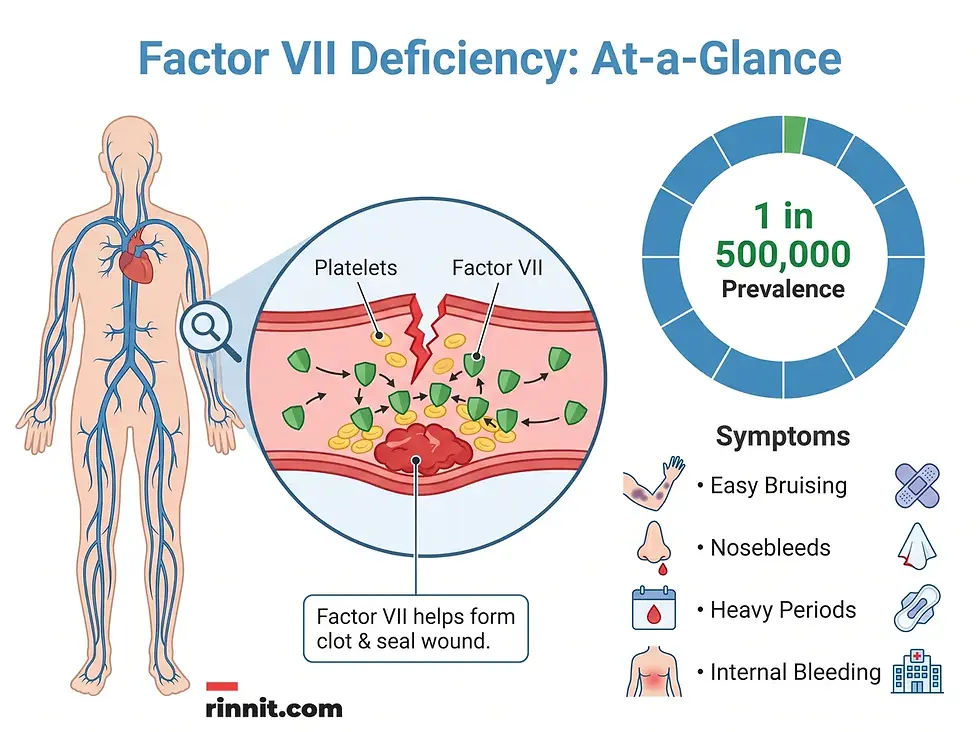
Factor VII deficiency is a rare blood disorder in which levels of Factor VII, a protein essential for clotting, are too low. It occurs in about 1 in 500,000 people and causes prolonged bleeding after injuries and frequent bruising. Management replaces the missing protein with recombinant Factor VIIa, plasma or concentrates and avoids blood thinners and high-risk activities.
What the research says
Severity varies widely, and heavy periods are common. A review describes factor VII deficiency as the most common of the rare congenital coagulation disorders, with autosomal recessive inheritance and a clinical picture ranging from no symptoms, even in homozygotes, to severe, life-threatening bleeding; menorrhagia affects two thirds of patients of fertile age, and the most effective treatments are plasma-derived factor VII concentrates and recombinant activated factor VII (rFVIIa), with rare treatment-related side effects (PubMed: Mariani & Bernardi, Semin Thromb Hemost, 2009 [1]).
Three-times-weekly rFVIIa prophylaxis showed better outcomes than less frequent dosing, though the difference was not statistically significant. In the Seven Treatment Evaluation Registry, 34 patients with severe factor VII deficiency received 38 prophylaxis courses; excluding courses for menorrhagia, 78% (18/23) of courses given three times weekly had an excellent outcome versus 41% (5/12) of courses given twice weekly or less (relative risk 1.88, 95% CI 0.93–3.79; P=0.079), and no thrombosis or new inhibitors occurred (PubMed: Napolitano et al., Haematologica, 2013 [2]).
Many women with factor VII deficiency deliver without routine prophylaxis. A systematic review of 62 women with factor VII deficiency who had 94 live births found that haemostatic prophylaxis was used in 32% of deliveries; postpartum haemorrhage occurred in 10% of deliveries with prophylaxis and 13% without, and the authors recommended having rFVIIa available for haemorrhage or surgery rather than as mandatory prophylaxis (PubMed: Baumann Kreuziger et al., Haemophilia, 2013 [3]).
Overview of Factor VII Deficiency
Factor VII deficiency is an inherited or acquired blood disorder that disrupts the body’s natural ability to form clots. Factor VII is a “coagulation factor”, one of several specialized proteins that work in sequence to help platelets seal wounds and stop bleeding [4]. When these protein levels are too low, the clotting process slows significantly, leading to excessive bleeding even from minor injuries.
This condition is also medically referred to as Alexander’s disease or proconvertin deficiency [4]. While it is classified as a rare disease, it holds the distinction of being the most frequent among the group of rare inherited bleeding disorders [1] [4].
Key Fact | Detail |
Prevalence | 1 in 500,000 people worldwide |
Primary Cause | Genetic mutation (inherited) or liver/vitamin K issues (acquired) |
Primary Risk | Prolonged bleeding and easy bruising |
Commonality | Most common of the “rare” inherited clotting disorders |
Symptoms and Warning Signs
The severity of Factor VII deficiency symptoms varies widely between individuals [4]. Some infants with severe deficiency are diagnosed at birth due to significant bleeding [4], while those with mild cases may not notice symptoms until they undergo surgery or experience a major injury in adulthood.
Common symptoms include [4]:
Surface Bleeding: Frequent nosebleeds (epistaxis) that are difficult to stop and bleeding gums.
Menstrual Issues: Abnormally heavy or prolonged menstrual periods (menorrhagia).
Internal Bleeding: Blood appearing in the urine (hematuria) or stools, and bleeding into joints or muscles.
Severe Risks: Spontaneous bleeding without an obvious cause and life-threatening intracranial (brain) bleeding.
Symptom Category | Specific Signs |
Minor Bleeding | Easy bruising, bleeding gums, frequent nosebleeds |
Major Bleeding | Heavy periods, blood in urine/stool, bleeding after surgery |
Emergency Signs | Intracranial bleeding, spontaneous internal hemorrhage |
Causes and Inheritance Patterns
Factor VII deficiency is primarily a genetic condition, though it can also be developed later in life due to underlying health issues [4].
Inherited Factor VII Deficiency
The inherited form is caused by a mutation in the F7 gene, which provides the instructions for making the Factor VII protein [4]. This follows an autosomal recessive inheritance pattern, meaning a child must inherit a mutated gene from both biological parents to develop the disorder [1] [4].
Parental Status | Chance for Child |
Both parents are carriers | 25% chance of having the disorder |
One parent is a carrier | Child may be a carrier but usually lacks symptoms |
Acquired Factor VII Deficiency
In some cases, individuals are born with normal Factor VII levels but develop a deficiency later. This is often a secondary effect of other conditions or treatments [4].
Acquired Cause | Mechanism |
Liver Disease | The liver produces Factor VII; severe damage stops production |
Vitamin K Deficiency | Vitamin K is a necessary “ingredient” for Factor VII synthesis |
Medications | Blood thinners like warfarin (Coumadin®) can lower Factor VII levels |
Blood Disorders | Aplastic anemia and leukemia have been linked to acquired cases |

Complications of Untreated Deficiency
If left unmanaged, chronic bleeding can lead to long-term physical damage. The most immediate risk is life-threatening blood loss [4], but other complications can arise over time.
Anemia: Chronic blood loss reduces red blood cell levels [4], leading to fatigue and weakness.
Joint Damage: Repeated bleeding into the joints can wear down tissue [4], causing chronic pain and reduced mobility.
Hematomas: Large collections of congealed blood under the skin can press on internal organs [4], causing pain and dysfunction.
Diagnosis and Clinical Testing
Diagnosis typically begins with a review of family history and symptoms [4]. Healthcare providers use specific blood tests to evaluate how well the blood clots and to measure the activity of Factor VII [4].
Diagnostic Test | Typical Result in Factor VII Deficiency |
Prothrombin Time (PT/INR) | Prolonged (blood clots slower than normal) |
Partial Thromboplastin Time (PTT) | Usually normal |
Factor VII Assay | Shows low or non-functioning Factor VII protein levels |
Treatment and Management Options
Treatment focuses on increasing the levels of functioning Factor VII in the bloodstream [4]. A hematologist (blood specialist) will determine the best course of action based on the frequency and severity of bleeding episodes.
Replacement Therapies
Recombinant Factor VIIa (NovoSeven®): An FDA-approved, lab-made protein that does not come from human-donated blood [4], reducing the risk of pathogen exposure.
Prothrombin Complex Concentrates (PCC): A concentrated mix of four clotting factors derived from donated human blood [4].
Fresh Frozen Plasma (FFP): IV infusions of donated plasma to replenish the body’s store of Factor VII [4].
Supportive Treatments
Antifibrinolytics: Medications like tranexamic acid that prevent the body from breaking down the clots it does form [4].
Hormonal Therapy: Birth control pills can be used to manage heavy menstrual bleeding in women [4].
Vitamin K: Supplements or injections are used if the deficiency is caused by a lack of Vitamin K [4].
Treatment Risk | Description |
Harmful Clots | Adding Factor VII can occasionally cause excessive clotting in vessels |
Pathogen Exposure | A small risk associated with donated blood products |
Plasma Overload | Too much IV fluid can lead to high blood pressure or lung swelling |

Outlook and Living with the Condition
Factor VII deficiency is a lifelong condition, but it can be effectively managed [4]. Because symptom severity does not always correlate perfectly with protein levels [3] [4], doctors manage each case individually.
Self-Care and Safety Strategies
Living safely with a bleeding disorder requires proactive lifestyle changes to minimize injury risks.
Strategy | Action to Take |
Activity Choice | Avoid contact sports and high-risk physical activities |
Medication Safety | Avoid aspirin, NSAIDs (ibuprofen), and certain SSRIs |
Supplement Caution | Avoid fish oil, Vitamin E, and turmeric (natural blood thinners) |
Emergency Prep | Carry a treatment plan letter from your hematologist at all times |
Communication | Inform all doctors, dentists, and school staff of the condition |
Emergency warning: Seek immediate care at an ER if you experience a nosebleed lasting more than one hour or if you bleed through two or more menstrual pads/tampons per hour for two consecutive hours.
Conclusion and Next Steps
Factor VII deficiency is a complex but manageable rare disorder. Understanding the genetic roots and recognizing the warning signs of severe bleeding are the first steps toward a safe life. If you or a family member experience frequent bruising or bleeding that is difficult to stop, consult a healthcare provider for specialized blood testing.
For those already diagnosed:
Establish a regular care routine with a hematologist.
Maintain a “safety kit” with your treatment plan and emergency contact information.
Discuss genetic counseling if you are planning to start a family.
Related on Rinnit: Hemophilia: Symptoms, Causes, Diagnosis & Treatment Guide
Further reading: Cleveland Clinic — Factor VII Deficiency
Frequently Asked Questions
1. Is Factor VII deficiency the same as hemophilia?
No, they are separate conditions. While both are inherited bleeding disorders, hemophilia A and B involve deficiencies in Factor VIII and Factor IX, respectively. Factor VII deficiency involves a different protein and is generally rarer than the most common forms of hemophilia.
2. Can Factor VII deficiency be cured?
There is currently no cure for Factor VII deficiency. It is a lifelong condition, but with modern replacement therapies and proper lifestyle management, most individuals can lead full and active lives.
3. Is Factor VII deficiency hereditary?
Yes, the primary form is inherited through an autosomal recessive pattern. This means a child must receive a mutated F7 gene from both parents to have the disorder. Parents who each carry one mutated gene have a 25% chance of passing the condition to their child.
4. What is acquired Factor VII deficiency?
Acquired Factor VII deficiency occurs when someone is born with normal clotting factors but develops a deficiency later in life. This can be caused by severe liver disease, a lack of Vitamin K, or the use of certain blood-thinning medications like warfarin.
5. How rare is Alexander’s disease?
Factor VII deficiency, also known as Alexander’s disease, is very rare, affecting approximately 1 in 500,000 people globally. Despite its rarity, it is the most common of the “rare” inherited clotting factor deficiencies.
6. What are the most common symptoms?
The most frequent signs are easy bruising and prolonged bleeding. This often manifests as frequent nosebleeds, bleeding gums, heavy menstrual periods, and excessive bleeding following minor injuries or surgical procedures.
7. Are there specific medications I should avoid?
Yes. Individuals with Factor VII deficiency should avoid medications that further thin the blood or interfere with clotting, such as aspirin, NSAIDs (like ibuprofen), and certain antidepressants (SSRIs). Some supplements like fish oil and Vitamin E should also be avoided.
8. How is the condition diagnosed?
Doctors use blood tests, specifically the Prothrombin Time (PT/INR) test, which usually shows a prolonged clotting time. A Factor VII assay is then used to confirm the diagnosis by measuring the specific activity level of the Factor VII protein.
9. Can women with Factor VII deficiency have children?
Yes, but they may face higher risks of excessive bleeding during childbirth. Women with the condition should work closely with a hematologist and an obstetrician to develop a safe delivery plan.
10. What is the “gold standard” treatment?
The most common FDA-approved treatment is recombinant Factor VIIa (NovoSeven®). Because it is lab-made, it eliminates the risk of viral transmission from donated blood products and is highly effective at promoting clotting during bleeding episodes.
References
Mariani G, Bernardi F. Factor VII deficiency. Semin Thromb Hemost. 2009;35(4):400-406. doi:10.1055/s-0029-1225762. PMID: 19598068.
Napolitano M, Giansily-Blaizot M, Dolce A, et al. Prophylaxis in congenital factor VII deficiency: indications, efficacy and safety. Results from the Seven Treatment Evaluation Registry (STER). Haematologica. 2013;98(4):538-544. doi:10.3324/haematol.2012.074039. PMID: 23403322.
Baumann Kreuziger LM, Morton CT, Reding MT. Is prophylaxis required for delivery in women with factor VII deficiency? Haemophilia. 2013;19(6):827-832. doi:10.1111/hae.12167. PMID: 23607277.
Cleveland Clinic. Factor VII deficiency. Cleveland Clinic Health Library. Medically reviewed; last updated May 15, 2024. https://my.clevelandclinic.org/health/diseases/factor-vii-deficiency
Medical Disclaimer
This article is for informational purposes only and does not constitute medical advice. Always seek the advice of your physician or other qualified health provider with any questions you may have regarding a medical condition. Never disregard professional medical advice or delay in seeking it because of something you have read here.



Comments