Exertion Headaches: Why Exercise Gives You a Headache and What to Do

Updated: 2 days ago
Medically reviewed by Dr. Baraa Alnahhal, MD · Last reviewed: October 2026
Quick Answer
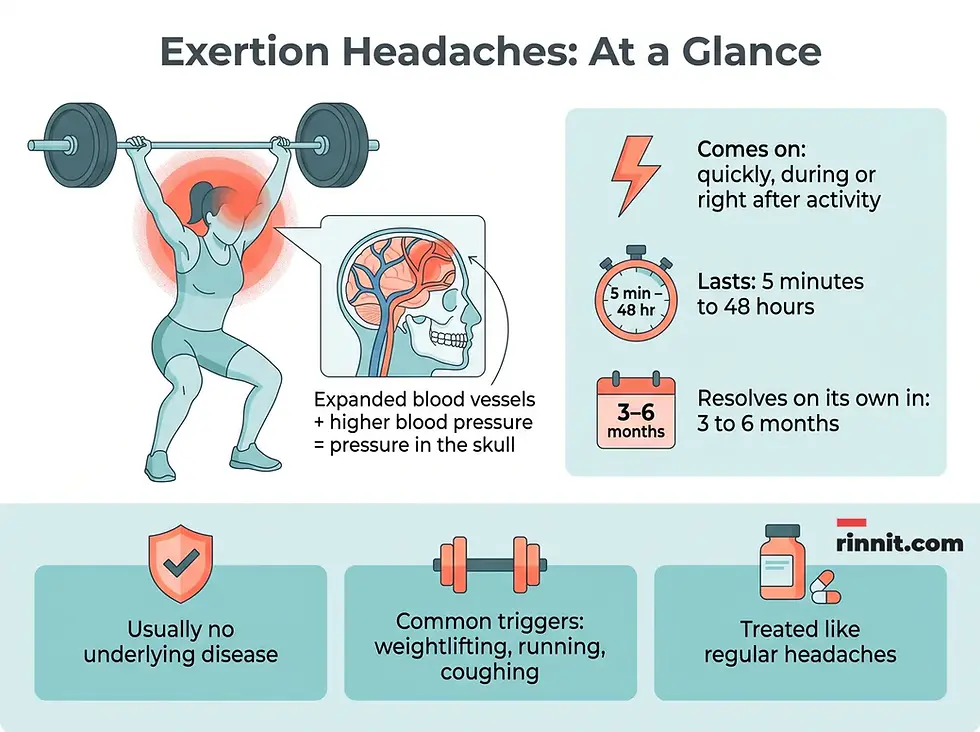
Exertion headaches, also called exercise or weightlifter's headaches, are headaches that occur during or right after physical activity such as weightlifting, running, coughing or sneezing [1]. They come on quickly and last from a few minutes up to 48 hours [1]. Most have no underlying disease, and episodes usually resolve on their own in three to six months [1].
What the research says
Exertion headache is uncommon in headache clinics but more common in the general population. A systematic review and meta-analysis of 12 studies found primary exercise headache in 0.46% (95% CI 0.18–1.20) of adults evaluated for headache in clinics versus 4.92% (95% CI 1.84–12.49) in population-based surveys. Onset was typically in the late 20s (mean 27.47 years), and the general population showed a female predominance (PubMed: Osiowski et al., Neuroepidemiology, 2026 [2]).
Headache linked to sexual activity — a related exertion-type headache — is also rare in clinics. A meta-analysis of 10 studies (40,702 people, 129 with the condition) found a prevalence of 0.37% (95% CI 0.17–0.81) among adults evaluated for headache, more often in men, with a mean age of onset of about 37 years; the authors describe it as an indomethacin-responsive, exercise-related headache disorder (PubMed: Osiowski et al., Headache, 2025 [3]).
What Is an Exertion Headache?
An exertion headache (also known as an exercise headache) involves pain during or immediately after physical activity [1]. It comes on quickly and goes away in a few minutes or hours, but can last as long as a couple of days [1]. There's usually no underlying disease or disorder [1]. Because exercise is a common culprit, exertion headaches are often called exercise headaches or weightlifter's headaches [1].
Key point | What it means |
Definition | Pain during or immediately after physical activity [1] |
Onset and duration | Comes on quickly; lasts a few minutes to a couple of days (max 48 hours) [1] |
Usual cause | None — usually no underlying disease or disorder [1] |
Pain mechanism | Expanded blood vessels and increased blood pressure create skull pressure [1] |
Pattern | Episodes repeat but usually resolve on their own in three to six months [1] |
Treatment | Similar to regular headaches: NSAIDs or beta-blockers [1] |
Symptoms of Exercise Headaches
Symptoms of an exercise-induced headache often include neck pain, pain on one or both sides of the head, and pulsating or throbbing [1]. Sometimes the headaches feel like migraines and involve effects on vision such as blind spots, nausea and vomiting, and sensitivity to light [1].
Symptom | What you might notice |
Neck pain | Pain or stiffness in the neck during or after exertion |
Head pain | On one or both sides of the head [1] |
Pulsating or throbbing | A rhythmic, pounding sensation [1] |
Migraine-like features (sometimes) | Blind spots or other vision effects, nausea and vomiting, sensitivity to light [1] |
What Causes an Exercise Headache?
When you exert yourself, your body needs more blood and oxygen [1]. Scientists believe an exertional headache occurs when an activity causes veins and arteries to expand to allow more blood flow [1]. That expansion and increased blood pressure create pressure in the skull, which causes the pain [1].
Activities that might trigger an exertion headache include coughing or sneezing, having sexual intercourse, running or doing aerobics, straining to go to the bathroom, and weightlifting [1].
Trigger activity | Example |
Coughing or sneezing [1] | Sudden pressure changes from a cough or sneeze |
Sexual intercourse [1] | Physical exertion during intimacy |
Running or aerobics [1] | Sustained cardio exercise |
Straining to go to the bathroom [1] | Bearing down during bowel movements |
Weightlifting [1] | Lifting heavy weights (hence "weightlifter's headaches") |

How Are Exertion Headaches Diagnosed?
Anyone who has severe or frequent headaches should seek medical attention [1]. Most exertional headaches aren't caused by an underlying disease or disorder [1]. But a healthcare provider may order some tests to rule out possible causes:
If tests don't find an underlying cause, the healthcare provider can diagnose exertion headaches if you have had at least two headaches that were caused by physical activity, started during or after physical activity, and lasted less than 48 hours [1].
Treatment for Exercise Headaches
Exertional headaches usually can be treated the same way as regular headaches [1]. Some medications that may help include prescription NSAIDs such as indomethacin for short-term use [1], beta-blockers such as nadolol and propranolol for longer-term use or for people who can't take NSAIDs [1], and over-the-counter NSAIDs such as naproxen, but only for short-term use [1].

Outlook: How Long Do They Last?
Headaches after exercise don't last long. Most are gone within a few minutes or hours, and they generally don't last longer than 48 hours [1]. Although the episodes repeat, they usually resolve on their own in three to six months [1].
Prevention: How to Avoid Exercise-Induced Headaches
The best way to prevent exercise-induced headaches is to avoid the activity that triggers them [1]. But if that's not realistic, you can try different strategies to lower the chances:
Prevention strategy | How it helps |
Avoid trigger activities | The most effective way to prevent exertion headaches [1] |
Avoid extreme temperatures | Too hot or too cold conditions can trigger headaches [1] |
Avoid unfamiliar altitudes | Don't work out at altitudes you're not used to [1] |
Hydration | Drink plenty of water to stay well-hydrated [1] |
Sleep | Get enough rest every day, including eight hours of sleep [1] |
Vary your routine | Try different activities and see if they trigger headaches [1] |
Warm up and cool down | Build intensity slowly over time [1] |
Protective gear and clothing | Sunglasses in bright light; moisture-wicking clothes in heat [1] |
Diet | Healthy eating; avoid processed foods and preservatives [1] |
Some studies suggest that certain supplements can help prevent exertional headaches [1]. Talk to your provider before starting any of them:
Supplement | Notes |
Coenzyme Q10 [1] | May help prevent exertional headaches (studies suggest) |
Feverfew [1] | May help prevent exertional headaches (studies suggest) |
Magnesium [1] | May help prevent exertional headaches (studies suggest) |
Riboflavin (vitamin B2) [1] | May help prevent exertional headaches (studies suggest) |
Boswellia | Natural anti-inflammatory; option if indomethacin is not well-tolerated [1] |
Living With Exertion Headaches: When to Seek Care
Although exertional headaches are generally not a sign of a problem, you should get emergency care right away for a sudden, severe headache, especially the first time it happens, and talk to a healthcare provider if your headache lasts longer than two days, is accompanied by sleepiness or confusion, or if you faint (syncope) [1].
Key Takeaways
Exertion headaches involve pain during or immediately after physical activity. They come on quickly and go away in a few minutes or hours, perhaps as long as a couple of days. There's usually no underlying disease or disorder, but you should talk to a healthcare provider to rule out any problems. Medications and other strategies can help you prevent and treat headaches, which usually stop happening after a few months.
Most exertion headaches are harmless and resolve on their own, but new, severe, or sudden headaches always deserve a medical check. See a healthcare provider to confirm the diagnosis and get a treatment plan — typically indomethacin, a beta-blocker, or a short course of NSAIDs. Then pair medication with hydration, proper warm-ups, and trigger avoidance to stay active comfortably.
Take the Next Step
If exercise keeps giving you a headache, see a healthcare provider to rule out other causes and build a plan. In the meantime, stay hydrated, warm up and cool down, and avoid extreme heat, cold, and unfamiliar altitudes.
Further reading: American Migraine Foundation — Primary Exercise Headache · American Migraine Foundation — Secondary Headaches · International Headache Society — ICHD-3 Primary Exercise Headache · National Headache Foundation — Exertional Headaches
Frequently Asked Questions
1. What is an exertion headache?
An exertion headache (also called an exercise headache or weightlifter's headache) involves pain during or immediately after physical activity. It comes on quickly and usually has no underlying disease or disorder.
2. What are the symptoms of an exertion headache?
Symptoms often include neck pain, pain on one or both sides of the head, and pulsating or throbbing. Some headaches feel like migraines, with vision effects such as blind spots, nausea and vomiting, and sensitivity to light.
3. What causes an exercise headache?
When you exert yourself, your body needs more blood and oxygen. Scientists believe activity causes veins and arteries to expand to allow more blood flow, and that expansion plus increased blood pressure creates pressure in the skull, which causes the pain.
4. What activities trigger exertion headaches?
Common triggers include weightlifting, running or doing aerobics, coughing or sneezing, straining to go to the bathroom, and sexual intercourse.
5. How long do exertion headaches last?
Most exercise headaches last five minutes to 48 hours. Episodes repeat but usually resolve on their own within three to six months.
6. How are exertion headaches diagnosed?
A provider may order angiography (CTA or MRA), MRI, or a spinal tap to rule out underlying causes. A diagnosis of exertion headaches requires at least two headaches that were caused by physical activity, started during or after the activity, and lasted less than 48 hours.
7. How is an exertion headache treated?
An exertion headache is usually treated like a regular headache. Prescription NSAIDs such as indomethacin work for short-term use; beta-blockers such as nadolol and propranolol suit longer-term use or people who can't take NSAIDs; over-the-counter NSAIDs such as naproxen are for short-term use only.
8. How can I prevent an exercise-induced headache?
The best prevention is avoiding the trigger activity. Other strategies include avoiding extreme temperatures and unfamiliar altitudes, staying hydrated, getting about eight hours of sleep, varying your routine, warming up and cooling down, wearing sunglasses and moisture-wicking clothes, and eating a healthy diet.
9. Can supplements help prevent exertion headaches?
Some studies suggest coenzyme Q10, feverfew, magnesium, riboflavin (vitamin B2), and boswellia may help prevent exertional headaches. Boswellia is a natural anti-inflammatory option if indomethacin is not well-tolerated.
10. When should I see a doctor about an exertion headache?
Get emergency care for a sudden, severe headache. Talk to a healthcare provider if your headache lasts longer than two days, comes with sleepiness or confusion, or if you faint (syncope). Anyone with severe or frequent headaches should seek medical attention.
Related Reading
References
Cleveland Clinic. Exertion Headaches. Cleveland Clinic. Last updated Oct. 12, 2021. https://my.clevelandclinic.org/health/diseases/21959-exertion-headaches
Osiowski A, Wróbel D, Majka K, et al. Epidemiology of primary exercise headache: a systematic review and meta-analysis with comparison between clinic- and population-based settings. Neuroepidemiology. 2026:1-9. doi:10.1159/000549397. PMID: 41915607.
Osiowski A, Wróbel D, Osiowski M, Taterra D. Epidemiology of primary headache associated with sexual activity: a meta-analysis with diagnostic and management considerations. Headache. 2025;65(10):1850-1859. doi:10.1111/head.15049. PMID: 40864524.
Medical Disclaimer
This article is for informational purposes only and does not constitute medical advice. Always seek the advice of your physician or other qualified health provider with any questions you may have regarding a medical condition. Never disregard professional medical advice or delay in seeking it because of something you have read here.



Comments