Altered Mental Status (AMS): Sudden Confusion Is a Medical Emergency — What Causes It and What to Do

Updated: 2 days ago
Medically reviewed by Dr. Baraa Alnahhal, MD · Last reviewed: September 2026
Editorial note: This article is for general education only. It is not medical advice, a diagnosis, or a treatment plan. Altered mental status is frequently a medical emergency — call your local emergency number (e.g., 911) if you or a loved one develops sudden confusion or unresponsiveness. Always consult a qualified healthcare professional for personal medical decisions.
TL;DR
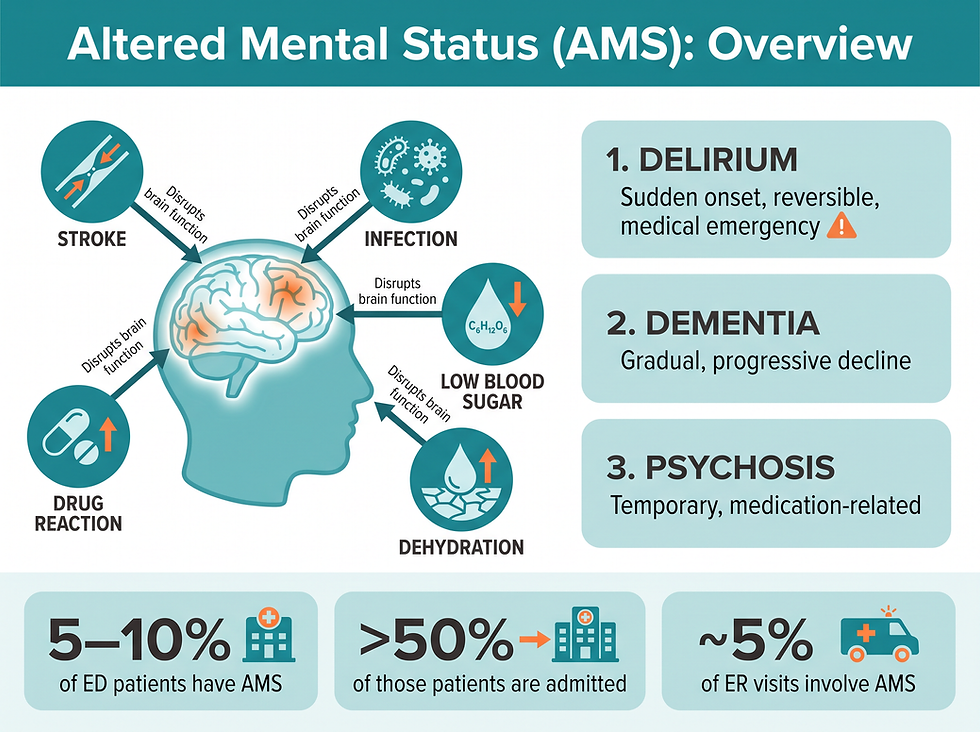
Altered mental status (AMS) is not a disease itself — it is a change in awareness, thinking, and behavior caused by illnesses, injuries, or disorders that affect the brain. It appears in three forms: sudden delirium (a reversible medical emergency), progressive dementia, and medication-related psychosis. Roughly 5–10% of emergency department patients have AMS, and it can stem from almost any organ system — stroke, infection, low blood sugar, drug reactions, or dehydration. Many causes are treatable with full recovery, but AMS can also be life-threatening, so seek emergency care immediately.
Quick Answer: What Is Altered Mental Status?
An altered mental status is a change in mental function caused by illnesses, disorders, and injuries that affect the brain, leading to changes in awareness, movement, and behavior. It includes sudden, reversible delirium; progressive dementia; and medication-related psychosis. Many causes — like infections or low blood sugar — are treatable and don't affect long-term well-being, but sudden AMS is a medical emergency that needs immediate care.
What Is Altered Mental Status?
Altered mental status is not a specific disease. It is a change in mental function that stems from illnesses, disorders, and injuries affecting your brain. The change leads to shifts in awareness, movement, and behaviors.
Think of AMS as a warning light on a dashboard. The light itself is not the problem — it tells you something is wrong under the hood. In AMS, that "something" can involve the brain directly or almost any other organ system whose failure disrupts how the brain works.
Some causes are temporary and fully reversible. Others signal a serious underlying illness. Because it is impossible to tell the difference without medical evaluation, sudden AMS always requires emergency care.
How Common Is Altered Mental Status?
AMS is one of the most common reasons people go to the emergency department. Approximately 5% of emergency department patients arrive with altered mental status as a complaint. Neurology estimates put the figure at 5% to 10% of ED patients, with significantly higher rates among older adults — and over half of these patients are admitted to the hospital.
All ED patients (AMS complaint): ~5% of visits
All ED patients (delirium rate): 5–10%; higher in elderly; >50% admitted
Older ED patients: 8–10% have delirium
ED patients overall: 7–20%, with 57–83% missed at first
Hospitalized older adults: ~28.8% develop delirium
ICU patients: ~25% develop delirium
The complication rate is sobering. Delirium in older adults is an independent predictor of higher mortality — hazard ratios of 1.18 to 3.77 for 12-month mortality after discharge — and patients with delirium face significantly higher in-hospital, 7-day, and 30-day death rates. In one study of hospitalized older adults, 90-day cumulative mortality was 54% with delirium versus 15% without.
These numbers are not meant to frighten — most AMS episodes are caused by treatable conditions. But they explain why providers take sudden confusion so seriously.
What Are the Types of Altered Mental Status?
Providers group AMS into three types. The distinction matters because two types are emergencies and one is a chronic condition:
Delirium: Starts suddenly (hours to days), usually temporary and reversible — disorientation, distraction, unusual behaviors; a medical emergency
Dementia: Starts gradually (months to years), progressive and chronic — declining mental function affecting daily life; mainly older adults
Psychosis (medication/condition-related): Varies in onset, usually temporary — loss of touch with reality; disturbing thoughts; false sights and sounds
What Causes Altered Mental Status?
In people with dementia, progressive mental decline is the natural course of the disease. But sudden AMS — delirium and psychosis — can stem from issues with nearly any organ system. Because the list is so long, doctors treat AMS as a signal to search the whole body.
Central nervous system: Brain bleed (hemorrhage); brain tumor; hepatic encephalopathy; obstructive hydrocephalus; seizure; stroke
Metabolic disorders: Dehydration; hypothermia; low blood oxygen; low blood sugar; low sodium; low calcium; underactive thyroid
Drug reactions: Antiseizure medications; anticholinergics; corticosteroids; sedatives; sleeping pills
Infections: Urinary tract infections; encephalitis; meningitis; pneumonia
Other: Cardiogenic and other shock; opioid, alcohol, or substance overdose or withdrawal; traumatic brain injury
A few practical patterns are worth knowing. Low blood sugar can mimic drunkenness and rapidly cause confusion, sweating, and unresponsiveness. In older adults, even a simple urinary tract infection can trigger sudden delirium. Medication side effects — especially sedatives, sleeping pills, and anticholinergics — are among the most reversible causes. And withdrawal from alcohol or opioids is a classic and dangerous trigger.
What Are the Signs and Symptoms?
AMS symptoms span three broad groups: thinking and awareness, mood, and physical signs. A person may show symptoms from one group or all three.
Awareness and thinking: Confusion; disorientation; amnesia; hallucinations; delusions; incoherent speech; slow responses; coma
Mood: Agitation; anxiety; depression; emotional outbursts; euphoria; social withdrawal
Physical: Fatigue; hyperactivity; shortness of breath

When Is Altered Mental Status an Emergency?
Because AMS can signal stroke, brain bleeding, severe infection, or overdose, any sudden change in mental status is an emergency until a doctor proves otherwise. Call your local emergency number (e.g., 911) if a person has any of the following:
Sudden confusion or disorientation: Could be stroke, bleed, or infection
Unresponsiveness or coma: Brain is failing to maintain consciousness
One-sided weakness or paralysis: Possible stroke — time-critical
Seizure, especially new or prolonged: Direct brain disturbance
High fever with confusion: Possible meningitis or encephalitis
Recent overdose or withdrawal: Reversible with immediate treatment
New confusion in an older adult: Delirium is common and often serious
How Is Altered Mental Status Diagnosed?
Diagnosing AMS involves a thorough evaluation to find the cause. In many cases, this takes place in a hospital emergency department.
The first five minutes: ABCDE
A — Airway: Ensuring the airway is open
B — Breathing: Listening to the lungs with a stethoscope
C — Circulation: Pulse, blood pressure, and heart rhythm
D — Neurological deficits: Level of consciousness; screening for injury such as one-sided paralysis
E — Exposure: Head-to-toe exam for injury signs and transdermal medicated patches
Tests to pinpoint the cause
Blood tests: Infection, electrolytes, organ function
Blood sugar test: Hypoglycemia — a fast, fixable cause
CT scan: Bleeding, tumors, hydrocephalus
Chest X-ray: Pneumonia
EKG: Heart rhythm problems
EEG: Seizure activity in brain waves
Urinalysis: Urinary tract infection — common in older adults
How Is Altered Mental Status Treated?
Treatment depends entirely on the medical or neurological cause and the type of AMS. Each cause has its own targeted fix:
Infection: Antibiotics
Drug reaction: Change of medications
Low blood sugar: Glucagon injection
Dehydration: Intravenous fluids
Narcotic overdose: Naloxone
Seizures: Rescue medications
Agitation or psychosis: Anxiolytics or antipsychotics
Brain hemorrhage or pressure: Surgery to repair or relieve pressure
Low blood oxygen: Supplemental oxygen
The good news is that this targeted approach works: for AMS due to delirium or psychosis, the outlook is good, and symptoms typically fade once treatment begins. For AMS due to dementia, treatments can stabilize life-threatening issues, but the mental decline will continue to progress.
Can Altered Mental Status Be Prevented?
Some causes — like dementia — cannot be prevented. Others may be avoidable. You can lower your risk by:
Follow chronic-care instructions: Epilepsy, diabetes, and thyroid disease management
Take medications correctly: Right dose, right time
Avoid nonmedical substance use: Overdose and withdrawal both trigger AMS
For people with diabetes, this means regular glucose monitoring — AMS due to hypoglycemia may require more frequent checks to keep blood sugar in a healthy range.
What Is Living With Altered Mental Status Like?
For delirium or psychosis, once treatment is received, life will likely return to normal after a short recovery. However, AMS can happen again in the future, so following care recommendations is essential.
The underlying cause shapes the long-term plan. Someone whose AMS came from a UTI or a medication reaction faces a very different future than someone with a bleeding brain tumor. Follow-up care typically includes managing chronic conditions, reviewing medications with a pharmacist or physician, and knowing the early warning signs that something is wrong again.
Key Takeaways
Altered mental status is a change in mental function — not a disease — caused by illnesses, injuries, and disorders that affect the brain. It arrives in three forms: sudden delirium (a reversible emergency), progressive dementia, and usually temporary, medication-related psychosis. It accounts for roughly 5–10% of emergency department visits, and over half of those patients are admitted. Causes span nearly every organ system — stroke, seizures, infections like UTIs and pneumonia, low blood sugar, dehydration, drug reactions, and overdose — which is why diagnosis involves an ABCDE assessment plus blood tests, imaging, and heart and brain studies. Treatment targets the cause: antibiotics, glucagon, naloxone, IV fluids, oxygen, surgery, or medication changes. The outlook for delirium and psychosis is good once treated, but AMS can quickly become life-threatening, making immediate emergency care essential whenever confusion, unresponsiveness, or hallucinations appear suddenly.
If a loved one suddenly becomes confused, disoriented, or hard to rouse, call 911 — do not wait to see if it passes. Fast treatment of the underlying cause is what makes AMS reversible.

Frequently Asked Questions
1. Can altered mental status be reversed?
Yes — when it is caused by delirium or psychosis, the outlook is good and symptoms typically fade away once the underlying cause is treated. AMS caused by dementia is not reversible, but its dangerous complications can be stabilized.
2. Is altered mental status the same as dementia?
No. Dementia is one of three types of AMS — a progressive, chronic decline mainly affecting older adults. AMS also includes sudden delirium (reversible and emergent) and medication-related psychosis (usually temporary).
3. Can altered mental status be caused by something as simple as a UTI?
Yes. Urinary tract infections are a listed cause of AMS, particularly in older adults — alongside pneumonia, meningitis, and encephalitis. In older ED patients, delirium is common and is initially missed in 57–83% of cases, which is why families should advocate for an infection workup.
4. How quickly does AMS develop?
Delirium develops suddenly — over hours to days — and is a medical emergency. Dementia develops gradually over months or years. Psychosis due to a condition or medication is usually temporary.
5. What are the first warning signs of AMS?
Sudden confusion, disorientation, forgetfulness, hallucinations, delusions, incoherent speech, slow responses, agitation, emotional outbursts, and unusual behavior. Physical signs can include fatigue, hyperactivity, and shortness of breath.
6. Can medications cause altered mental status?
Yes. Antiseizure drugs, anticholinergics, corticosteroids, sedatives, and sleeping pills are all listed causes. If AMS appears after a new medication or dose change, providers may change the medications as the treatment.
7. How is AMS diagnosed in the ER?
Providers start with an ABCDE exam — airway, breathing, circulation, neurological deficits, and full-body exposure — then order blood tests, blood sugar checks, CT scans, chest X-rays, EKGs, EEGs, and urinalysis to find the cause.
8. Can low blood sugar cause confusion?
Yes. Hypoglycemia is a listed metabolic cause of AMS and is treated immediately with a glucagon injection if confirmed. This is why people with diabetes are advised to monitor glucose regularly.
References
Cleveland Clinic. "Altered Mental Status (AMS)." Medically reviewed; last updated 06/02/2022.
StatPearls/NIH NCBI. "Altered Mental Status."
UpToDate. "Evaluation of Abnormal Behavior in the Emergency Department."
Nursing CE Central. "ER Review: Altered Mental Status (AMS)."
ScienceDirect. "Clinical Decision Rule for ED Altered Mental Status Outcomes."
Continuum: American Academy of Neurology. "Altered Mental Status."
NIH PMC. "Evaluation and Treatment of AMS Patients in the ED."
Vasilevskis et al. (2012). "Epidemiology and Risk Factors for Delirium Across Hospital Settings."
Chen et al. (2022). "Delirium Prevalence in Geriatric Emergency Department Patients."
JAMA Internal Medicine. "Delirium Predicts 12-Month Mortality."
Comments