Eruption Cyst: What This Fluid-Filled Gum Lump Means, When It Goes Away, and When It Needs a Quick Procedure

Updated: 3 days ago
Medically reviewed by Dr. Baraa Alnahhal, MD · Last reviewed: October 2026
Quick Answer
An eruption cyst, also called an eruption hematoma [3] [4], is a fluid-filled sac over a tooth about to break through the gums, appearing as a bluish or clear lump [4]. It is usually painless and harmless and typically pops on its own as the tooth comes in [4]. If it lasts over two weeks, bleeds or causes pain, see a dentist [3] [4].
What the research says
The evidence on eruption cysts comes mostly from case reports and small series. A literature review plus four case reports described eruption cysts associated with permanent teeth in four patients — three in the upper jaw and one in the lower jaw; surgical treatment was done in three, and in one the cyst disappeared gradually and the tooth erupted in a normal pattern (PubMed: Nagaveni et al., Indian J Dent Res, 2011 [1]).
Watchful monitoring worked in a newborn. In a case report of a congenital eruption cyst, the lesion was monitored clinically and with X-rays without any surgery; by the fourth month it had completely regressed and the baby's deciduous central incisors had erupted without problems (PubMed: de Oliveira et al., Int J Clin Pediatr Dent, 2018 [2]).
Surgical exposure is kept for cysts that cause problems. A case report notes that an eruption cyst forms shortly before a primary or permanent tooth erupts, is usually found in children, and in some cases disappears on its own; if pain, bleeding, or infection develop, surgical exposure and drainage are necessary — in that case, the crown of an erupting permanent tooth was exposed with a diode laser (PubMed: Bansal et al., Int J Clin Pediatr Dent, 2022 [3]).
What Is an Eruption Cyst?
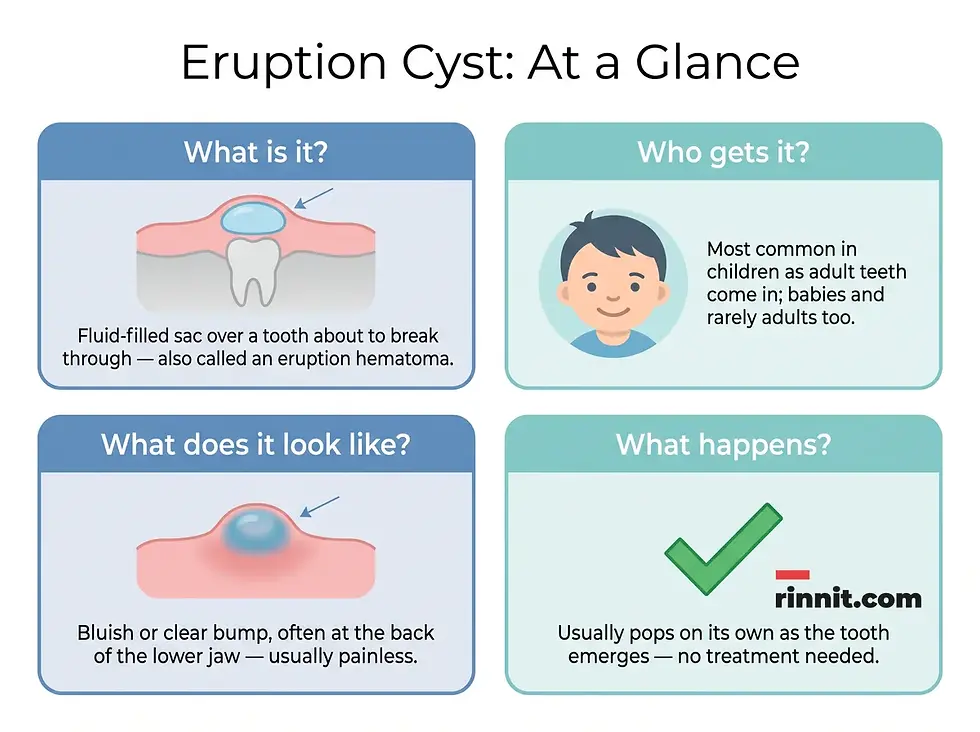
An eruption cyst is a discolored, fluid-filled lump that shows up on the gums just before a new tooth comes in [4]. It forms a fluid-filled sac over the emerging tooth [4]. While it may look unusual, it is not harmful. In fact, it is a pretty normal part of tooth development [4].
Eruption cysts are most common during childhood, when baby teeth fall out and make room for permanent adult teeth [3] [4]. But they are possible at any age. Babies can develop them before their first teeth grow in [2] [4]. Adults can get them too, though this is rare [4].
The good news is that eruption cysts usually do not require treatment. They tend to go away on their own [3] [4]. If symptoms such as pain or infection develop, a simple procedure may help [3] [4].
Symptoms: What Does an Eruption Cyst Look Like?
An eruption cyst looks like a bluish or clear bump on the gums [4]. It appears in the exact area where a new tooth is about to come in [4]. Eruption cysts are most common toward the back of the lower jaw [4].
They are often painless [4]. The bump itself may be the only sign you notice.

Causes: How Does an Eruption Cyst Form?
An eruption cyst forms when fluid gets trapped between an emerging tooth and its protective sac, called the dental follicle [4]. Experts are not sure exactly why it happens, but they think it could have something to do with minor trauma or inflammation during tooth development [4].
Complications: What Problems Can an Eruption Cyst Cause?
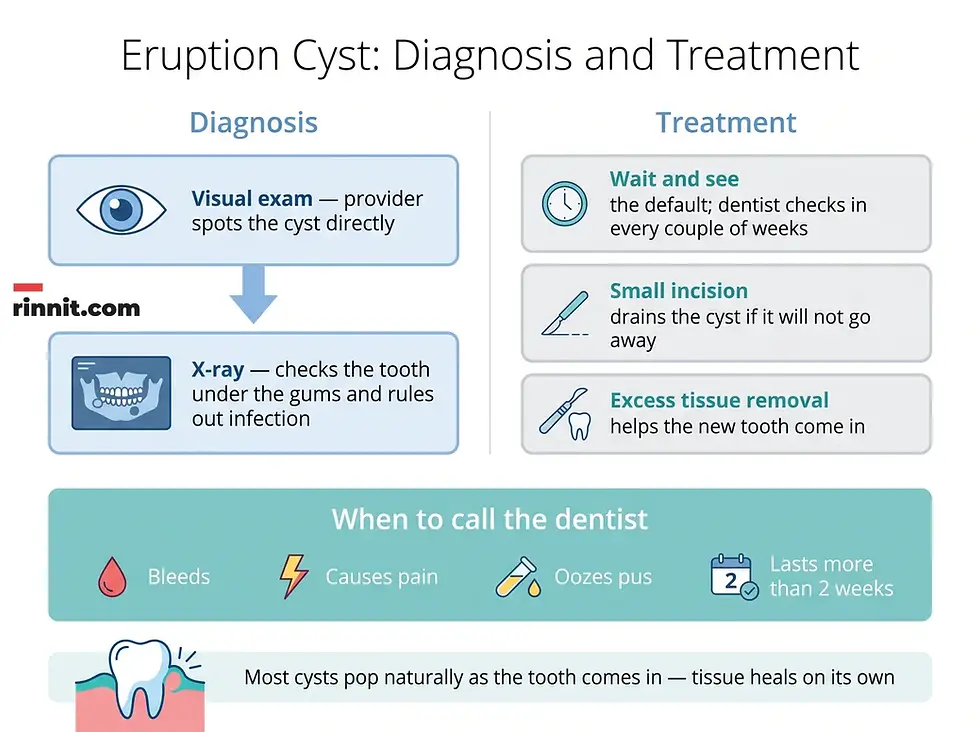
If an eruption cyst lasts longer than two weeks, it is best to tell your dentist [4].
Diagnosis: How Is an Eruption Cyst Diagnosed?
A healthcare provider can spot an eruption cyst during a simple visual exam [4]. They may take an X-ray to make sure the tooth under the gums looks healthy [4]. X-rays can also help rule out infection [4].
Treatment: How Are Eruption Cysts Treated?
Eruption cysts usually do not require treatment [4]. Most care involves a "wait and see" approach. Your child's dentist may check in every couple of weeks until the new tooth emerges [4].
If your child has an eruption cyst that will not go away, a dentist might make a small incision (cut) in the area [3] [4]. They may also remove excess tissue to help coax the new tooth to come in [4].
Outlook: What Can I Expect?
While an eruption cyst can look a bit unusual, it is typically not harmful [4]. If you think your child has one, it is a good idea to tell their dentist. They may want to check in periodically to make sure the cyst does not cause infection or other issues.
When your child's new tooth starts its final journey through the gums, the eruption cyst will naturally pop (rupture) [4]. As the tooth grows in, the tissue around it will heal [4].
If your child has an eruption cyst that lasts longer than a month, your dentist may recommend minor surgery [4]. This can help drain the cyst and encourage the new tooth to emerge [4].
Words like "lump" and "cyst" can sound like alarm bells. But eruption cysts are a common part of tooth development. They are not harmful unless they get infected or cause pain [3] [4]. Chances are, you can let nature run its course.
Timeline | What happens |
Cyst appears | Bluish or clear bump over the erupting tooth [4] |
Watch and wait | Dentist checks in every couple of weeks [4] |
Tooth emerges | The cyst naturally pops and the tissue heals [4] |
Over 2 weeks | Tell your dentist — it may need attention [4] |
Over 1 month | Minor surgery may be recommended to drain it [4] |
When Should You Call the Dentist?
Tell your healthcare provider if an eruption cyst:
Prevention: Can Eruption Cysts Be Prevented?
Because experts do not know the exact cause — only that fluid gets trapped between an emerging tooth and its dental follicle [4], possibly linked to minor trauma or inflammation — there is no known way to prevent eruption cysts. The best protection is a regular routine of telling your dentist about any gum lumps and keeping scheduled dental check-ins so a persistent cyst gets attention early.
Questions to Ask Your Child's Dentist
Question | Why it matters |
Is this an eruption cyst? | Confirms the diagnosis visually |
Should we take an X-ray? | Checks the tooth underneath and rules out infection [4] |
How often should we check in? | Sets the wait-and-see schedule |
What signs should make me call? | Bleeding, pus, pain, or lasting more than two weeks [4] |
What if it lasts a month? | Minor surgery to drain it and help the tooth emerge [4] |
Conclusion: Don't Let the Word "Cyst" Alarm You
An eruption cyst is a bluish or clear bump that looks unusual but is a normal part of tooth development in children. It forms when fluid gets trapped between an emerging tooth and its protective dental follicle, most often on the back of the lower jaw [4]. Most of the time, no treatment is needed — the cyst pops on its own as the new tooth breaks through, and the gum heals [4].
Keep a "wait and see" routine with your dentist, checking in every couple of weeks. Call sooner if the cyst bleeds, causes pain, oozes pus, or lasts longer than two weeks [4]. A cyst that persists past a month can be resolved with minor surgery [4] — a quick, simple procedure.
Take the Next Step
If you or your child has a gum lump that won't go away, schedule a dental visit today. A quick exam — and sometimes a quick procedure — is all it takes to keep a new tooth on track.
Related on Rinnit: Dental Injuries (Dental Trauma): Types, First Aid, and Treatment Options · Understanding Your Gums: Anatomy, Function, and Proactive Care
Further reading: Cleveland Clinic — Eruption Cyst
Frequently Asked Questions
1. What is an eruption cyst?
An eruption cyst is a fluid-filled sac that forms over a tooth that is about to break through the gums. It appears as a bluish or clear bump on the gums, most often on the back of a child's lower jaw. It is also called an eruption hematoma and is usually harmless.
2. What causes an eruption cyst?
An eruption cyst forms when fluid gets trapped between an emerging tooth and its protective sac, called the dental follicle. Experts are not sure exactly why it happens, but it may be related to minor trauma or inflammation during tooth development.
3. Are eruption cysts common in children?
Yes. Eruption cysts are most common during childhood, when baby teeth fall out and permanent adult teeth come in. Babies can get them before their first teeth grow in, and adults can get them too, though that is rare.
4. What does an eruption cyst look like?
An eruption cyst looks like a bluish or clear bump on the gums. It appears in the area where a new tooth is about to come in. It is most common toward the back of the lower jaw and is often painless — the bump itself may be the only sign.
5. Do eruption cysts go away on their own?
Yes, usually. When the new tooth starts its final journey through the gums, the eruption cyst naturally pops (ruptures). As the tooth grows in, the tissue around it heals.
6. Do eruption cysts need treatment?
Most do not. The default is a "wait and see" approach, with the dentist checking in every couple of weeks until the new tooth emerges. Treatment is only considered if the cyst causes symptoms or will not go away.
7. How is an eruption cyst diagnosed?
A healthcare provider can spot an eruption cyst during a visual exam of the gums. They may take an X-ray to make sure the tooth under the gums looks healthy and to help rule out infection.
8. How is an eruption cyst treated if it won't go away?
A dentist may make a small incision (cut) in the area to drain it. They may also remove excess tissue to help coax the new tooth to come in. If the cyst lasts longer than a month, minor surgery may be recommended.
9. When should I call the dentist about an eruption cyst?
Tell your dentist if the cyst bleeds, causes pain, oozes pus (a sign of infection), or lasts longer than two weeks.
10. Are eruption cysts harmful?
No, they are typically not harmful. They are a common part of tooth development and are only a concern if they get infected or cause pain. Words like "lump" and "cyst" can sound alarming, but nature usually runs its course.
References
Nagaveni NB, Umashankara KV, Radhika NB, Maj Satisha TS. Eruption cyst: a literature review and four case reports. Indian J Dent Res. 2011;22(1):148-151. doi:10.4103/0970-9290.79982. PMID: 21525694.
de Oliveira AJ, Silveira MLG, Duarte DA, Diniz MB. Eruption cyst in the neonate. Int J Clin Pediatr Dent. 2018;11(1):58-60. doi:10.5005/jp-journals-10005-1485. PMID: 29805237.
Bansal MB, Kumari A, Asrani KH, Yadav A. Eruption cyst treated with diode laser: a case report. Int J Clin Pediatr Dent. 2022;15(2):215-217. doi:10.5005/jp-journals-10005-2357. PMID: 37457208.
Cleveland Clinic. Eruption cyst. Cleveland Clinic Health Library. Medically reviewed; last updated July 10, 2025. https://my.clevelandclinic.org/health/diseases/eruption-cyst
Medical Disclaimer
This article is for informational purposes only and does not constitute medical advice. Always seek the advice of your physician or other qualified health provider with any questions you may have regarding a medical condition. Never disregard professional medical advice or delay in seeking it because of something you have read here.



Comments