Embryonal Tumor: Symptoms, Causes, and Treatment

Updated: 2 days ago
Medically reviewed by Dr. Baraa Alnahhal, MD · Last reviewed: October 2026

Quick answer
An embryonal tumor is a malignant brain tumor that forms from cells left over from fetal development, most commonly medulloblastoma in the cerebellum. [1] [3] It most often affects babies and young children, and cancer cells can spread through the cerebrospinal fluid. [1] [3] Treatment is usually surgery first, followed by radiation therapy and sometimes chemotherapy to reduce the chance of recurrence. [2] [3]
What the research says
According to PubMed:
Standard-risk medulloblastoma has good but not perfect survival. A systematic review and meta-analysis of 16 studies (2,002 patients aged 3 to 21 years with standard-risk medulloblastoma treated with craniospinal radiotherapy) found pooled 5-year progression-free survival of 76.9% and overall survival of 83.8%, with survival practically unchanged over the past 30 years. (Edvardsson et al., Radiother Oncol, 2025, DOI) [6]
Proton beam radiation matched photon radiation for survival with fewer long-term effects. A meta-analysis of 10 cohort studies (1,034 children; no randomized trials) found no difference in overall survival between proton and photon craniospinal radiotherapy (RR 0.984, 95% CI 0.902 to 1.073), while proton therapy reduced growth hormone deficiency (RR 0.379), hypothyroidism (RR 0.256), and neurocognitive decline. (Viani et al., Radiother Oncol, 2026, DOI) [7]
High-risk disease has lower survival. In a meta-analysis of 18 articles on postoperative radiotherapy for pediatric medulloblastoma, 5-year overall survival in high-risk cases was 68.6% (95% CI 56.1 to 78.3%), versus about 82% to 83% in standard-risk cases, with no significant difference in survival between proton and photon radiation. (Li et al., Cancers, 2025, DOI) [8]
Study details are from PubMed abstracts.
What is an embryonal tumor?
Embryonal tumors are growths of cells that happen in the brain. The growths involve cells that are left over from fetal development, called embryonal cells. [1] [3]
An embryonal tumor is a type of brain cancer, also called a malignant brain tumor. This means the cells that make up the tumor can grow to invade the brain and cause damage to healthy brain tissue. They also can spread through the fluid that surrounds the brain and spinal cord, called cerebrospinal fluid. [1] [3]
There are several kinds of embryonal tumors. The most common is medulloblastoma. This type starts in the lower back part of the brain, called the cerebellum. [1] [3] [4]
Key facts at a glance
Question | Answer |
What it is | A malignant brain tumor growing from cells left over from fetal development |
Most common type | Medulloblastoma, which starts in the cerebellum |
Who it affects | Most often babies and young children, but it can happen at any age |
Is it cancer | Yes. It is a malignant brain tumor that can invade brain tissue |
Can it spread | Yes, through the cerebrospinal fluid to other parts of the brain and spinal cord |
Cause | Often not known; DNA changes in embryonal cells drive the growth |
If a child is diagnosed with an embryonal tumor, seek care at a medical center that has experience caring for children with brain tumors. Centers with expertise in pediatric brain tumors provide access to the latest treatments and technology to ensure proper diagnosis and treatment. [1]
Embryonal tumor symptoms
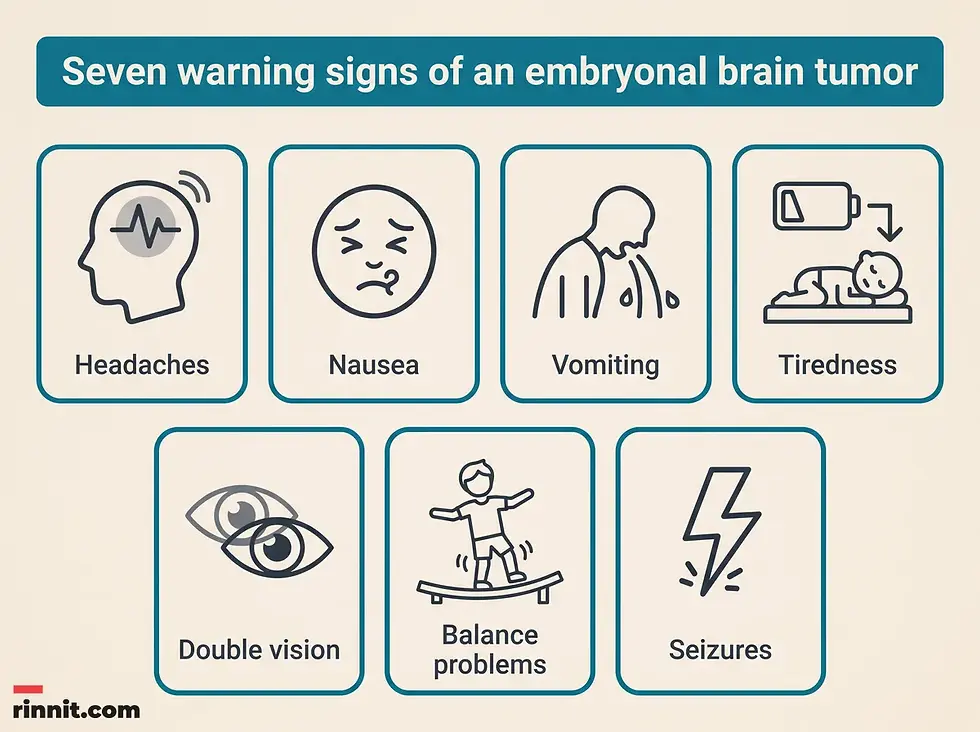
Symptoms of an embryonal tumor may include:
When to see a doctor
Make an appointment with a doctor or other healthcare professional if a child has any symptoms that worry them. [1] [2]
These symptoms are not unique to embryonal tumors, and most children with headaches or nausea will not have a brain tumor. But a new pattern of these symptoms, especially headaches with vomiting, double vision, or balance problems, is a reason to be seen and checked.
What causes an embryonal tumor?
These tumors form when embryonal cells (cells left over from fetal development) develop changes in their DNA. A cell's DNA holds the instructions that tell the cell what to do. In healthy cells, the DNA gives instructions to grow and multiply at a set rate and tells the cells to die at a set time. [1]
In cancer cells, the DNA changes give different instructions. The changes tell the cancer cells to grow and multiply quickly, and the cells can keep living when healthy cells would die. This causes too many cells. [1]
The cancer cells might form a mass called a tumor. The tumor can grow and press on parts of the brain. The cancer cells also can travel in the fluid that supports the brain and spine. This can spread the cancer to other parts of the brain and spinal cord. When cancer spreads, it is called metastatic cancer. [1]
Risk factors
Two factors raise the risk of an embryonal tumor:
Risk factor | What it means |
Young age | This cancer can happen at any age, but it happens most often in children |
Hereditary syndromes | Some conditions that run in families can raise the risk of embryonal tumor |
Hereditary syndrome | Notes |
Fanconi anemia | A rare condition that runs in families |
Li-Fraumeni syndrome | An inherited condition linked to several cancer types |
Nevoid basal cell carcinoma syndrome | A condition that runs in families |
Rubinstein-Taybi syndrome | An inherited condition |
Turcot syndrome | An inherited condition linked to brain tumors |
How embryonal tumors are diagnosed
The healthcare team reviews the child's medical history and symptoms. Tests and procedures used to diagnose embryonal tumors include: [2]
Test or procedure | What it does |
Neurological exam | Tests vision, hearing, balance, strength, coordination, and reflexes; helps find out which part of the brain might be affected |
Imaging tests | CT and MRI make pictures of the brain that show the size and location of the tumor, plus pressure or blockages of fluid; advanced techniques such as perfusion MRI and magnetic resonance spectroscopy also may be used |
Biopsy | Removes a sample of tumor tissue for lab testing to determine the types of cells; often taken during tumor-removal surgery, or before surgery if imaging shows atypical features |
Spinal tap (lumbar puncture) | A needle between two bones in the lower spine draws out cerebrospinal fluid, which is tested for tumor cells; done only after managing brain pressure or removing the tumor |
Embryonal tumor treatment
Treatment for embryonal tumors usually involves surgery. Other treatments might be used after surgery to reduce the risk that the tumor may come back. Which treatments are best depends on the child's age, the type of embryonal tumor, and its location. [2] [3]
Treatment option | What it involves |
Surgery to relieve fluid buildup | Some tumors block the flow of fluid in the brain, causing a buildup called hydrocephalus that puts pressure on the brain; a neurosurgeon can create a pathway for the fluid to flow out, sometimes combined with tumor-removal surgery |
Surgery to remove the tumor | A brain surgeon removes as much of the tumor as possible while protecting nearby tissue; additional treatments usually follow to target remaining cancer cells |
Radiation therapy | Powerful energy beams kill tumor cells; standard radiation uses X-rays, while newer proton beam radiation can be carefully targeted to the tumor area to lower the risk of hurting nearby healthy tissue; available at a limited number of centers in the United States |
Chemotherapy | Strong medicines kill tumor cells; many are given through a vein and some come in pill form; given after surgery or radiation, sometimes at the same time as radiation |
Clinical trials | Studies of new treatments that give a child a chance to try the latest options, though side-effect risks may not be fully known |

Preparing for your child's appointment
If a health professional thinks a child may have an embryonal tumor, they may refer the family to a specialist. Often this is a doctor who specializes in cancer that affects children, called a pediatric oncologist. [2]
Appointments can be short, and being prepared can help. When making the appointment, ask if anything is needed in advance, such as fasting before a test. Then bring a list of:
The child's symptoms, including any that seem unrelated to the reason for the appointment
Key personal information, including recent life changes and family medical history
All medicines, vitamins, or other supplements the child takes, including doses
Questions to ask the healthcare professional [2]
Some basic questions to ask include: Does my child have cancer? Does my child need more tests? What are the treatment options, and what are their potential risks? Do any of the treatments cure the cancer? Can I have a copy of the pathology report? How much time do we have to consider the options? Are there brochures, printed materials, or recommended websites to take home? [2]
The healthcare professional is likely to ask several questions too, such as when the symptoms began, whether they are continuous or occasional, how severe they are, and what seems to improve or worsen them. [2]
Conclusion and next steps
Embryonal tumors are a serious form of pediatric brain cancer that form from cells left over from fetal development, with medulloblastoma being the most common type. The warning signs (headaches, nausea, vomiting, unusual tiredness, double vision, balance problems, and seizures) can look like ordinary childhood illnesses, which is why persistent or worsening symptoms deserve a prompt medical check.
If your child has been diagnosed or you are preparing for an appointment, the most important step is to seek care at a medical center with experience in pediatric brain tumors. Treatment almost always starts with surgery to relieve pressure and remove the tumor, followed by radiation and sometimes chemotherapy to reduce the chance of the tumor returning.
Take action: If a child has persistent headaches with vomiting, double vision, balance problems, or seizures, see a healthcare professional promptly, and seek care at a center experienced with pediatric brain tumors if a diagnosis is made.
Frequently asked questions
What is the difference between an embryonal tumor and a brain tumor?
An embryonal tumor is a specific type of brain tumor. Like other brain tumors, it grows in the brain, but it is always malignant (cancerous) and forms from embryonal cells, which are cells left over from fetal development.
Is an embryonal tumor cancer?
Yes. An embryonal tumor is a malignant brain tumor. The cancer cells can invade brain tissue, press on parts of the brain, and spread through the cerebrospinal fluid to other parts of the brain and spinal cord. [1]
What is the most common embryonal brain tumor?
Medulloblastoma is the most common type. It starts in the cerebellum, the lower back part of the brain. [1] [3]
Can an embryonal tumor spread to the spinal cord?
Yes. The cancer cells can travel in the cerebrospinal fluid that surrounds the brain and spine, spreading to other parts of the brain and spinal cord. This is called metastatic cancer. [1] [3] [4]
What are the warning signs of a brain tumor in a child?
The seven main symptoms are headaches, nausea, vomiting, feeling more tired than usual, double vision, difficulty with balance, and seizures. See a doctor if a child has any symptoms that worry you. [1]
This article is for general education and is not a substitute for professional medical advice, diagnosis, or treatment. Always consult a qualified healthcare professional about your individual situation.
How is an embryonal tumor diagnosed?
Doctors use a neurological exam and imaging tests such as MRI. A sample of tumor tissue and sometimes a test of spinal fluid help confirm the type and whether it has spread.
What are the long-term side effects of treatment?
Treatment can affect growth, hormones, hearing, learning and memory, especially in young children. Regular follow-up care helps find and manage these effects early.
What is the outlook for children with an embryonal tumor?
Outlook depends on the tumor type, the child's age, how much tumor can be removed and whether it has spread. Many children with medulloblastoma survive with treatment.
Can adults get an embryonal tumor?
Yes. Embryonal tumors are most common in children, but they can happen at any age.
Are embryonal tumors inherited?
Most are not. Some inherited conditions, such as Li-Fraumeni syndrome and nevoid basal cell carcinoma syndrome, can raise the risk.
Trusted external resources
Related Reading
Childhood Brain Tumors: Types, Symptoms, and Treatment Explained explains the main brain tumor types in children and their treatment.
Atypical Teratoid/Rhabdoid Tumor (ATRT): Symptoms, Causes, Diagnosis & Treatment — Complete Guide describes a rare, fast-growing embryonal brain tumor in young children.
Hydrocephalus: Symptoms, Causes & Treatment — What You Need to Know explains fluid buildup in the brain that brain tumors can cause.
Craniotomy: What It Is, Why It's Done, Types, Steps and Recovery describes the brain surgery used to remove tumors and what recovery involves.
References
Mayo Clinic Staff. Embryonal tumors: Symptoms and causes. Mayo Clinic. December 23, 2025. https://www.mayoclinic.org/diseases-conditions/embryonal-tumor/symptoms-causes/syc-20579617
Mayo Clinic Staff. Embryonal tumors: Diagnosis and treatment. Mayo Clinic. December 23, 2025. https://www.mayoclinic.org/diseases-conditions/embryonal-tumor/diagnosis-treatment/drc-20579642
National Cancer Institute. Childhood Medulloblastoma and Other Central Nervous System Embryonal Tumors Treatment (PDQ®)–Patient Version. Cancer.gov. Updated December 2, 2024. https://www.cancer.gov/types/brain/patient/child-cns-embryonal-treatment-pdq
National Cancer Institute. Childhood Medulloblastoma and Other Central Nervous System Embryonal Tumors Treatment (PDQ®)–Health Professional Version. Cancer.gov. Updated April 11, 2025. https://www.cancer.gov/types/brain/hp/child-cns-embryonal-treatment-pdq
Louis DN, Perry A, Wesseling P, et al. The 2021 WHO Classification of Tumors of the Central Nervous System: a summary. Neuro Oncol. 2021;23(8):1231-1251. PMID 34185076. https://doi.org/10.1093/neuonc/noab106
Edvardsson A, Lannering B, Gorgisyan J, Munck af Rosenschöld P, Björk-Eriksson T. A systematic review and meta-analysis with focus on radiotherapy of pediatric standard-risk medulloblastoma: New strategies are needed to improve survival and reduce side-effects. Radiother Oncol. 2025;211:111045. PMID 40652966. https://doi.org/10.1016/j.radonc.2025.111045
Viani GA, Hamamura AC, Arruda CV, Cardoso CE, Salmon HA, Amaral GO. Children's outcomes in medulloblastoma proton versus photon craniospinal radiotherapy (CURE): meta-analysis. Radiother Oncol. 2026;223:111367. PMID 41529731. https://doi.org/10.1016/j.radonc.2026.111367
Li Y, Mizumoto M, Oshiro Y, et al. Systematic Review and Meta-Analysis of Proton Beam Therapy Versus Photon Radiotherapy for Medulloblastoma: TRP-Medulloblastoma 2025. Cancers (Basel). 2025;17(13). PMID 40647489. https://doi.org/10.3390/cancers17132191



Comments