Diamond-Blackfan Anemia (DBA): What It Is, How It Affects the Body, and What Treatment Can Do

Updated: 3 days ago
Medically reviewed by Dr. Baraa Alnahhal, MD · Last reviewed: November 2026
Quick Answer
Diamond-Blackfan anemia is a rare, lifelong genetic disorder beginning at birth in which the bone marrow does not make enough red blood cells [1] [4]. Symptoms like fatigue, paleness and weakness range from mild to severe [1]. Diagnosis uses blood counts and bone marrow testing [1]. Treatment starts with corticosteroids or transfusions [1] [5], and stem cell transplant is the only known cure [1] [8].
What the research says
DBA is mainly a disorder of ribosomal protein genes. A clinical review reports that in more than 50% of cases, the syndrome appears to result from haploinsufficiency of a small- or large-subunit ribosomal protein, and that management centers on accurate diagnosis, appropriate use of transfusions and iron chelation, corticosteroids, stem cell transplantation, and a coordinated multidisciplinary approach (PubMed: Vlachos & Muir, Blood, 2010 [5]).
People with DBA have a higher-than-expected cancer risk. In the North American DBA Registry (608 patients; 9,458 person-years of follow-up), the observed-to-expected ratio for all cancers combined was 5.4, the cumulative incidence of solid tumors or leukemia was approximately 20% by age 46, and median survival was 56 years (PubMed: Vlachos et al., Blood, 2012 [6]).
Stem cell transplant is the only definitive cure for the blood-related features, but experience is limited. An expert panel of the European Society for Blood and Marrow Transplantation (EBMT) states that transplant is the only definitive curative treatment for the hematological features of DBA and, because there is little experience with its use, issued recommendations on indications, donor selection, conditioning, and post-transplant follow-up (PubMed: Diaz-de-Heredia et al., Bone Marrow Transplant, 2021 [8]).
What Is Diamond-Blackfan Anemia?
Diamond-Blackfan anemia, sometimes called Blackfan anemia, DB anemia, or DBA for short, is a very rare blood disorder. It keeps the bone marrow from making enough red blood cells [1] [4]. Your body needs red blood cells to carry oxygen throughout every organ and tissue [1].
DBA is a genetic disorder. It happens when certain genes carry variations, also called changes. Those genetic changes determine which symptoms develop and whether they are mild or severe [1].
Almost everyone with DBA has anemia [1], and some people also experience other health issues that affect daily life. Over time, there is also a higher risk of certain cancers, especially leukemia [1] [6].
DBA affects around 1 in 500,000 babies [1]. It is a lifelong condition, but treatment can manage symptoms and improve quality of life [1].
Fact | Detail |
Type | Rare genetic blood disorder present at birth |
Alternate names | Blackfan anemia, DB anemia, DBA |
Core problem | Bone marrow does not make enough red blood cells |
How many are affected | Around 1 in 500,000 babies |
Duration | Lifelong condition |
Higher long-term risk | Certain cancers, especially leukemia |

What are the symptoms of Diamond-Blackfan anemia?
DBA symptoms range from mild to severe [1]. Because the condition causes anemia, most symptoms reflect the body not getting enough oxygen.
Symptom | What it looks like |
Fatigue | Persistent tiredness beyond normal |
Headache | Recurring head pain |
Loss of appetite | Reduced desire to eat |
Rapid heartbeat | Tachycardia, the heart working harder to deliver oxygen |
Shortness of breath | Dyspnea, especially with activity |
Skin paleness | Pallor, a washed-out skin color |
Swelling | Edema in the hands and feet |
Weakness | Reduced physical strength |
Not everyone experiences every symptom, and severity varies widely from person to person [4].

What Causes Diamond-Blackfan Anemia?
DBA happens when there is a change in your ribosomal protein genes [1] [2]. Ribosomal protein genes help make red blood cells. The changes cause a decrease in red blood cell production, which leads to anemia [1].
The inheritance pattern is worth understanding clearly. Between 10% and 25% of people with DBA inherit it from their biological parents [1]. Most cases, however, occur in people with no family history of the condition at all [1].
Cause detail | Explanation |
Root cause | Genetic variation in ribosomal protein genes |
Effect on the body | Reduced red blood cell production → anemia |
Inherited cases | 10% to 25% of people with DBA |
New (non-inherited) cases | Most people with DBA have no family history |
What decides severity | The specific genetic changes determine symptom type and intensity |
What complications and associated conditions come with Diamond-Blackfan anemia?
DBA can be linked to several other health issues, some present from birth and others that develop over time.
Complication | What it means |
Birth defects | Problems with the heart, kidneys, or limbs |
Growth faltering | Slower-than-expected growth in children |
Iron overload | Too much iron in the body, caused by repeated blood transfusions |
Neutropenia | Low levels of neutrophils, a type of white blood cell |
Pancytopenia | Low levels of all blood cell types |
Thrombocytopenia | Low platelet count, which affects blood clotting |
People with DBA also carry a slightly increased risk of developing certain cancers and related conditions [1] [6]:
Condition | Type |
Acute myeloid leukemia (AML) | A type of blood cancer |
Myelodysplastic syndrome (MDS) | A group of bone marrow disorders |
Osteosarcoma | A type of bone cancer |
Other tumors | Additional tumor types |
Regular monitoring is one of the reasons lifelong follow-up care matters so much with this condition.
How Is Diamond-Blackfan Anemia Diagnosed?
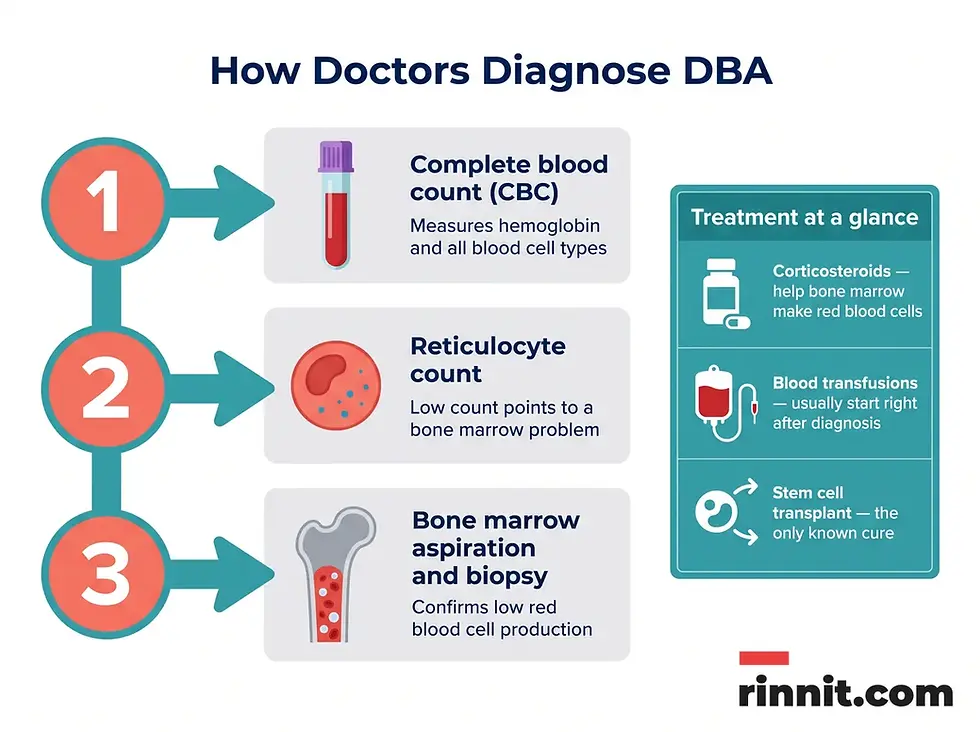
Healthcare providers use several tests to diagnose DBA. The combination of results, rather than any single test, points to the condition.
Test | What it does |
Complete blood count (CBC) | Measures hemoglobin, red blood cells, white blood cells, and platelets |
Reticulocyte count | Checks immature red blood cells; a low count suggests a bone marrow problem |
Bone marrow aspiration and biopsy | Collects bone marrow samples to confirm low red blood cell production |
The reticulocyte count is particularly telling. Reticulocytes are young red blood cells, and a low number signals that the bone marrow is not producing enough of them, which is exactly what happens in DBA.
How Is Diamond-Blackfan Anemia Treated?
Treatment options for DB anemia, listed from most to least common, are summarized below.
Treatment | How it works | Notes |
Corticosteroids | Help the bone marrow make more red blood cells | Typically help within two to four weeks |
Blood transfusion | Donated red blood cells boost your levels | Usually started immediately after diagnosis; usually brings fast relief |
Stem cell transplant | Replaces faulty blood-forming cells using cells from a family member or unrelated donor | The only known cure for DBA; can cause life-threatening complications; considered case by case |
Most people feel improvement within weeks of starting steroids [1], and transfusions typically bring relief even faster [1]. Everyone’s response is different, so it is important to ask your provider what to expect in your specific case.
Question people commonly ask | Answer |
Which treatment is most common? | Corticosteroids |
When do transfusions start? | Usually immediately after diagnosis |
How fast do steroids help? | Within two to four weeks |
Is there a cure? | Yes — stem cell transplant is the only known cure |
Is the cure risk-free? | No, it can cause life-threatening complications and is weighed case by case |
What Is the Outlook for Diamond-Blackfan Anemia?
With treatment, the outlook is good, but DBA requires lifelong care and monitoring [1]. Your risk of serious complications increases around age 25 [1].
How long someone lives with DBA depends on their symptoms and treatment. Research shows that about 75% of people with DBA are alive at age 50 [1]. Because the condition is so rare, the available data is limited [1], and your provider can offer more personalized information.
Outlook factor | Detail |
Overall outlook with treatment | Good |
Care requirement | Lifelong monitoring |
Higher-risk period begins | Around age 25 |
Survival statistic | About 75% of people with DBA are alive at age 50 |
Data limitation | Limited, because the condition is rare |
How can people live well with Diamond-Blackfan anemia?
If you or your child has DBA, staying in close communication with your healthcare provider is essential. Routine check-ups are part of the plan, and you should also report any worsening symptoms right away — for example, if you suddenly feel more tired all the time or have had several recent infections [1].
Call 911 or go to the nearest emergency room if you develop any of these warning signs [1]:
Emergency sign | Why it matters |
Chest pain | Heart is struggling to deliver oxygen |
Severe belly pain | Can signal a serious internal problem |
Sudden headache or confusion | Possible stroke signs |
Uncontrolled bleeding | May indicate dangerously low platelets |
Living with a lifelong illness like DBA is hard, especially when it affects a child — and even harder when most people have never heard of it. You are not alone. Your provider can connect you with resources, support, and a care plan tailored to your needs.
Key Takeaways
Diamond-Blackfan anemia is a rare genetic blood disorder, present at birth, that stops the bone marrow from making enough red blood cells.
Around 1 in 500,000 babies are affected; 10–25% inherit it, but most cases have no family history.
Symptoms include fatigue, paleness, rapid heartbeat, shortness of breath, weakness, and swelling in the hands and feet.
Possible complications include birth defects, growth faltering, iron overload, neutropenia, pancytopenia, and thrombocytopenia.
Diagnosis combines a CBC, reticulocyte count, and bone marrow aspiration/biopsy.
Corticosteroids and blood transfusions are the most common treatments; stem cell transplant is the only known cure.
The outlook with treatment is good, and about 75% of people with DBA are alive at age 50 — but lifelong monitoring is essential.
Take the Next Step
If you or your child has signs of unexplained anemia or unusual symptoms at birth or in early childhood, talk to a healthcare provider about a complete blood count. Early diagnosis and a consistent care plan make a real difference with Diamond-Blackfan anemia. Share this guide with anyone caring for a child with a rare blood disorder.
Related reading: pancytopenia
Frequently Asked Questions
1. What is Diamond-Blackfan anemia?
Diamond-Blackfan anemia (DBA) is a rare genetic blood disorder present at birth that prevents the bone marrow from making enough red blood cells, causing anemia. It affects around 1 in 500,000 babies and is lifelong, though treatment can manage symptoms and improve quality of life.
2. What causes Diamond-Blackfan anemia?
Diamond-Blackfan anemia happens when there is a change in ribosomal protein genes, which help make red blood cells. The genetic change reduces red blood cell production, leading to anemia. Between 10% and 25% of cases are inherited, but most people with DBA have no family history.
3. What are the symptoms of Diamond-Blackfan anemia?
Symptoms range from mild to severe and include fatigue, headache, loss of appetite, rapid heartbeat, shortness of breath, skin paleness, swelling in the hands and feet, and weakness. Severity varies widely from person to person.
4. How is Diamond-Blackfan anemia diagnosed?
Providers use a complete blood count (CBC), a reticulocyte count (low levels suggest a bone marrow problem), and bone marrow aspiration and biopsy to confirm low red blood cell production.
5. What is the most common treatment for Diamond-Blackfan anemia?
Corticosteroids are the most common treatment; they help the bone marrow make more red blood cells and typically help within two to four weeks. Blood transfusions are also common and usually begin right after diagnosis.
6. Is there a cure for Diamond-Blackfan anemia?
Yes — a stem cell transplant from a family member or unrelated donor is the only known cure. However, it can cause life-threatening complications, so providers consider it on a case-by-case basis.
7. What complications can Diamond-Blackfan anemia cause?
Possible complications include birth defects of the heart, kidneys, or limbs; slower-than-expected growth; iron overload from repeated transfusions; neutropenia; pancytopenia; and thrombocytopenia. There is also a slightly increased cancer risk.
8. Does Diamond-Blackfan anemia increase cancer risk?
Yes, slightly. People with DBA have a somewhat higher risk of acute myeloid leukemia (AML), myelodysplastic syndrome (MDS), osteosarcoma, and other tumors, which is one reason lifelong monitoring matters.
9. What is the life expectancy for people with Diamond-Blackfan anemia?
It depends on symptoms and treatment, but research shows about 75% of people with DBA are alive at age 50. The risk of serious complications increases around age 25, and data is limited because the condition is rare.
10. When should someone with DBA go to the emergency room?
Go to the ER or call 911 for chest pain, severe belly pain, sudden headache or confusion (possible stroke signs), or uncontrolled bleeding. Report worsening fatigue or frequent infections to your provider promptly.
References
Cleveland Clinic. Diamond-Blackfan Anemia. Cleveland Clinic. May 13, 2025. https://my.clevelandclinic.org/health/diseases/14476-diamond-blackfan-anemia
Da Costa L, Leblanc T, Mohandas N. Diamond-Blackfan anemia. Blood. 2020;136(11):1262-1273. doi:10.1182/blood.2019000947. PMID: 32702755.
Killeen RB, Wills C. Diamond-Blackfan Anemia. In: StatPearls [Internet]. Treasure Island (FL): StatPearls Publishing; 2026 Jan-. Updated Jul. 7, 2025. PMID: 31424886. https://pubmed.ncbi.nlm.nih.gov/31424886/
Genetic and Rare Diseases Information Center. Diamond-Blackfan anemia. National Institutes of Health. Last updated June 2026. https://rarediseases.info.nih.gov/diseases/6274/diamond-blackfan-anemia
Vlachos A, Muir E. How I treat Diamond-Blackfan anemia. Blood. 2010;116(19):3715-3723. doi:10.1182/blood-2010-02-251090. PMID: 20651069.
Vlachos A, Rosenberg PS, Atsidaftos E, Alter BP, Lipton JM. Incidence of neoplasia in Diamond Blackfan anemia: a report from the Diamond Blackfan Anemia Registry. Blood. 2012;119(16):3815-3819. doi:10.1182/blood-2011-08-375972. PMID: 22362038.
Vlachos A, Rosenberg PS, Atsidaftos E, et al. Increased risk of colon cancer and osteogenic sarcoma in Diamond-Blackfan anemia. Blood. 2018;132(20):2205-2208. doi:10.1182/blood-2018-05-848937. PMID: 30266775.
Diaz-de-Heredia C, Bresters D, Faulkner L, et al. Recommendations on hematopoietic stem cell transplantation for patients with Diamond-Blackfan anemia. On behalf of the Pediatric Diseases and Severe Aplastic Anemia Working Parties of the EBMT. Bone Marrow Transplant. 2021;56(12):2956-2963. doi:10.1038/s41409-021-01449-w. PMID: 34462566.
Medical Disclaimer
This article is for informational purposes only and does not constitute medical advice. Always seek the advice of your physician or other qualified health provider with any questions you may have regarding a medical condition. Never disregard professional medical advice or delay in seeking it because of something you have read here.



Comments