Dependent Personality Disorder (DPD): The Excessive Need to Be Taken Care Of, Explained

Updated: 2 days ago
Medically reviewed by Dr. Baraa Alnahhal, MD · Last reviewed: October 2026
Quick Answer
Dependent personality disorder (DPD) is a mental health condition involving an excessive need to be taken care of by others [1] [4]. Key signs include difficulty making everyday decisions without reassurance, fear of being alone and avoiding disagreement [1]. It is not diagnosed before age 18 [1] [2]. The main treatment is psychotherapy, often with medication for co-occurring anxiety or depression [1] [5], and early treatment helps [1].
What the research says
Personality disorders as a group are common and linked to higher mortality. A systematic review and meta-regression of population-based surveys (60 studies, 28 countries; prevalence analyses included 139,373 individuals) estimated the pooled prevalence of any personality disorder, including dependent personality disorder, at 4.1% (95% UI 2.8–6.0) in low- and middle-income countries and 5.2% (3.7–7.3) in high-income countries. Personality disorder was associated with elevated mortality, with pooled standardised mortality ratios of 1.8 (1.4–2.2) for outpatients and 4.7 (3.7–5.8) for inpatients (PubMed: Shadid et al., Lancet Psychiatry, 2025 [7]).
DPD has been studied far less than other personality disorders. A critical review traced the diagnosis from its psychoanalytic roots to the DSM-IV-TR, examined gender and cultural considerations, stability across development, and comorbidity, and concluded with shortcomings in the DPD research base and suggestions for improvement (PubMed: Disney, Clin Psychol Rev, 2013 [8]).
Psychotherapy can reduce dependency traits, and the therapist relationship matters. In a naturalistic study of 74 patients with DPD undergoing long-term clarification-oriented psychotherapy, a decrease in dependency traits was predicted by an increase in the therapist's quality of relationship offer, understanding of content and directivity over the course of the working phase (PubMed: Maccaferri et al., Psychiatry, 2019 [9]).
What Is Dependent Personality Disorder?
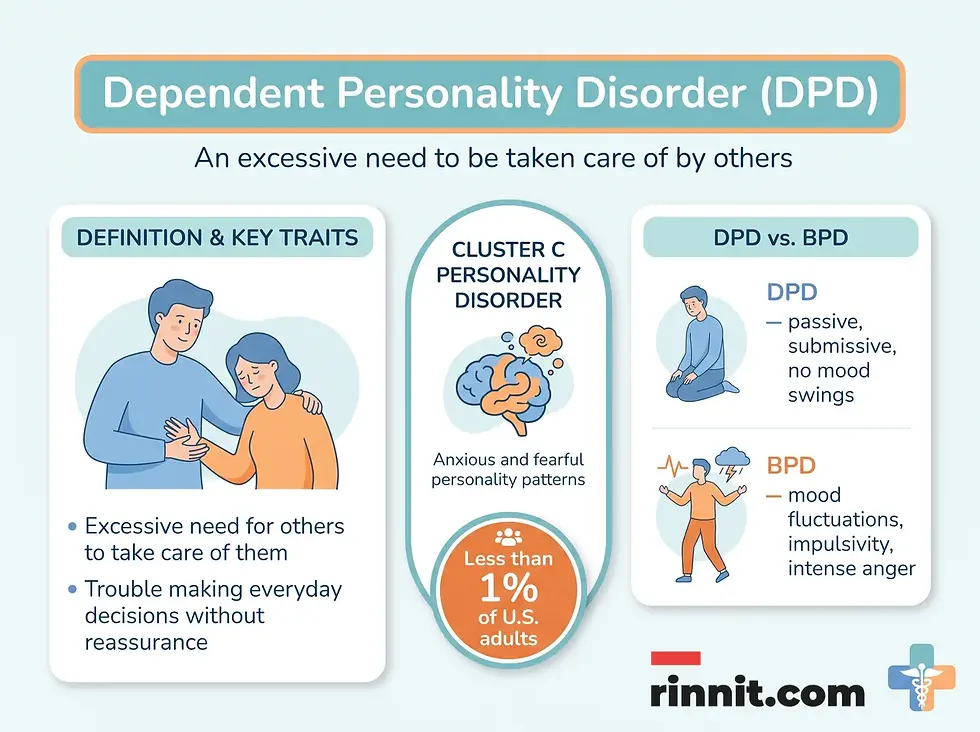
Dependent personality disorder (DPD) is a mental health condition that involves an excessive need to be taken care of by others. A person with DPD relies on people close to them for their emotional or physical needs [1] [5]. Others may describe them as needy or clingy.
People with DPD believe they can't take care of themselves. They may have trouble making everyday decisions, like what to wear or what food to eat, without others' reassurance [1]. They usually don't realize that their thoughts and behaviors are problematic [1].
DPD is one of a group of conditions called "Cluster C" personality disorders. These involve feelings of anxiety and fear [1]. Personality disorders are lasting patterns of behavior that are out of touch with cultural norms (how we're expected to act) [2]. They start before adulthood — in childhood or adolescence — and cause distress for the person with the condition and/or those around them [2].
DPD vs. Borderline Personality Disorder
Dependent personality disorder (DPD) and borderline personality disorder (BPD) both involve interpersonal difficulties and fear of abandonment, but they're different personality disorders.
BPD involves extreme mood fluctuations, instability in relationships and impulsivity. People with BPD have an intense fear of abandonment and have trouble regulating their emotions, especially anger.
DPD doesn't typically involve mood fluctuations and impulsivity. People with DPD are typically passive and submissive because they don't want to cause conflict in their relationships.
Factor | Dependent Personality Disorder (DPD) | Borderline Personality Disorder (BPD) |
|---|---|---|
Mood fluctuations | Not typical | Extreme fluctuations |
Impulsivity | Not typical | Common |
Fear of abandonment | Present — drives passive, clinging behavior | Intense — drives instability and anger |
Relationship style | Passive and submissive to avoid conflict | Unstable, marked by emotional intensity |
Emotional regulation | Submissive reliance on others | Difficulty regulating, especially anger |
Symptoms and Causes
What Are the Symptoms?
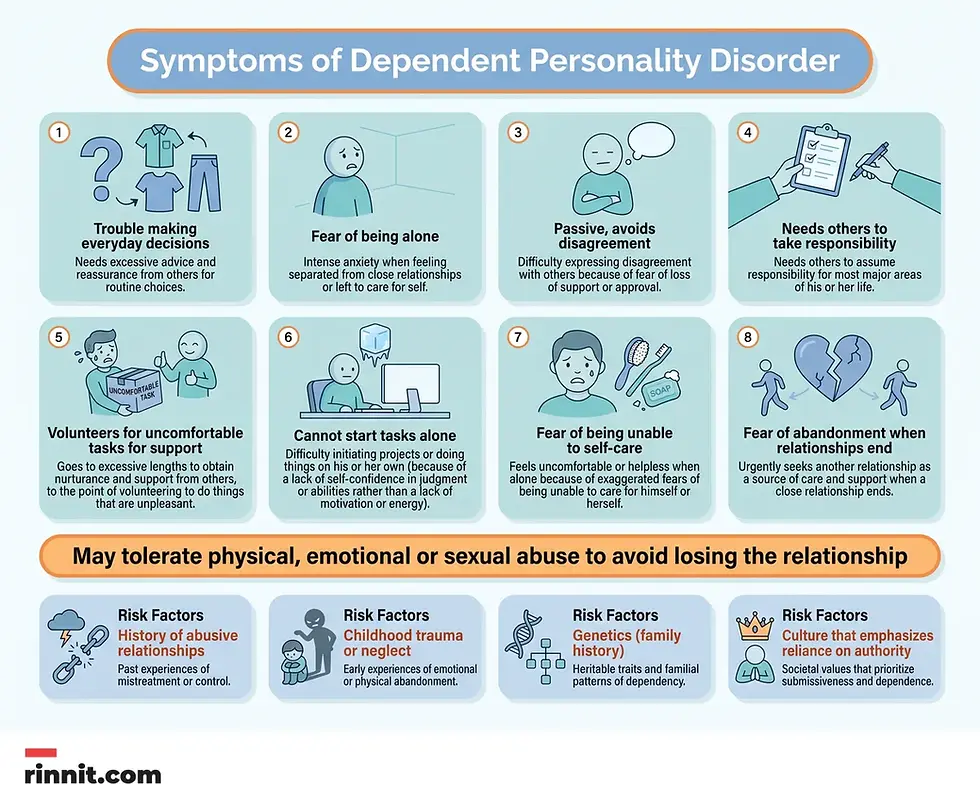
Someone with dependent personality disorder may have several behavioral symptoms. These center on relying on others, avoiding independence, and clinging to relationships.
People with DPD tend to interact only with the few people they depend on. They're also more likely to tolerate physical, sexual or emotional abuse because they don't want to lose the relationship [1] [5].
Behavioral Symptom | What It Looks Like |
|---|---|
Trouble making everyday decisions | Needs constant reassurance and advice, even for small choices like what to wear |
Difficulty starting tasks alone | Struggles to begin tasks without others involved |
Fear of self-care failure | Intense fear of not being able to take care of themselves |
Tolerating discomfort for support | Does or volunteers for uncomfortable tasks to get support or nurturance |
Handing over responsibility | Needs others to be responsible for various aspects of their life |
Avoiding disagreement | Won't express disagreement or create conflict for fear of losing the relationship |
Discomfort when alone | Feels uncomfortable when alone |
Fear of abandonment | Fear of abandonment and helplessness when relationships end |
What Causes Dependent Personality Disorder?
Personality disorders, including DPD, are among the least understood mental health conditions. Researchers think DPD develops due to several factors working together [1].
Risk Factor | How It Raises Risk |
|---|---|
Experiencing abuse | People with a history of abusive relationships have a higher risk of a DPD diagnosis |
Childhood trauma | Child abuse (including verbal abuse) or neglect; life-threatening illness during childhood |
Genetics | A biological family member with DPD or another anxiety disorder raises likelihood |
Cultural, religious or family behaviors | Practices that emphasize reliance on authority may contribute |
Diagnosis and Tests
How Is Dependent Personality Disorder Diagnosed?
Personality continues to evolve throughout child and adolescent development. Because of this, healthcare providers don't typically diagnose someone with dependent personality disorder until after the age of 18 [1] [2]. Providers need evidence that these patterns of behavior are long-lasting and haven't really changed with time [1].
Personality disorders, including DPD, can be difficult to diagnose. This is because most people with one don't think there's a problem with their behavior or way of thinking [1].
When they do seek help, it's often due to conditions such as anxiety or depression from the problems created by their personality disorder, like relationship or work difficulties [1].
When a mental health professional, such as a psychologist or psychiatrist, suspects someone might have dependent personality disorder, they often ask broad, general questions that shed light on past history, relationships, previous work history and reality testing. A person suspected of having DPD may lack insight into their behaviors and thought patterns, so mental health professionals often work with the person's family and friends to collect more information [1].

DSM-5 Diagnostic Criteria for DPD
Mental health providers base a diagnosis of dependent personality disorder on the criteria for the condition in the American Psychiatric Association's Diagnostic and Statistical Manual of Mental Disorders (DSM-5). Diagnostic criteria involve a persistent pattern of at least five of the following behaviors [1] [4].
# | DSM-5 Behavior |
|---|---|
1 | Difficulty making daily decisions without an excessive amount of advice and reassurance from others |
2 | Needing others to be responsible for the most important aspects of their life |
3 | Difficulty disagreeing with others because they fear the loss of support or approval |
4 | Issues starting projects on their own because they're not confident in their judgment and abilities |
5 | Willingness to go to great lengths (like doing unpleasant tasks) to get support from others |
6 | Feeling uncomfortable or helpless when alone because they fear they can't take care of themselves |
7 | Urgently needing to form a new relationship with someone who will provide care and support when a close relationship ends |
8 | Unrealistic worry of being left to take care of themselves |
Management and Treatment
What Is the Treatment?
Treating personality disorders is difficult because people with these conditions have deep-rooted patterns of thinking and behavior that have existed for many years.
Treatment for people with DPD is most effective with the involvement and support of loved ones [1]. It usually involves psychotherapy and, potentially, medication [1].
Psychotherapy for DPD
Psychotherapy (talk therapy) is the treatment of choice for personality disorders [1] [2]. The goal is to help you uncover the motivations and fears associated with your thoughts and behavior, and to learn to relate to others more positively.
Therapy Type | How It Works | DPD Focus |
|---|---|---|
Psychodynamic therapy | Focuses on the psychological roots of emotional suffering; self-reflection into problematic relationships and behavior patterns | Helps you understand yourself and change how you relate to people and your environment |
Cognitive behavioral therapy (CBT) | Structured, goal-oriented therapy; examines how thoughts affect actions; unlearns negative thoughts and behaviors | Examines fears of independence and difficulties with assertiveness |
Medication for DPD
There's currently no medication that can treat personality disorders [1] [2]. But there's medication for depression and anxiety, which people with dependent personality disorder may also have [1] [4]. Treating these conditions can make it easier to treat DPD.
For the best results, you should take medication in combination with psychotherapy [1].
Treatment Approach | Role in DPD Care |
|---|---|
Psychotherapy (treatment of choice) | Uncovers motivations and fears; builds healthier ways to relate to others |
Psychodynamic therapy | Explores psychological roots of suffering through self-reflection |
Cognitive behavioral therapy (CBT) | Changes negative thoughts and habits; targets fears of independence |
Medication (adjunct) | Treats co-occurring depression or anxiety; used in combination with psychotherapy |
Loved-one involvement | Support of loved ones makes treatment most effective |
Outlook / Prognosis
What's the Prognosis?
The prognosis (outlook) for dependent personality disorder depends on if it's treated or not.
Left untreated, DPD may result in additional mental health conditions, like depression and substance use disorder, relationship difficulties, and an increased likelihood of experiencing physical, emotional or sexual abuse [1] [5].
People with DPD also experience higher rates of suicidal ideation and suicide attempts [1] [5]. If you or a loved one are thinking about suicide, dial 988 on your phone to reach the Suicide and Crisis Lifeline. Someone is available to help you 24/7 [6].
Outcome Category | What Untreated DPD May Lead To |
|---|---|
Mental health | Depression, substance use disorder, higher rates of suicidal ideation and attempts |
Relationships | Relationship difficulties |
Safety | Increased likelihood of physical, emotional or sexual abuse |
Can Dependent Personality Disorder Be Prevented?
You can't prevent dependent personality disorder [1]. But treatment can help lessen the issues it causes. Seeking help as soon as symptoms appear can help decrease the disruption to the person's life, family and friendships [1].
The loved ones of people with DPD often experience stress, depression and isolation [1]. It's important to take care of your mental health and seek help if you're experiencing these symptoms.
Key Takeaways
Dependent personality disorder (DPD) is an anxious Cluster C personality disorder defined by an excessive need to be taken care of by others — affecting less than 1% of U.S. adults. Key signs include trouble making everyday decisions without reassurance, difficulty being alone, passivity, and tolerating abuse to avoid losing relationships. It's often confused with borderline personality disorder, but DPD lacks the mood swings and impulsivity of BPD. Diagnosis requires at least five of eight DSM-5 behaviors and doesn't happen before age 18. Psychotherapy is the treatment of choice, medication treats co-occurring anxiety or depression, and the condition itself cannot be prevented — but early treatment reduces disruption for the person and their loved ones.
Take the next step: If you or someone close to you shows a persistent pattern of needing others to take charge of everyday life, talk to a mental health professional — a psychologist or psychiatrist. An initial evaluation is the lowest-pressure way to start, and loved ones can support the process. If you're having thoughts of suicide, dial 988 to reach the Suicide and Crisis Lifeline, available 24/7.
Frequently Asked Questions (FAQ)
1. Is dependent personality disorder real?
Yes. Dependent personality disorder (DPD) is a recognized mental health condition — a type of anxious personality disorder in the "Cluster C" group. It's defined by an excessive need to be taken care of by others, and less than 1% of U.S. adults meet the diagnostic criteria. It's treatable with psychotherapy.
2. What is dependent personality disorder (DPD)?
DPD is a mental health condition involving an excessive need to be taken care of by others. People with DPD rely on people close to them for emotional or physical needs, may struggle to make everyday decisions without reassurance, and usually don't realize their thoughts and behaviors are problematic.
3. What are the symptoms of dependent personality disorder?
Symptoms include trouble making everyday decisions without constant reassurance, difficulty starting tasks alone, intense fear of not being able to care for oneself, volunteering for uncomfortable tasks to get support, avoiding disagreement for fear of losing relationships, discomfort when alone, and fear of abandonment.
4. What causes dependent personality disorder?
Researchers think DPD develops from several factors: a history of abusive relationships, childhood trauma (including verbal abuse, neglect, or life-threatening childhood illness), genetics (a family member with DPD or another anxiety disorder), and cultural, religious or family behaviors that emphasize reliance on authority.
5. How is dependent personality disorder diagnosed?
Providers usually don't diagnose DPD until after age 18, once behavior patterns have lasted a long time. A psychologist or psychiatrist asks broad questions about past history, relationships, work history and reality testing, and gathers information from family and friends. Diagnosis is based on the DSM-5 criteria — at least five of eight specific behaviors.
6. What are the DSM-5 criteria for dependent personality disorder?
The DSM-5 defines DPD as a persistent pattern of at least five of eight behaviors, including difficulty making daily decisions without excessive reassurance, needing others to be responsible for major life aspects, difficulty disagreeing with others, trouble starting projects alone, going to great lengths to get support, helplessness when alone, urgently seeking new caretaking relationships, and unrealistic worry about being left to care for oneself.
7. What's the difference between DPD and borderline personality disorder?
Both involve fear of abandonment, but BPD includes extreme mood fluctuations, relationship instability and impulsivity with trouble regulating emotions — especially anger. DPD doesn't typically involve mood fluctuations or impulsivity; people with DPD are usually passive and submissive because they don't want to cause conflict.
8. What is the treatment for dependent personality disorder?
Psychotherapy (talk therapy) is the treatment of choice — especially psychodynamic therapy, which explores the psychological roots of suffering, and cognitive behavioral therapy (CBT), which targets fears of independence and assertiveness difficulties. Medication can treat co-occurring depression or anxiety, but should be combined with psychotherapy. Loved ones' support makes treatment most effective.
9. Can dependent personality disorder be cured or prevented?
You can't prevent DPD. Treatment can't "cure" a personality disorder overnight because its patterns are deep-rooted, but psychotherapy helps lessen the issues it causes. Seeking help as soon as symptoms appear reduces disruption to the person's life, family and friendships.
10. What happens if dependent personality disorder goes untreated?
Left untreated, DPD may lead to additional mental health conditions like depression and substance use disorder, relationship difficulties, a higher likelihood of experiencing physical, emotional or sexual abuse, and higher rates of suicidal ideation and suicide attempts.
11. When should I seek help for dependent personality disorder?
Seek help as soon as symptoms appear — especially if you (or someone you love) can't make everyday decisions without others, feel helpless when alone, or tolerate abuse to keep a relationship. If you're having thoughts of suicide, dial 988 to reach the Suicide and Crisis Lifeline, available 24/7.
Related Reading
What Are Cluster C Personality Disorders? Symptoms, Causes, Diagnosis and Treatment explains the anxious and fearful personality disorder group that includes DPD.
What Is Avoidant Personality Disorder? Signs, Causes, and Treatment describes a closely related condition driven by fear of rejection.
Personality Disorders: Types, Symptoms & Treatment Guide gives an overview of all personality disorder types and their treatment.
Cognitive Behavioral Therapy (CBT): What It Is, What It Treats and What to Expect explains how CBT works and which conditions it helps treat.
References
Cleveland Clinic. Dependent Personality Disorder. Cleveland Clinic. Last updated Sept. 28, 2023. https://my.clevelandclinic.org/health/diseases/9783-dependent-personality-disorder
American Psychiatric Association. What Are Personality Disorders? Psychiatry.org. Physician review Nov. 2024. https://www.psychiatry.org/patients-families/personality-disorders/what-are-personality-disorders
Mental Health Foundation. Dependent Personality Disorder. Mental Health Foundation. Accessed October 30, 2026. https://mentalhealthfoundation.org/health-conditions/personality-disorders/dependent/
Merck Manual Professional Edition. Dependent Personality Disorder (DPD). Merck Manuals. Full review Sept. 2023; last updated Jan. 2026. https://www.merckmanuals.com/professional/psychiatric-disorders/personality-disorders/dependent-personality-disorder-dpd
MedlinePlus. Dependent personality disorder. MedlinePlus Medical Encyclopedia. Review date Oct. 20, 2024. https://medlineplus.gov/ency/article/000941.htm
988 Suicide & Crisis Lifeline. If you need to talk, the 988 Lifeline is here. 988 Suicide & Crisis Lifeline. Accessed October 30, 2026. https://988lifeline.org
Shadid J, Ferrari AJ, Bach B, et al. The global epidemiology of personality disorder: a systematic review and meta-regression. Lancet Psychiatry. 2025;12(12):932-946. doi:10.1016/S2215-0366(25)00299-8. PMID: 41197646.
Disney KL. Dependent personality disorder: a critical review. Clin Psychol Rev. 2013;33(8):1184-1196. doi:10.1016/j.cpr.2013.10.001. PMID: 24185092.
Maccaferri GE, Dunker-Scheuner D, De Roten Y, Despland JN, Sachse R, Kramer U. Psychotherapy of dependent personality disorder: the relationship of patient-therapist interactions to outcome. Psychiatry. 2019;83(2):179-194. doi:10.1080/00332747.2019.1675376. PMID: 31614097.
Medical Disclaimer
This article is for informational purposes only and does not constitute medical advice. Always seek the advice of your physician or other qualified health provider with any questions you may have regarding a medical condition. Never disregard professional medical advice or delay in seeking it because of something you have read here.



Comments