Congenital Myasthenic Syndrome (CMS): Symptoms, Types, Causes, Diagnosis, and Treatment

Updated: 2 days ago
Medically reviewed by Dr. Baraa Alnahhal, MD · Last reviewed: October 2026
Quick Answer
Congenital myasthenic syndrome (CMS) is a group of genetic conditions present at birth in which physical exertion causes muscle weakness, mainly in the facial muscles used for chewing, swallowing and blinking [1]. It is diagnosed with exams, nerve studies and genetic testing [1]. There is no cure, but medications and therapy help, and severe breathing problems are a medical emergency [1].
What the research says
Which drug works depends on the genetic cause, so a genetic diagnosis matters. A comprehensive review of the 35 genes reported in CMS (citing 442 articles) found that cholinesterase inhibitors are effective in most groups of CMS but are contraindicated in some groups, and that ephedrine, salbutamol (albuterol), and amifampridine work in most but not all groups. The authors state that clinical and electrophysiological features are not enough to identify the defective molecule, so genetic studies are always required for an accurate diagnosis. This was a narrative review rather than a trial (PubMed: Ohno et al., Int J Mol Sci, 2023) [3].
The drug evidence has been mapped by genetic type. A systematic review gathered the evidence on drug treatment for each CMS type from 207 studies covering over 1,000 patients, stratified by the underlying genetic defect because treatment varies depending on the cause. The authors graded the strength and quality of the evidence rather than testing a single treatment (PubMed: Thompson et al., Emerg Top Life Sci, 2019) [2].
Evidence for ephedrine in CMS is still observational. A Cochrane review searching for randomized or quasi-randomized trials of ephedrine in myasthenia, including CMS, found none, so it could not establish the drug's effect. It described 53 non-randomized studies (37 in people with CMS), and the reported adverse effects included tachycardia, sleep disturbances, nervousness, and withdrawal symptoms (PubMed: Vrinten et al., Cochrane Database Syst Rev, 2014) [4].
What Is Congenital Myasthenic Syndrome?
Congenital myasthenic syndrome (CMS) is a group of conditions that cause muscle weakness that gets worse with physical activity, or exertion. The word "congenital" means the condition is present at birth.
CMS most commonly affects the facial muscles, like the ones used to chew, swallow, and blink [1]. It can also affect the skeletal muscles used for movement. Symptoms can be mild or severe. Severe cases may be life-threatening, especially if CMS affects the muscles that help you breathe [1].
CMS is rare, and its prevalence is not well known. One U.K. study estimated that CMS affects about 9 children (under age 18) per 1 million people [1].
Key Fact | Detail |
Definition | Group of conditions where physical activity causes muscle weakness |
Nature of condition | Genetic (present at birth) |
Most affected muscles | Facial muscles used to chew, swallow, and blink; also skeletal muscles |
Severity | Ranges from mild to life-threatening |
Prevalence | Estimated 9 children per 1 million (one U.K. study) |
Cure status | No cure; treatment manages symptoms |
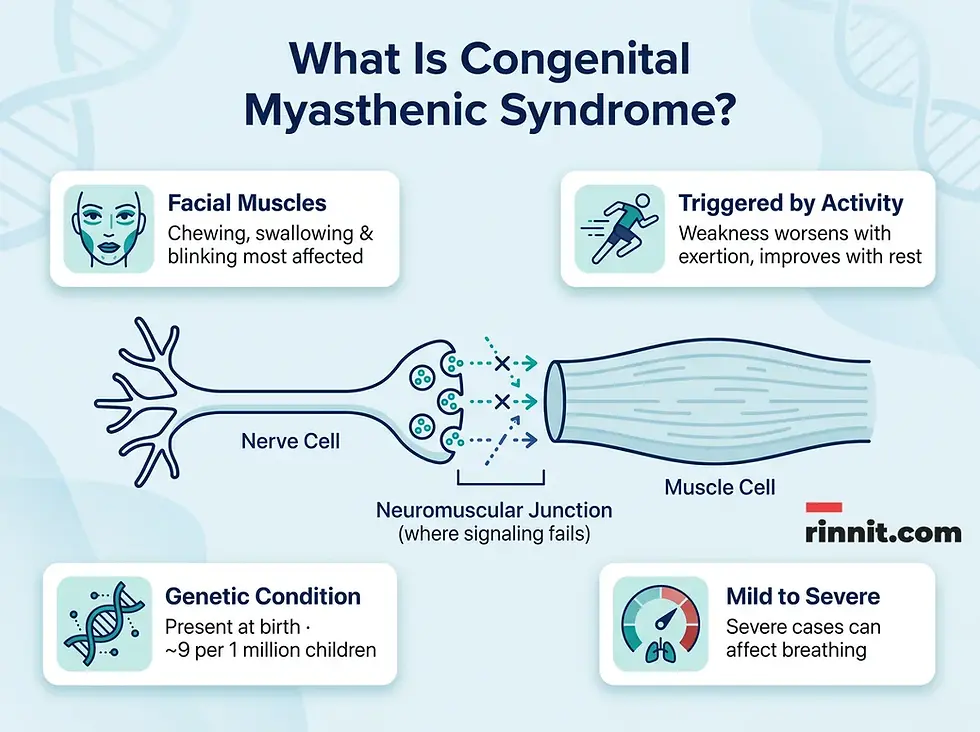
How does the neuromuscular junction relate to congenital myasthenic syndrome types?
CMS happens when nerve and muscle cells do not communicate as expected. The two types of cells meet at the neuromuscular junction, a bridge where nerve cells signal muscle cells to move [1].
This explains the everyday experience of people with CMS. When you exercise, your muscles feeling tired afterward is an expected response. With CMS, any effort made during exertion can cause symptoms like muscle weakness, making the activity more difficult and sometimes unsafe. When the activity stops, you will likely feel better [1].
Healthcare providers group CMS types by which part of the neuromuscular junction the condition affects. They further identify types by the specific cellular structures or components affected at the junction, such as the basal lamina or the acetylcholine receptor [1].
CMS Type | Where It Occurs |
Presynaptic CMS | Occurs in the nerve cell |
Synaptic CMS | Occurs in the area between the nerve cell and the muscle cell |
Postsynaptic CMS | Occurs in the muscle cell |
How is congenital myasthenic syndrome different from myasthenia gravis?
Congenital myasthenic syndrome and myasthenia gravis are similar conditions. Both cause weakness due to problems where nerve cells and muscle cells meet at the neuromuscular junction.
The difference is the cause. CMS is a genetic condition caused by a genetic change. Myasthenia gravis is an autoimmune condition caused by the immune system mistakenly attacking the neuromuscular junction [1].
Condition | Cause |
Congenital myasthenic syndrome | Genetic change (present from birth) |
Myasthenia gravis | Autoimmune attack on the neuromuscular junction |
What are the symptoms of congenital myasthenic syndrome (CMS)?
The signs and symptoms of CMS vary based on type but could include the following [1].
Symptom | What It Looks Like |
Muscle fatigue and weakness | Triggered by physical activity |
Poor muscle regulation | Limited or a lack of muscle regulation |
Eyelid and eye issues | Droopy eyelids, double vision, or a lazy eye |
Speaking and eating issues | Difficulty talking or swallowing |
Age of Onset
Most CMS symptoms begin in early childhood [1]. A sign that a child might have CMS is delayed motor skills development, such as delays in crawling and walking. Some symptoms of CMS start later, for example during adolescence or adulthood [1].
When should you see a doctor about congenital myasthenic syndrome?
Visit a healthcare provider if you or your child experience symptoms of CMS when participating in physical activities, such as muscle weakness. Let your child's provider know if your child is unable to eat or if they miss developmental milestones for their age [1].
Emergency warning: Contact 911 or your local emergency services number immediately if your child has trouble breathing or their skin, lips, or nails turn pale or blueish gray (cyanosis) [1]. These can signal that the muscles controlling breathing are failing.
What Causes Congenital Myasthenic Syndrome?
A genetic change, or mutation, causes congenital myasthenic syndrome. Some of the responsible gene changes include, but are not limited to, the following [1].
Gene | Role |
CHRNE | Provides instructions for proteins that help signals pass at the neuromuscular junction |
RAPSN | Same signaling role at the junction |
CHAT | Same signaling role at the junction |
COLQ | Same signaling role at the junction |
DOK7 | Same signaling role at the junction |
These genes provide instructions for your cells to produce proteins that help signals pass between cells at the neuromuscular junction. Signaling is how your nerves and muscles communicate across this bridge. When your nerve cells signal to your muscle cells, your nerves tell your muscles to move.
If a genetic mutation happens, your cells lack the instructions they need to send signals or messages across the bridge. This leads to the symptoms of CMS.
Inheritance and Risk
You can inherit congenital myasthenic syndrome. It usually happens in an autosomal recessive pattern, meaning both biological parents need to have the gene and pass it on to their child for the child to develop the condition [1]. Some CMS types pass in an autosomal dominant pattern, where only one biological parent needs to pass the gene on [1].
Some gene changes happen randomly, without any history of the condition in a person's biological family [1]. Anyone can develop CMS, but you are more at risk if it runs in your biological family history [1].
What are the complications of congenital myasthenic syndrome (CMS)?
CMS complications may include the following [1].
Complication | Description |
Feeding difficulties | Weak chewing and swallowing muscles make eating hard |
Stiff muscles | Reduced muscle regulation causes stiffness |
Delayed developmental milestones | Motor skills such as crawling and walking |
Inability to walk | Weakness affecting the legs |
Breathing pauses (apnea) | Weakness of the muscles that control breathing |
Seizures | Occur in some people with CMS |
Intellectual disability | Occurs in some people with CMS |
Neuropathy | Nerve damage affecting sensation or movement |
Metabolic abnormalities | Disruptions in the body's metabolic processes |
Breathing-related complications are the most concerning, because weakness in the muscles that regulate breathing can become life-threatening.

How is congenital myasthenic syndrome (CMS) diagnosed?
A healthcare provider diagnoses CMS after a physical exam and neurological exam, reviewing your symptoms and taking a complete medical history [1]. If they suspect CMS, they may ask you to perform a physical activity under their supervision, like walking up stairs, to observe how your body reacts [1].
They may also order tests to rule out conditions with similar symptoms [1].
Test | What It Shows |
Blood tests | Rules out other conditions with similar symptoms |
Nerve conduction study | Measures how well electrical signals travel along the nerves |
Electromyography (EMG) | Measures the electrical activity of muscles and nerves |
Genetic Testing
Genetic testing helps your healthcare provider detect the gene change causing your symptoms. The provider may draw a small sample of your blood to examine your DNA [1]. The gene change can help the provider detect what type of CMS you have and where in your neuromuscular junction there is an issue [1].
How is congenital myasthenic syndrome (CMS) treated?
There is no cure for CMS, but treatment is available to help manage symptoms [1]. Medications are usually helpful to maintain or boost muscle function [1].
Medication Category | Examples |
Cholinergic agonists | Pyridostigmine, amifampridine, or 3,4-diaminopyridine |
Open channel blockers | Fluoxetine or quinidine |
Adrenergic agonists | Salbutamol or ephedrine |
Therapy and Mobility Support
Physical activity can make CMS symptoms worse, but your healthcare provider may suggest meeting with a physical therapist. The therapist helps you find light activities and exercises that are safe, maintain good health, and prevent muscle stiffness [1].
You may also need assistive devices, such as a wheelchair, to navigate and prevent injury [1].
Possible Side Effects
Side effects vary by medication type but may include the following [1].
Possible Side Effect | Notes |
Abdominal cramps | Varies by medication |
Allergic reaction | Varies by medication |
Breathing problems | Requires immediate attention |
Diarrhea | Varies by medication |
Fatigue | Varies by medication |
Increased saliva or sweat production | Common with cholinergic agonists |
Vision changes | Varies by medication |
Talk to your provider about the possible side effects before starting a medication, so you can make an informed decision about your health.

What is the prognosis and life expectancy for congenital myasthenic syndrome?
CMS symptoms range from mild to severe. The condition may have very little effect on your life, while others may experience life-threatening symptoms like breathing difficulties. Your provider can give you the best outlook for your situation.
CMS may or may not affect your life expectancy. If you have mild symptoms, CMS will not have a major effect on your overall health [1]. CMS can impact life expectancy if symptoms affect the muscles that regulate your breathing [1]. Your care team will help manage your symptoms to prevent life-threatening complications.
Can Congenital Myasthenic Syndrome Be Prevented?
Congenital myasthenic syndrome has no known prevention, but genetic testing can show your risk of having an affected child, and checking new medications with your provider prevents worsening symptoms. If you plan on expanding your family, you can learn more about your risk of having a child with a genetic condition by talking to a healthcare provider about genetic testing [1].
There is one important way to prevent worsening symptoms: always talk to your provider about having CMS before taking a new medication [1]. To prevent worsening symptoms, your healthcare provider may recommend alternatives if you need to take certain medications [1].
Medication Category | Why Caution Is Needed |
Antibiotics | May worsen CMS symptoms |
Cardiovascular medications | May worsen CMS symptoms |
Psychiatric condition medications | May worsen CMS symptoms |
How can people live well with congenital myasthenic syndrome (CMS)?
CMS symptoms are different for each person. The condition can interfere with your daily routine and make things a little more challenging, like using the stairs or exercising. Your healthcare provider may recommend assistive devices like a wheelchair to prevent falls or injury [1].
Children diagnosed with the condition may miss developmental milestones for their age, especially motor skills, like taking their first steps. If you notice your child needs more time than other children to reach growth goals, let their healthcare provider know.
After a diagnosis, you will likely have several questions. Your care team is available to help you understand how this condition affects you and what treatment options are available.
Question to Ask | Why It Matters |
What is the type of CMS? | Guides treatment and expectations |
What type of treatment do you recommend? | Sets the immediate care plan |
Are there side effects of the treatment? | Helps you prepare and monitor safely |
Can my child participate in sports or activities with CMS? | Balances health and quality of life |
Conclusion
A congenital myasthenic syndrome diagnosis brings real challenges, from weakened facial muscles to the effort-triggered fatigue that limits daily activities. But the outlook is far better than it once was: medications like pyridostigmine, guided physical therapy, and mobility aids give families effective tools to manage symptoms, and careful attention to breathing problems keeps the most serious risks under control.
When to Talk to a Healthcare Provider
If your child shows muscle weakness during activity, delayed motor milestones, droopy eyelids, or trouble eating or breathing, talk to a healthcare provider. Seek emergency care right away for breathing trouble or blueish skin, lips, or nails.
Related reading: physical therapy benefits
Frequently Asked Questions
1. What is congenital myasthenic syndrome?
Congenital myasthenic syndrome (CMS) is a group of genetic conditions present at birth that cause muscle weakness that gets worse with physical activity. It happens when nerve and muscle cells fail to communicate properly at the neuromuscular junction.
2. How common is congenital myasthenic syndrome?
CMS prevalence is not well known. One U.K. study estimated it affects about 9 children under age 18 per 1 million people.
3. What are the symptoms of congenital myasthenic syndrome?
Symptoms vary by type but can include muscle fatigue and weakness triggered by physical activity, limited muscle regulation, droopy eyelids, double vision, a lazy eye, and difficulty talking or swallowing.
4. At what age does congenital myasthenic syndrome start?
Most CMS symptoms begin in early childhood, often showing as delayed motor skills like crawling and walking. Some symptoms start later, during adolescence or adulthood.
5. What causes congenital myasthenic syndrome?
A genetic change (mutation) causes CMS. Genes such as CHRNE, RAPSN, CHAT, COLQ, and DOK7 provide instructions for proteins that help signals pass at the neuromuscular junction. When a mutation disrupts these instructions, nerve cells cannot tell muscle cells to move properly.
6. Is congenital myasthenic syndrome inherited?
Yes. CMS usually follows an autosomal recessive pattern, meaning both biological parents must pass on the gene. Some types follow an autosomal dominant pattern, where only one parent needs to pass on the gene. Some cases happen randomly with no family history.
7. What is the difference between CMS and myasthenia gravis?
Both conditions cause weakness at the neuromuscular junction. CMS is a genetic condition caused by a genetic change, while myasthenia gravis is an autoimmune condition caused by the immune system mistakenly attacking the neuromuscular junction.
8. How is congenital myasthenic syndrome diagnosed?
Diagnosis involves a physical and neurological exam, a review of symptoms and medical history, supervised activity testing (like walking up stairs), blood tests, a nerve conduction study, and electromyography. Genetic testing identifies the gene change, the CMS type, and where the junction is affected.
9. How is congenital myasthenic syndrome treated?
There is no cure, but medications help manage symptoms. Options include cholinergic agonists (pyridostigmine, amifampridine, 3,4-diaminopyridine), open channel blockers (fluoxetine, quinidine), and adrenergic agonists (salbutamol, ephedrine). Physical therapy and mobility aids like wheelchairs also help.
10. Can medication side effects occur with CMS treatment?
Yes. Side effects vary by medication but may include abdominal cramps, allergic reactions, breathing problems, diarrhea, fatigue, increased saliva or sweat production, and vision changes. Always discuss side effects with your provider before starting treatment.
11. What is the prognosis and life expectancy for CMS?
CMS ranges from mild to severe. Mild cases may have little effect on health or life expectancy. Life expectancy can be affected when symptoms involve the muscles that regulate breathing. The care team manages symptoms to prevent life-threatening complications.
References
Cleveland Clinic. Congenital Myasthenic Syndrome. Cleveland Clinic. Feb. 15, 2024. https://my.clevelandclinic.org/health/diseases/congenital-myasthenic-syndrome
Thompson R, Bonne G, Missier P, Lochmüller H. Targeted therapies for congenital myasthenic syndromes: systematic review and steps towards a treatabolome. Emerg Top Life Sci. 2019;3(1):19-37. PMID 30931400. https://doi.org/10.1042/ETLS20180100
Ohno K, Ohkawara B, Shen XM, Selcen D, Engel AG. Clinical and pathologic features of congenital myasthenic syndromes caused by 35 genes—a comprehensive review. Int J Mol Sci. 2023;24(4):3730. PMID 36835142. https://doi.org/10.3390/ijms24043730
Vrinten C, van der Zwaag AM, Weinreich SS, Scholten RJPM, Verschuuren JJGM. Ephedrine for myasthenia gravis, neonatal myasthenia and the congenital myasthenic syndromes. Cochrane Database Syst Rev. 2014;(12):CD010028. PMID 25515947. https://doi.org/10.1002/14651858.CD010028.pub2
Medical Disclaimer
This article is for informational purposes only and does not constitute medical advice. Always seek the advice of your physician or other qualified health provider with any questions you may have regarding a medical condition. Never disregard professional medical advice or delay in seeking it because of something you have read here.



Comments