Congenital Central Hypoventilation Syndrome: What It Is, Why It Happens, and How It's Treated

Updated: 2 days ago
Medically reviewed by Dr. Baraa Alnahhal, MD · Last reviewed: October 17, 2026
Quick Answer
Congenital central hypoventilation syndrome (CCHS) is a rare genetic disorder in which the body breathes too shallowly or slowly, especially during sleep, because breathing is not regulated automatically [1] [6]. It is caused by a PHOX2B gene mutation [1] [6]. There is no cure; treatment manages symptoms [5]. People with mild CCHS can lead productive lives, while severe cases can shorten life span [5] [6].
What the research says
According to PubMed, the research on CCHS comes mainly from expert reviews and clinical guidelines rather than large trials, so the sources below describe the state of the evidence rather than study-level numbers:
CCHS now includes milder and later presentations, and care relies on lifelong ventilatory support. A 2020 guideline notes that PHOX2B mutations are found in most patients and that the condition has evolved from a life-threatening neonatal disorder to include broader and milder presentations affecting children, adults, and families. Management relies on lifelong ventilatory support and close follow-up of autonomic dysfunction. (Trang et al., Orphanet J Rare Dis, 2020) 1
Genetic testing has found more later-onset cases. A 2024 review defines later-onset CCHS as a diagnosis in children older than 1 month, and explains that PHOX2B genetic testing has increased diagnosis in newborns and led to more older children, adolescents, and adults being identified, often with milder disease. (Amos, Med Clin North Am, 2024) 2
Breathing problems can include weak responses to low oxygen and high carbon dioxide. A 2024 review reports that congenital disorders of ventilatory control typically show up as central apneas, periodic breathing, and hypoventilation in the newborn period, though some present later, and that affected people can have absent or impaired ventilatory and arousal responses to low oxygen and high carbon dioxide. (Kasi and Perez, Clin Chest Med, 2024) 3
Study details are from PubMed abstracts.
What Is Congenital Central Hypoventilation Syndrome?
Congenital central hypoventilation syndrome (CCHS) is a rare, potentially life-threatening disorder [5]. The word "congenital" means it is present at birth, and it affects a person throughout life.
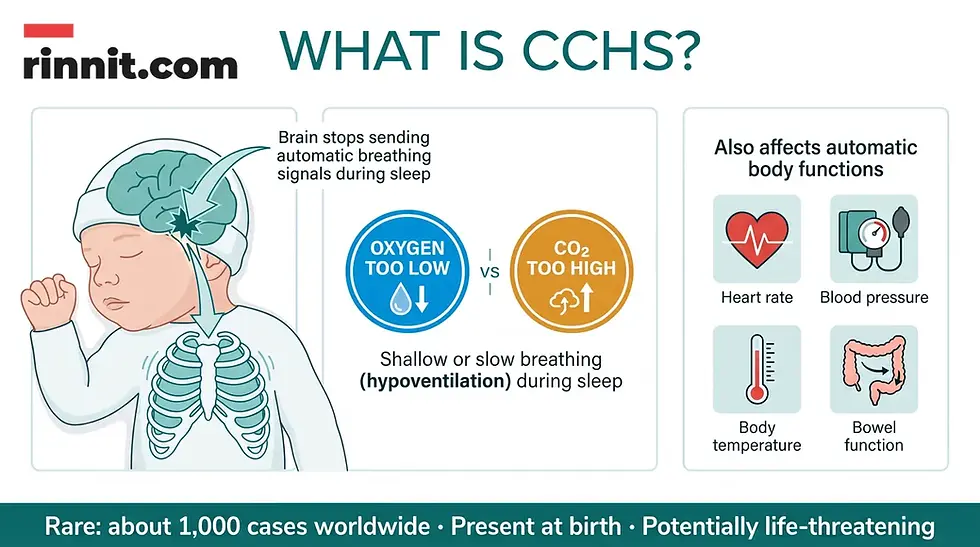
CCHS makes you hypoventilate, which means breathing too shallowly or too slowly. This happens most often when sleeping [6]. As a result, the blood does not get enough oxygen and holds too much carbon dioxide [2].
CCHS affects the autonomic nervous system, the part of the nervous system that regulates involuntary bodily processes, meaning processes the body runs automatically without conscious thought. The disorder may also impact other automatic body functions, including blood pressure, bowel function, heart rate, and body temperature [5] [6].
What are other names for CCHS?
CCHS has several other names. You may see it called congenital central hypoventilation, congenital failure of autonomic control, congenital failure of respiratory drive, Haddad syndrome, or Ondine syndrome. Ondine syndrome is also sometimes called Ondine-Hirschsprung disease or Ondine's curse.
Name | What it highlights |
Congenital central hypoventilation | Slow or shallow breathing present at birth |
Congenital failure of autonomic control | Automatic body systems do not self-regulate |
Congenital failure of respiratory drive | The brain's automatic breathing drive fails |
Haddad syndrome | CCHS combined with Hirschsprung disease |
Ondine syndrome / Ondine's curse | Myth-inspired name for forgotten automatic breathing |
Ondine-Hirschsprung disease | Combination of CCHS and Hirschsprung disease |
How common is CCHS?
CCHS is rare, with only about 1,000 cases identified worldwide [5] [6]. However, scientists believe that undiagnosed CCHS may have caused some cases of sudden infant death syndrome (SIDS) [6].
What Are the Symptoms of CCHS?
The first symptoms of CCHS usually appear shortly after birth [3]. They may include bluish skin or lips, called cyanosis, and hypoventilation when sleeping [6].
But mild cases may not be noticed until later in life [1] [2]. Other signs may include a range of symptoms that reflect how the disorder affects automatic body functions beyond breathing.
Symptom | What it looks like |
Cyanosis | Bluish skin or lips from low oxygen |
Sleep hypoventilation | Shallow or slow breathing during sleep |
Eye abnormalities | Decreased response to light, crossed eyes (strabismus), or altered depth perception |
Decreased pain perception | Reduced ability to sense pain |
Growth hormone deficiency | The body does not produce enough growth hormone |
Unexplained sweating | Episodes of excessive sweating for no apparent reason |
GI issues | Reflux, constipation, small or large bowel obstruction, or Hirschsprung disease |
Low body temperature | The body does not regulate temperature properly |
Neurological problems | Including learning disabilities |
Heart rate and blood pressure problems | Trouble regulating both |

What Causes Congenital Central Hypoventilation Syndrome?
A mutation in the PHOX2B gene causes CCHS [1] [6]. This gene helps make a protein that is important to the production of nerve cells during fetal development, the period when the baby grows before birth [5] [6].
Most cases of CCHS involve a sporadic mutation, meaning a new, sudden mutation that was not inherited from a parent. However, the mutation can also be inherited [5] [6].
How Is CCHS Diagnosed?
The only way to confirm a CCHS diagnosis is to verify a PHOX2B gene mutation through genetic testing, a test that checks a person's DNA for gene mutations.
Because CCHS affects multiple body systems, healthcare providers may order other tests to understand the condition's effects.
Test | Why it is ordered |
Genetic testing | The only way to confirm a CCHS diagnosis by finding the PHOX2B gene mutation |
Blood tests | General health assessment |
Colonoscopy, sometimes with biopsy | To assess gastrointestinal symptoms |
Echocardiogram | To evaluate the heart |
X-ray, CT scan, or MRI | To see inside the chest and abdomen and look for blockages |
Ophthalmologic tests | To evaluate the eyes |
Sleep studies | To measure breathing during sleep |
How Is Congenital Central Hypoventilation Syndrome Treated?
Congenital central hypoventilation syndrome (CCHS) has no cure, so treatment manages symptoms, and most people need lifelong ventilatory support to help them breathe [1] [5].

Is there a cure for CCHS?
There is no cure for CCHS. Treatment aims to manage symptoms and keep the person safe and comfortable.
What does treatment involve?
Most people with CCHS need lifelong ventilatory support, a machine that helps them breathe [1]. Some people need it all day, every day. Others need it only during sleep [5].
Other common supportive treatments include:
Glasses, contact lenses, or surgery to correct vision problems or protect the eyes from too much light
Growth hormone therapy
Medications to relieve GI symptoms
Medications or procedures to help manage blood pressure and heart rate
Routine screening tests to catch associated health problems early
What kind of specialists are involved in CCHS care?
Because CCHS affects many body systems, treatment often involves a team of specialists working together.
Specialist | What they manage |
Cardiologist | Heart problems |
Ear, nose, and throat specialist | ENT-related issues |
Endocrinologist | Hormone-related issues |
Gastroenterologist | Digestive problems |
Neurologist | Effects on the brain and learning |
Ophthalmologist | Symptoms affecting the eyes |
Primary care physician (e.g., pediatrician) | Overall care |
Pulmonologist | Breathing issues |
Speech and language pathologist | Speech support |
Social worker | Family and care coordination |
What Is the Outlook for People with CCHS?
Life expectancy and disabilities with CCHS vary widely. The prognosis depends on disease severity, as well as the timing and effectiveness of treatments [6].
With early diagnosis and effective treatment, people with mild CCHS can have fulfilling, productive lives [5]. But those with severe cases or ineffective treatment can have significant disabilities, health issues, and a shorter life span.
Comfort note: CCHS is serious but manageable. With early diagnosis, lifelong ventilatory support, and a coordinated care team, many people with mild CCHS live full, productive lives.
It is important to note that people with CCHS may be more likely to get certain nervous system tumors [6]. They should have regular screening tests for neuroblastoma, ganglioneuroblastoma, and ganglioneuroma [5].
When to seek care: If you notice that you or your baby has symptoms of CCHS, such as bluish skin or lips or shallow, slow breathing during sleep, seek medical attention as soon as possible.
Can CCHS Be Prevented?
To date, there are no proven strategies to prevent CCHS. Because the mutation can be inherited, people in a family with CCHS may want to discuss genetic testing with their healthcare provider [5].
What questions should you ask your doctor about congenital central hypoventilation syndrome?
Questions about congenital central hypoventilation syndrome (CCHS) can cover how severe it is, which body systems it affects, which specialists you need and whether you need a ventilator.
How severe is my case of CCHS?
What body systems does my CCHS affect?
What specialists will I need?
Do I need a ventilator? If so, will I use it all the time or only when I'm sleeping?
How often should I have tests to monitor my eyes, heart, lungs, GI tract, and other body systems?
How often should I be screened for cancer?
Should people in my family get genetic testing?
Conclusion
Congenital central hypoventilation syndrome is a rare genetic disorder that affects breathing and other automatic body functions from birth onward [5] [6]. While there is no cure, lifelong ventilatory support and a coordinated team of specialists can manage symptoms and protect quality of life [1]. Early diagnosis matters. If you notice signs of CCHS in yourself or your baby, seek medical attention as soon as possible.
Learn more at Rinnit.com — explore our complete library of clear, expert-reviewed health guides.
Frequently Asked Questions
What is congenital central hypoventilation syndrome?
CCHS is a rare, potentially life-threatening disorder present at birth that causes shallow or slow breathing, especially during sleep, because the autonomic nervous system does not regulate breathing automatically.
Is CCHS life-threatening?
Yes. CCHS is a potentially life-threatening disorder, but with early diagnosis and effective treatment, people with mild cases can live fulfilling, productive lives.
How rare is CCHS?
Only about 1,000 cases of CCHS have been identified worldwide.
What causes CCHS?
A mutation in the PHOX2B gene causes CCHS. The gene helps make a protein important to producing nerve cells during fetal development.
Is CCHS inherited?
Most cases involve a sporadic (new, sudden) mutation, but the mutation can be inherited.
Can CCHS go undiagnosed?
Yes. Mild cases may not be noticed until later in life, and scientists believe undiagnosed CCHS may have caused some cases of sudden infant death syndrome (SIDS).
What are the first symptoms of CCHS in babies?
The first symptoms usually appear shortly after birth and may include bluish skin or lips (cyanosis) and hypoventilation when sleeping.
What does hypoventilation mean?
Hypoventilation means breathing too shallowly or too slowly, which leads to too little oxygen and too much carbon dioxide in the blood.
Does CCHS affect anything besides breathing?
Yes. It affects the autonomic nervous system and may impact blood pressure, bowel function, heart rate, and body temperature.
What eye problems can CCHS cause?
CCHS can cause eye abnormalities such as decreased response to light, crossed eyes (strabismus), or altered depth perception.
Does CCHS affect pain perception?
Yes. People with CCHS may have a decreased perception of pain.
What GI problems are linked to CCHS?
CCHS can be associated with reflux, constipation, small bowel obstruction, large bowel obstruction, or Hirschsprung disease.
What is Haddad syndrome?
Haddad syndrome is one of the other names for CCHS, used when it is combined with Hirschsprung disease.
How is CCHS diagnosed?
The only way to confirm a CCHS diagnosis is to verify a PHOX2B gene mutation through genetic testing.
What tests are used to assess the effects of CCHS?
Providers may order blood tests, colonoscopy with possible biopsy, echocardiogram, X-ray, CT scan, MRI, ophthalmologic tests, and sleep studies.
Is there a cure for CCHS?
No. There is no cure. Treatment aims to manage symptoms and keep the person safe and comfortable.
Do people with CCHS need a ventilator?
Most people with CCHS need lifelong ventilatory support. Some need it all day, every day, while others need it only during sleep.
What growth problems can CCHS cause?
CCHS can involve a deficiency in growth hormones, which may be treated with growth hormone therapy.
What specialists treat CCHS?
Care often involves cardiologists, ENT specialists, endocrinologists, gastroenterologists, neurologists, ophthalmologists, primary care physicians, pulmonologists, speech and language pathologists, and social workers.
Can people with CCHS live normal lives?
With early diagnosis and effective treatment, people with mild CCHS can have fulfilling, productive lives.
What is the life expectancy for someone with CCHS?
Life expectancy varies widely and depends on disease severity and the timing and effectiveness of treatments. Severe cases or ineffective treatment can lead to significant disabilities and a shorter life span.
Do people with CCHS need cancer screening?
Yes. People with CCHS may be more likely to get certain nervous system tumors, so they should have regular screening for neuroblastoma, ganglioneuroblastoma, and ganglioneuroma.
Can CCHS be prevented?
To date, there are no proven strategies to prevent CCHS.
What should I ask my doctor about CCHS?
Useful questions include how severe the case is, which body systems are affected, which specialists are needed, whether a ventilator is required, how often monitoring tests and cancer screening should occur, and whether family members should get genetic testing.
When should I seek medical attention for possible CCHS?
If you notice that you or your baby has symptoms of CCHS, seek medical attention as soon as possible.
Related Reading
References
Trang H, et al. Guidelines for diagnosis and management of congenital central hypoventilation syndrome. Orphanet J Rare Dis. 2020;15(1):252. PMID 32958024. https://doi.org/10.1186/s13023-020-01460-2
Amos L. Later Onset Congenital Central Hypoventilation Syndrome. Med Clin North Am. 2024;108(1):215-226. PMID 37951652. https://doi.org/10.1016/j.mcna.2023.05.021
Kasi AS, et al. Congenital Central Hypoventilation Syndrome and Disorders of Control of Ventilation. Clin Chest Med. 2024;45(3):663-673. PMID 39069329. https://doi.org/10.1016/j.ccm.2024.02.018
Genetic and Rare Diseases Information Center. Central hypoventilation syndrome, congenital, 1, with or without Hirschsprung disease. GARD, National Institutes of Health. Last updated September 2026. https://rarediseases.info.nih.gov/diseases/8535/congenital-central-hypoventilation-syndrome
National Organization for Rare Disorders. Congenital Central Hypoventilation Syndrome - Symptoms, Causes, Treatment. NORD. Last updated December 13, 2019. https://rarediseases.org/rare-diseases/congenital-central-hypoventilation-syndrome/
MedlinePlus, National Library of Medicine. Congenital central hypoventilation syndrome. MedlinePlus Genetics. Last updated September 1, 2019. https://medlineplus.gov/genetics/condition/congenital-central-hypoventilation-syndrome/
Medical disclaimer
This article is for general informational purposes only and does not constitute medical advice. It is based on publicly available health information and should not replace professional medical diagnosis or treatment. Always consult a qualified healthcare provider for personal medical decisions. In a medical emergency, contact emergency services immediately.



Comments