Cold Feet: What It Is, Why It Happens, and How It's Treated

Updated: 2 days ago
Medically reviewed by Dr. Baraa Alnahhal, MD · Last reviewed: October 17, 2026
Quick Answer
Cold feet are feet at a lower temperature than the rest of your body. They are normal occasionally, but persistent cold feet can signal poor circulation or conditions such as anemia, hypothyroidism, peripheral artery disease or Raynaud's phenomenon [4]. Diagnosis includes blood tests and an ankle-brachial index test [4]. Treatment addresses the cause, plus warm socks, exercise and avoiding tobacco [4].

What the research says
According to PubMed, recent research related to the causes and care of cold feet reports the following:
The ankle-brachial index is the first-line test for artery disease, but it has limits. A 2026 systematic review and meta-analysis of 17 studies (1,749 patients) notes that the ABI is the guideline-recommended first-line diagnostic tool for peripheral artery disease but has well-recognized limitations. Pedal acceleration time on duplex ultrasound detected lower-limb ischemia with pooled sensitivity of 72% and specificity of 84% compared with ABI, supporting it as a complementary test. (Rosado-Fonseca et al., BMC Med Imaging, 2026) 1
Exercise helps when peripheral artery disease is the cause. A 2026 meta-analysis of five randomized trials (728 patients) in intermittent claudication, the most frequent symptom of leg artery disease, found that both supervised exercise therapy and endovascular revascularization improved quality of life and walking distance compared with optimal medical therapy. Beyond 24 months, improvements were sustained with exercise but attenuated after procedures. (Puljevic et al., Healthcare, 2026) 2
Some medicines can trigger cold-sensitive circulation problems. A 2025 systematic review identified 61 cases of Raynaud syndrome (skin color changes and increased sensitivity to cold) reported with ADHD medicines. Most cases were mild and resolved within weeks of stopping the drug, lowering the dose, or switching, but no randomized trials were found, so a causal link could not be confirmed. (Besag et al., CNS Drugs, 2025) 3
Study details are from PubMed abstracts.
What Are Cold Feet?
Cold feet occur when your feet feel like they're at a lower temperature than the rest of your body. For example, your hands could be warm, while your feet feel like you walked barefoot in the snow.
There are a lot of reasons why your feet could be cold, ranging from cold climates to a sign of a serious medical condition [4]. The most common cause of cold feet is poor blood flow in your legs and feet [4]. If you experience frequent cold feet, reach out to your healthcare provider for an examination.
Who Do Cold Feet Affect?
Cold feet can affect anyone. You might experience cold feet if you live in an area with a cool climate. Cold feet are more common among people who have autoimmune conditions, circulation problems, conditions that affect the hormones, and conditions that affect the nervous system [4].
How Common Are Cold Feet?
Cold feet are a normal and common experience to have every once in a while. The exact rate of occurrence is unknown because many cases of cold feet are temporary or associated with a symptom of another condition [4].
How Do Cold Feet Affect My Body?
Having cold feet can make you uncomfortable. While the rest of your body is warm, your feet aren't. You might experience mild pain in your feet until your feet can warm up to the same temperature as the rest of your body [4]. Cold feet can be temporary, but it's important to visit your provider to make sure your cold feet aren't a symptom of an underlying condition.
Term | What It Means |
Circulation (blood flow) | The movement of blood through your body; poor circulation means blood takes longer to reach your feet |
Blood vessels | The pathways your blood travels through in your circulatory system. They can close, harden, and narrow |
Anemia | A condition in which you don't have enough healthy red blood cells, which can cause cold feet as a symptom |
Hypothyroidism | A hormonal change that can cause cold feet as a symptom |
Fibromyalgia | A chronic pain condition that can cause cold feet as a symptom |
Peripheral artery disease (PAD) | Narrow artery blockages or constricted blood vessels that cause cold feet as a symptom |
Raynaud's phenomenon | A condition affecting blood flow that causes cold feet as a symptom |
Ankle-brachial index (ABI) | A test that measures blood flow in your legs using an inflatable blood pressure cuff |
What Are the Symptoms of Cold Feet?
If you have cold feet, you might experience symptoms that appear once in a while, or happen consistently when temperatures in your environment drop.
Symptom | What You Might Notice |
Lower temperature | Your feet are at a lower temperature than the rest of your body |
Mild throbbing pain | Pain in your feet and toes |
Slow warming | Your feet take longer to warm up if you're exposed to cold temperatures |
Color changes | Your feet are a different color (pale, red, blue or purple) than the rest of your body |
Nighttime cold feet | You experience cold feet during specific hours of the day, like at night |
Why Is My Body Warm but My Feet Cold?
When you're exposed to cold temperatures, you might notice your feet and hands are the first to get cold, but your chest and torso are still warm. Since your feet are furthest away from your heart, it can take longer for your blood to circulate through the limbs of your body [4]. This can cause your hands and feet to take longer to warm up.
What Causes My Feet to Always Be So Cold?
There are several causes of cold feet. If you live in a cold climate, you could experience cold feet frequently. In addition, some of the most common causes of cold feet are poor blood flow, a symptom of an underlying condition, or a side effect of a medicine [4].
How Does Poor Blood Flow Cause Cold Feet?
Poor blood flow (circulation) in your legs and feet causes cold feet. Poor blood flow means that it takes longer for the blood to reach your feet.
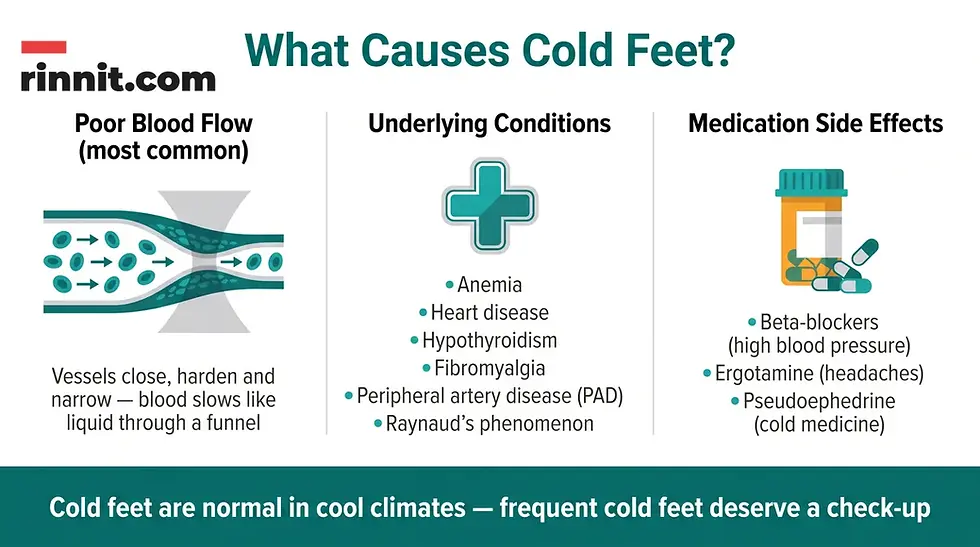
Your blood travels through pathways (blood vessels) in your circulatory system. These pathways can close, harden and narrow, making it difficult for blood to flow steadily [4]. If your pathways are blocked or narrow, the movement of your blood slows down similar to pouring liquid through a funnel. A lot of liquid can enter the funnel, but the funnel narrows, which slows down how fast the liquid moves. This delay in blood flow causes symptoms of cold feet.
What Conditions Cause Cold Feet as a Symptom?
Cold feet could be a sign of an underlying condition. Several conditions that affect blood flow include:
Category | Condition |
Blood conditions | Anemia |
Heart conditions | Heart disease |
Hormonal changes | Hypothyroidism |
Blood vessel problems | Narrow artery blockages or constricted blood vessels |
Nerve and pain conditions | Fibromyalgia |
Artery disease | Peripheral artery disease (PAD) |
Circulation conditions | Raynaud's phenomenon |
Can Medicines Cause Cold Feet?
Some medicines could cause cold feet as a side effect based on how the medicine interacts with your blood flow [4]. Medicines that could cause cold feet include:
Medicine | Used For |
Beta-blockers | High blood pressure |
Ergotamine | Headaches |
Pseudoephedrine | Cold medicine |
How Are Cold Feet Diagnosed?
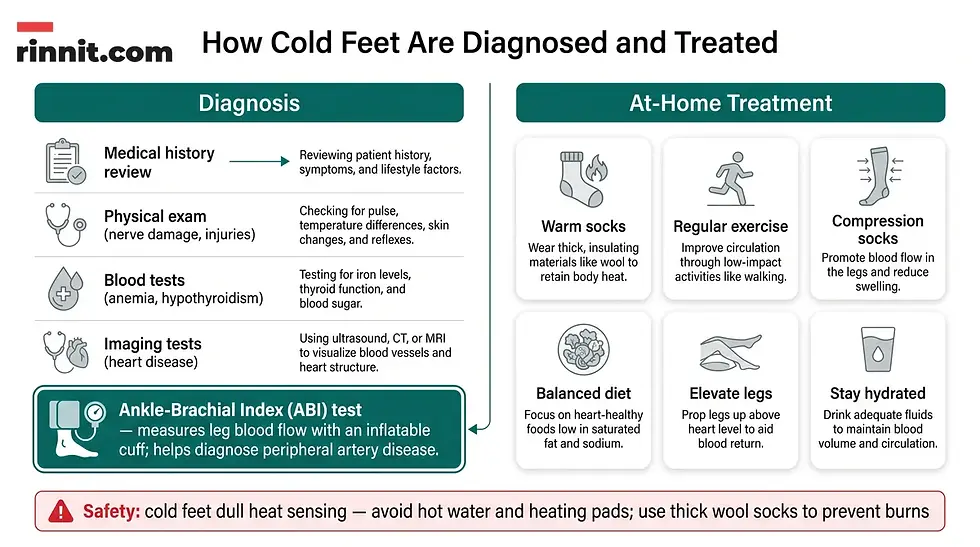
Since symptoms of cold feet can relate to other conditions or medications you currently take, your provider will begin your diagnosis by gathering information about your medical history. A physical exam will follow, where your provider will look for nerve damage or any injuries that could cause cold feet. Your provider will offer tests to rule out any conditions that might cause cold feet as a symptom, like a blood test to detect anemia or hypothyroidism or imaging tests to rule out heart disease [4].
Your provider might use an ankle-brachial index (ABI) test to measure blood flow in your legs, using an inflatable blood pressure cuff. An ABI helps diagnose peripheral artery disease, which causes cold feet as a symptom [1] [4].
Even if you have cold feet that happen every once in a while, it's important to talk with your healthcare provider to make sure your symptoms are temporary and not a sign of an underlying condition.
How Are Cold Feet Treated?
There are several ways to treat cold feet. You can treat cold feet by managing any underlying medical conditions that cause cold feet as a symptom. If your cold feet are a symptom of a medication you're taking, don't stop taking the medicine. Instead, talk with your provider about your symptoms and they will decide whether you should continue taking the medicine or not [4].
You can take steps to treat your cold feet at home by:
At-Home Step | How It Helps |
Wearing warm socks | Warms your feet directly |
Exercising regularly | Supports healthy blood flow |
Wearing compression socks or stockings | Can ease vein-related swelling, but check with your provider first, because compression can be harmful if poor artery flow (PAD) is causing your cold feet |
Eating a healthy, well-balanced diet | Supports overall vascular health |
Elevating your legs with a pillow when lying down | Supports circulation |
Staying hydrated and drinking water | Supports circulation |
Are There Side Effects of the Treatment?
If you have cold feet, it may take longer for your nerves to tell you when they encounter too much heat. This could lead to burns from water that is too hot or heating pads [4]. The safest alternative to warming cold feet is to wear thick socks, like wool socks, to prevent burns [4].
How Soon After Treatment Will I Feel Better?
The time frame of when you'll feel better depends on diagnosing and treating what caused your symptoms of cold feet. Some people will feel better immediately by putting on warm socks. Other people might still feel cold, even if they're wearing warm socks until the underlying cause of their symptoms receives treatment [4]. Talk to your provider about a treatment option that is unique to your symptoms to prevent you from experiencing cold feet.
What Can I Expect If I Have Cold Feet?
Cold feet are normal to experience every once in a while, and warm socks and movement can help blood flow to your feet. Persistent cold feet could be a sign of an underlying condition. When your feet get cold, put on a pair of warm socks and take a short walk or move around to help blood flow to your feet. If your symptoms are the result of an underlying condition, work with your provider to manage or treat the condition that causes your symptoms to prevent your feet from being cold all the time.
How Can I Reduce My Risk of Getting Cold Feet?
Cold feet can be made less likely with a few simple everyday habits.
Prevention Step | How It Helps |
Avoiding caffeine | Reduces a risk factor for cold feet symptoms |
Exercising | Supports healthy circulation |
Managing underlying conditions | Addresses the root cause |
Moving around regularly | Avoids sitting all day, which supports blood flow |
Not smoking or using tobacco products | Protects your blood vessels |
Not walking around barefoot | Keeps your feet warmer |
When Should I See My Healthcare Provider?
Talk to your provider if you experience cold feet regularly and at-home treatment doesn't work. Remember that having cold feet is normal, but you shouldn't ignore symptoms of cold feet that happen frequently.
Seek care immediately: If you experience numbness, severe pain, or sores on your feet that won't heal, or you can't feel your feet when you touch them, talk to your healthcare provider immediately [4]. If one foot or leg suddenly turns cold, pale or blue and becomes painful or numb, call 911 or your local emergency number, because this can mean a blocked artery.
What Questions Should I Ask My Doctor?
Helpful questions to ask your provider include: Are my cold feet a sign of an underlying condition? How do I take care of my feet at home? Are compression socks or stockings right for me? How often do I need to follow the treatment you recommended?
What is the bottom line on cold feet?
Cold feet happen when your feet are at a lower temperature than the rest of your body, and occasional cold feet are normal, especially if you live in a cooler climate. The most common cause is poor blood flow in your legs and feet [4]: blood vessels can close, harden, and narrow, slowing circulation the way a funnel narrows the flow of liquid. Cold feet can also be a symptom of an underlying condition, including anemia, heart disease, hypothyroidism, fibromyalgia, peripheral artery disease, and Raynaud's phenomenon, or a side effect of medicines like beta-blockers, ergotamine, and pseudoephedrine [4].
Typical symptoms include cold feet, mild throbbing pain, slow warming, color changes (pale, red, blue, or purple), and cold feet at night. Diagnosis involves a medical history review, physical exam, blood tests, imaging tests, and an ankle-brachial index (ABI) test [4]. Treatment targets the underlying cause and adds at-home steps: warm socks, regular exercise, compression socks, a balanced diet, leg elevation, hydration, moving regularly, avoiding caffeine and tobacco, and not going barefoot. One important safety note: cold feet can dull your nerves' heat warning, so skip the hot water and heating pads [4]. Thick wool socks are the safest way to warm up. If your cold feet are frequent and at-home care doesn't help, talk to your provider. And if you ever develop numbness, severe pain, non-healing sores, or loss of feeling in your feet, contact your healthcare provider immediately.
Frequently Asked Questions
What are cold feet?
Cold feet happen when your feet are at a lower temperature than the rest of your body. For example, your hands could be warm, while your feet feel like you walked barefoot in the snow.
Are cold feet normal?
Yes. Cold feet are a normal occurrence, especially if you live in cooler climates. It's normal and common to get cold feet every once in a while.
What is the most common cause of cold feet?
The most common cause of cold feet is poor blood flow in your legs and feet.
Who do cold feet affect?
Cold feet can affect anyone. They're more common among people who have autoimmune conditions, circulation problems, conditions that affect the hormones, and conditions that affect the nervous system.
Why do cold feet happen in cold climates?
Cold feet are a normal occurrence, especially if you live in cooler climates. If you live in a cold climate, you could experience cold feet frequently.
Why is my body warm but my feet cold?
When you're exposed to cold temperatures, your feet and hands are the first to get cold, but your chest and torso are still warm. Since your feet are furthest away from your heart, it takes longer for your blood to circulate through the limbs of your body, causing your hands and feet to take longer to warm up.
How does poor blood flow cause cold feet?
Poor blood flow in your legs and feet means it takes longer for the blood to reach your feet. Blood travels through pathways (blood vessels) in your circulatory system. These pathways can close, harden and narrow, making it difficult for blood to flow steadily.
What does the funnel analogy mean for blood flow?
If your blood vessels are blocked or narrow, the movement of your blood slows down similar to pouring liquid through a funnel. A lot of liquid can enter the funnel, but the funnel narrows, which slows down how fast the liquid moves. This delay in blood flow causes symptoms of cold feet.
What conditions cause cold feet as a symptom?
Anemia, heart disease, hormonal changes (hypothyroidism), narrow artery blockages or constricted blood vessels, fibromyalgia, peripheral artery disease, and Raynaud's phenomenon.
What is anemia in this context?
Anemia is a condition in which you don't have enough healthy red blood cells. It can cause cold feet as a symptom.
What is hypothyroidism?
A hormonal change that can cause cold feet as a symptom.
What is fibromyalgia?
A chronic pain condition that can cause cold feet as a symptom.
What is peripheral artery disease (PAD)?
A condition involving narrow artery blockages or constricted blood vessels that causes cold feet as a symptom.
What is Raynaud's phenomenon?
A condition affecting blood flow that causes cold feet as a symptom.
Can medicines cause cold feet?
Yes. Some medicines could cause cold feet as a side effect based on how the medicine interacts with your blood flow.
What medicines can cause cold feet?
Beta-blockers for high blood pressure, ergotamine for headaches, and pseudoephedrine in cold medicine.
What are beta-blockers?
Medicines used for high blood pressure that can cause cold feet as a side effect.
What is ergotamine?
A medicine used for headaches that can cause cold feet as a side effect.
What is pseudoephedrine?
An ingredient in cold medicine that can cause cold feet as a side effect.
Should I stop my medicine if it causes cold feet?
No. If your cold feet are a symptom of a medication you're taking, don't stop taking the medicine. Instead, talk with your provider about your symptoms and they will decide whether you should continue taking the medicine or not.
What are the symptoms of cold feet?
Feet at a lower temperature than the rest of your body, mild throbbing pain in your feet and toes, feet that take longer to warm up, feet a different color (pale, red, blue or purple) than the rest of your body, and cold feet during specific hours of the day, like at night.
Why do my feet change color when they're cold?
Cold feet can cause your feet to be a different color (pale, red, blue or purple) than the rest of your body.
Why are my feet cold at night?
Cold feet can happen during specific hours of the day, like at night. Symptoms appear once in a while, or happen consistently when temperatures in your environment drop.
Can cold feet hurt?
Yes. You might experience mild, throbbing pain in your feet and toes. You might experience mild pain in your feet until your feet can warm up to the same temperature as the rest of your body.
How are cold feet diagnosed?
Your provider begins by gathering information about your medical history, since symptoms can relate to other conditions or medications you take. A physical exam follows, where your provider looks for nerve damage or injuries that could cause cold feet.
What tests detect the conditions behind cold feet?
Your provider will offer tests to rule out conditions that might cause cold feet as a symptom, like a blood test to detect anemia or hypothyroidism or imaging tests to rule out heart disease.
What is an ankle-brachial index (ABI) test?
A test that measures blood flow in your legs, using an inflatable blood pressure cuff. An ABI helps diagnose peripheral artery disease, which causes cold feet as a symptom.
How is peripheral artery disease diagnosed?
An ankle-brachial index (ABI) test helps diagnose peripheral artery disease.
Should I see a doctor for occasional cold feet?
Even if you have cold feet that happen every once in a while, it's important to talk with your healthcare provider to make sure your symptoms are temporary and not a sign of an underlying condition.
When should I see my healthcare provider?
Talk to your provider if you experience cold feet regularly and at-home treatment doesn't work. Remember that having cold feet is normal, but you shouldn't ignore symptoms of cold feet that happen frequently.
When should I contact my provider immediately?
If you experience numbness, severe pain, or sores on your feet that won't heal, or you can't feel your feet when you touch them, talk to your healthcare provider immediately.
How are cold feet treated?
You can treat cold feet by managing any underlying medical conditions that cause cold feet as a symptom, and by taking at-home steps like wearing warm socks, exercising regularly, and staying hydrated.
What are the at-home treatments for cold feet?
Wearing warm socks, exercising regularly, wearing compression socks or stockings, eating a healthy well-balanced diet, elevating your legs with a pillow when lying down, and staying hydrated and drinking water.
Do compression socks help cold feet?
Sometimes. Compression socks can help vein-related swelling, but they can be harmful if peripheral artery disease is the cause, so ask your provider before using them.
Does exercise help cold feet?
Yes. Exercising regularly is one of the at-home steps to treat cold feet.
Does diet affect cold feet?
Yes. Eating a healthy, well-balanced diet is one of the at-home steps to treat cold feet.
Does elevating my legs help cold feet?
Yes. Elevating your legs with a pillow when lying down is one of the at-home steps to treat cold feet.
Does drinking water help cold feet?
Yes. Staying hydrated and drinking water is one of the at-home steps to treat cold feet.
Can warming my feet cause burns?
Yes, this is an important safety point. If you have cold feet, it may take longer for your nerves to tell you when they encounter too much heat. This could lead to burns from water that is too hot or heating pads.
What is the safest way to warm cold feet?
The safest alternative to warming cold feet is to wear thick socks, like wool socks, to prevent burns.
How soon will I feel better after treatment?
The time frame depends on diagnosing and treating what caused your symptoms. Some people feel better immediately by putting on warm socks. Others might still feel cold, even wearing warm socks, until the underlying cause receives treatment.
What can I expect if I have cold feet?
It's normal to experience cold feet every once in a while. Persistent cold feet could be a sign of an underlying condition. When your feet get cold, put on warm socks and take a short walk or move around to help blood flow to your feet.
How can I prevent cold feet?
You can reduce your risk by avoiding caffeine, exercising, managing underlying conditions, moving around regularly (avoiding sitting all day), not smoking or using tobacco products, and not walking around barefoot.
Does caffeine cause cold feet?
Avoiding caffeine is one of the ways to reduce your risk of experiencing symptoms of cold feet.
Does smoking affect cold feet?
Yes. Not smoking or using tobacco products is one of the ways to reduce your risk of cold feet symptoms.
Does sitting all day cause cold feet?
Moving around regularly and avoiding sitting all day is one of the ways to reduce your risk of cold feet symptoms.
Should I walk barefoot with cold feet?
No. Not walking around barefoot is one of the ways to reduce your risk of cold feet symptoms.
What questions should I ask my doctor?
Are my cold feet a sign of an underlying condition? How do I take care of my feet at home? Are compression socks or stockings right for me? How often do I need to follow the treatment you recommended?
Can cold feet be a sign of a serious condition?
Yes. There are a lot of reasons why your feet could be cold, ranging from cold climates to a sign of a serious medical condition. Persistent cold feet could be a sign of an underlying condition.
Are cold feet the same as Raynaud's phenomenon?
No. Raynaud's phenomenon is one of several conditions that can cause cold feet as a symptom.
How do I know if my cold feet are temporary?
The time frame depends on diagnosing and treating what caused your symptoms. Talk to your provider about a treatment option that is unique to your symptoms to prevent you from experiencing cold feet.
Related Reading
References
Rosado-Fonseca M, et al. Pedal acceleration time as a diagnostic and prognostic tool in peripheral artery disease: systematic review and meta-analysis. BMC Med Imaging. 2026;26(1). PMID 42426635. https://doi.org/10.1186/s12880-026-02493-y
Puljevic M, et al. Durability of Exercise vs. Revascularization in Intermittent Claudication: An Updated Meta-Analysis of Randomized Trials Focusing on Patient-Centered Outcomes. Healthcare (Basel). 2026;14(2):170. PMID 41595306. https://doi.org/10.3390/healthcare14020170
Besag FMC, et al. Raynaud Syndrome Associated with Medication for Attention-Deficit/Hyperactivity Disorder: A Systematic Review. CNS Drugs. 2025;39(3):213-241. PMID 39875750. https://doi.org/10.1007/s40263-024-01154-4
Cleveland Clinic. Cold Feet Causes & Treatment. Cleveland Clinic. Last updated May 19, 2022. https://my.clevelandclinic.org/health/diseases/23045-cold-feet
Medical disclaimer
This article is for general informational purposes only and is not a substitute for professional medical advice, diagnosis, or treatment. Always seek the advice of your physician or other qualified health provider with any questions you may have regarding a medical condition. Never disregard professional medical advice or delay seeking it because of something you have read here. If you experience numbness, severe pain, sores on your feet that won't heal, or loss of feeling in your feet when you touch them, contact your healthcare provider immediately. Warming devices such as very hot water or heating pads can cause burns if your feet cannot sense heat properly. Thick wool socks are the safest way to warm up.



Comments