Clear Cell Sarcoma: What It Is, Why It Happens, and How It's Treated

Updated: 2 days ago
Medically reviewed by Dr. Baraa Alnahhal, MD · Last reviewed: October 2026
Quick Answer
Clear cell sarcoma is a very rare soft tissue sarcoma that typically starts in the lower legs or feet, often as a lump under the skin that does not go away. It is caused by an EWSR1 and ATF1 gene fusion. Treatment is surgery, usually followed by radiation therapy. It can recur, so regular checkups are needed. [4]
What the research says
According to PubMed, studies of clear cell sarcoma are small because the cancer is so rare. Key findings:
Survival is better when the cancer is caught early and the tumor is small. A 2019 analysis of the U.S. SEER database (175 patients diagnosed from 1973 to 2009) found a 5-year survival rate of 62.9% and a 10-year survival rate of 51.3%. Local stage and a tumor size of 3 cm or less were linked to better survival. (Li et al., Med Sci Monit, 2019) [1]
Spread to the lymph nodes is relatively common. A 2026 SEER study of 9,682 adults with four soft tissue sarcoma types found nodal metastasis in 25.8% of staged clear cell sarcoma cases, and nodal spread was linked to worse survival across the group. (Gibson et al., Surg Oncol, 2026) [2]
It is easily confused with melanoma. A case report and literature review describes clear cell sarcoma as a deep tumor with a preference for the lower limbs, especially the foot and ankle. Diagnosis relies on tissue examination and special stains because the tumor looks like melanoma under the microscope. (Abdollahi et al., Int J Hematol Oncol Stem Cell Res, 2018) [3]
Study details are from PubMed abstracts.
What Is Clear Cell Sarcoma?
Clear cell sarcoma is a very rare form of soft tissue sarcoma. Sarcomas are cancers that start in soft tissues, such as the muscles, tendons, and other supportive structures of the body, or in bone. This type causes tumors that typically begin in the soft tissues surrounding and supporting the tendons and muscles of the lower legs or feet. It is also sometimes called melanoma of soft parts [3].
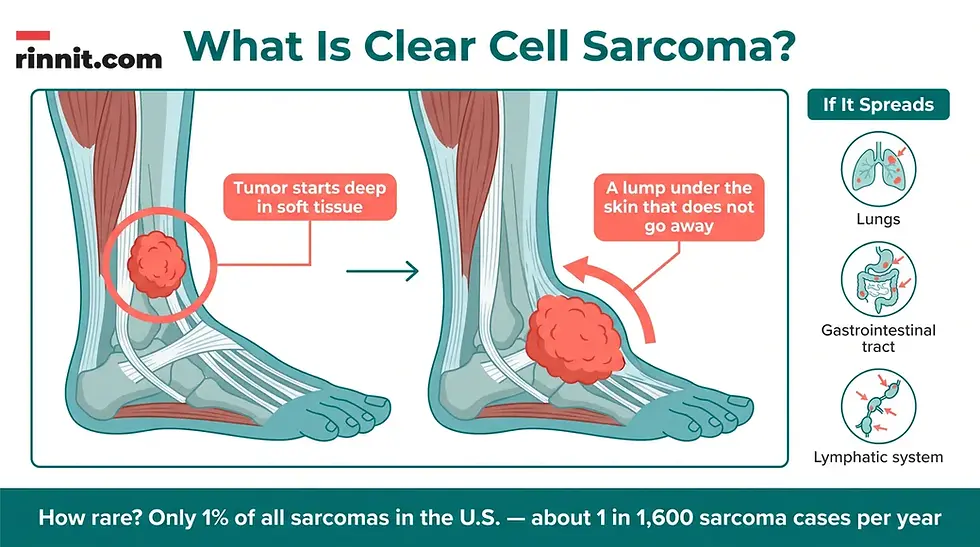
The tumors usually start deep in the body, in the soft tissues that wrap around tendons and muscles or in the fascia. Fascia is the band of stringy tissue that wraps around every structure in your body.
Like many cancers, clear cell sarcoma is easier to treat before it spreads. Healthcare providers treat it with surgery and radiation therapy, and sometimes chemotherapy. It can come back after treatment, which doctors call recurrence. Researchers are investigating new ways to treat it [4]. For related reading on other sarcomas, see our guides to epithelioid sarcoma and Ewing sarcoma.
How Does Clear Cell Sarcoma Affect the Body?
You might not notice any change until the cancer has grown large enough to make a lump under the skin on your foot or leg. The lump can look like one from a hard hit to your leg or foot. The key difference is that this lump does not go away.
Clear cell sarcoma grows slowly. As it moves from the deep soft tissues toward just under the skin, it may also spread to other areas of the body, such as the lungs or the lymphatic system, the network that moves fluid and immune cells through the body [4].
How Rare Is Clear Cell Sarcoma?
Clear cell sarcoma is a very rare subtype of a rare group of cancers. Experts estimate it affects about one person per million each year [4]. Because it is so rare, survival estimates come from pooled studies of small numbers of people.
Who Is Most Likely to Get Clear Cell Sarcoma?
It can occur at any age but most often affects people from their late teens through their 30s [4].
What Are the Symptoms of Clear Cell Sarcoma?
The most common symptom is a lump under the skin on the leg or foot. The lump may not hurt, but it does not go away. You may notice it gets larger over time. [4]
Symptom | What It Looks Like |
Lump under the skin | On the leg or foot; may not hurt; does not go away; may get larger |
Fatigue | Ongoing tiredness that does not improve with rest |
Unexplained weight loss | Losing weight without trying or changing your habits |
Night sweats | Sweating through the night for no clear reason |
What Causes Clear Cell Sarcoma?
Clear cell sarcoma happens when two genes from different chromosomes swap places, creating what researchers call a fused or fusion gene. [4]
The process starts when two chromosomes break apart. The broken sections carry two specific genes. The EWSR1 gene appears to play a role in how cells function. The ATF1 gene helps manage cell growth. The chromosomes rejoin, but now contain genes that do not belong there. Researchers call this swap reciprocal translocation, and they do not know what triggers it.
Once the genes are in their new chromosomal home, they combine to make the fused gene EWSR1/ATF1. Researchers believe the fused gene causes clear cell sarcoma. [4]
Key terms: A gene is a unit of DNA that carries instructions for how the body works. A chromosome is a long strand of DNA that holds many genes. A fusion gene forms when parts of two different genes join together by mistake, and it can drive cancer growth.

How Is Clear Cell Sarcoma Diagnosed?
Healthcare providers may start with a physical exam to determine the tumor's location and approximate size. They may also order magnetic resonance imaging (MRI) scans, which use magnets and radio waves to create detailed pictures of the inside of the body.
Most often, providers diagnose clear cell sarcoma from tissue samples taken during a biopsy, a procedure where a small piece of the lump is removed for testing. Pathologists, doctors who study diseased tissue, examine the samples under a microscope and look for the EWSR1/ATF1 fusion gene. Because the tumor can look like melanoma, this testing is important [3]. [4]
What's the Treatment for Clear Cell Sarcoma?
Treatment focuses on keeping clear cell sarcoma from spreading. Most of the time, surgery removes the tumor and any lymph nodes where the tumor has spread. Next comes adjuvant therapy, treatment given after the main treatment to catch remaining disease, usually radiation therapy to kill any remaining cancer cells.
Researchers are also evaluating other treatments, including immunotherapy, which helps the body's own immune system fight cancer, and drugs now used for other cancers, to see if they can stop clear cell sarcoma from spreading. [4]

Treatment | What It Involves |
Surgery | Removes the tumor and any lymph nodes where the tumor has spread |
Radiation therapy | Adjuvant treatment that kills any remaining cancer cells |
Chemotherapy | Sometimes used as part of treatment |
Immunotherapy | Under evaluation; may do more to control the cancer |
Other cancer drugs | Being tested to see if they can stop the cancer from spreading |
What Should I Expect After Treatment?
Clear cell sarcoma can come back or develop in a new area of the body, sometimes many years later. Recurrence may require more surgery and additional radiation therapy. Your healthcare provider will recommend regular checkups, including MRIs, to look for signs of new tumors [4].
Can Clear Cell Sarcoma Be Cured?
Early diagnosis and treatment may cure clear cell sarcoma, according to Cleveland Clinic [4]. However, it often isn't found until after it has spread, which makes it harder to treat, and it can return after treatment. Ask your care team what to expect in your situation.
What's the Survival Rate for Clear Cell Sarcoma?
Estimates vary between studies because the cancer is so rare. Cleveland Clinic cites a study in which 57% of people were alive five years after diagnosis [4]. A SEER database analysis of 175 patients reported 5-year survival of 62.9% and 10-year survival of 51.3% [1].
These are estimates, not predictions. Survival rates are based on outcomes of groups of people with this cancer, and many things affect an individual's outlook, including tumor size and whether the cancer has spread. In general, people whose cancer has spread to other parts of the body have a worse outlook than people treated before it spreads. Your healthcare provider is your best resource for what you can expect.
What Questions Should I Ask My Healthcare Provider?
Clear cell sarcoma is very rare and can be life-threatening, so it helps to ask your healthcare provider focused questions after a diagnosis. If you have been diagnosed, you may want to ask:
Where is the tumor?
How big is it?
Has the tumor spread anywhere else in my body?
What treatments do you recommend?
What are the treatment side effects?
If I have surgery, what are the chances the tumor will come back?
Are there clinical trials I should consider?
Clinical trials are research studies where new treatments are tested on people. If you are interested, ask your healthcare provider for help.
What is the bottom line on clear cell sarcoma?
Clear cell sarcoma is a rare and challenging soft tissue cancer that typically starts in the deep tissues of the lower legs or feet and shows up as a lump that does not go away. It is caused by a rare genetic swap that creates the fusion gene EWSR1/ATF1. It is usually treated with surgery followed by radiation therapy, and it can come back, so regular follow-up matters. If you notice a lump on your leg or foot that does not go away, especially if it seems to be growing, see your healthcare provider. Early detection matters because the cancer is easier to treat before it spreads.
Get trusted health answers from Rinnit.com. Our health information is clear, practical, and reviewed for accuracy, so when something unusual shows up on your body, you know what's happening, what to expect, and what questions to ask. Visit rinnit.com.
Frequently Asked Questions
What is clear cell sarcoma?
Clear cell sarcoma is a very rare form of soft tissue sarcoma. It causes tumors that typically start in the soft tissues surrounding the tendons and muscles in the lower legs or feet. [4]
Is clear cell sarcoma cancer?
Yes. It is a type of soft tissue sarcoma, which is a cancer that starts in the body's soft tissues. [4]
How rare is clear cell sarcoma?
Clear cell sarcoma is very rare. Experts estimate it affects about one person per million each year. [4]
Where does clear cell sarcoma usually start?
Clear cell sarcoma typically starts in the deep soft tissues around the tendons and muscles of the lower legs or feet, or in the fascia.
What does a clear cell sarcoma lump feel like?
A clear cell sarcoma lump is a lump under the skin on the leg or foot that may not hurt but does not go away, and it may get larger. It can look like a lump from a hard hit, except this one does not go away. [4]
What are the symptoms of clear cell sarcoma?
The most common symptom is a lump under the skin on the leg or foot. Later, fatigue, unexplained weight loss, and night sweats may appear. [4]
What causes clear cell sarcoma?
Clear cell sarcoma happens when two genes from different chromosomes swap places, creating a fused gene called EWSR1/ATF1. Researchers do not know what triggers this swap. [4]
What are the EWSR1 and ATF1 genes?
The EWSR1 gene appears to play a role in how cells function, and the ATF1 gene helps manage cell growth. When they fuse together, researchers believe the fused gene drives the cancer.
Who is most likely to get clear cell sarcoma?
Clear cell sarcoma can occur at any age but most often affects people from their late teens through their 30s.
How is clear cell sarcoma diagnosed?
Usually through a biopsy, where a tissue sample is taken and examined by a pathologist under a microscope for the EWSR1/ATF1 fusion gene. A physical exam and MRI scans may also be used. [4]
How is clear cell sarcoma treated?
Most often with surgery to remove the tumor and any affected lymph nodes, followed by radiation therapy. Chemotherapy may also be used, and researchers are evaluating immunotherapy and other drugs. [4]
Can clear cell sarcoma be cured?
Early diagnosis and treatment may cure it, according to Cleveland Clinic. It often isn't found until it has spread, and it can return after treatment.
Does clear cell sarcoma come back?
Clear cell sarcoma can. It may return in the same place or develop in a new area, sometimes years later, which is why regular checkups and MRIs are recommended. [4]
Where does clear cell sarcoma spread?
Clear cell sarcoma may spread to the lungs or the lymphatic system. [4]
What is the survival rate for clear cell sarcoma?
Estimates vary. One study cited by Cleveland Clinic found 57% of people alive at five years, and a SEER analysis of 175 patients found 62.9% at five years and 51.3% at ten years. These are population estimates, not individual predictions. [4] [1]
Can clear cell sarcoma be fatal?
Clear cell sarcoma can be. People whose cancer has spread to other parts of the body generally have a worse outlook than people whose cancer was treated before it spread.
Why doesn't the lump go away like a bruise lump?
Because it is cancer, not an injury. A lump from a hard hit heals and disappears, but a clear cell sarcoma lump persists and may grow.
What should I do if I find a lump on my leg or foot?
See your healthcare provider, especially if the lump does not go away or seems to grow. Early detection matters because the cancer is easier to treat before it spreads.
What questions should I ask my provider after diagnosis?
Ask where the tumor is, how big it is, whether it has spread, what treatments are recommended, what side effects to expect, the chances of recurrence, and whether clinical trials are an option.
Related Reading
References
Li AB, Jiang BJ, Wang HH, et al. Prognostic Factors for Survival in Patients with Clear Cell Sarcoma: An Analysis of the Surveillance, Epidemiology, and End Results (SEER) Database. Med Sci Monit. 2019;25:6950-6956. PMID 31522190. https://doi.org/10.12659/MSM.916705
Gibson J, Thompson B, Chapala S, et al. Lymph node metastasis in high-risk soft tissue sarcoma: Predictors and survival in a population-based SEER study. Surg Oncol. 2026;68:102523. PMID 42612459. https://doi.org/10.1016/j.suronc.2026.102523
Abdollahi A, Khatami F, Tavangar SM. Clear Cell Sarcoma: A Case Report and Review of Literature. Int J Hematol Oncol Stem Cell Res. 2018;12(1):65-68. PMID 29951180. https://pubmed.ncbi.nlm.nih.gov/29951180/
Cleveland Clinic. Clear Cell Sarcoma. Cleveland Clinic. Last updated September 8, 2026. https://my.clevelandclinic.org/health/diseases/24150-clear-cell-sarcoma
Medical disclaimer
This article is for general informational purposes only and is not a substitute for professional medical advice, diagnosis, or treatment. Always seek the advice of your physician or other qualified health provider with any questions you may have regarding a medical condition. Never disregard professional medical advice or delay seeking it because of something you have read here.



Comments