Ewing Sarcoma: Symptoms, Causes, and Treatment

Updated: 2 days ago
Medically reviewed by Dr. Baraa Alnahhal, MD · Last reviewed: October 17, 2026
Quick Answer
Ewing sarcoma is a cancer that begins as a growth of cells in the bones and the soft tissue around them, mostly in children and young adults. [1] Symptoms include a lump, bone pain, swelling or a broken bone, sometimes with fever and weight loss. [1] It is most often treated with chemotherapy and surgery, sometimes with radiation or targeted therapy.
What the research says
Giving chemotherapy every 2 weeks instead of every 3 improved long-term survival. In a randomized trial of 568 eligible patients with localized Ewing sarcoma, 10-year event-free survival was 70% with the shorter interval versus 61% with the standard interval, and 10-year overall survival was 76% versus 69%, with no difference in second cancers (Cash et al., J Clin Oncol, 2023). [6]
A large European trial favored the vincristine-doxorubicin-cyclophosphamide/ifosfamide-etoposide (VDC/IE) regimen. Among 640 patients, 3-year event-free survival was 67% with VDC/IE versus 61% with the European VIDE-based regimen, and grade 3-5 febrile neutropenia occurred in 58% versus 74% of patients (Brennan et al., Lancet, 2022). [7]
Adding a targeted drug did not improve outcomes in newly diagnosed metastatic disease. In 298 eligible patients, 3-year event-free survival was 37.4% with standard chemotherapy and 39.1% with added ganitumab (hazard ratio 1.00), and the drug may add toxicity (DuBois et al., J Clin Oncol, 2023). [8]
Key Facts at a Glance
Fact | Detail |
Definition | Cancer starting in bones or the soft tissue around bones [1] |
Pronunciation | Yoo-ing sar-KOH-muh |
Who it affects | Mostly children and young adults; any age possible [1] |
Common sites | Leg bones and pelvis; can happen in any bone [1] |
Risk factors | Young age; European ancestry; no known way to prevent it [1] |
Main tests | X-ray, MRI, CT, bone scan, PET scan, biopsy with DNA testing [2] |
Main treatment | Chemotherapy and surgery; radiation and targeted therapy as options |
Where it spreads | Most often the lungs and other bones [3] |
What Is Ewing Sarcoma?
Ewing sarcoma is a type of cancer that begins as a growth of cells in the bones and the soft tissue around the bones. [1] It mostly happens in children and young adults, although it can happen at any age. [1]
The cancer most often begins in the leg bones and in the pelvis, but it can happen in any bone. [1] Less often, it starts in the soft tissues of the chest, abdomen, arms, or other locations.

Major advances in the treatment of Ewing sarcoma have improved the outlook for this cancer. [1] Young people diagnosed with Ewing sarcoma are living longer. They sometimes face late effects from the strong treatments, and healthcare professionals often suggest long-term monitoring for side effects after treatment.
Symptoms
Ewing sarcoma signs and symptoms typically start in and around a bone. [1] This cancer most often affects bones in the legs and the pelvis. [1]
When symptoms happen in and around a bone, they might include:
Sometimes Ewing sarcoma causes symptoms that affect the whole body. These can include:
When to See a Doctor
These symptoms are common in growing children and active young adults and are far more likely to have everyday causes such as sports injuries, growing pains, or infections. But the right move is simple: make an appointment with a healthcare professional if you or your child has ongoing signs and symptoms that worry you. Pain that persists or worsens, especially pain at night or pain with a lump, deserves a proper evaluation.

Causes
It is not clear what causes Ewing sarcoma. [1]
Ewing sarcoma happens when cells develop changes in their DNA. [1] A cell's DNA holds the instructions that tell a cell what to do. [1] In healthy cells, the DNA gives instructions to grow and multiply at a set rate, and tells the cells to die at a set time.
In cancer cells, the DNA changes give different instructions. The changes tell the cancer cells to make many more cells quickly, and cancer cells can keep living when healthy cells would die. [1]
The cancer cells might form a mass called a tumor. [1] The tumor can grow to invade and destroy healthy body tissue. [1] In time, cancer cells can break away and spread to other parts of the body. When cancer spreads, it is called metastatic cancer. [1]
In Ewing sarcoma, the DNA changes most often affect a gene called EWSR1 [1]. If a healthcare professional suspects Ewing sarcoma, the cancer cells may be tested to look for changes in this gene. [2]
Risk Factors
Risk factors for Ewing sarcoma include:
There is no way to prevent Ewing sarcoma. [1]
Complications
Complications of Ewing sarcoma and its treatment include the following.
Cancer that spreads. Ewing sarcoma can spread from where it started to other areas. It most often spreads to the lungs and to other bones. [3]
Long-term treatment side effects. The strong treatments needed to control Ewing sarcoma can cause major side effects, both in the short and long term. [2] A healthcare team can help manage the side effects that happen during treatment, and can provide a list of side effects to watch for in the years after treatment.
How Ewing Sarcoma Is Diagnosed
Ewing sarcoma diagnosis usually begins with a physical exam. Based on the findings of the exam, there might be other tests and procedures.
Imaging tests. Imaging tests make pictures of the body. They can show the location and size of the Ewing sarcoma. Tests might include X-ray, MRI, CT, bone scan, and positron emission tomography (PET) scan. [2]
Biopsy. A biopsy removes a sample of tissue for testing in a lab. The tissue might be removed using a needle passed through the skin and into the cancer. [2] Sometimes surgery is needed to get the tissue sample. [2] The sample is tested in a lab to see if it is cancer, and other special tests give more details about the cancer cells. A biopsy is needed to confirm an Ewing sarcoma diagnosis, and the healthcare team uses this information to make a treatment plan. [2]
DNA testing of the cancer cells. A sample of the cancer cells is tested in the lab to find which DNA changes are in the cells. Ewing sarcoma cells mostly have changes in the EWSR1 gene. Most often, the EWSR1 gene joins with another gene called FLI1, which creates a new gene called EWS-FLI1. Testing for these gene changes can help confirm the diagnosis. [2]
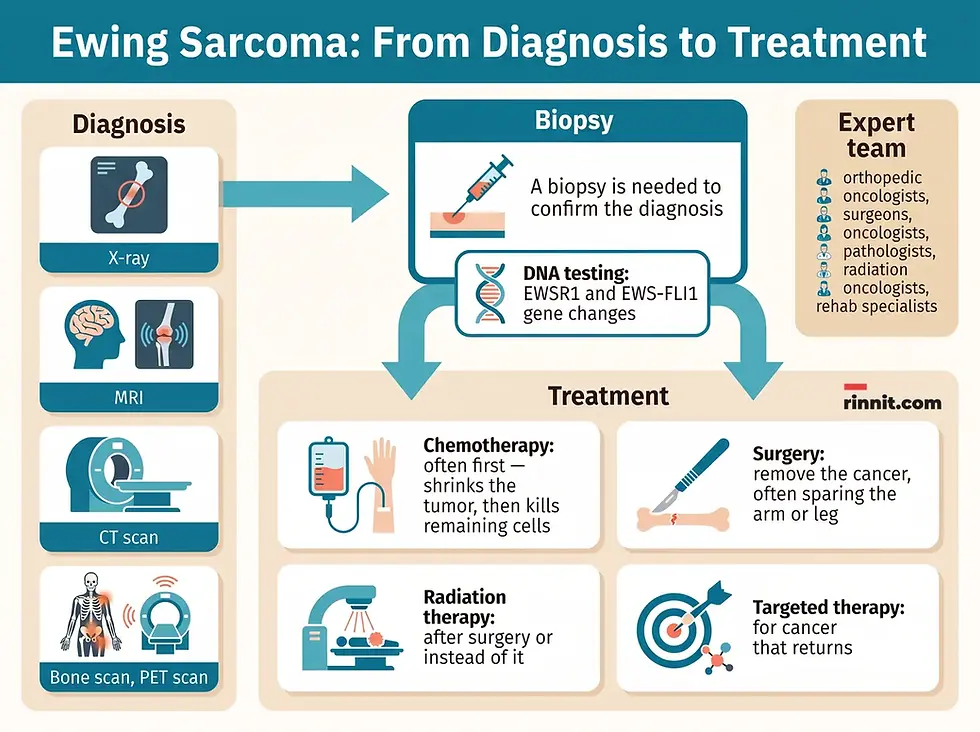
Treatment
Ewing sarcoma treatment most often includes chemotherapy and surgery. Which treatment comes first depends on the situation. Other treatment options might include radiation therapy and targeted therapy.
Care is typically delivered by a team of specialists. This team may include orthopedic surgeons who specialize in operating on bone cancers (orthopedic oncologists), other surgeons such as chest or pediatric surgeons depending on the cancer's location and the person's age, medical oncologists or pediatric oncologists, pathologists who study tissue to diagnose the cancer type, radiation oncologists, and rehabilitation specialists who help with recovery after surgery. [2]
Chemotherapy
Chemotherapy treats cancer with strong medicines. [2] It is sometimes used as the first treatment for Ewing sarcoma, because the medicines may shrink the cancer, making it easier to remove with surgery or target with radiation therapy. [2] [3]
After surgery or radiation therapy, chemotherapy treatments might be used to kill any cancer cells that might remain. [2] For advanced cancer that has spread to other areas of the body, chemotherapy might help relieve pain and slow the growth of the cancer.
Surgery
The goal of surgery is to remove all the cancer cells. [2] Surgery for Ewing sarcoma might mean removing a small portion of bone and some surrounding tissue. [2] Rarely, it might mean removing the affected arm or leg. [2]
Surgery on an arm or leg might affect how well you can use that limb. [2] Surgeons carefully plan the surgery to minimize this risk when possible.
Whether surgeons can remove all the cancer without removing the arm or leg depends on several factors, including the size of the cancer, where it is, and whether chemotherapy helps shrink it. [2]
Radiation Therapy
Radiation therapy treats cancer with powerful energy beams. [2] The energy can come from X-rays, protons, or other sources. [2] During treatment, the person lies on a table while a machine moves around them, directing radiation to precise points on the body. [2]
Radiation therapy might be suggested after surgery to kill cancer cells that remain. It might be used instead of surgery if an operation is not possible or if it is likely to hurt nearby organs, for example, if the surgery might cause loss of bowel or bladder control.
For advanced Ewing sarcoma, radiation therapy can slow the growth of the cancer and help relieve pain.
Targeted Therapy
Targeted therapy uses medicines that attack specific ways that cancer cells can grow. By blocking these specific things in the cells, targeted treatments can cause cancer cells to die.
For Ewing sarcoma, researchers are looking at using targeted therapy when the cancer comes back or does not respond to other treatments. [2]
Clinical Trials
Clinical trials are studies of new treatments that provide a chance to try the latest options. The risk of side effects might not be known. [2] It is worth asking the healthcare team whether you or your child might be able to join a clinical trial.
Coping and Support
A diagnosis of Ewing sarcoma can feel overwhelming, and with time you will find ways to cope with the distress and uncertainty of cancer. Practical steps include learning about Ewing sarcoma and its treatment options to make decisions about care, and, if a child has the cancer, asking the healthcare team to guide you in talking to your child about it in a caring way the child can understand.
Keeping close relationships strong helps with daily tasks and emotional support. Professional mental health support from a counselor, medical social worker, or psychologist can also help, and cancer organizations such as the American Cancer Society list support services worth exploring.
Preparing for Your Appointment
If signs and symptoms worry you, start by making an appointment with a healthcare professional for you or your child. If Ewing sarcoma is suspected, ask to be referred to an experienced specialist.
What you can do: make a list of signs and symptoms, including any that seem unrelated to the reason for the appointment, and when they began; list all medicines you or your child takes, including vitamins and herbal supplements, with doses; note key personal information such as major stresses or recent life changes; bring scans or X-rays, both the images and the reports, plus any other medical records linked to the condition; make a list of questions; and take a relative or friend to the appointment to help remember what you hear.
Useful questions include: What type of cancer is this? Has the cancer spread? Are more tests needed? What are the treatment options? What are the chances that treatment will cure this cancer? What are the side effects and risks of each option? Will treatment affect the ability to have children, and are there ways to preserve that ability? What printed material or websites do you recommend?
What to expect from your doctor: questions about what symptoms worry you, when you noticed them, whether they are constant or come and go, how severe they are, and what seems to improve or worsen them.
Conclusion
Ewing sarcoma is a bone cancer that mostly strikes children and young adults, and its signature is where it begins: most often the leg bones and the pelvis, sometimes any other bone or nearby soft tissue. Its earliest signals are easy to dismiss: bone pain, a lump, a fracture, or swelling near a joint. Because these overlap so heavily with growing pains and sports injuries, the deciding factor is persistence. Symptoms that continue, worsen, or wake a child at night are the ones that deserve imaging and, if needed, a biopsy.
There is real reason for optimism. Treatment advances have steadily improved the outlook, and young people diagnosed with Ewing sarcoma are living longer. Modern care is a coordinated effort: chemotherapy to shrink the tumor, surgery to remove it, radiation and targeted therapy when they fit the situation, delivered by a multidisciplinary team and followed by long-term monitoring for late effects. Anyone with ongoing bone pain or an unexplained lump, in themselves or in a child, should get it checked; early diagnosis remains the most powerful step.
Take Action: What to Do Next
If you or your child has ongoing bone pain, a growing lump, or a fracture from a minor injury, schedule an appointment with a healthcare professional, who can refer you to an experienced specialist.
When you go, bring any prior scans or X-rays (images and reports), a written symptom list, your medicines and doses, a relative or friend, and your questions.
FAQ: Ewing Sarcoma
What is Ewing sarcoma?
Ewing sarcoma is a type of cancer that begins as a growth of cells in the bones and the soft tissue around the bones. [1] It mostly happens in children and young adults, although it can happen at any age. [1] It most often starts in the leg bones and the pelvis but can occur in any bone. [1]
What are the symptoms of Ewing sarcoma?
Signs typically start in and around a bone and may include a lump in the arm, leg, chest, or pelvis; bone pain; a broken bone; and pain, swelling, or tenderness near the affected area. [1] Sometimes whole-body symptoms occur, including fever, unexplained weight loss, and tiredness. [1]
What causes Ewing sarcoma?
The exact cause is not clear. [1] Ewing sarcoma happens when cells develop changes in their DNA, most often affecting a gene called EWSR1, which joins with the FLI1 gene to create EWS-FLI1. [2] These changes tell cells to multiply quickly and keep living when healthy cells would die, forming a tumor that can grow and spread. [1]
How is Ewing sarcoma treated?
Treatment most often includes chemotherapy and surgery, and which comes first depends on the situation. Radiation therapy and targeted therapy are other options. Care is delivered by a team of specialists including orthopedic oncologists, surgeons, medical or pediatric oncologists, pathologists, radiation oncologists, and rehabilitation specialists. [2]
What are the complications of Ewing sarcoma?
The cancer can spread from where it started, most often to the lungs and other bones. [3] The strong treatments needed to control Ewing sarcoma can also cause major short- and long-term side effects [2], so long-term monitoring after treatment is usually recommended.
Additional Resources
For further reading, these authoritative external references support the information above:
National Cancer Institute. Ewing Sarcoma Treatment (PDQ) — Patient Version
MedlinePlus. Ewing Sarcoma
American Cancer Society. Ewing Sarcoma
National Comprehensive Cancer Network. Bone Cancer
Content reviewed and produced following the Rinnit editorial framework. Last updated: October 13, 2026.
This article is for general educational purposes only and is not a substitute for professional medical advice, diagnosis, or treatment. Always seek the advice of your physician with any questions about a medical condition.
References
Mayo Clinic Staff. Ewing sarcoma: Symptoms and causes. Mayo Clinic. September 30, 2026. https://www.mayoclinic.org/diseases-conditions/ewing-sarcoma/symptoms-causes/syc-20351071
Mayo Clinic Staff. Ewing sarcoma: Diagnosis and treatment. Mayo Clinic. September 30, 2026. https://www.mayoclinic.org/diseases-conditions/ewing-sarcoma/diagnosis-treatment/drc-20351072
National Cancer Institute. Ewing Sarcoma Treatment (PDQ®)–Patient Version. Cancer.gov. Updated February 28, 2025. https://www.cancer.gov/types/bone/patient/ewing-treatment-pdq
National Cancer Institute. Ewing Sarcoma and Undifferentiated Small Round Cell Sarcomas of Bone and Soft Tissue Treatment (PDQ®)–Health Professional Version. Cancer.gov. Accessed October 14, 2026. https://www.cancer.gov/types/bone/hp/ewing-treatment-pdq
National Comprehensive Cancer Network. Bone Cancer. NCCN Guidelines. Accessed October 14, 2026. https://www.nccn.org/guidelines/guidelines-detail?category=1&id=1418
Cash T, Krailo MD, Buxton AB, et al. Long-Term Outcomes in Patients With Localized Ewing Sarcoma Treated With Interval-Compressed Chemotherapy on Children's Oncology Group Study AEWS0031. J Clin Oncol. 2023;41(30):4724-4728. PMID 37651654. https://doi.org/10.1200/JCO.23.00053
Brennan B, Kirton L, Marec-Bérard P, et al. Comparison of two chemotherapy regimens in patients with newly diagnosed Ewing sarcoma (EE2012): an open-label, randomised, phase 3 trial. Lancet. 2022;400(10362):1513-1521. PMID 36522207. https://doi.org/10.1016/S0140-6736(22)01790-1
DuBois SG, Krailo MD, Glade-Bender J, et al. Randomized Phase III Trial of Ganitumab With Interval-Compressed Chemotherapy for Patients With Newly Diagnosed Metastatic Ewing Sarcoma: A Report From the Children's Oncology Group. J Clin Oncol. 2023;41(11):2098-2107. PMID 36669140. https://doi.org/10.1200/JCO.22.01815



Comments