Ciliary Body: The Eye's Internal Command Center for Focus and Health

Updated: 3 days ago
Medically reviewed by Dr. Baraa Alnahhal, MD · Last reviewed: October 2026
Quick Answer
The ciliary body is a part of the eye's uvea located behind the iris. It secretes aqueous humor to nourish the lens and cornea and maintain eye pressure, and it controls the shape of the lens for focusing, rounding it for near vision and flattening it for far vision. Disorders affecting this structure can lead to vision loss or glaucoma. [1]
What the research says
The ciliary body does more than one job. A review of ciliary body imaging describes its functions as producing aqueous humor in the ciliary processes, regulating how that fluid leaves the eye through the uveoscleral pathway, and powering accommodation (focusing) through the ciliary muscle; studies have found a larger ciliary body in myopia and a smaller one with age (Fernández-Vigo et al., European Journal of Ophthalmology, 2022) [2].
Focusing problems after 40 are extremely common. A systematic review, meta-analysis, and modelling study estimated that 1.8 billion people worldwide (25%; 95% CI 23% to 27%) had presbyopia in 2015, and 826 million of them had near vision impairment because they had no, or inadequate, vision correction (Fricke et al., Ophthalmology, 2018) [3].
Uveitis, which can involve the ciliary body, is relatively uncommon but varies widely. A meta-analysis of 49 studies found a pooled incidence of 50.45 cases per 100,000, while prevalence estimates ranged from 9 to 730 cases per 100,000 depending on the population and definitions used (García-Aparicio et al., Ophthalmic Epidemiology, 2021) [4].
Where is the ciliary body located, and what is its anatomy?
The ciliary body is situated behind the iris, which is the colored portion of the eye. It is part of the uvea, a vascular layer that also includes the iris and the choroid. [1] Structurally, the ciliary body is shaped like a ring and features ridges or pleats known as ciliary processes. [1] These processes are essential for secreting fluid and are oriented toward the iris. [1]
The tissue itself consists of an external epithelium that is dark in color and an internal layer that is clear. [1] The ciliary body connects to each side of the iris and uses zonular fibers to provide structural support to the lens. [1] This strategic placement allows it to influence both the internal environment of the eye and the mechanism of visual accommodation. [1]

Figure 1: The ciliary body is positioned behind the iris and connects to the lens via zonular fibers.
What does the ciliary body do?
The ciliary body performs two indispensable tasks that sustain the eye's biological and mechanical functions. First, it produces aqueous humor, a clear fluid that fills the space between the cornea and the iris. [1] This fluid serves as a source of nutrients for the lens and cornea and provides the necessary internal pressure to keep the eye properly inflated. [1]
Second, the ciliary body regulates the eye's ability to focus on objects at different distances. This process, known as accommodation, involves the ciliary muscles. [1] When focusing on near objects, these muscles contract, causing the lens to become more rounded. [1] Conversely, when looking at distant objects, the lens flattens out. [1] This mechanical adjustment is facilitated by the zonular fibers that extend from the ciliary body to the lens. [1]
Function | Description | Key Component |
Aqueous Production | Secretes clear fluid to nourish the eye and maintain pressure | Ciliary Processes |
Accommodation | Adjusts lens shape to focus on near or far objects | Ciliary Muscles |
Structural Support | Holds the lens in place through tension fibers | Zonular Fibers |
Nutrient Delivery | Supplies essential vitamins and minerals to the lens and cornea | Aqueous Humor |
What conditions and disorders affect the ciliary body?
The ciliary body can be affected by several medical issues, including uveitis, tumors and trauma, potentially leading to significant vision impairment. Inflammation of the uvea, known as uveitis, frequently involves the ciliary body. [1] A specific form called iridocyclitis occurs when both the iris and the ciliary body become inflamed, sometimes due to infections or underlying conditions like arthritis. [1]
The ciliary body can also be affected by tumors and cysts. While adenomas are noncancerous, intraocular melanoma is a serious form of cancer that can progress into the ciliary body from the choroid. [1] Additionally, damage to the ciliary body from blunt trauma or chemical exposure can cause detachment, leading to severe complications. [1]
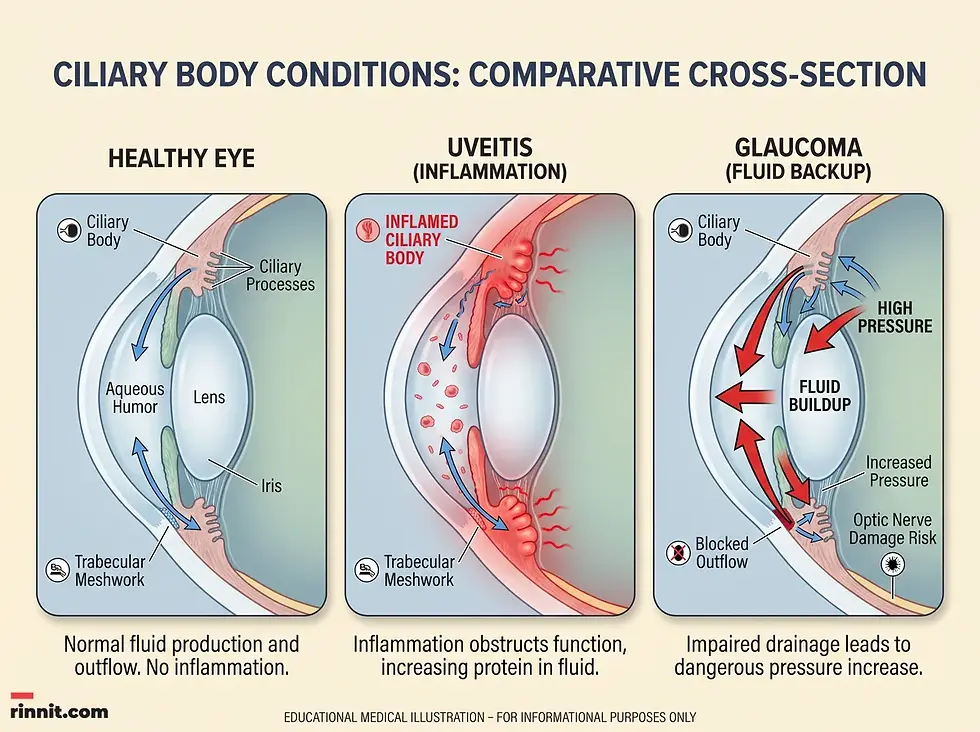
Figure 2: Common disorders affecting the ciliary body include inflammation (uveitis) and impaired fluid drainage (glaucoma).
How can you keep the ciliary body and eyes healthy?
Not all eye conditions are preventable, but certain lifestyle choices can support the health of the ciliary body and the eye as a whole. Regular comprehensive eye exams are crucial for early detection of issues like glaucoma, which is often linked to the ciliary body's fluid production. [1] Adequate lighting during work or reading can also reduce the strain on the ciliary muscles. [1]
A diet rich in vitamins A, C, and E, found in fruits, vegetables, and oily fish, provides the nutrients necessary for eye health. [1] Staying hydrated and avoiding smoking are also recommended, as these habits help maintain the integrity of the vascular system within the eye. [1]

Figure 3: Proactive steps to protect your vision and support the internal structures of the eye.
Conclusion
The ciliary body is a silent but powerful regulator of visual health, managing everything from the pressure inside the eye to the precision of our focus. By producing life-sustaining fluid and mechanically adjusting the lens, it ensures that the eye remains nourished and capable of adapting to the world around us. Protecting this vital structure through regular care and healthy habits is essential for long-term visual clarity.
What are potential next steps for ciliary body and eye health?
Next steps for ciliary body health include scheduling a comprehensive eye exam, eating more leafy greens and oily fish and ensuring proper lighting at your workspace.
Schedule a comprehensive eye exam to check internal eye pressure.
Incorporate more leafy greens and oily fish into your diet for essential eye nutrients.
Ensure your workspace has proper lighting to minimize focusing strain.
Frequently Asked Questions
What is the ciliary body?
The ciliary body is a ring-shaped structure behind the iris that produces eye fluid and controls the lens's ability to focus.
Where is the ciliary body located?
The ciliary body is located behind the iris (the colored part of the eye) and is part of the middle layer of the eye called the uvea.
What are the two main jobs of the ciliary body?
The ciliary body's two main jobs are producing aqueous humor (eye fluid) and changing the shape of the lens to focus on objects.
What is aqueous humor?
Aqueous humor is a clear fluid produced by the ciliary body that provides nutrients to the eye and maintains internal pressure.
How does the ciliary body help with focusing?
The ciliary body uses ciliary muscles to pull or release zonular fibers, which changes the shape of the lens to see near or far objects clearly.
What is uveitis?
Uveitis is the inflammation of the uvea, which includes the ciliary body, iris, and choroid, often causing pain and blurred vision.
Can the ciliary body get cancer?
Yes, intraocular melanoma is a rare but serious cancer that can affect the uvea and progress into the ciliary body.
How does aging affect the ciliary body?
Many researchers believe that changes in ciliary body function are related to presbyopia, the difficulty in focusing on near objects after age 40.
What happens if the ciliary body is injured?
Blunt trauma or chemical injuries can cause the ciliary body to detach, which may lead to serious vision problems or loss.
How can I keep my ciliary body healthy?
You can support eye health by getting regular eye exams, eating a nutrient-rich diet, staying hydrated, and not smoking.
Related Reading
The Fluids of Sight: Understanding Aqueous and Vitreous Humor explains the eye fluid made by the ciliary body and its role.
Understanding the Uvea: The Eye’s Essential Middle Layer describes the eye layer that includes the ciliary body and iris.
Glaucoma: The Silent Threat to Vision, and How Early Treatment Can Protect Your Sight covers how eye pressure damages vision and how it is treated.
Presbyopia: Complete Guide to Age-Related Near Vision Loss, Symptoms, and Treatment Options explains why near focus gets harder with age.
References
Cleveland Clinic. Ciliary Body (Ciliary Body of the Eye: Anatomy and Function). Cleveland Clinic. Medically reviewed; last updated March 17, 2023. https://my.clevelandclinic.org/health/body/24839-ciliary-body
Fernández-Vigo JI, Kudsieh B, Shi H, et al. Diagnostic imaging of the ciliary body: technologies, outcomes, and future perspectives. European Journal of Ophthalmology. 2022;32(1):75-88. PMID 34233517. https://doi.org/10.1177/11206721211031409
Fricke TR, Tahhan N, Resnikoff S, et al. Global prevalence of presbyopia and vision impairment from uncorrected presbyopia: systematic review, meta-analysis, and modelling. Ophthalmology. 2018;125(10):1492-1499. PMID 29753495. https://doi.org/10.1016/j.ophtha.2018.04.013
García-Aparicio Á, García de Yébenes MJ, Otón T, et al. Prevalence and incidence of uveitis: a systematic review and meta-analysis. Ophthalmic Epidemiology. 2021;28(6):461-468. PMID 33557663. https://doi.org/10.1080/09286586.2021.1882506
Medical disclaimer
This article is for general educational purposes only and is not a substitute for professional medical advice, diagnosis or treatment. Always seek the guidance of your eye care professional with any questions about your vision or eye health. If you have sudden vision loss, severe eye pain, or an eye injury, seek emergency care right away.



Comments