Carcinomatosis (Carcinosis): What It Means When Cancer Spreads to Multiple Sites

Updated: 2 days ago
Medically reviewed by Dr. Baraa Alnahhal, MD · Last reviewed: October 2026
Quick answer
Carcinomatosis is an advanced form of metastatic cancer in which cancer spreads and blankets another part of the body with several new tumors [1]. The three main types affect the brain and spinal cord membranes, the lung lymphatic system, or the abdominal lining [1]. In most cases it is not curable, so treatment focuses on easing symptoms and extending quality time [1].
What the research says
According to PubMed:
Imaging: CT is the method of choice for peritoneal carcinomatosis. A radiology review reports that peritoneal carcinomatosis originates mostly from colorectal, gastric, and gynaecological cancers. Ultrasound has low sensitivity and specificity, CT is the method of choice, and MRI is comparable to CT when peritoneal implants are larger than 10 mm (Szadkowska et al., Polish Journal of Radiology, 2023) [6].
Heated chemotherapy improved survival in ovarian cancer — with more complications. In a meta-analysis of 8 randomized trials (1,259 patients), adding HIPEC to cytoreductive surgery improved overall survival (HR 0.79; 95% CI 0.67–0.94), but increased operative time and grade 3–5 adverse events (OR 1.50) (Guerra et al., European Journal of Surgical Oncology, 2025) [7].
In gastric cancer with peritoneal spread, the evidence is still very uncertain. A Cochrane review of 9 randomized trials (829 participants) found that adding intraperitoneal chemotherapy to cytoreductive surgery may improve survival (HR 0.52; 95% CI 0.28–0.96; 2 trials, 173 participants), but the certainty of the evidence was very low (Mu et al., Cochrane Database of Systematic Reviews, 2025) [8].
Study details are from PubMed abstracts.
What is carcinomatosis?
Carcinomatosis (carcinosis) is a condition that happens when cancer in one part of your body spreads, blanketing another part of your body with several new tumors [1]. Carcinomatosis may be the first sign of cancer. More often, it occurs after you've already been living with cancer for a while [1].
A type of metastatic cancer, carcinomatosis is a sign that cancer is in the advanced stages and likely can't be cured [1]. Your healthcare providers may recommend treatment that eases your symptoms and gives you as much time as possible to be with your loved ones [1].
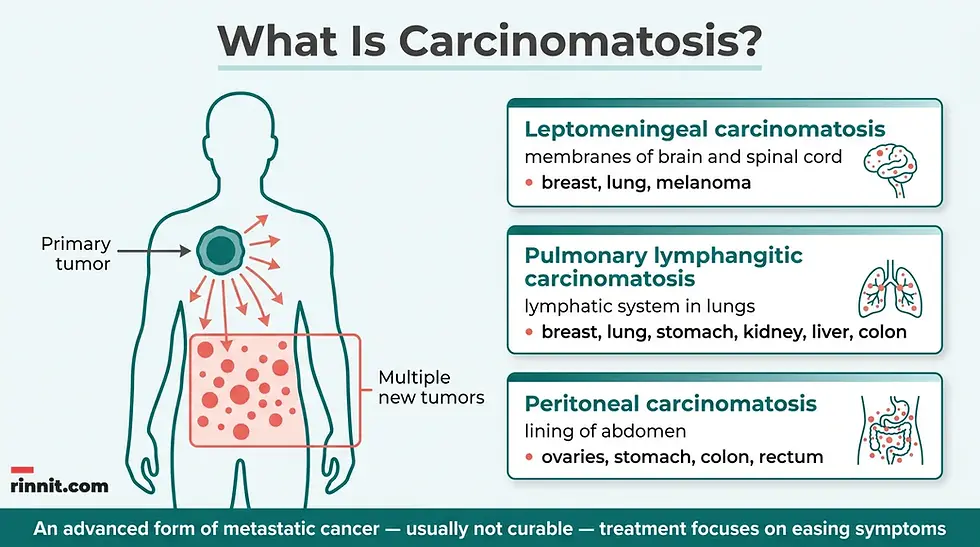
What are the types of carcinomatosis?
There are three common forms of carcinomatosis. Each is associated with different types of cancer:
Type | Where cancer has spread | Cancers that commonly cause it |
Leptomeningeal carcinomatosis | The membranes on your brain and spinal cord | Breast cancer, lung cancer, melanoma [1] |
Pulmonary lymphangitic carcinomatosis | The lymphatic system in your lungs | Cancers that started in the breast, lungs, stomach, kidneys, liver, or colon [1] |
Peritoneal carcinomatosis | The lining of your abdomen (peritoneum) | Cancers that started in the ovaries, stomach, colon, or rectum [1] |
What are the symptoms of carcinomatosis?
Carcinomatosis symptoms vary based on where the cancer has spread. For example, carcinomatosis in your brain causes different symptoms from carcinosis in your lungs or abdomen.

What causes carcinomatosis?
Carcinomatosis happens when a malignant tumor that started in one part of your body spreads to another part. Often, several tumors appear in more than one site [1]. Medical experts don't know why the cancer spreads [1], but carcinosis creates new challenges when it comes to living with cancer.
How is carcinomatosis diagnosed?
If you have carcinosis, you've likely already been coping with cancer. That's why healthcare providers may weigh the benefit of doing tests to confirm you have carcinomatosis against the physical discomfort you might have during them [1].
Tests that check for the various types of carcinomatosis include:
Test | What it shows |
Bronchoscopy | A provider uses a scope to look inside your lungs and may remove a tissue sample to check for cancer cells (biopsy) [1] |
Chest X-ray | Can show signs of swelling in your lungs [1] |
CT scan of your chest | The most common test used to show tumors in your abdomen; can also show signs of tumors in your lungs [1] |
Electrocardiography and echocardiography | Check how your heart is working and can show if lung problems are harming your heart [1] |
Lung V/Q scan | Looks for blood clots in your lungs [1] |
MRI | Can show detailed images of tumors in your brain or abdomen [1] |
PET scan | A radioactive tracer is injected to detect signs of cancer spread to your lungs or abdomen [1] |
Spinal tap | A sample of cerebrospinal fluid (the liquid that surrounds your brain and spinal cord) is collected to check for cancer cells [1] |
Ultrasound of your abdomen or pelvis | Can show fluid build-up in your abdomen (ascites) — most people with peritoneal carcinomatosis have ascites [1] |
How is carcinomatosis treated?
In most cases, carcinomatosis is a sign that cancer has advanced beyond the point of being curable [1]. Your healthcare provider will keep that in mind when recommending treatments. In some cases, your provider might recommend palliative care to help ease symptoms. They may talk to you about hospice care [1].
Treatments that may ease carcinosis symptoms or help you live longer include surgery, radiation therapy, chemotherapy, and targeted therapy and immunotherapy [1].
Treatment | How it may help |
Surgery | |
Radiation therapy | Strong beams of energy that kill cancer cells; may treat tumors causing symptoms in your lungs or brain [1]. |
Chemotherapy | Kills cancer cells throughout your body. Specialized forms treat cancer in your abdomen (HIPEC) and brain (intrathecal chemo) [1]. |
Targeted therapy and immunotherapy | May be recommended if a primary tumor that responds well to them has spread to your brain or spinal cord [1]. |

Can carcinomatosis be prevented?
You can't prevent carcinomatosis [1]. But you can take steps to catch it early so your healthcare provider can treat it. If you have advanced-stage cancer, talk to your healthcare provider about carcinosis symptoms so you'll know what to look for [1].
How can people live well with carcinomatosis?
People living with carcinomatosis can take steps to maintain their quality of life, and although there is no cure, treatments may help them live longer.
How do I take care of myself?
There are things you can do to maintain your quality of life if you're living with carcinomatosis:
Self-care step | What it means |
Ask about treatment options | While you and your provider may decide against aggressive treatment, there may be treatments to ease your symptoms and manage the cancer [1]. |
Tell your provider about changes in your symptoms | Your provider can recommend ways to help manage symptoms if they're changing or getting worse. |
Let your loved ones know what you need | Family and friends often want to help but don't know what you need — someone running errands, making meals, or simply spending time with you [1]. |
Get help with planning for the future | Ask your provider about programs that will help with the final steps in your cancer journey [1]. |
What can I expect if I have carcinomatosis?
Unfortunately, there isn't a cure for carcinomatosis. But your outlook depends on many factors, including the primary tumor type (where the cancer started) and your age [1]. There may be treatments available that can help you live longer and with a better quality of life. It's important to discuss your prognosis with your healthcare provider so you know what your best options are.
A note of hope. For many people, carcinomatosis marks the final steps in their cancer journey. But there's still hope for living well with cancer for as long as you're able. There are treatments to help ease your symptoms and — in some cases — give you a bit more time. Your healthcare provider can talk to you about options available to help you make the most of your health and time.
Conclusion
Carcinomatosis is one of the most challenging words a person can hear in a cancer journey — it means the cancer has spread widely, blanketing a new region of the body with multiple tumors. Whether it arrives as the first sign of cancer or after years of treatment, it signals advanced-stage disease that usually cannot be cured. But "advanced" does not mean "nothing can be done." Treatment — surgery, radiation, chemotherapy, targeted therapy, and immunotherapy, often paired with palliative or hospice care — can ease symptoms and extend quality time. If you or someone you love is living with this diagnosis, stay in close contact with your care team, be honest about changing symptoms, lean on the people around you, and ask about the support programs that help you make the most of the time you have.
Looking for clear answers on tough health questions? Browse hundreds of plain-language guides at Rinnit.com.
Frequently asked questions
What is carcinomatosis?
Carcinomatosis (also spelled carcinosis) is a condition that happens when cancer in one part of your body spreads, blanketing another part of your body with several new tumors. It's a type of metastatic cancer.
Is carcinomatosis the first sign of cancer?
It can be — sometimes carcinomatosis is the first indication you have cancer. But more often, it occurs after you've already been living with cancer for a while.
Is carcinomatosis curable?
In most cases, carcinomatosis is a sign that cancer is in the advanced stages and likely can't be cured. Treatment focuses on easing symptoms and giving you as much time as possible with your loved ones.
What are the types of carcinomatosis?
Three common forms: leptomeningeal (spread to the membranes on your brain and spinal cord), pulmonary lymphangitic (spread to the lymphatic system in your lungs), and peritoneal (spread to the lining of your abdomen).
What cancers cause leptomeningeal carcinomatosis?
Breast cancer, lung cancer, and melanoma are commonly associated with this type.
What cancers cause peritoneal carcinomatosis?
Most peritoneal carcinomatosis starts in the ovaries, stomach, colon, or rectum.
What are the symptoms?
Symptoms depend on where the cancer spread: headaches, confusion, and memory problems for the brain; trouble breathing, chest pain, cough, and coughing up blood for the lungs; diarrhea, nausea, vomiting, abdominal pain, and unintended weight loss for the abdomen.
Why does the cancer spread?
Medical experts don't know why the cancer spreads. What's known is that several tumors often appear in more than one site, creating new challenges for living with cancer.
How is it diagnosed?
With tests like bronchoscopy (sometimes with biopsy), chest X-ray, CT scan of the chest, electrocardiography and echocardiography, lung V/Q scan, MRI, PET scan, spinal tap, and abdominal or pelvic ultrasound. Most people with peritoneal carcinomatosis have ascites (fluid build-up in the abdomen).
Do all tests happen after diagnosis?
Providers weigh the benefit of confirming carcinomatosis against the physical discomfort you might have during tests — since you've likely already been coping with cancer.
How is carcinomatosis treated?
Treatments that may ease symptoms or help you live longer include surgery (cytoreductive surgery for the abdomen, lung tumor removal, or a shunt for fluid build-up in the brain), radiation therapy, chemotherapy (including HIPEC for the abdomen and intrathecal chemo for the brain), and targeted therapy and immunotherapy.
What is HIPEC?
A specialized form of chemotherapy used to treat cancer in the abdomen.
What role do palliative and hospice care play?
Providers may recommend palliative care to help ease symptoms, and they may talk to you about hospice care as cancer advances.
What is the outlook?
There isn't a cure, but outlook depends on factors including the primary tumor type and your age. Treatments may help you live longer and with a better quality of life — discuss your prognosis with your provider.
Can it be prevented?
No. But if you have advanced-stage cancer, you can talk to your provider about carcinosis symptoms so you'll know what to look for and catch it early.
Related reading
This article is for general informational purposes only and is not a substitute for professional medical advice, diagnosis, or treatment. Always seek the advice of your physician or other qualified health provider with any questions about a medical condition. Never disregard professional medical advice or delay seeking care because of something you have read here.
References
Cleveland Clinic. Carcinomatosis (Carcinosis): Types, Definition & Symptoms. Cleveland Clinic. Last updated October 24, 2024. https://my.clevelandclinic.org/health/diseases/22182-carcinomatosis-carcinosis
Batool A, Kasi A. Leptomeningeal Carcinomatosis. Updated March 27, 2023. In: StatPearls [Internet]. Treasure Island (FL): StatPearls Publishing; 2023 Jan-. PMID 29763037. https://www.ncbi.nlm.nih.gov/books/NBK499862/
Menon G, Ramos Santillan V. Peritoneal Surface Malignancies. Updated August 9, 2025. In: StatPearls [Internet]. Treasure Island (FL): StatPearls Publishing; 2025 Jan-. PMID 31082158. https://www.ncbi.nlm.nih.gov/books/NBK541114/
Ajith Kumar AK, Mantri SN. Lymphangitic Carcinomatosis. Updated July 4, 2023. In: StatPearls [Internet]. Treasure Island (FL): StatPearls Publishing; 2023 Jan-. PMID 32809756. https://www.ncbi.nlm.nih.gov/books/NBK560921/
Guo W, et al. 68Ga FAPI PET/CT Imaging in Peritoneal Carcinomatosis. Radiology. 2020;297(3):521. PMID 33048036. https://doi.org/10.1148/radiol.2020202469
Szadkowska MA, et al. Diagnosis and treatment of peritoneal carcinomatosis - a comprehensive overview. Pol J Radiol. 2023;88:e89-e97. PMID 36910885. https://doi.org/10.5114/pjr.2023.125027
Guerra GB, et al. Hyperthermic intraperitoneal chemotherapy (HIPEC) for primary advanced-stage or recurrent ovarian cancer: A systematic review and meta-analysis of randomized control trials. Eur J Surg Oncol. 2025;51(11):110424. PMID 40916270. https://doi.org/10.1016/j.ejso.2025.110424
Mu M, et al. Intraperitoneal chemotherapy for gastric cancer. Cochrane Database Syst Rev. 2025;10(10):CD015698. PMID 41065080. https://doi.org/10.1002/14651858.CD015698.pub2



Comments