Carbapenem-Resistant Enterobacterales (CRE): The Antibiotic-Resistant "Superbug" Infection Explained

Updated: 2 days ago
Medically reviewed by Dr. Baraa Alnahhal, MD · Last reviewed: October 2026
Quick Answer
Carbapenem-resistant Enterobacterales (CRE) are bacteria, such as E. coli and Klebsiella, that resist carbapenem antibiotics, making infections very hard to treat. They spread mostly in hospitals and long-term care facilities via unwashed hands, surfaces and medical devices. Treatment uses special antibiotics chosen by lab testing. Mortality ranges from about 13% for UTIs to 50%+ for bloodstream infections. [1]
What the research says
Resistance raises the risk of death. A meta-analysis of 15 studies (1,019 patients with carbapenem-resistant and 1,148 with carbapenem-susceptible Klebsiella pneumoniae bacteremia) found higher mortality with resistant infections (unadjusted odds ratio 2.2; 95% CI 1.8 to 2.6). Mortality was lower in patients who received appropriate initial antibiotic therapy (OR 0.5; 95% CI 0.3 to 0.8), and patients with resistant infections were less likely to receive it [3].
Newer antibiotics may improve outcomes. In a prospective observational study of 137 patients with CRE infections, adjusted 30-day hospital mortality was 9% with ceftazidime-avibactam (38 patients) versus 32% with colistin (99 patients). The authors note that this needs confirmation in a randomized controlled trial [4].
Infection control works. In a study across four long-term acute-care hospitals, a bundle of screening, contact isolation, daily chlorhexidine bathing, and staff education was linked to a fall in KPC-producing CRE bacteremia from 0.9 to 0.4 per 1,000 patient-days and in new KPC colonization from 4 to 2 acquisitions per 100 patient-weeks [5].
A newer, harder-to-treat form is spreading. CDC reports that infections with NDM-producing CRE rose by more than 460% in the U.S. between 2019 and 2023 [6], and that the overall incidence of CRE rose 18% over the same period [2].
What are carbapenem-resistant Enterobacterales (CREs)?
Enterobacterales are a closely-related group of bacteria that commonly cause infections. Carbapenem-resistant Enterobacterales (CREs) are resistant to commonly prescribed antibiotics called carbapenems. This can make infections with these bacteria harder to treat.
Antibiotics are medications that healthcare providers use to treat bacterial infections. But with a lot of exposure to them, like in a hospital or skilled nursing facility, bacteria can develop ways to survive antibiotics (resistance). CREs are resistant to carbapenem antibiotics. Carbapenems include ertapenem, imipenem, and meropenem [8].
Some people use "CRE" to stand for carbapenem-resistant Enterobacterales and some use it to stand for carbapenem-resistant Enterobacteriaceae. Enterobacterales is an order (large group) of many different types of bacteria. It includes several families, or subgroups. One of its subgroups is Enterobacteriaceae, which includes bacteria like Escherichia (most commonly, E. coli), Klebsiella, Salmonella, and Shigella [7].
The most common CREs are versions of Klebsiella pneumoniae and E. coli that are antibiotic-resistant. But if you get a Klebsiella or E. coli infection, it doesn't necessarily mean you have a version that's resistant.
What you need to know | Details |
What Enterobacterales are | A large group (order) of closely related bacteria that commonly cause infections |
What makes them "CREs" | Resistance to carbapenems, strong, commonly used antibiotics |
The carbapenem drugs | Ertapenem, imipenem, and meropenem |
Most common resistant versions | Klebsiella pneumoniae and E. coli |
Related bacteria in the group | E. coli, Klebsiella, Salmonella, Shigella |

What kinds of infections do CREs cause?
CREs can cause infections in many parts of your body. Most commonly, this includes your blood, urinary tract (UTI), lungs (pneumonia), and abdomen (intra-abdominal abscess).
How common are CRE infections?
In the U.S., CREs cause about 13,000 infections per year. Of those, about 1,100 people die [1]. CDC's more recent estimate for 2020 is approximately 12,700 infections and more than 1,100 deaths [2]. CRE infections are still pretty rare in the U.S., though they are more common outside of the country.
What are the symptoms?
Carbapenem-resistant Enterobacterales cause different symptoms depending on where you're infected. Some symptoms could include fever, chills, shortness of breath, cough, abdominal (belly) pain, pain when you pee, and redness, swelling or itching at a surgical or injury site.
Note that these can be symptoms of other types of infections, not just CREs.
What causes CRE infections?
Bacteria that have resistance to carbapenem antibiotics cause CRE infections. Bacteria develop antibiotic resistance for many reasons, including to co-exist in nature with other organisms.
In hospitals and other healthcare settings, bacteria can become resistant to certain antibiotics, like carbapenems, that are used often to treat serious infections. Bacteria can pass their resistant genes to other, existing bacteria (horizontal gene transfer). They can also survive the antibiotics by other means and go on to reproduce, passing on their genes (including resistance) to more copies of the bacteria.
There are many ways CRE can become resistant. One of the most common is by acquiring an enzyme (carbapenemase) to chop up the carbapenem antibiotics so they no longer work.
How do CREs spread?
Carbapenem-resistant Enterobacterales can be on your skin or even in your gastrointestinal tract (gut) without making you sick. This is called colonization. Both people who are sick (infected) with a CRE and someone who is colonized without having symptoms can spread CREs.
You're most at risk of getting a CRE infection in a hospital or healthcare facility because bacteria, many that exist naturally on our skin or in our bodies, are exposed to antibiotics often and can build up resistance. You can get a CRE infection from contact with someone who has it on their skin (for instance, if they don't wash their hands); contaminated surfaces, especially sinks and toilets; or contaminated medical equipment and medical devices in your body (like a central venous line or breathing tube).
Who is at higher risk?
You might be at higher risk for getting a CRE infection if you fall into one of these groups:
Risk factor | Why it raises risk |
Tubes or devices in your body | A central venous line, breathing tube, feeding tube, or other device lets CREs get into your body from the outside |
Long or frequent antibiotic use | More exposure gives bacteria more chances to develop resistance, and kills "good" gut bacteria that keep other bacteria from growing out of control |
Weakened immune system | HIV, blood cancers, diabetes, or organ/stem cell transplants make it harder for your body to fight infections |
Needing help with daily activities | Help with bathing or going to the bathroom increases contact with stool and bacteria from the GI tract |
Long hospital stays | Especially if hospitalized outside the U.S. in the past six months, since CREs are more common outside the country |
A systematic review of 33 studies on risk factors found that the factors most often linked to death from CRE were antibiotic use, other health conditions, and hospital-related factors [9].

What are the complications?
If providers can't get rid of a bacterial infection with antibiotics, it can spread throughout your body and cause fatal complications, like organ failure.
How is a CRE infection diagnosed?
Your provider may think you have a CRE infection if you have symptoms of a bacterial infection that don't go away with antibiotics. They may look for bacteria by testing samples from your body, including blood, pee (urine), poop (stool), and fluid or tissue from a wound.
A lab can determine if any bacteria found in the samples are CREs. Tell your provider about any implanted medical devices you have or if you've stayed in a hospital recently.
How are CREs treated?
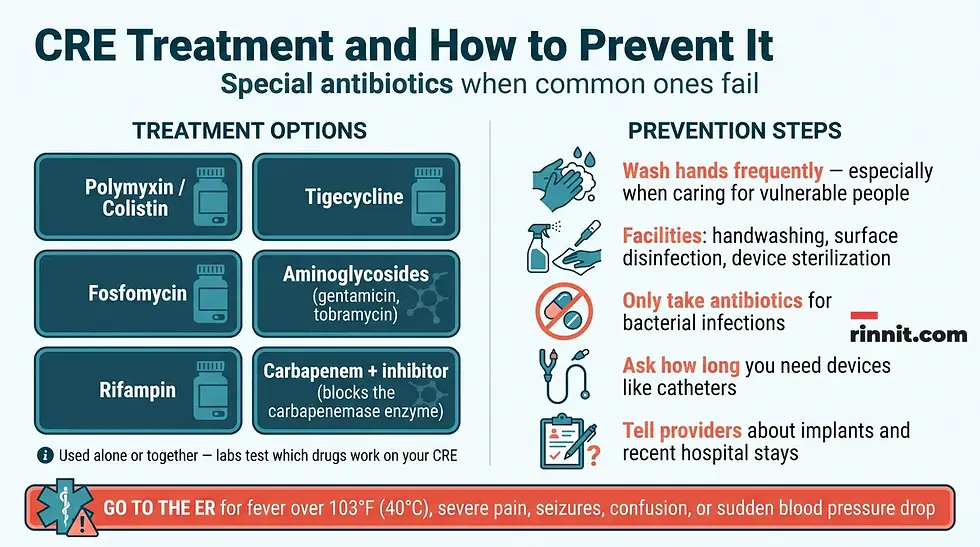
CREs can be hard to treat since common antibiotics don't work against them. A provider may treat you with a different antibiotic, often a newer combination such as ceftazidime-avibactam, meropenem-vaborbactam or imipenem-relebactam, in which an added drug blocks the bacteria's carbapenemase, or cefiderocol. Labs can test different drug options to see which will work on CREs.
Antibiotic option | Notes |
Polymyxin/Colistin | An older option with more kidney and nerve side effects, now mainly used when newer drugs cannot be |
Tigecycline | A broad-spectrum antibiotic option |
Fosfomycin | A different antibiotic class, available as an oral solution |
Aminoglycosides (gentamicin, tobramycin) | Used alone or in combination |
Rifampin | Sometimes added in combination |
Newer combinations (ceftazidime-avibactam, meropenem-vaborbactam, imipenem-relebactam) or cefiderocol | Preferred first choices for many CRE infections; the added drug blocks the carbapenemase enzyme |
Providers may use these antibiotics together or separately, guided by lab testing of which drugs work against the specific CRE. A systematic review of treatment studies found that, in studies that did not include ceftazidime-avibactam, 7 of 10 reported lower mortality with combination therapy than with a single drug, while six studies reported lower mortality with ceftazidime-avibactam regimens than with other regimens [9]. Another review summarizes the therapeutic options in more detail [10].
How serious is a CRE infection?
CREs can cause serious illness that's difficult to treat. Some people develop life-threatening infections. You'll be treated in a hospital where healthcare providers can monitor you closely.
Studies suggest mortality (death) rates range from around 13% for UTIs caused by CREs to 50% or higher for bloodstream infections caused by CREs [1].
Can CREs be prevented?
Healthcare providers follow safety and sterilization rules to prevent healthcare-acquired infections like CREs. These include washing their hands, disinfecting surfaces, ensuring that people only take antibiotics when they have bacterial infections, and sterilizing medical devices.
You can help prevent CRE infections by washing your hands frequently, especially if you're caring for someone with a weakened immune system or who needs help with bathing or going to the bathroom. You can also ask your provider how long you need to use invasive medical devices like catheters and how to prevent infection while you need the device.
How can people live with a carbapenem-resistant Enterobacterales (CRE) infection?
Living with a CRE infection means watching for signs of infection, staying in close contact with your healthcare team and going to the ER for severe symptoms.
When should I see my healthcare provider?
If you have an implanted medical device or a weakened immune system, ask your healthcare provider what signs of infection you should look out for. Follow up with your provider if you have any concerning symptoms.
Even when you're in the hospital, communication with your healthcare team is important. Let them know if you're experiencing symptoms of an infection, like pain, rapid heart rate, weakness or fever.
When should I go to the ER?
Go to the emergency room if you have any signs of severe illness, including:
Fever over 103 degrees Fahrenheit (39.4 degrees Celsius)
Severe pain
Seizures
Confusion or disorientation
Sudden drop in blood pressure (symptoms include weakness, dizziness and fainting)
What questions should I ask my doctor?
It might be helpful to ask your healthcare provider: What are my treatment options? When can I expect to feel better? How did I get this infection? What can I do to prevent an infection like this in the future?
Conclusion
CRE infections sit at the sharp end of the antibiotic resistance problem: bacteria that once-common antibiotics can no longer stop. The good news is that CRE infections are still pretty rare in the U.S., and providers have real strategies to treat them: special antibiotics, inhibitor drugs, and lab-guided drug selection. The best defenses are also the simplest: careful handwashing, only taking antibiotics when you truly have a bacterial infection, and asking about how long you need any device in your body. If you have an implanted device or a weakened immune system, don't wait out worrying symptoms. Tell your healthcare team immediately, and get emergency care for fever over 103°F, severe pain, seizures, confusion, or sudden blood pressure drops.
Looking for clear answers on tough health questions? Browse plain-language health guides at Rinnit.com.
Frequently Asked Questions
What are carbapenem-resistant Enterobacterales (CREs)?
CREs are bacteria from the Enterobacterales group (including E. coli and Klebsiella) that resist carbapenems, strong, commonly used antibiotics like ertapenem, imipenem, and meropenem, making their infections much harder to treat.
Are CRE infections common?
In the U.S., CREs cause about 13,000 infections and about 1,100 deaths per year. CDC's estimate for 2020 is approximately 12,700 infections and more than 1,100 deaths. They are still pretty rare in the U.S. but more common in other parts of the world.
How do bacteria become resistant to carbapenems?
Bacteria develop resistance through heavy antibiotic exposure (common in hospitals), by passing resistant genes to other bacteria (horizontal gene transfer), and most commonly by acquiring an enzyme called carbapenemase that chops up carbapenem antibiotics so they no longer work.
How do CREs spread?
CREs spread through contact with someone who has them on their skin (e.g., unwashed hands), contaminated surfaces (especially sinks and toilets), and contaminated medical equipment or devices in the body like central venous lines or breathing tubes.
What is colonization versus infection?
CREs can live on your skin or in your gut without making you sick. That's called colonization. Both infected and colonized people (with no symptoms) can spread CREs.
Who is most at risk?
People with tubes or devices in their body (central venous lines, breathing tubes, feeding tubes), long or frequent antibiotic use, weakened immune systems (HIV, blood cancers, diabetes, transplant recipients), need for help with daily activities like bathing or toileting, and long recent hospital stays, especially outside the U.S. in the past six months.
What infections do CREs cause?
Most commonly bloodstream infections, UTIs, pneumonia, and intra-abdominal abscesses.
What are the symptoms?
Symptoms depend on where the infection is and can include fever, chills, shortness of breath, cough, abdominal pain, pain when peeing, and redness, swelling or itching at a surgical or injury site. These symptoms are shared with many other infections.
How is a CRE infection diagnosed?
Providers suspect CRE when a bacterial infection doesn't respond to antibiotics. Labs test samples of blood, urine, stool, or wound fluid/tissue to find the bacteria and confirm CREs.
How are CRE infections treated?
With special antibiotics that may include polymyxin/colistin, tigecycline, fosfomycin, aminoglycosides (gentamicin, tobramycin), rifampin, or newer combinations such as ceftazidime-avibactam, meropenem-vaborbactam or imipenem-relebactam, or cefiderocol. Labs test different drug options to see which will work.
How serious are CRE infections?
Very. Some are life-threatening. Mortality ranges from around 13% for CRE UTIs to 50% or higher for CRE bloodstream infections. Treatment happens in a hospital with close monitoring.
What are the complications?
If antibiotics can't clear the infection, it can spread through the body and cause fatal complications like organ failure.
Can CRE infections be prevented?
Healthcare facilities prevent them through handwashing, surface disinfection, responsible antibiotic use, and device sterilization. You can help by washing hands frequently (especially when caring for someone vulnerable) and asking about how long you need any invasive device.
When should I go to the ER?
For signs of severe illness: fever over 103°F (39.4°C), severe pain, seizures, confusion or disorientation, or a sudden drop in blood pressure (weakness, dizziness, fainting).
What questions should I ask my doctor?
What are my treatment options? When can I expect to feel better? How did I get this infection? What can I do to prevent an infection like this in the future?
Related Reading
References
Cleveland Clinic. Carbapenem-Resistant Enterobacterales (CREs). Cleveland Clinic. Last updated November 13, 2023. https://my.clevelandclinic.org/health/diseases/cre-infection
Centers for Disease Control and Prevention. About Carbapenem-resistant Enterobacterales (CRE). CDC. Last reviewed December 17, 2025. https://www.cdc.gov/cre/about/index.html
Kohler PP, Volling C, Green K, et al. Carbapenem resistance, initial antibiotic therapy, and mortality in Klebsiella pneumoniae bacteremia: a systematic review and meta-analysis. Infect Control Hosp Epidemiol. 2017;38(11):1319-1328. PMID 28950924. https://doi.org/10.1017/ice.2017.197
van Duin D, Lok JJ, Earley M, et al. Colistin versus ceftazidime-avibactam in the treatment of infections due to carbapenem-resistant Enterobacteriaceae. Clin Infect Dis. 2018;66(2):163-171. PMID 29020404. https://doi.org/10.1093/cid/cix783
Hayden MK, Lin MY, Lolans K, et al. Prevention of colonization and infection by Klebsiella pneumoniae carbapenemase-producing Enterobacteriaceae in long-term acute-care hospitals. Clin Infect Dis. 2015;60(8):1153-1161. PMID 25537877. https://doi.org/10.1093/cid/ciu1173
Rankin DA, Stahl A, Sabour S, et al. Changes in carbapenemase-producing carbapenem-resistant Enterobacterales, 2019 to 2023. Ann Intern Med. 2025;178(12):1818-1821. PMID 40982973. https://doi.org/10.7326/ANNALS-25-02404
Janda JM, Abbott SL. The changing face of the family Enterobacteriaceae (order: "Enterobacterales"): new members, taxonomic issues, geographic expansion, and new diseases and disease syndromes. Clin Microbiol Rev. 2021;34(2):e00174-20. PMID 33627443. https://doi.org/10.1128/CMR.00174-20
Werth BJ. Carbapenems. Merck Manual Professional Version. Full review May 2024. https://www.merckmanuals.com/professional/infectious-diseases/bacteria-and-antibacterial-medications/carbapenems
Hu Q, Chen J, Sun S, Deng S. Mortality-related risk factors and novel antimicrobial regimens for carbapenem-resistant Enterobacteriaceae infections: a systematic review. Infect Drug Resist. 2022;15:6907-6926. PMID 36465807. https://doi.org/10.2147/IDR.S390635
Sheu CC, Chang YT, Lin SY, Chen YH, Hsueh PR. Infections caused by carbapenem-resistant Enterobacteriaceae: an update on therapeutic options. Front Microbiol. 2019;10:80. PMID 30761114. https://doi.org/10.3389/fmicb.2019.00080
Medical disclaimer
This article is for general informational purposes only and is not a substitute for professional medical advice, diagnosis, or treatment. Always seek the advice of your physician or other qualified health provider with any questions about a medical condition. Never disregard professional medical advice or delay seeking care because of something you have read here.



Comments